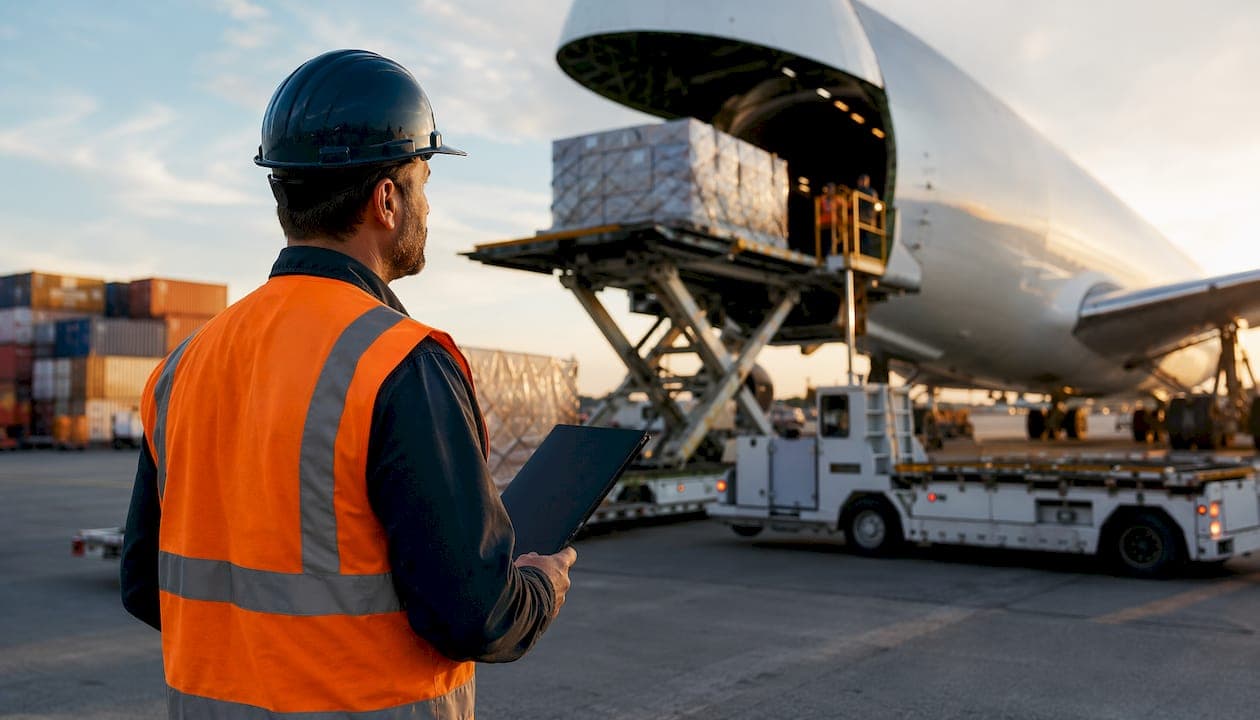
Air freight gives exporters the fastest, most reliable way to move high-value or time-sensitive goods across borders. According to IATA, air cargo carries about one-third of world trade by value while representing less than 1% by volume, which tells you exactly what it's built for: goods where speed, security, and transit-time consistency matter more than cost per kilogram.
When air freight is the right call:
- Perishables, pharmaceuticals, high-value electronics, critical spare parts, and product-launch samples where delay has a direct cost
- Any shipment where your customer SLA, shelf life, or regulatory timeline cannot absorb the multi-week transit typical of ocean freight
When sea or rail makes more sense:
- Low-value, high-volume commodities where freight cost as a percentage of goods value makes air unworkable
- Shipments with flexible lead times and no cold-chain or time-sensitivity requirement
IATA and ICAO both identify air cargo as a critical enabler of global commerce, particularly for high-value and time-sensitive trade flows. Simplyparcel helps exporters navigate these decisions with multi-carrier booking, instant quotes, and documentation support across international lanes.
Table of Contents
- How does air freight support export operations?
- Which industries and export scenarios depend on air freight?
- How does air freight fit into the export supply chain?
- What drives air freight pricing and how do you evaluate landed cost?
- What are the regulatory checkpoints for U.S. air exports?
- How does air freight help you manage capacity risk and supply chain disruptions?
- Cold chain and high-value exports: what standards and practices protect product integrity?
- How do you decide whether to use air freight and choose the right service?
- Key Takeaways
- Air freight deserves a place in your export strategy, not just your emergency plan
- Simplyparcel helps you put air freight to work for your exports
- Useful sources and references for exporters
How does air freight support export operations?
Air freight's competitive advantage is not just speed. It's the consistency of transit times that lets you reduce working inventory, tighten service-level agreements, and protect customer relationships in ways ocean freight simply cannot match.

ICAO notes that air cargo expands market reach for high-value and time-sensitive flows, with countries like Austria moving approximately 27% of their total export value by air. That figure reflects a deliberate commercial choice: when your product's margin per unit is high enough, paying a premium for a 1–3 day transit versus 25–40 days at sea is straightforward math.
Operational and commercial benefits of air freight for exports:
- Speed: Typical air transit times run a few days internationally, compared to several weeks by ocean.
- Predictable transit times: Scheduled airline departures create reliable delivery windows, which is the foundation of just-in-time manufacturing and tight customer SLAs.
- Lower inventory carrying costs: Faster replenishment cycles mean you hold less safety stock, freeing up working capital.
- Reduced damage and theft risk: Shorter handling windows and secure cargo facilities lower the probability of loss or damage versus multi-week ocean voyages.
- Faster customs clearance options: Pre-clearance programs and electronic air waybills (e-AWB) supported by IATA's digitalization push allow expedited border processing.
- Just-in-time manufacturing support: Component shipments by air keep production lines running when ocean lead times are too long or too variable.
The shipping speed trade-off between air and sea is ultimately a margin question, not a logistics question.
Pro Tip: To decide whether air's premium is justified, calculate your cost of delay: multiply the daily gross margin at risk by the transit-time difference between air and sea. If that figure exceeds the relative air freight premium, air pays for itself. For high-margin SKUs, this calculation often resolves in favor of air even on routes where the rate differential is significant.
Which industries and export scenarios depend on air freight?
Certain product categories are structurally dependent on air freight. The common thread is value density, shelf life, or service commitments that ocean transit simply cannot support.
Industries that regularly rely on air exports:
- Pharmaceuticals and vaccines: Temperature-controlled, time-critical, and often subject to regulatory chain-of-custody requirements
- Perishable food: Fresh seafood, cut flowers, berries, and produce where shelf life is measured in days
- High-value electronics: Semiconductors, memory chips, and AI-related components, with IATA data showing that roughly three-quarters of AI-related goods trade was carried by air in 2025
- Aerospace and industrial spare parts: Downtime cost for a grounded aircraft or halted production line far exceeds any air freight premium
- Fashion and product samples: Prototypes and pre-production samples for buyer approval, where time-to-market is a competitive advantage
- E-commerce express: Consumer expectations for 3–5 day international delivery make air the only viable mode
Two realistic export scenarios:
Scenario 1: Pharmaceutical vaccine shipment. A U.S. biotech exporter ships a temperature-sensitive vaccine to a distributor in Southeast Asia. The product requires 2–8°C cold-chain integrity throughout transit, has a regulatory release deadline, and carries a per-unit value that makes ocean transit's 30-day window commercially unacceptable. Air freight with validated temperature packaging and pre-clearance documentation is the only workable option.
Scenario 2: Electronics prototype for a product launch. A U.S. electronics manufacturer needs 500 prototype units in a European buyer's hands within 72 hours for a trade show. The units are high-value, low-weight, and the commercial consequence of missing the show date is a lost season. Air freight is not a cost question here; it's a business requirement.
The World Bank's air freight study also highlights how air enables rapid spare-part replacement and warranty service cycles, protecting customer relationships in ways that sea freight cannot.
How does air freight fit into the export supply chain?
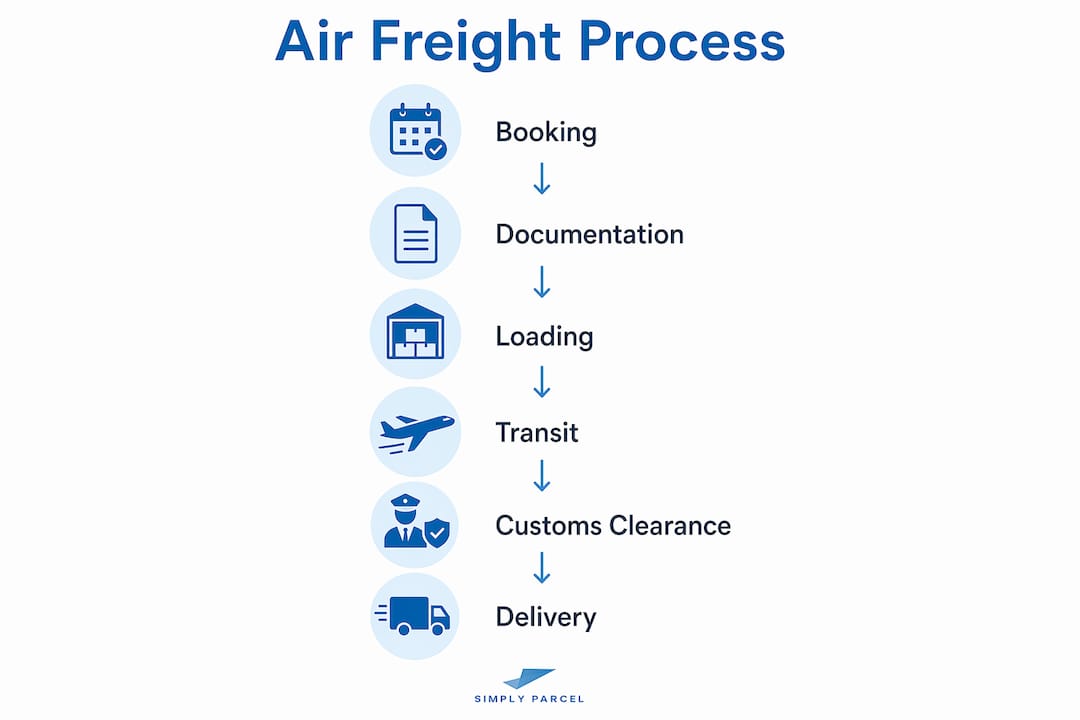
The air export process moves through a defined sequence of nodes, each with specific responsibilities. Understanding who does what prevents costly delays.
Process flow from origin to consignee:
- Origin pickup: Freight forwarder or carrier collects cargo from the shipper's facility
- Consolidation or direct loading: Cargo is either consolidated with other shipments into a unit load device (ULD) or loaded directly onto the aircraft
- Freight forwarder: Manages documentation, booking, customs filing, and carrier coordination; the role of freight forwarders is central to smooth air export execution
- Airline/air carrier: Transports the ULD or loose cargo on scheduled or charter freighter services
- Ground handlers: Manage ramp operations, cargo breakdown, and transfer at destination airports
- Customs clearance: Import customs at destination; pre-clearance filing accelerates release
- Final delivery: Last-mile carrier delivers to the consignee
Required export documents checklist:
- Air Waybill (AWB): the contract of carriage and primary tracking document
- Commercial invoice: declares value, description, and parties
- Packing list: itemizes contents, weights, and dimensions
- Export declaration via AES/EEI (Automated Export System / Electronic Export Information): required for U.S. exports valued over $2,500 or requiring a license
- Certificate of origin: required by many destination countries for tariff purposes
- Export licenses: required for controlled goods (dual-use technology, certain chemicals, defense articles)
- Dangerous goods declaration: Shipper's Declaration for Dangerous Goods when applicable
Key terms every air exporter should know:
AWB (Air Waybill): Non-negotiable transport document issued by the carrier or forwarder; serves as receipt, contract, and customs declaration.
ULD (Unit Load Device): Standardized container or pallet used to load cargo onto aircraft efficiently.
AES/EEI: The U.S. Census Bureau's electronic filing system for export declarations; filing is mandatory for most commercial exports.
Incoterms most relevant to air exports: FCA (Free Carrier) transfers risk at origin once handed to the carrier; CIP (Carriage and Insurance Paid To) covers freight and insurance to named destination; DDP (Delivered Duty Paid) places full responsibility on the seller through final delivery.
Accurate shipping documentation is the single most controllable variable in air export clearance speed.
What drives air freight pricing and how do you evaluate landed cost?
Air freight is a premium service priced primarily by chargeable weight, which is the greater of actual weight and volumetric (dimensional) weight. Route capacity, seasonality, and surcharges layer on top of that base rate.
Primary pricing drivers:
- Chargeable weight: Calculated as actual weight vs. volumetric weight (length × width × height in cm ÷ 6,000 for most carriers); you pay whichever is higher
- Fuel surcharges: Fluctuate with jet fuel prices and can represent a significant portion of total cost
- Security surcharges: Applied per kilogram to cover screening and handling
- Peak-season surcharges: Rates spike around Chinese New Year, Q4 e-commerce peaks, and post-holiday restocking periods
- Terminal handling charges (THC): Origin and destination airport fees for cargo processing
- Currency and lane imbalances: Routes with low outbound cargo volumes carry higher rates; the World Bank notes that landlocked and developing-country exporters often face elevated inbound rates due to limited return cargo flows, impacting transport costs
- Customs entry fees: Broker fees for import clearance at destination
Typical rate context: The World Bank's air freight study places typical air freight rates in a moderate dollar per kilogram range on many lanes (historic ranges), though actual rates vary significantly by route, commodity, and market conditions.
Sample landed-cost calculation:
| Cost Component | Example (100 kg shipment, U.S. to EU) |
|---|---|
| Total landed freight cost | 12.5% of product value |
For a shipment of 100 units valued at $50 each ($5,000 total), that's $6.25 per unit in freight cost, or 12.5% of product value. Whether that's acceptable depends entirely on your margin structure and the cost of the alternative.
Pro Tip: Three tactics consistently reduce air freight costs without sacrificing speed: (1) use freight consolidation to share ULD space with other shippers; (2) book belly capacity 5–7 days ahead rather than at the last minute, when rates spike; (3) negotiate multi-lane contracts with forwarders to lock in rates across your regular corridors and reduce exposure to peak-season surcharges.
What are the regulatory checkpoints for U.S. air exports?
Correct documentation and dangerous-goods compliance are the two most common operational barriers to fast air export clearance. Getting either wrong delays your shipment at origin, not just at destination.
U.S. air export compliance checklist:
- AES/EEI filing: Required for exports valued over $2,500 per Schedule B commodity or for any shipment requiring an export license; file through the U.S. Census Bureau's Automated Export System before cargo is tendered to the carrier
- Export licenses: Controlled goods under the Export Administration Regulations (EAR) or International Traffic in Arms Regulations (ITAR) require a license from the Bureau of Industry and Security (BIS) or the Directorate of Defense Trade Controls (DDTC) before export
- Commercial invoice accuracy: Declared value, HS code, and country of origin must match the physical shipment exactly; discrepancies trigger holds
- USMCA/certificate of origin: Required when claiming preferential tariff treatment for shipments to Canada or Mexico
- Pharma and perishable permits: FDA prior notice for food shipments; DEA permits for controlled substances; USDA/APHIS phytosanitary certificates for plant-based products
Dangerous goods categories commonly encountered in air exports:
- Lithium batteries (Class 9): found in electronics, power tools, and medical devices; require UN-certified packaging and specific labeling
- Flammable liquids (Class 3): solvents, adhesives, and certain industrial chemicals
- Infectious substances (Class 6.2): biological samples and diagnostic specimens
- Dry ice (Class 9): used as a refrigerant in cold-chain shipments; quantity limits apply
For each DG category, you need a completed Shipper's Declaration for Dangerous Goods, UN-specification packaging, proper hazard labels, and carrier pre-approval. IATA's Dangerous Goods Regulations (DGR) is the authoritative reference.
Common errors and quick fixes:
| Error | Mitigation |
|---|---|
| Mismatched HS code or declared value | Cross-check invoice against Schedule B database before filing AES |
| Missing signatures on DG declaration | Use a pre-flight checklist; carrier will reject unsigned DG docs at check-in |
| Inaccurate weight or dimensions | Weigh and measure after final packing; volumetric errors cause rate disputes and delays |
The customs process guide on Simplyparcel's blog covers clearance workflows in more detail.
How does air freight help you manage capacity risk and supply chain disruptions?
Air freight provides resilience, but it is itself exposed to capacity constraints that can tighten quickly and without warning. Understanding both sides of that equation is what separates reactive exporters from prepared ones.
Capacity depends on two sources: dedicated freighter aircraft and belly space on passenger flights. When passenger networks contract, as they did during COVID-19, belly capacity disappears almost overnight. Recent disruptions in Middle East airspace have demonstrated the same dynamic: route closures force longer detours, reduce effective capacity, and push rates up on alternative lanes.
Scenarios where exporters substitute air for sea:
- Port congestion or labor disputes extend ocean transit by weeks, threatening customer SLAs
- Extended Panama Canal or Suez Canal routing adds 10–14 days to ocean shipments
- Seasonal demand spikes require faster replenishment than ocean lead times allow
- A supplier failure requires emergency sourcing from a distant market
Air cargo is reemerging as a deliberate supply-chain resilience lever rather than an emergency-only fallback. Industry commentary from Logistics Viewpoints documents a clear shift: exporters are pre-defining which SKUs and lanes justify air freight and setting numeric thresholds for activation, rather than making emotional, costly last-minute decisions when disruptions hit.
Risk-mitigation checklist for air freight capacity:
- Pre-identify which SKUs and lanes have air freight as a defined contingency option
- Set a numeric cost-of-delay threshold that triggers the switch to air
- Pre-book capacity on critical lanes during peak seasons rather than booking spot
- Maintain multi-carrier contracts so you are not dependent on a single airline's schedule
- Identify alternative routing options (different hub airports, different carriers) for your key lanes
- Use consolidators to access capacity on lanes where you don't have direct carrier relationships
Addressing international shipping challenges proactively, rather than reactively, is what keeps your export program running when disruptions occur.
Cold chain and high-value exports: what standards and practices protect product integrity?
For pharmaceutical and perishable exporters, air freight is not just a speed choice. It's a regulatory and commercial requirement. Cold-chain integrity during air transit is governed by specific standards, and failure to meet them can result in product rejection, regulatory action, or loss of buyer contracts.
IATA and WHO have documented air cargo's role in delivering vaccines and life-saving medical supplies, noting that air-transported vaccinations have supported immunization programs that prevented millions of deaths. That public-health dependency is why the standards are rigorous.
Relevant standards and programs:
- IATA CEIV (Center of Excellence for Independent Validators): Certification program for airlines, freight forwarders, and ground handlers that validates compliance with pharmaceutical handling standards; CEIV Pharma and CEIV Fresh are the two most relevant certifications for exporters
- IATA/WHO guidance for vaccine distribution: Specifies temperature ranges, packaging validation, and documentation requirements for vaccine shipments
- ICAO safety and facilitation references: Govern aircraft safety requirements for dangerous goods and special cargo, including dry ice and biological substances
In practice, IATA CEIV certification is often a buyer or regulatory prerequisite. If your carrier or forwarder is not CEIV-certified for pharmaceutical handling, some buyers will not accept the shipment regardless of the temperature record.
Cold-chain exporter checklist:
- Use validated shippers: carriers and forwarders with CEIV Pharma or equivalent certification
- Specify conditioned packaging: validated insulated containers with phase-change materials or dry ice appropriate to the temperature range and transit time
- Install temperature monitors: data loggers or real-time telemetry devices that record the full transit temperature history
- File pre-clearance documentation: submit import permits and product registrations before the shipment departs to avoid holds at destination
- Document contingency procedures: define in writing what happens if a temperature excursion occurs in transit, including who is notified and what the acceptance/rejection criteria are
For perishable food exporters, the IATA study on Peru's export experience illustrates how air freight enables market entry for quality-sensitive products: roughly 85% of Peru's blueberry exports to new destination markets were delivered exclusively by air during the first year of market penetration, before sea logistics matured enough to handle the volume.
How do you decide whether to use air freight and choose the right service?
The decision to use air freight comes down to four variables: value density, cost of delay, customer SLA, and regulatory requirements. If any one of those four factors is non-negotiable, air is usually the answer.
Decision checklist:
- Is the product's value-to-weight ratio high enough to absorb air freight cost within acceptable margin?
- What is the cost of delay per day if the shipment misses its delivery window?
- Does your customer SLA require delivery within a timeframe that only air can meet?
- Does the product require cold-chain handling, special permits, or DG compliance that air carriers are better equipped to manage?
- Is reverse logistics or warranty service part of the product's value proposition?
Questions to ask carriers and freight forwarders:
- What capacity guarantees do you offer on this lane, and what are your contingency options if space is unavailable?
- What are your AWB options (master AWB vs. house AWB), and how does that affect my customs filing?
- What are your standard transit times and your on-time performance rates for this route?
- What are your liability limits, and what additional cargo insurance options are available?
- Are you IATA CEIV certified for pharmaceutical or perishable handling?
- What customs support do you provide at destination, and do you have a licensed broker relationship there?
Typical air export timeline by lane:
| Lane | Booking Lead Time | Cargo Cutoff | Transit Time | Customs Clearance Window |
|---|---|---|---|---|
| U.S. to Western Europe | 2–3 days | 4–6 hours before departure | 1–2 days | 1–2 days at destination |
| U.S. to Southeast Asia | 2–4 days | 4–6 hours before departure | 2–3 days | 1–3 days at destination |
| U.S. to East Asia | 2–3 days | 4–6 hours before departure | 1–2 days | 1–2 days at destination |
| U.S. to Latin America | 3–5 days | 4–6 hours before departure | 2–4 days | 2–4 days at destination |
Transit times are typical ranges for direct or single-connection services; actual performance varies by carrier, route, and customs conditions. For bulk or multimodal freight options, sea freight remains the cost-effective baseline when lead times allow.
Key Takeaways
Air freight's role in exports is most valuable when treated as a planned resilience lever for critical SKUs and lanes, not as an emergency option activated only when other modes fail.
| Point | Details |
|---|---|
| Air freight's economic weight | Air cargo carries about 33% of world trade by value while representing less than 1% by volume. |
| When to choose air | Use air for high-value, time-sensitive, or cold-chain goods where cost of delay exceeds the freight premium. |
| Documentation is the bottleneck | AES/EEI filing, accurate HS codes, and DG declarations are the most common causes of air export delays. |
| Plan capacity, don't react to it | Pre-define which SKUs and lanes trigger air freight, and pre-book during peak seasons to avoid rate spikes. |
| Simplyparcel for air export booking | Simplyparcel offers instant quotes, multi-carrier booking, and documentation support for international air shipments. |
Air freight deserves a place in your export strategy, not just your emergency plan
The conventional wisdom treats air freight as a cost center to be minimized. That framing misses the point. For the right SKUs and the right lanes, air freight is a margin-protection tool, a customer-retention tool, and a supply-chain resilience tool all at once.
The exporters who get the most value from air freight are not the ones who use it most often. They're the ones who have decided in advance exactly when to use it. They've mapped their critical SKUs, calculated their cost-of-delay thresholds, and built air freight into their scenario planning rather than reaching for it in a panic when a port backs up or a supplier misses a production date.
Two practical prioritization examples: SKU A, a high-margin pharmaceutical product with a 30-day shelf life and a hospital buyer SLA, should always ship by air regardless of cost. SKU B, a standard industrial component with a 90-day lead time and a flexible delivery window, ships by sea with air as a defined contingency if ocean transit is disrupted beyond a set threshold. The difference is not the product category. It's the discipline of having made the decision before the disruption happens.
Practical next steps for export managers:
- Identify your top 10 SKUs by margin and map their current transit-mode assignment against their cost-of-delay profile
- Set a numeric threshold (cost of delay per day vs. air freight premium) that triggers the switch to air for each SKU
- Negotiate contingent capacity with at least two carriers on your highest-volume lanes
- Document your cold-chain and DG procedures in a standard operating procedure before you need them under pressure
Simplyparcel helps you put air freight to work for your exports
When you're ready to move from planning to booking, Simplyparcel gives you a direct path to competitive air freight rates without the back-and-forth of manual quoting. The platform connects exporters to multiple carrier options, generates shipping labels and documentation automatically, and provides real-time tracking from pickup to delivery.
For exporters working through the checklist above, Simplyparcel's capabilities map directly to the operational requirements:
- Door-to-airport pickup with scheduled collection and confirmation
- AWB generation handled automatically at booking
- Multi-carrier comparison so you can weigh transit time against cost on your specific lane
- Real-time shipment tracking from origin to consignee
- Documentation support including customs-related resources to help you file accurately
Whether you're shipping a pharmaceutical sample, a batch of electronics prototypes, or a time-sensitive commercial order, get an instant quote and compare your options across carriers before your next export deadline. You can also explore Simplyparcel's full international shipping services to see how the platform fits your export program.
Useful sources and references for exporters
These are the primary and industry sources cited throughout this guide. Each is worth bookmarking for ongoing reference.
-
IATA: Value of Air Cargo — The primary source for the 33% of world trade by value statistic and the role of air cargo in pharmaceutical and vaccine supply chains. Use for benefits and cold-chain sections.
-
IATA: Cargo Programs and Digitalization — Covers e-AWB adoption, border management improvements, and CEIV certification programs. Use for process and compliance sections.
-
IATA: Air Cargo, Trade, and Economic Growth in 2025 — Documents air cargo's role in 2025 trade frontloading, AI-related goods transport, and trade lane restructuring. Use for capacity and resilience sections.
-
IATA: Air Cargo as an Enabler of Export Growth and Diversification — Peru case study on perishable exports and market entry via air. Use for use-cases and cold-chain sections.
-
IATA: Air Transport and Global Value Chains — Quantifies the association between air cargo connectivity and export growth (a 1% increase in air cargo connectivity is associated with a 6.3% increase in total exports and imports). Use for benefits and market-access sections.
-
ICAO: Air Cargo — ICAO's overview of air cargo's role in commerce, including value-density data by country. Use for benefits and market-access sections.
-
World Bank: Air Freight Market Study — The primary source for per-kg rate ranges, lane imbalance dynamics, and the use of air freight for samples and spare parts. Use for pricing and use-case sections.
-
Logistics Viewpoints: Air Cargo Is Reemerging as a Critical Supply Chain Lever — Industry commentary on the shift from emergency-only to planned air freight use. Use for capacity, resilience, and perspective sections.
-
ICAO: Facts and Figures — Statistical data on cargo load factors, capacity growth, and non-scheduled services. Use for capacity and market context sections.