
Shipping speed is defined as the total transit time from the moment a parcel leaves its origin to when it reaches the recipient's door, and it directly shapes customer satisfaction, purchase decisions, and repeat business in international logistics. The role of shipping speed has shifted significantly in recent years. 42% of consumers aged 25–44 are more likely to buy from retailers offering same-day delivery, and 19% would switch retailers for significantly faster shipping. Yet the story does not end at raw speed. Consumer priorities are moving toward delivery reliability, cost, and transparency, making this a more complex decision than it once was.
How does shipping speed affect customer satisfaction?
Delivery speed shapes how customers perceive your brand before the product even arrives. A fast, smooth delivery signals that your business is organized and trustworthy. A slow or unpredictable one raises doubts that no product quality can fully erase.

The connection between speed and purchase behavior is direct. 27% of consumers say fast delivery increases last-minute purchases. That figure shows how delivery timelines actively drive revenue, not just satisfaction scores. When customers know a package will arrive by a specific date, they are more likely to complete the purchase.
Cart abandonment is another area where shipping speed importance shows up clearly. Over 90% of shoppers abandon carts when high shipping costs appear at checkout. This tells you that cost and speed are tightly linked in the customer's mind. Offering fast shipping at a steep price can hurt conversions just as much as slow shipping.
The most current data adds an important nuance. Delivery speed dropped from the top priority in 2022 to fifth place by 2024. Customers still want their parcels quickly, but they now rank accurate delivery dates, free shipping, and clear communication higher than raw transit time. Brands like Macy's and Ulta have responded to this shift directly.
- Delivery reliability builds repeat business. Macy's and Ulta both state that predictable delivery windows matter more than speed for customer trust and loyalty.
- Ambiguous delivery dates increase anxiety. When customers cannot see a clear expected arrival date, they lose confidence in the purchase.
- Speed without accuracy backfires. Promising fast delivery and missing the window damages trust more than offering a slower but guaranteed timeline.
- Transparency reduces post-purchase regret. Clear tracking and communication keep customers satisfied even when delivery takes longer.
Pro Tip: Display a specific delivery date at the product page and checkout stage, not just a vague range. Businesses that invest in accurate delivery date infrastructure see measurable improvements in conversion rates and cart completion.
Shipping speed options: how do cost, speed, and reliability compare?
Choosing the right shipping speed means weighing three factors against each other: how fast the customer needs the parcel, how much they are willing to pay, and how reliably the carrier can hit that window. No single option wins on all three.
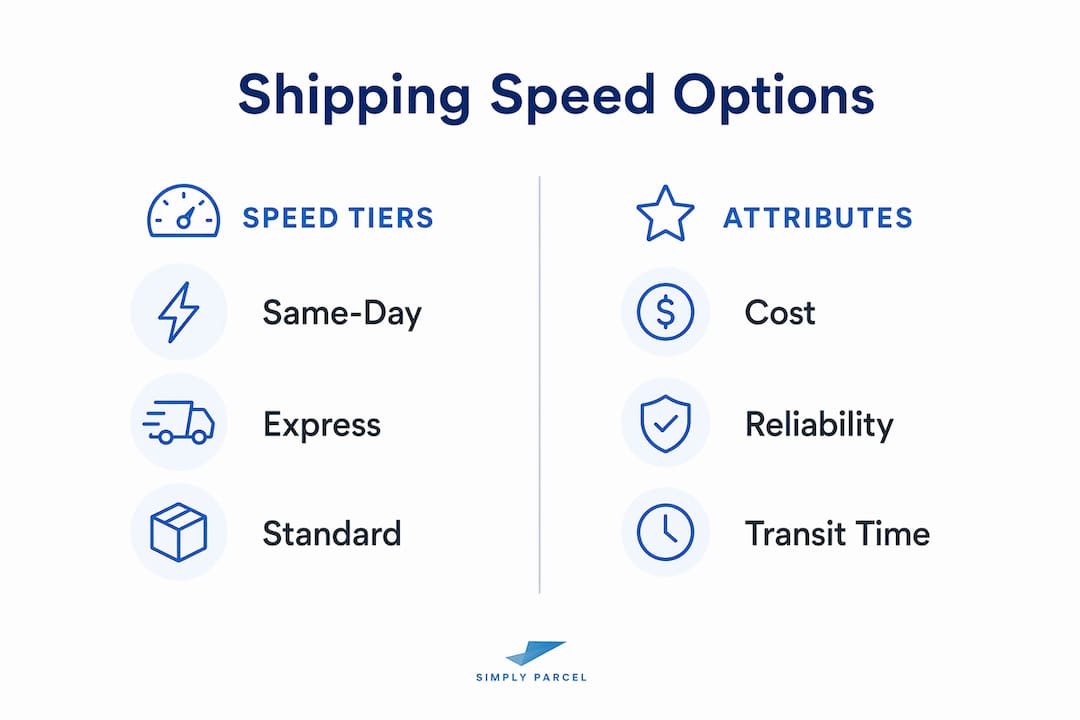
Here is a practical comparison of the most common shipping speed tiers used in international logistics:
| Speed Tier | Typical Transit Time | Cost Level | Reliability | Best For |
|---|---|---|---|---|
| Same-Day | Under 24 hours | Very High | Variable | Urgent, high-value items |
| Next-Day / Express | 1–2 business days | High | High | Time-sensitive orders |
| Standard Express | 3–5 business days | Moderate | High | Most e-commerce orders |
| Economy / Standard | 7–14 business days | Low | Moderate | Non-urgent, budget-conscious shipments |
The cost gap between tiers is significant for both businesses and consumers. Around 40% of consumers would pay a small premium for faster delivery, but willingness drops sharply once the surcharge exceeds a modest threshold. This means fast shipping works best when it is priced as an accessible convenience, not a premium add-on.
Ultra-fast shipping also carries hidden reliability risks. Same-day and next-day services depend on tight carrier capacity, local warehouse proximity, and real-time logistics coordination. Any disruption in that chain produces a missed promise, which hurts trust more than a slower but accurate delivery would.
Key trade-offs to keep in mind when reviewing your shipping speed options:
- Speed increases cost exponentially, not linearly. Moving from 5-day to 2-day shipping often doubles the carrier fee.
- Over 90% of shoppers prefer free standard delivery over paying for expedited options. Cost sensitivity is the dominant factor for most buyers.
- Economy shipping with accurate tracking often outperforms fast shipping with poor visibility in customer satisfaction scores.
- International shipments add customs clearance time to every tier, which can compress the speed advantage of express options.
Does delivery reliability matter more than speed?
The short answer is yes, for most customers in 2026. The longer answer reveals a set of business outcomes that make reliability the smarter investment for most international shippers.
62% of consumers prefer accurate delivery dates and full transparency over fast but unpredictable shipping. That majority preference has real implications for how you structure your logistics commitments. Promising a date and hitting it consistently builds the kind of trust that generates repeat orders.
The return rate data is particularly striking. Consider these four dynamics:
- Longer delivery windows reduce returns by 20%–30%. More predictable shipping reduces purchase urgency and buyer's remorse, which means fewer returns to process and lower reverse logistics costs.
- Ultra-fast delivery can increase return rates. When customers order impulsively because of a same-day option, they are more likely to regret the purchase and send it back.
- Unpredictable delivery windows erode loyalty. A customer who receives a parcel three days later than promised is less likely to reorder, regardless of how fast the original estimate was.
- Transparency compensates for slower speed. Customers who receive proactive tracking updates and clear communication report higher satisfaction even when transit times are longer.
Retailers face a real logistics cost squeeze right now. Many are shifting away from free ultra-fast shipping toward slower, consolidated options that align costs with growing consumer patience. This is not a step backward. It is a recalibration toward what customers actually value.
Pro Tip: If you cannot guarantee a fast delivery window reliably, do not advertise it. A slower but accurate delivery promise builds more long-term trust than a fast estimate you miss. Invest in carrier partners with strong on-time performance records before investing in speed upgrades.
How to choose the right shipping speed for your business
Selecting the right delivery speed is a practical decision that depends on your product type, customer base, and cost structure. There is no universal answer, but there is a clear framework for getting it right.
Start by assessing product urgency and customer expectations. A business shipping perishable goods or medical supplies has a different calculus than one shipping apparel or home decor. Customers buying gifts close to a holiday have different expectations than those restocking household items. Match your shipping tier to the actual urgency of the purchase, not to a general desire to appear fast.
Next, weigh cost against what your customers will actually pay. Use the data as your guide: most buyers will wait if you remove the shipping fee entirely. Offering free economy shipping often converts better than charging for express. If you do offer paid upgrades, keep the premium modest to stay within the range where consumer willingness holds.
Here is a practical checklist for making the right call on choosing shipping speed:
- Know your product category. High-value, time-sensitive items justify express tiers. Standard goods rarely do.
- Segment your customer base. Younger consumers aged 25–44 respond more strongly to speed options. Older or more budget-conscious buyers prioritize cost.
- Communicate delivery windows clearly. Show a specific date at checkout, not a range. Specific dates reduce cart abandonment from shipping ambiguity.
- Use slower shipping as a cost control tool. Consolidated economy shipping cuts carrier costs and, when communicated well, does not hurt satisfaction.
- Build in buffer time for international routes. Customs clearance, public holidays, and carrier capacity all affect actual transit time. Pad your estimates to protect your reliability record.
- Review your carrier's on-time performance data. A carrier that hits 95% on-time for economy beats one that hits 80% on express every time.
For businesses managing shipping costs for small operations, the right speed tier is often the one that keeps total landed cost low while still meeting the customer's actual need. Speed is a tool, not a goal.
Key takeaways
Shipping speed matters most when it is reliable, transparent, and priced within what customers are willing to pay.
| Point | Details |
|---|---|
| Speed drives purchases | 42% of consumers aged 25–44 favor retailers offering same-day delivery, directly lifting conversion rates. |
| Reliability now outranks speed | 62% of consumers prefer accurate delivery dates over fast but unpredictable shipping windows. |
| Cost sensitivity is high | Over 90% of shoppers prefer free standard delivery over paying for expedited options. |
| Longer windows cut returns | More predictable delivery reduces return rates by 20%–30%, lowering reverse logistics costs. |
| Transparency builds trust | Showing a specific delivery date at checkout reduces cart abandonment and improves customer confidence. |
What working with international shippers has taught me
Speed is the first thing most businesses ask about when they start thinking about logistics. It is rarely the most important thing by the time they have been shipping internationally for a year.
What I have seen consistently is that businesses overinvest in fast shipping options before they have solved the reliability problem. They pay premium carrier rates to promise two-day delivery, then lose customer trust when customs delays or capacity issues push that to five days. The speed promise becomes a liability.
The smarter move is to build your reliability record first. Choose carriers with strong on-time performance. Invest in tracking visibility so customers always know where their parcel is. Set delivery estimates that you can hit 95% of the time, even if that means adding a day or two to your advertised window. Once that foundation is solid, you can layer in faster options for customers who genuinely need them and are willing to pay.
The other thing worth saying plainly: free shipping beats fast shipping for most product categories. If you are choosing between offering free economy delivery and charging for express, the data consistently favors free. Customers will wait. They will not pay surprise fees at checkout.
Shipping speed is a conversion tool when used correctly. It is a cost center when used as a default.
— Simply
Ship smarter with Simplyparcel
Simplyparcel gives you direct access to multiple international courier options, each with clearly stated transit times and competitive rates. Whether you need priority express delivery or a cost-effective economy option, you can compare speeds, costs, and carrier performance in one place before committing to a booking. The platform covers free parcel pickup, automatic documentation, and real-time tracking so your customers always know where their shipment stands. Get an instant shipment quote today and find the delivery speed that fits your budget and your customer's expectations. You can also explore the full range of international shipping options from Singapore to find the right balance of speed, reliability, and cost for every route you ship.
FAQ
What is the role of shipping speed in e-commerce?
Shipping speed directly influences purchase decisions, cart abandonment rates, and customer loyalty. 42% of consumers aged 25–44 are more likely to buy from retailers offering same-day delivery, making it a measurable conversion factor.
Why does delivery reliability matter more than raw speed?
62% of consumers prefer accurate delivery dates over fast but unpredictable shipping. Hitting a promised delivery window consistently builds more trust and repeat business than offering speed you cannot guarantee.
How does shipping speed affect return rates?
Longer, more predictable delivery windows reduce return rates by 20%–30% by lowering purchase urgency and buyer's remorse. Ultra-fast delivery can actually increase returns when it encourages impulsive purchases.
How do i choose the right shipping speed for international orders?
Match the shipping tier to your product's urgency and your customer's willingness to pay. For most categories, free economy shipping converts better than paid express, since over 90% of shoppers prefer free standard delivery over paying for faster options.
What is the best way to reduce cart abandonment related to shipping?
Display a specific delivery date at checkout rather than a vague range. Businesses that invest in delivery date accuracy infrastructure see measurable reductions in cart abandonment by removing uncertainty from the purchase decision.