
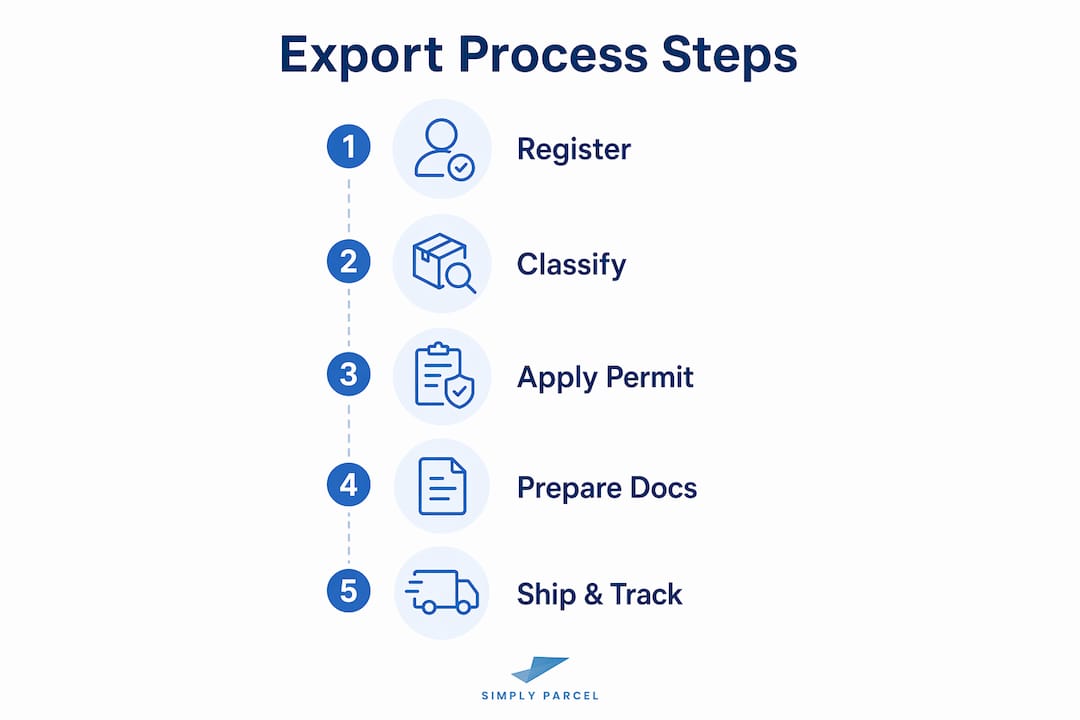
Exporting goods from Singapore is defined as the commercial dispatch of products to overseas buyers, requiring a Unique Entity Number (UEN), an active Singapore Customs Account, and a valid export permit before any cargo leaves the country. Singapore ranks among Asia's top trading hubs, and the process of exporting products from Singapore follows a clear regulatory path managed by Singapore Customs and the Inland Revenue Authority of Singapore (IRAS). Whether you are a first-time exporter or scaling an existing operation, understanding the steps to export goods in Singapore, from registration to shipment tracking, determines whether your cargo clears customs without delays or gets held at the terminal.
What initial steps are required to start exporting from Singapore?
Every commercial export from Singapore begins with two non-negotiable registrations. You must register for a UEN through the Accounting and Corporate Regulatory Authority (ACRA), and then activate a Customs Account via the TradeNet system. Without both, you cannot legally submit export permit applications or move commercial cargo.
Here is a clear comparison of the four foundational steps:
| Step | Action Required | Authority | Key Detail |
|---|---|---|---|
| UEN Registration | Register your business entity | ACRA | Legal identifier for all trade transactions |
| Customs Account Activation | Activate via TradeNet portal | Singapore Customs | Required before any permit application |
| TradeNet User ID Setup | Create login credentials | Singapore Customs | Enables digital permit submissions |
| HS Code Ruling (optional) | Apply for Customs Ruling | Singapore Customs | Costs S$75; provides binding classification |
Once your Customs Account is active, you set up a TradeNet user ID to submit permit applications digitally. If you prefer not to manage submissions yourself, you can appoint a licensed Declaring Agent to handle permit applications on your behalf. This is a practical option for businesses that export frequently or deal with complex cargo categories.
Pro Tip: Apply for a formal Customs Ruling on your product's Harmonized System (HS) code before your first shipment. At S$75 per ruling, it is a low-cost way to get a binding classification decision and avoid costly reclassification disputes later.
How to identify controlled goods and secure the right licenses
Not all goods can leave Singapore freely. Controlled goods are products that require a license or permit from a designated Competent Authority (CA) before export. Categories include dual-use electronics, certain chemicals, strategic goods under the Strategic Goods Control Act, and food products regulated by the Singapore Food Agency.
The fastest way to check your product's status is the HS/CA Product Code Checker tool on the Singapore Customs website. Enter your product's HS code and the tool immediately tells you whether a CA license is required and which authority to contact.
Follow this verification checklist before booking any shipment:
- Identify the correct 8-digit HS code for your product
- Run the HS/CA Product Code Checker to flag any controls
- Contact the relevant Competent Authority to apply for the required license
- Confirm the license is valid and covers the quantity and destination of your shipment
- Attach the license number to your export permit application
Exporting controlled goods without the proper authorization carries serious consequences, including cargo seizure, financial penalties, and potential criminal liability. Regularly consulting Singapore Customs export procedures keeps your classification current, since HS code lists are updated periodically.
Pro Tip: If your product sits on the boundary between two HS codes, apply for a Customs Ruling before export. A wrong classification on a controlled item is treated the same as an unlicensed export.
What are the steps to apply for an export permit and prepare documents?
The export permit is the legal authorization that links your UEN, your product's HS codes, and your transport details into a single approved record. All commercial permit applications must be submitted digitally through TradeNet, and Singapore Customs processes over 90% of electronic applications in under 10 minutes. That speed only holds when your application is accurate.
Follow these steps to apply and prepare your shipment documents:
- Log in to TradeNet and select the correct permit type (OUT for standard exports, or the relevant strategic goods permit if applicable).
- Enter your cargo details including HS code, product description, quantity, and declared value.
- Input transport information including the vessel or flight number, port of loading, and destination country.
- Attach supporting documents before submission.
- Submit and receive your permit reference number, then present it to your freight forwarder or carrier for cargo loading authorization.
The table below shows the core documents required for every commercial export:
| Document | Purpose | Who Prepares It |
|---|---|---|
| Commercial Invoice | States value, buyer, and seller details | Exporter |
| Packing List | Details contents, weight, and dimensions | Exporter |
| Bill of Lading or Air Waybill | Confirms cargo receipt and transport contract | Carrier or freight forwarder |
| Export Permit | Legal authorization to load and ship cargo | Submitted via TradeNet |
| CA License (if applicable) | Authorizes export of controlled goods | Competent Authority |
Permit accuracy is critical because any mismatch between the permit details and the actual shipment parameters causes terminal hold-ups, demurrage charges, and potential fines. Double-check that the HS code, declared quantity, and transport details on the permit match exactly what is on your Commercial Invoice and Bill of Lading.
Pro Tip: Choose your Incoterms carefully before finalizing the Commercial Invoice. Using Delivered at Place (DAP) or Cost, Insurance and Freight (CIF) reduces exporter liability once goods are in transit, which simplifies your documentation obligations.
How to comply with GST zero-rating and record-keeping rules
Singapore's Goods and Services Tax (GST) system gives exporters a significant financial advantage. Exported goods qualify for zero-rated GST, meaning you charge 0% instead of the standard 9%. But this benefit is conditional.
Businesses have up to 60 days/charging-gst-(output-tax)/when-to-charge-0-gst-(zero-rate)/exporting-of-goods) from the time of supply to export the goods and retain the supporting export evidence. Miss that window and GST at 9% applies retroactively. This is a rule many new exporters discover only after receiving an IRAS audit notice.
Acceptable export evidence includes:
- The approved export permit from TradeNet
- The Bill of Lading or Air Waybill confirming shipment
- The Commercial Invoice showing the overseas buyer's details
- Freight receipts or delivery orders confirming cargo departure
Beyond the 60-day rule, Singapore law requires you to retain all trade records for a minimum of five years. This covers export permits, invoices, packing lists, and any CA licenses. IRAS and Singapore Customs can audit your records at any time within that window, and missing documentation is treated as non-compliance regardless of whether the export itself was legitimate.
Keep a dedicated digital folder for each shipment containing all five core documents: the export permit, Commercial Invoice, Packing List, Bill of Lading or Air Waybill, and any CA license. Label it by shipment date and destination for fast retrieval during audits.
Pro Tip: Set a calendar reminder at day 45 after each sale to confirm your export evidence is complete and filed. That gives you a 15-day buffer before the 60-day GST deadline closes.
What packaging, shipping methods, and tracking practices work best?
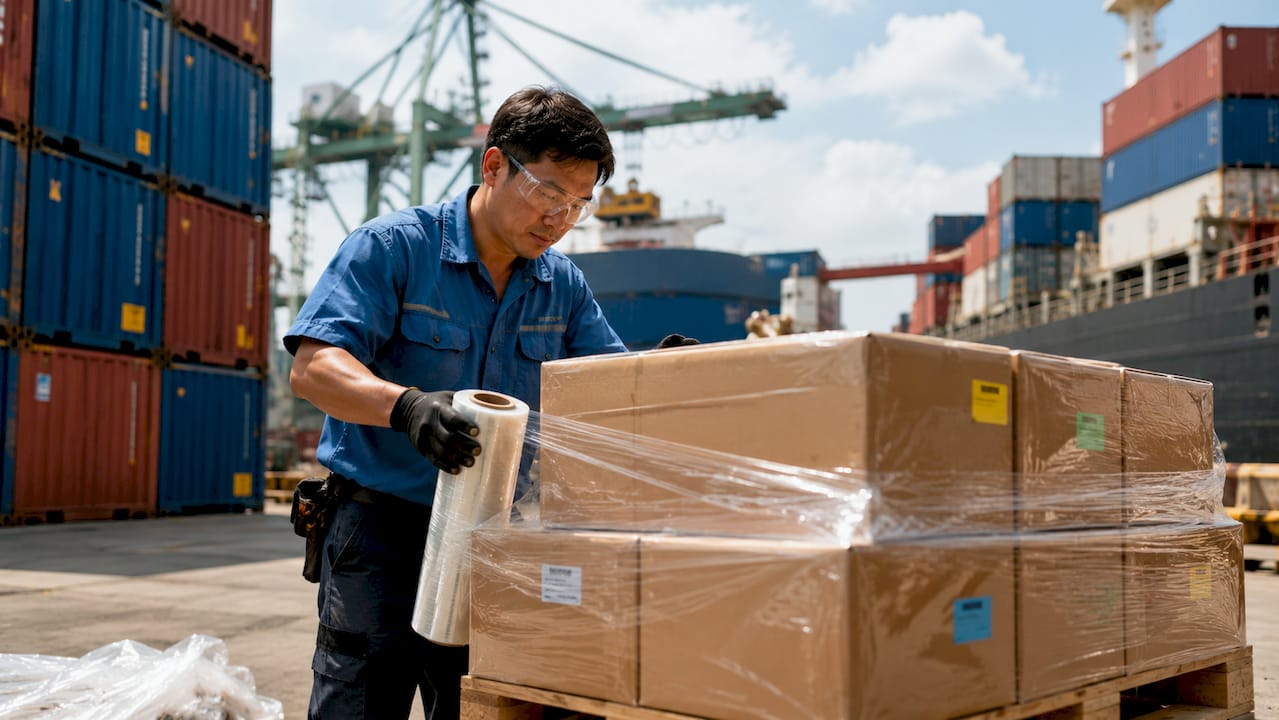
Packaging is not just a physical concern. Improper packing causes approximately 14% of shipping delays, and customs authorities at destination ports can refuse entry to cargo that fails biosecurity standards. For wooden crates and pallets, ISPM 15 heat-treated timber is the international standard. Non-compliant timber packaging is a common reason for cargo rejection in markets like Australia, the United States, and the European Union.
Choosing the right shipping mode depends on your cargo type, budget, and delivery timeline:
| Mode | Typical Transit Time | Cost Level | Best For |
|---|---|---|---|
| Air freight | 1 to 5 days | High | High-value, time-sensitive goods |
| Sea freight (FCL) | 10 to 30 days | Low | Large volume, non-urgent cargo |
| Sea freight (LCL) | 14 to 35 days | Medium | Smaller shipments sharing container space |
| Courier/express | 1 to 7 days | Medium to high | Small parcels and e-commerce orders |
Once your shipment is in transit, digital tracking with updates every 6 hours gives you real-time visibility across the entire linehaul. This level of oversight lets you catch delays early, notify buyers proactively, and resolve carrier issues before they escalate. For practical guidance on monitoring shipments in transit, real-time tracking tools make a measurable difference in customer satisfaction.
Pro Tip: Always request a pre-shipment inspection for high-value cargo. It creates a documented condition record that protects you in insurance claims and buyer disputes.
Key takeaways
Exporting goods from Singapore requires UEN registration, a valid Customs Account, accurate export permits, and documented GST compliance to avoid penalties and shipment delays.
| Point | Details |
|---|---|
| Register before you ship | Obtain a UEN via ACRA and activate your Customs Account through TradeNet before any export. |
| Check controlled goods first | Use the HS/CA Product Code Checker to confirm whether your product needs a Competent Authority license. |
| Permit accuracy prevents delays | Match HS codes, quantities, and transport details exactly across your permit, invoice, and Bill of Lading. |
| Meet the 60-day GST rule | Export goods and retain evidence within 60 days of supply to maintain zero-rated GST status. |
| Keep records for five years | Store all export documents digitally for a minimum of five years to satisfy Singapore Customs and IRAS audit requirements. |
What I've learned from watching exporters get this wrong
After working with hundreds of Singapore exporters across industries, the pattern is consistent. The businesses that run into trouble are not the ones who skip steps deliberately. They are the ones who underestimate how tightly the system connects every piece of documentation.
The most common mistake is treating the export permit as a formality rather than the legal anchor of the entire shipment. When the HS code on the permit does not match the Commercial Invoice, or the declared quantity differs from the Packing List, the cargo stops. Not slows. Stops. And the cost of a terminal hold at Tanjong Pagar or Pasir Panjang adds up fast.
The second mistake is the 60-day GST window. Many exporters assume that because they exported the goods, the zero-rating is automatic. It is not. IRAS requires you to hold the evidence, not just complete the export. I have seen businesses lose GST zero-rating on entire quarters of sales because their filing system was disorganized.
My honest recommendation is to treat documentation as a parallel process to the physical shipment. The moment you confirm an order, start building the document file. Do not wait until the cargo is ready to move. Use digital platforms that auto-generate labels and documentation to reduce manual error. And if you are new to exporting, appoint a Declaring Agent for your first few shipments. The cost is worth the learning curve you skip.
For businesses managing international shipping challenges across multiple markets, the exporters who scale successfully are those who build compliance into their workflow from day one, not as an afterthought.
— Simply
Ship smarter with Simplyparcel
Simplyparcel makes the logistics side of exporting from Singapore straightforward. The platform lets you compare and book courier services instantly, with access to multiple carrier partners and competitive rates across priority, economy, and express shipping options. Simplyparcel automatically generates shipping labels and export documentation, reducing the manual work that causes permit errors. Real-time shipment tracking gives you and your buyers full visibility from pickup to delivery. Whether you are sending a single parcel or managing regular commercial exports, Simplyparcel's free pickup service and transparent pricing make it a practical tool for Singapore businesses looking to ship internationally without the guesswork. Get an instant shipping quote and book your next export in minutes.
FAQ
What documents are required to export goods from Singapore?
Every commercial export requires an export permit from TradeNet, a Commercial Invoice, a Packing List, and a Bill of Lading or Air Waybill. Controlled goods also require a license from the relevant Competent Authority.
How long does it take to get an export permit in Singapore?
Singapore Customs processes over 90% of electronic permit applications via TradeNet in under 10 minutes. Accurate submissions with correct HS codes and transport details receive the fastest approvals.
Do I need to charge GST on exported goods?
Exported goods qualify for zero-rated GST at 0%, provided you export the goods and retain supporting evidence within 60 days of the time of supply. Missing this deadline means standard 9% GST applies.
What are controlled goods and how do I check if my product qualifies?
Controlled goods are products that require a license from a Competent Authority before export, including strategic goods, certain chemicals, and regulated electronics. Use the HS/CA Product Code Checker on the Singapore Customs website to verify your product's status before shipping.
How long must I keep export records in Singapore?
Singapore law requires exporters to retain all trade records for a minimum of five years. This includes export permits, invoices, packing lists, and any applicable CA licenses.