
Getting your goods out of the United States and into another country without delays comes down to two things: the right documents and the right procedures. The core export documents every U.S. exporter needs are the commercial invoice, bill of lading (or air waybill), packing list, certificate of origin, export license (when required), and a filed Electronic Export Information (EEI). Miss one, or fill one out incorrectly, and your shipment can sit in customs while fines accumulate.
Here is a quick overview of what each document does and why it matters:
- Commercial invoice: The primary legal document between you and your foreign buyer. Customs uses it to assess duties and verify shipment contents, so it must include HS codes, pricing, Incoterms, and country of origin.
- Bill of lading (ocean) / Air waybill: The transport contract between you and the carrier. Ocean bills of lading can be negotiable documents of title; air waybills are not.
- Packing list: A detailed breakdown of every item in the shipment, including weights, dimensions, and package types. Customs officers use it to verify cargo without opening boxes.
- Certificate of origin: A signed statement confirming where your goods were made. Some countries require it even when the commercial invoice already states the origin.
- Export license: Required for controlled goods such as dual-use technology, defense articles, nuclear materials, and certain chemicals. Multiple U.S. agencies issue these licenses depending on the product.
- Electronic Export Information (EEI): A mandatory electronic filing through the Automated Export System (AES) for shipments valued over $2,500 per Schedule B number, or whenever an export license is required.
Your responsibility as the exporter is to prepare accurate versions of all applicable documents before the shipment moves. Errors are not just inconvenient. They can trigger fines, delays, and outright rejection at the destination port.
What are the key export documents you need to prepare?
Every international shipment from the United States travels with a set of documents that serve different audiences: customs authorities, carriers, buyers, and banks. Understanding who needs what, and when, keeps your shipment moving.

Commercial invoice
The commercial invoice is the document customs relies on most heavily to determine duties and verify what is actually in the shipment. It is a legal bill from you to your foreign buyer, and it must be accurate down to the last detail. Required fields include your name and address, the buyer's name and address, a full product description, HS (Harmonized System) codes, country of origin, unit prices, total value, currency, and the agreed Incoterms. Some destination countries specify the exact format, language, and number of copies they will accept, so check those requirements before you print.
Proforma invoice
Before the final commercial invoice, you will often issue a proforma invoice early in the sales negotiation. Think of it as a formal quote that commits you to a price, quantity, and delivery date. It eventually becomes the template for the commercial invoice once the deal is finalized.
Packing list
A packing list goes well beyond a simple inventory. It lists the seller, buyer, shipper, invoice number, shipment date, transport mode, carrier, and a line-by-line breakdown of every package, including type (box, crate, drum, carton), quantity, net weight, gross weight in kilograms, and dimensions. Customs officials in both the U.S. and the destination country use it to check cargo, so any discrepancy between the packing list and the actual contents will cause delays and potential claims. It is not a substitute for the commercial invoice, but it must be consistent with it.
Bill of lading and air waybill
For ocean freight, you need a bill of lading, which is the contract between you (the cargo owner) and the ocean carrier. A negotiable (shipper's order) bill of lading lets the goods be bought, sold, or traded while in transit. Your buyer typically needs an original to take possession of the cargo. A straight bill of lading is non-negotiable and names a specific consignee. Air freight uses an air waybill instead, which is always non-negotiable and shipper-specific, though it does allow real-time tracking of the shipment.
Certificate of origin
Some countries require a certificate of origin as a separate document even when the commercial invoice already states where the goods were made. It is a signed statement confirming the country of manufacture, and it is usually validated by a semi-official organization such as a local chamber of commerce. If you are exporting under a free trade agreement (FTA), you may need a specific FTA certificate of origin to qualify for reduced tariff rates.
Export license
An export license is a government-issued authorization to export specific goods in specific quantities to a specific destination for a specific end use. You must obtain it before the shipment moves. The issuing agency depends on the product: the Bureau of Industry and Security (BIS) handles dual-use items on the Commerce Control List, the State Department's Directorate of Defense Trade Controls covers defense articles, the Nuclear Regulatory Commission oversees nuclear materials, and the Drug Enforcement Administration (DEA) covers controlled substances and precursor chemicals. If your goods fall under any of these categories, check your license requirements early.
Electronic Export Information (EEI)
The Foreign Trade Regulations (15 CFR Part 30) require EEI filing through the Automated Export System (AES) for all physical goods exports where the value of any commodity under a single Schedule B number exceeds $2,500, or where an export license is required. You, as the U.S. Principal Party in Interest (USPPI), are responsible for filing, though you may authorize a freight forwarder or customs broker to file on your behalf. Errors or missed filings can result in fines and shipment holds.
Export documents at a glance
| Document | Required for | Prepared by | When |
|---|---|---|---|
| Commercial invoice | All export shipments | Exporter | Before shipment |
| Proforma invoice | Pre-sale negotiation | Exporter | At quote stage |
| Packing list | All export shipments | Exporter / freight forwarder | Before shipment |
| Bill of lading | Ocean freight | Carrier / freight forwarder | At time of loading |
| Air waybill | Air freight | Carrier / freight forwarder | At time of loading |
| Certificate of origin | Country-specific requirement | Exporter / chamber of commerce | Before shipment |
| Export license | Controlled goods | Exporter (via relevant U.S. agency) | Before shipment |
| EEI (AES filing) | Shipments over $2,500 per Schedule B | Exporter or authorized agent | Before export |
How do U.S. export procedures and compliance requirements work?
Knowing which documents to prepare is only part of the picture. You also need to follow the right procedures, meet packaging and labeling standards, and understand where your legal responsibilities begin and end.
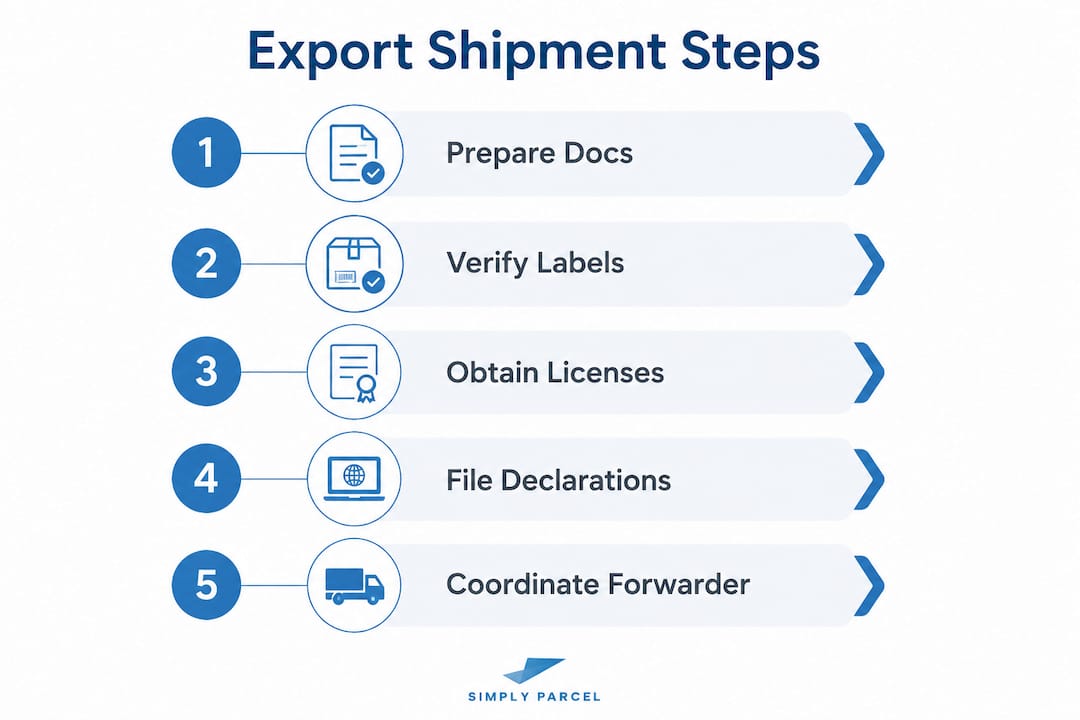
Step-by-step export process
- Classify your goods. Find the correct Schedule B number (the U.S. export classification code) and the corresponding HS code for the destination country. Classification determines your EEI filing obligation and any license requirements.
- Check export controls. Screen your product against the Commerce Control List (CCL) and the International Traffic in Arms Regulations (ITAR). If your item appears on either list, determine whether you need a license before proceeding.
- Prepare your documents. Complete the commercial invoice, packing list, and any required certificates. If an export license applies, obtain it first.
- File EEI through AES. Submit your Electronic Export Information before the shipment departs. For ocean freight, filing is typically required 24 hours before loading; for air freight, the deadline is two hours before departure.
- Package and label the shipment. Follow international packaging standards and apply all required labels before handing the goods to the carrier.
- Hand off to the carrier. Provide all transport documents (bill of lading or air waybill) to the carrier at the time of loading.
- Customs clearance. U.S. Customs and Border Protection (CBP) processes the export declaration. The destination country's customs authority then reviews your documents upon arrival.
Packaging standards for international shipments
Packaging for export must do more than protect the goods. It must also satisfy international regulations. Wood packaging materials (pallets, crates, dunnage) must be heat-treated and marked according to ISPM 15 standards to prevent the spread of pests across borders. Non-compliant wood packaging is one of the most common reasons for customs holds. Use double-walled corrugated boxes for fragile items, fill void space with appropriate cushioning, and seal all seams with pressure-sensitive tape rated for international transit.
Labeling requirements
Accurate labeling on every package must include the sender's full name and address, the recipient's full name and address, country of origin, handling instructions (e.g., "Fragile," "This Side Up"), and any required hazard markings. Use waterproof labels or cover labels with clear tape to prevent smearing during transit. For hazardous materials, U.S. exporters must comply with the Department of Transportation (DOT) hazmat labeling rules and, for air shipments, the IATA Dangerous Goods Regulations. Incorrect hazmat labeling can result in carrier refusal and regulatory penalties.

The role of a freight forwarder
Freight forwarders prepare transport documents, file export declarations, and advise on compliance requirements. They act as your agent with carriers and customs authorities, which makes them especially valuable when you are shipping to an unfamiliar market or dealing with complex documentation. A good freight forwarder will catch documentation errors before they become customs problems. If you are new to exporting, or shipping to a country with strict import requirements, engaging a licensed forwarder early in the process is one of the most practical steps you can take. You can learn more about how forwarders fit into the broader logistics picture in this freight forwarding guide.
Understanding Incoterms
Incoterms (International Commercial Terms, published by the International Chamber of Commerce) define exactly who pays for freight, insurance, and customs clearance at each stage of the journey. They appear on the commercial invoice and the bill of lading. Common terms for U.S. exporters include:
- EXW (Ex Works): The buyer takes responsibility from your loading dock. You have minimal obligations.
- FOB (Free on Board): Your responsibility ends once the goods are loaded onto the vessel at the named port.
- CIF (Cost, Insurance, and Freight): You pay freight and insurance to the destination port; the buyer handles import clearance.
- DDP (Delivered Duty Paid): You cover everything, including import duties at the destination. Maximum obligation for the exporter.
Choosing the wrong Incoterm can leave you liable for costs and risks you did not anticipate, so confirm the term with your buyer before issuing any invoice.
Export insurance
Cargo insurance is not legally required for most U.S. exports, but shipping without it exposes you to the full financial risk of loss or damage in transit. Standard carrier liability is limited and rarely covers the full value of the goods. You can purchase coverage through a freight forwarder, a marine insurance broker, or directly from an insurer. All-risk policies cover physical loss and damage from external causes; named-perils policies cover only the specific risks listed. For high-value or fragile shipments, all-risk coverage is the more practical choice.
Export compliance and restricted goods
Some goods require special handling beyond a standard export license. Items subject to a Destination Control Statement (DCS) under the Bureau of Industry and Security's Export Administration Regulations (EAR) must carry that statement on the commercial invoice, bill of lading, or air waybill. The DCS notifies the carrier and all foreign parties that the item may only be exported to certain destinations. Separately, certain goods are outright prohibited from export to specific countries under U.S. sanctions administered by the Office of Foreign Assets Control (OFAC). Always screen your buyer, end user, and destination country against the Consolidated Screening List before shipping. For a detailed look at how customs fits into the overall process, the role of customs in shipping is worth reviewing.
Pro Tip: Engage your freight forwarder before you finalize the sales contract, not after. They can flag documentation requirements, licensing issues, and packaging restrictions specific to your destination market before you have committed to terms you cannot meet.
Why verifying documents with your foreign buyer early makes a real difference
The single most effective step you can take to avoid customs delays is to ask your foreign buyer which documents their country requires before you prepare anything. Consulting the importer early in the sales cycle to confirm destination-specific requirements is a best practice recommended by the U.S. Department of Commerce, because documentation needs vary significantly by country and product type.
What this means in practice:
- Country-specific certificates: Some countries require phytosanitary certificates, health certificates, or pre-shipment inspection reports that are not part of the standard U.S. export document set. You will not find these requirements on a generic checklist.
- Language requirements: Certain destination countries require documents in their official language, or at minimum a certified translation alongside the English version.
- FTA documentation: If your buyer is in a country that has a free trade agreement with the United States, they may need a specific certificate of origin to claim a reduced tariff rate. Missing it means they pay full duties.
- Letter of credit compliance: If payment is via letter of credit, every document must match the letter's exact terms, including spelling, dates, and quantities. A single discrepancy can delay payment.
The practical steps for integrating early verification into your export workflow:
- During the sales negotiation, ask the buyer to provide a list of documents required for customs clearance in their country.
- Cross-reference that list against the standard U.S. export document set and identify any gaps.
- Determine lead times for any special certificates or inspections, and build those into your production and shipping schedule.
- Confirm with your freight forwarder that the documents you plan to prepare will satisfy both U.S. export requirements and the destination country's import requirements.
- Keep copies of all correspondence with the buyer about documentation, in case of a dispute at customs.
Early verification also protects you commercially. A shipment rejected at the destination port because of missing documents does not just cost you time. It can damage your relationship with the buyer and, depending on your Incoterms, leave you responsible for return freight and storage costs. The shipping documentation process covers country-specific compliance in more detail if you want to go deeper on this topic.
Key Takeaways
Preparing export shipments correctly requires accurate documentation, compliant packaging, and early coordination with your foreign buyer to meet destination-specific requirements.
| Point | Details |
|---|---|
| Core documents are mandatory | Every U.S. export needs a commercial invoice, packing list, and transport document at minimum. |
| EEI filing has a clear threshold | Shipments valued over $2,500 per Schedule B number require EEI filing through AES before departure. |
| Packaging must meet ISPM 15 | Wood packaging must be heat-treated and marked to ISPM 15 standards or face customs holds. |
| Incoterms define your liability | The Incoterm on your invoice and bill of lading determines who pays freight, insurance, and import duties. |
| Early buyer verification prevents delays | Confirming destination document requirements with your importer before shipment avoids costly rejections. |
Ready to ship internationally without the paperwork headaches? Simplyparcel makes it straightforward to compare courier options, generate shipping labels, and book pickups for cross-border shipments. Get an instant quote and see how simple export shipping can be.