
Freight consolidation is defined as the practice of combining multiple smaller shipments into a single, larger load to maximize vehicle utilization and reduce the cost per shipment. It is the industry term for what logistics professionals also call load consolidation or shipment bundling, and it sits at the center of every serious freight cost reduction program. The role of freight consolidation goes well beyond saving money on a single lane. It reshapes how supply chains move goods, how carriers are managed, and how sustainability targets get met. Consolidation centers, freight forwarders, and third-party logistics providers all play direct roles in making this work at scale.
How does freight consolidation work, and when is it financially viable?
Freight consolidation bundles smaller shipments by grouping orders that share overlapping destinations, time windows, or routes into a single truck or container. The goal is to push load factor high enough that the cost per unit shipped drops significantly. This is not a vague efficiency goal. There are clear financial thresholds that determine when consolidation pays off.
The most common crossover is from less-than-truckload (LTL) to full truckload (FTL). LTL-to-FTL consolidation becomes financially viable when combined shipments within a 48–72 hour window exceed 8–12 pallets or approximately 10,000 lbs. At that threshold, you can expect savings of 20–40% compared to sending those same shipments as separate LTL moves. That is a material reduction in freight spend, not a rounding error.
For shipments that fall between LTL and FTL volumes, partial truckload (PTL) is a middle option. PTL avoids the terminal handling and transfer stops of LTL while not requiring a full truck's worth of freight. It works well for mid-volume shippers who ship regularly to a consistent set of destinations.
Here is a practical breakdown of how the consolidation decision plays out:
- Assess your volume and frequency. Pull 90 days of order data. Identify lanes where you ship at least weekly to the same region.
- Check your time window flexibility. Consolidation requires holding shipments until the bundle threshold is met. If your customers accept a 48–72 hour delivery window shift, you have room to consolidate.
- Calculate the LTL-to-FTL crossover. If combined weekly volume on a lane exceeds 8–12 pallets, run a rate comparison between your current LTL cost and an FTL quote.
- Map carrier rates for that lane. Not all carriers price FTL the same way. Rate mapping across two or three carriers on the same lane often reveals a 5–10% additional gap.
- Run a pilot. Start with one or two high-volume lanes before committing to a full program rollout.
Pro Tip: Timing is the most underestimated variable in consolidation. Locking shipment groupings before carrier cutoff times is what separates a successful consolidation run from a missed load. Build your planning cycle around the cutoff, not the other way around.
What are the measurable benefits of freight consolidation for supply chains?

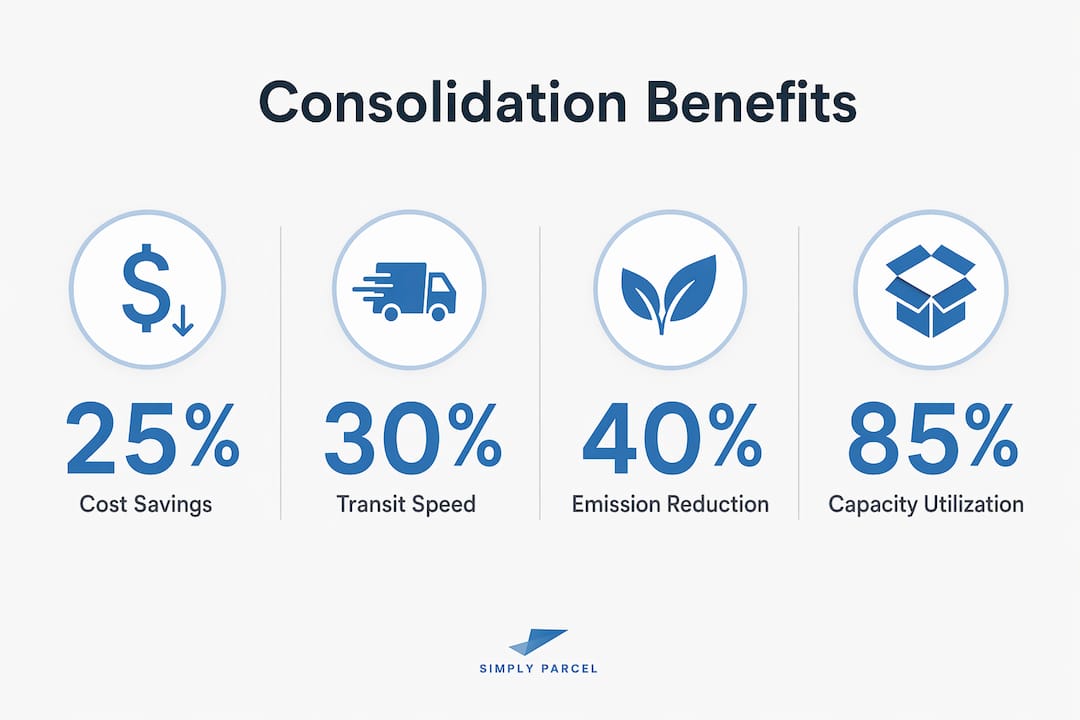
The benefits of freight consolidation extend across cost, speed, damage reduction, and environmental performance. Realistic overall savings from well-executed consolidation programs range between 10% and 25% on total freight spend. That figure assumes recurring volume and consistent routing. One-off consolidation efforts produce smaller gains.
The specific advantages of consolidating freight include:
- Lower per-unit shipping costs. Fewer trucks moving more freight per trip reduces the base cost allocated to each unit or pallet.
- Faster transit times. Consolidated direct shipments skip the intermediate terminal stops common in LTL networks, cutting transit time on many lanes.
- Reduced product damage. Every handling event is a damage risk. Consolidation cuts the number of times freight is touched between origin and destination.
- Smaller carbon footprint. Fewer trucks on the road means lower fuel consumption and fewer emissions per unit shipped. This is a credible lever for supply chains with corporate sustainability commitments.
- Better dock efficiency. Receiving fewer, larger deliveries reduces dock congestion and labor time at destination warehouses.
- Improved schedule predictability. Consolidated loads on fixed lanes create more consistent delivery patterns, which simplifies inbound planning.
"Consolidation benefits extend beyond cost to operational efficiency and sustainability, reducing handling events and administrative handoffs across the supply chain." — Worldwide Express
Walmart's prepaid consolidation program is a well-known example of these benefits at scale. Walmart requires suppliers to ship through designated consolidation points, which allows Walmart to control inbound freight costs and maintain tight delivery windows across its distribution network. The result is lower inbound freight cost and higher dock utilization at its distribution centers.
The ATA Container Utilization Index (CUI) initiative offers a more granular example. Container capacity utilization improved from a 64.2% baseline to a target of 75% or above through structured consolidation monitoring and supplier coordination. That improvement unlocked up to approximately $0.99 million in annualized freight savings for a single agricultural equipment supply chain. The lesson is clear: measuring utilization and acting on the data produces real savings.
What operational challenges affect successful freight consolidation?
Consolidation is not a set-and-forget program. The most common reason consolidation programs underperform is that operational constraints are underestimated at the planning stage.
Without operational gating such as warehouse receiving windows and staging capacity, meeting consolidation thresholds becomes difficult. You may have the volume on paper, but if your warehouse cannot hold and stage freight for 48–72 hours without disrupting outbound operations, the bundling window collapses. This is the single most overlooked bottleneck in new consolidation programs.
Other common challenges include:
- Misaligned delivery windows. Suppliers or customers with rigid delivery requirements make it hard to hold shipments long enough to bundle them.
- Poor data quality. Consolidation is an optimization problem. If your order data is incomplete or delayed, you cannot accurately forecast which shipments can be grouped.
- Multi-supplier coordination complexity. Cross-border or multi-supplier consolidation requires synchronized pickup schedules, shared documentation, and carrier alignment. Any gap in coordination creates a missed load.
- Carrier visibility gaps. Without real-time tracking across consolidated loads, exceptions are harder to catch and resolve before they affect delivery performance.
- Container utilization variability. Active tracking of container utilization is required to sustain gains. Without it, many containers remain underutilized despite a consolidation program being in place.
Pro Tip: Treat consolidation as a control-tower workflow. Map the full cycle: collection, consolidation, onward transport, and deconsolidation. Each handoff point needs a defined owner and a documented process. Gaps in ownership are where schedules and load factors fall apart.
How can logistics managers implement and measure freight consolidation programs?
A structured implementation approach separates programs that deliver sustained savings from those that produce a one-time result and then drift. The freight consolidation process requires data-driven planning at every stage.
Follow these steps to build a program that holds:
- Analyze historical order data. Pull at least 90 days of shipment records. Segment by lane, volume, frequency, and delivery window. This tells you where consolidation is structurally possible.
- Align delivery windows. Work with customers and internal teams to create flexible delivery windows of 48–72 hours on target lanes. This is the single biggest enabler of consistent bundling.
- Map carrier rates and performance. Compare LTL and FTL rates across two or three carriers per lane. Include transit time and damage rate data, not just price.
- Pilot on targeted lanes. Start with two or three lanes that show the highest volume and most flexible delivery windows. Run the pilot for 60–90 days before expanding.
- Track key performance indicators. Measure cost savings per lane, load factor, and container utilization index (CUI) on a weekly basis. Monthly reporting is too slow to catch drift.
- Coordinate with suppliers continuously. Schedule regular check-ins with key suppliers to align pickup schedules and flag volume changes that affect bundling windows.
The table below shows the core metrics to track and what each one tells you about program health:
| KPI | What it measures | Target range |
|---|---|---|
| Cost savings per lane | Freight spend reduction vs. baseline | 10–40% depending on mode |
| Load factor | Actual weight or volume vs. truck capacity | 85% or above |
| Container utilization index (CUI) | Container fill rate across the network | 75% or above |
| Damage rate | Incidents per 1,000 shipments | Decreasing trend |
| On-time delivery rate | Consolidated loads arriving on schedule | 95% or above |
Technology platforms that support transportation management, such as Oracle Transportation Management or SAP TM, provide the shipment visibility and data aggregation needed to run these metrics in real time. Smaller operations can start with carrier portals and a shared tracking spreadsheet before investing in a full TMS. The key is that you track consistently, not that you use a specific tool from day one. For businesses shipping internationally from Singapore, platforms like Simplyparcel offer a practical starting point for comparing rates across consolidated freight options.
Key Takeaways
Freight consolidation delivers measurable cost savings, faster transit, and lower emissions when volume, timing, and data quality align across the supply chain.
| Point | Details |
|---|---|
| Financial threshold matters | LTL-to-FTL consolidation saves 20–40% when combined loads exceed 8–12 pallets within 48–72 hours. |
| Operational gating is the real bottleneck | Warehouse staging capacity and receiving windows limit consolidation more than volume alone. |
| Measure utilization actively | Tracking the container utilization index (CUI) is required to sustain savings over time. |
| Pilot before scaling | Start with two or three high-volume lanes and run 60–90 days of data before expanding the program. |
| Sustainability is a real benefit | Consolidated loads reduce fuel consumption and emissions per unit, supporting corporate sustainability goals. |
Simplyparcel's view on freight consolidation as a long-term discipline
Freight consolidation gets sold as a cost-cutting tactic. After working closely with shippers across international lanes, I have seen it work best when teams treat it as an ongoing operational discipline rather than a one-time project.
The programs that deliver sustained savings share three traits. First, they are built on clean, timely data. Consolidation is fundamentally an optimization problem, and poor data quality kills the math before a single shipment is bundled. Second, they have someone who owns the process end to end. Without a clear owner, the control-tower coordination that consolidation requires falls apart within a few months. Third, they measure consistently. Teams that track load factor and CUI weekly catch drift early. Teams that check in quarterly are always reacting to problems that have already cost them money.
The uncomfortable truth is that consolidation requires more operational discipline than most companies expect when they start. The savings are real. The 10–25% freight cost reduction is achievable. But it does not happen automatically. It happens because someone is watching the numbers and coordinating the handoffs every week. If you are willing to build that discipline, consolidation pays for itself many times over. If you are looking for a set-and-forget solution, you will be disappointed.
— Simply
Simplyparcel's freight solutions for smarter shipping
Simplyparcel gives logistics managers and business owners in Singapore a direct way to compare courier rates and book consolidated international shipments without the complexity of managing multiple carrier relationships. The platform integrates with major courier partners, generates shipping labels automatically, and provides real-time tracking across all active shipments. Whether you are moving parcels or bulk freight, Simplyparcel's economy, connect-plus, and priority options let you match shipping speed to budget on every order. Get an instant shipping quote and see how much your business can save by shipping smarter on international lanes.
FAQ
What is freight consolidation in simple terms?
Freight consolidation combines multiple smaller shipments heading to the same region into a single truck or container. This increases vehicle utilization and reduces the cost per shipment compared to sending each order separately.
How much can freight consolidation save on shipping costs?
Realistic savings from freight consolidation range between 10% and 25% on overall freight spend. LTL-to-FTL consolidation on qualifying lanes can save 20–40% compared to separate LTL shipments.
What volume is needed to make freight consolidation work?
Combined shipments need to exceed 8–12 pallets or approximately 10,000 lbs within a 48–72 hour window to make LTL-to-FTL consolidation financially viable. Below that threshold, LTL or PTL is usually the better choice.
What is the biggest operational challenge in freight consolidation?
The most common bottleneck is operational gating. Warehouse receiving windows and staging capacity limit how long shipments can be held for bundling, often more than volume availability does.
How does freight consolidation support sustainability goals?
Consolidated loads put fewer trucks on the road, which cuts fuel consumption and emissions per unit shipped. This makes consolidation a direct contributor to corporate carbon reduction targets alongside its cost benefits.