
Singapore consistently earns top marks as a global logistics hub, holding the number one ranking on the World Bank Logistics Performance Index with a score of 4.3 out of 5. That reputation is well earned. But here's the reality many shippers learn the hard way: being based in one of the world's most efficient ports does not make your international shipments immune to disruption. From port congestion to container shortages and unpredictable route closures, real challenges affect businesses and individuals shipping from Singapore every day. This guide breaks down those challenges clearly and gives you the tools to stay ahead of them.
Table of Contents
- The landscape of international shipping from Singapore
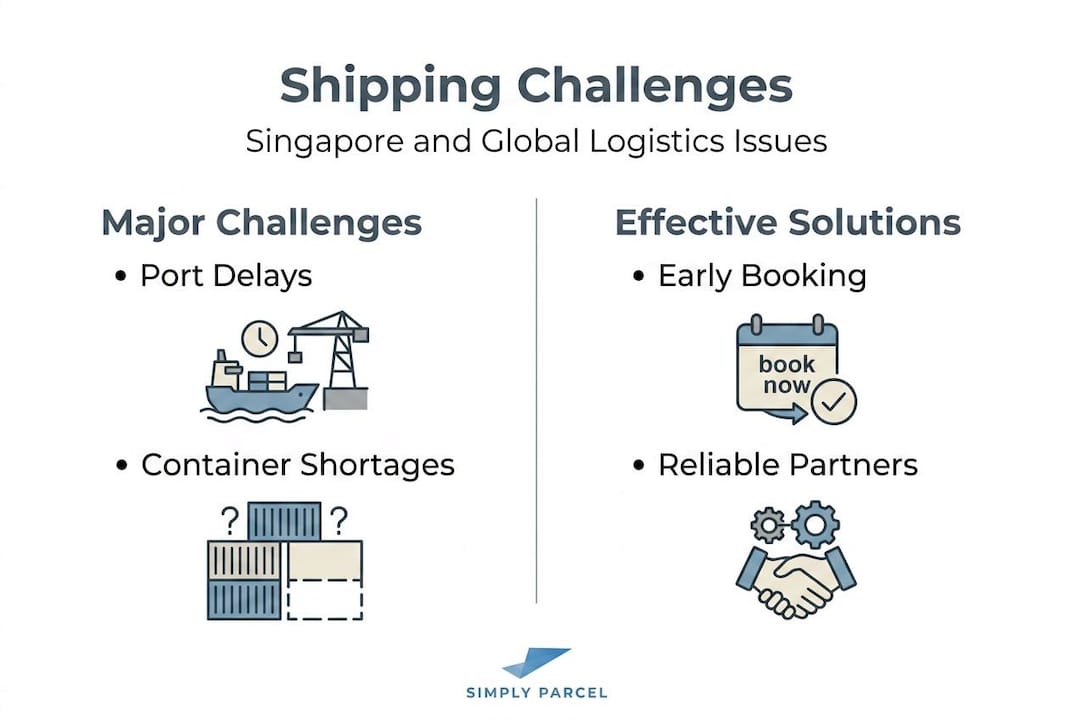
- Persistent global challenges: Delays, congestion, and bottlenecks
- Capacity constraints and equipment shortages: The container challenge
- Benchmarking performance: How Singapore measures up and adapts
- Strategies for navigating international shipping challenges
- Why relying on Singapore's port efficiency isn't enough
- Get expert support for your Singapore shipping needs
- Frequently asked questions
Key Takeaways
| Point | Details |
|---|---|
| Global disruptions persist | Even top-ranked Singapore faces significant port congestion and shipment delays due to world events. |
| Container shortages impact all | Capacity issues and equipment imbalances create ongoing challenges for shippers of all sizes. |
| Benchmarks track risk | Key industry metrics help businesses monitor performance and adapt to changing logistics realities. |
| Proactive strategies are key | Early booking, flexible routing, and digital tracking help mitigate shipment risks. |
| Support is available | Singapore-based platforms can offer expert help and real-time solutions for international shipping challenges. |
The landscape of international shipping from Singapore
Singapore processes millions of twenty-foot equivalent units (TEUs, the standard measure of container volume) each year, connecting Asia to Europe, the Americas, the Middle East, and Africa through one of the busiest port systems in the world. The city-state's geographic position at the Strait of Malacca makes it a natural crossroads for global trade, and its infrastructure reflects that role with world-class terminals, streamlined customs processes, and a dense network of carrier relationships.
The World Bank LPI score of 4.3 reflects Singapore's strength across six key pillars: customs efficiency, infrastructure quality, ease of arranging competitive shipments, logistics competence, tracking and tracing capability, and timeliness. No other country outranks Singapore on this combined measure in 2026.
But here is the part that often goes unspoken. Singapore's strength as a hub means it absorbs enormous traffic from across the region. When disruptions strike anywhere along major trade lanes, the effects flow directly into Singapore's port operations. You can follow the latest Singapore shipping trends to stay current, but the core issue is structural: the more connected a port is, the more exposure it has to external shocks.
Key factors that shape Singapore's international shipping environment include:
- Trade volume density: Singapore handles transhipment cargo from dozens of regional ports, which means congestion in one part of Asia can ripple inward fast.
- Route dependencies: Shipping lanes through the Red Sea, Suez Canal, and Strait of Malacca are critical arteries. Any disruption on these routes affects Singapore directly.
- Carrier consolidation: A smaller number of major alliances now control a large share of global capacity, reducing flexibility when individual carriers face problems.
- Seasonal surges: Pre-holiday periods and post-Lunar New Year surges create predictable but still difficult peaks in demand.
Understanding this landscape is the first step toward making smarter decisions about when, how, and through whom you ship internationally.
Persistent global challenges: Delays, congestion, and bottlenecks
The statistics behind global shipping delays are striking. According to data on port congestion and disruptions, as many as 90% of vessel arrivals at Singapore occur off-schedule, with average wait times running between 1.5 and 2 days. Those numbers may seem manageable in isolation, but they compound quickly when you factor in downstream processing, inland transport, and customs clearance timelines.
"Vessel bunching, yard utilization above 90%, labor shortages, and adverse weather are combining to create persistent delay patterns that no single port can solve on its own." — Marine Report, 2026
The causes behind these delays are worth understanding in detail, because each one suggests a different type of mitigation strategy:
| Delay cause | Typical impact | Where it hits hardest |
|---|---|---|
| Vessel bunching | Multiple ships arrive together, overwhelming berths | Major transhipment hubs like Singapore |
| Yard over-utilization | Containers stack up, slowing processing | Ports operating above 85% capacity |
| Labor shortages | Fewer workers per shift, slower loading | Ports in North America, Europe, Australia |
| Weather disruptions | Port closures, rerouting | Typhoon-prone Asia-Pacific corridors |
| Route closures | Longer voyages, missed connections | Red Sea, Suez Canal, Panama Canal |
Vancouver, for example, saw vessel wait times increase significantly following labor actions in 2024, with effects still being felt through 2025 as carrier schedules struggled to normalize. North China ports have also seen periodic slowdowns tied to weather and demand spikes. You can review recent port disruption cases to see how these global events translate into practical outcomes for Singapore-origin shipments.
Pro Tip: If you're shipping time-sensitive goods, always check the current port status at your destination before finalizing your booking. Many carriers provide advisory alerts, and shipping platforms with real-time tracking can surface early warning signals.
The key takeaway here is that delays are not random. They follow identifiable patterns, and knowing those patterns lets you plan around them more effectively.
Capacity constraints and equipment shortages: The container challenge
Container shortages are one of the most frustrating and least visible problems in international shipping. The equipment imbalances and capacity constraints that emerged from the pandemic years have not fully resolved. When global disruptions reroute vessels or extend voyage times, containers pile up in the wrong locations. Empties sit at destination ports while origin ports run short. That mismatch drives up spot rates and can push your shipment to a later sailing.

For Singapore-based shippers, this plays out in very specific ways depending on what you're shipping and where it's going.
| Route type | Container availability | Typical booking lead time |
|---|---|---|
| Asia to Europe | Tight, especially 20-foot containers | 2 to 3 weeks ahead |
| Asia to North America (West Coast) | Moderate, improving slowly | 1 to 2 weeks ahead |
| Intra-Asia | Generally better, but subject to surges | 1 week ahead |
| Asia to Middle East | Variable, affected by route closures | 2 to 4 weeks ahead |
Here's how container shortages typically unfold and affect your shipments:
- A disruption occurs on a major route (for example, Red Sea instability forces vessels around the Cape of Good Hope, extending voyage times by 10 to 14 days).
- Containers remain at destination ports longer because vessel turnaround is slower, reducing the number of empty units available at origin ports like Singapore.
- Carriers practice selective bookings, prioritizing high-value cargo or established shipper relationships during peak periods.
- Spot rates climb sharply, sometimes doubling or tripling within weeks, as demand for available capacity spikes.
- Smaller shippers and individuals face the greatest difficulty securing space on short notice.
Pro Tip: If you regularly ship on Asia-Europe or Asia-Middle East lanes, establish a relationship with a logistics partner who has pre-allocated space with major carriers. This provides priority access even during periods of severe equipment imbalance. You can get a clear breakdown of shipping challenges and compare available options before committing to a carrier.
The practical steps Singapore exporters and importers can take to reduce exposure to container shortages include booking space at least two to four weeks ahead during peak seasons, using less-than-container load (LCL) consolidation when full container load (FCL) space is tight, and maintaining flexibility on sailing dates when delivery windows allow.
Benchmarking performance: How Singapore measures up and adapts
Numbers matter in logistics. The shipping industry uses several specific metrics to track performance, and understanding them helps you evaluate your logistics partners with precision rather than guesswork.
Three key metrics to know:
| Metric | What it measures | Why it matters |
|---|---|---|
| GSCSI-M (Global Supply Chain Stress Index, Maritime) | Delayed TEU capacity across global trade lanes | Signals systemic pressure across routes |
| CPPI (Container Port Performance Index) | Vessel time spent in port | Indicates terminal efficiency at specific ports |
| Schedule reliability | Percentage of vessels arriving on time | Directly affects your transit time estimates |
According to empirical benchmarking data, schedule reliability has fallen below 20% at some of the world's busiest ports in recent periods, meaning fewer than one in five vessels arrive on their advertised schedule. Singapore performs better than most, but even here, on-time performance fluctuates with global conditions.
What makes Singapore stand out in these benchmarks:
- Infrastructure investment: Tuas Mega Port, when fully operational, will be among the largest and most automated port facilities in the world, expanding capacity significantly.
- Customs efficiency: Singapore's single-window TradeNet system enables fast digital clearance, reducing dwell time for most cargo categories.
- Carrier diversity: Singapore's port hosts more shipping lines than almost any other hub, giving shippers more routing options when one carrier faces problems.
- Multi-modal connectivity: Air, sea, and road options are all accessible, allowing shippers to track shipment reliability across modes and switch when necessary.
For your own logistics operations, benchmarking your current carrier's performance against industry standards is a concrete action you can take today. Request on-time performance data, transit time consistency records, and claim resolution timelines from your provider. These numbers tell you more than marketing materials ever will.
Strategies for navigating international shipping challenges
With a clear picture of the obstacles, you can build a practical approach to managing them. These strategies apply whether you're an individual sending a parcel overseas or a business managing regular export volumes.
- Book early and confirm capacity. The earlier you book, especially on high-demand lanes, the better your access to preferred sailing dates and container availability. For time-sensitive shipments, confirm space in writing with your carrier.
- Build flexible routing into your plan. If your goods can move via multiple ports or on alternative carriers, you have options when your first choice is disrupted. Discuss routing flexibility with your logistics provider before booking.
- Use digital tracking tools. Real-time visibility into where your shipment is and what its current status means allows you to respond quickly to exceptions. Waiting for problems to surface at delivery is too late.
- Create contingency plans for critical shipments. Identify your top-priority shipments and decide in advance what you'll do if they're delayed. Options might include air freight for urgent restocking or pre-positioning inventory closer to your customer base.
- Work with experienced logistics partners. A provider with established carrier relationships and market knowledge can advocate for your shipment during tight periods and offer alternatives you might not find on your own.
- Stay informed on route disruptions. Subscribe to carrier advisories and logistics news. Singapore's LPI score of 4.3 reflects strong domestic performance, but global route conditions change frequently and require your attention.
Pro Tip: Keep a running record of your shipments' actual versus estimated transit times. After three to six months, you'll have your own performance data specific to your routes and carriers, which is far more useful than industry averages. Use these insights when reviewing contracts or selecting new providers. Explore more shipping tips to build on this foundation.
The combination of early action, good information, and the right partners creates a shipping operation that absorbs disruptions rather than being stopped by them.
Why relying on Singapore's port efficiency isn't enough
Here is a view that many in the logistics industry are reluctant to say directly: Singapore's top ranking in global benchmarks can actually work against you if it creates a sense of security that discourages active risk management.
Businesses that assume their logistics are stable because they're operating through a world-class hub are the ones most caught off guard when disruptions hit. The 2021 to 2023 global supply chain crisis demonstrated this clearly. Companies with diversified carrier networks and proactive monitoring recovered faster than those who relied on established relationships and assumed things would self-correct.
The pattern repeats in 2026. Shippers who tracked Red Sea disruptions early and rerouted through alternative carriers or modes maintained delivery commitments. Those who waited for carriers to notify them faced weeks of delays they couldn't explain to their customers.
Singapore's strengths in infrastructure, customs, and connectivity are real and significant. But those strengths exist at the port level. They don't automatically translate to resilience for individual shipments moving through the full international supply chain. A vessel delayed by congestion in Rotterdam, a container stuck in a yard in Los Angeles, or a customs hold in a transit country are all outside Singapore's control, regardless of how efficiently goods leave Singapore's shores.
The businesses that perform best in this environment treat logistics as an ongoing operational discipline rather than a background function. They review carrier performance regularly, maintain relationships with multiple providers, and keep contingency options ready before they need them. You'll find deeper perspective and global shipping insights that support this kind of proactive approach.
Efficient infrastructure is a starting point. Operational resilience is what you build on top of it.
Get expert support for your Singapore shipping needs
Managing international shipments across challenging global conditions is easier when you have the right platform behind you. Simply Parcel gives Singapore-based shippers instant access to international shipment quotes across multiple courier services, so you can compare rates, transit times, and service levels in one place rather than contacting carriers individually. You can review full shipping details and options to choose between priority, connect-plus, and economy services based on your urgency and budget. Once your shipment is moving, real-time tools let you track shipments at every stage. Whether you're sending a single parcel or managing regular export volumes, Simply Parcel simplifies the process so you can focus on your business rather than your logistics.
Frequently asked questions
What are the biggest causes of international shipping delays in 2026?
Major delays are driven by port congestion and labor shortages, as well as weather disruptions, vessel bunching, and global supply-demand mismatches that push yard utilization above 90%.
How can I minimize my risk if I need urgent shipments from Singapore?
Book early, use flexible carriers, and request regular status updates throughout transit. Working with a logistics partner who has pre-allocated carrier space is especially important during peak demand periods when container availability tightens.
Why does Singapore rank so high in global logistics despite these challenges?
Singapore leads the World Bank LPI at 4.3 out of 5 due to strong infrastructure, efficient customs processing, carrier diversity, and continued investment in port automation and logistics technology.
Are container shortages still a problem in 2026?
Yes, container and capacity shortages persist on key trade lanes, particularly during demand peaks, post-disruption recovery periods, and on routes affected by ongoing geopolitical instability.