
Bulk freight shipping is defined as the transport of goods that exceed standard parcel carrier limits, typically starting at 150 lbs or requiring palletization, and handled through specialized methods like Less-than-Truckload (LTL) or Full Truckload (FTL) freight. Knowing how to send bulk freight correctly saves your business money, prevents costly delays, and keeps your supply chain moving. This guide covers freight classification, packaging, documentation, carrier selection, and cost control, giving logistics managers a clear, practical path from first shipment to repeatable process.
How to classify and prepare your bulk freight for shipment
Freight classification is the foundation of accurate pricing. The National Motor Freight Classification (NMFC) system assigns freight classes ranging from 50 to 500, with pricing based heavily on density. Miscalculating freight density causes costly disputes with carriers and reclassification fees that arrive long after delivery.
Density is calculated by dividing the shipment's weight in pounds by its volume in cubic feet. A shipment that measures 48 x 40 x 48 inches and weighs 500 lbs has a volume of 53.3 cubic feet, giving a density of roughly 9.4 lbs per cubic foot. That density number determines your freight class, which directly sets your base rate.
| Freight class | Density (lbs/cu ft) | Typical goods |
|---|---|---|
| Class 50 | Over 50 | Heavy machinery, metal parts |
| Class 100 | 15–22.5 | Boat covers, car covers |
| Class 150 | 10–15 | Auto sheet metal, furniture |
| Class 250 | 4–6 | Bamboo furniture, mattresses |
| Class 500 | Under 1 | Ping-pong balls, gold dust |
Once you know your class, determine whether your shipment fits LTL or FTL. Freight shipping thresholds set LTL at 1–10 pallets and FTL at shipments over 10 pallets or 10,000 lbs. A standard dry van holds up to 44,000 lbs or 26 pallets, so FTL makes sense when you fill more than half that capacity.

Packaging protects your freight and your rate. Use pallets that match your cargo footprint, shrink-wrap layers tightly, and add corner boards on fragile stacks. Cargo shifting during transit causes damage, delays, and fines. Secure loads with anti-shift boards and trim surfaces to prevent movement.
Pro Tip: Measure your freight after palletizing and wrapping, not before. Carriers measure the final loaded dimensions, and even a few extra inches can push you into a higher freight class.
What bulk freight shipping options are available?
Choosing the right freight method depends on your volume, budget, and delivery timeline. Each option carries different cost structures and handling requirements.
LTL (Less-than-Truckload) works for shipments between 1 and 10 pallets. Your cargo shares trailer space with other shippers, which lowers cost but adds handling touchpoints. Transit times are longer because the carrier makes multiple stops.
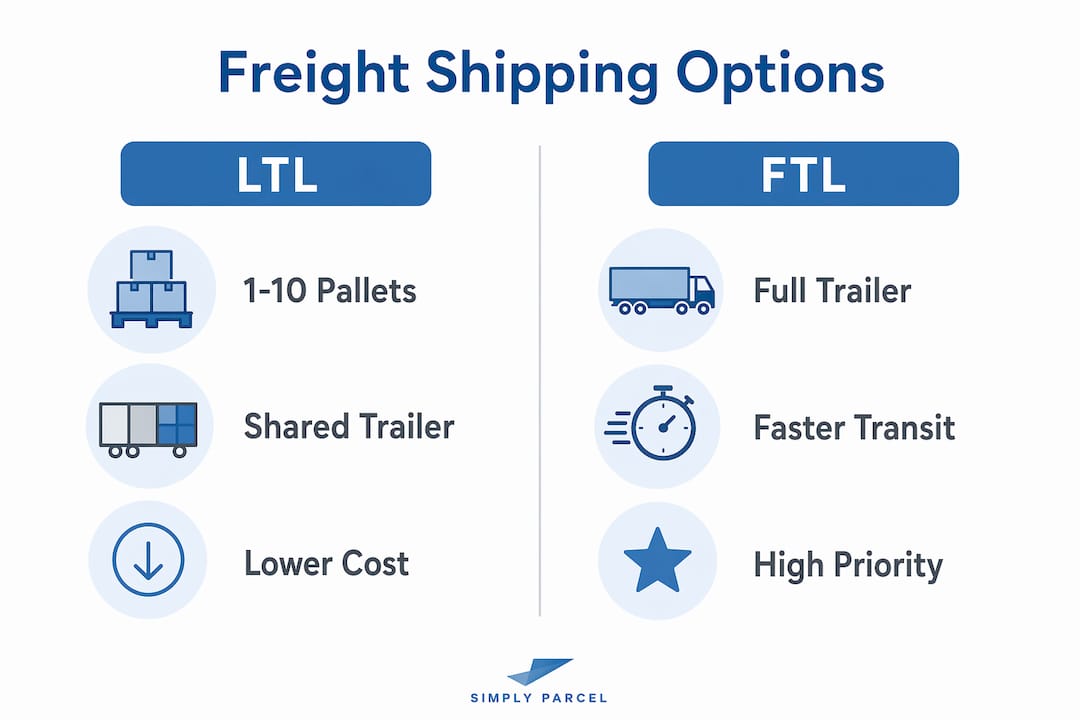
FTL (Full Truckload) gives your freight the entire trailer. It moves faster, gets handled less, and suits time-sensitive or fragile bulk goods. The tradeoff is a higher flat rate regardless of how much space you actually use.
Flatbed freight handles oversized or irregularly shaped cargo that cannot fit inside a standard enclosed trailer. Construction materials, heavy equipment, and large machinery typically move on flatbeds.
Expedited freight prioritizes speed above all else. Carriers dedicate vehicles to single shipments and minimize stops. Expect to pay a significant premium over standard LTL or FTL rates.
| Method | Best for | Cost level | Transit speed |
|---|---|---|---|
| LTL | 1–10 pallets, flexible timing | Low to moderate | Moderate |
| FTL | 10+ pallets, full loads | Moderate to high | Fast |
| Flatbed | Oversized, irregular cargo | Moderate to high | Moderate |
| Expedited | Urgent, time-critical freight | High | Very fast |
Carrier selection goes beyond price. Cheapest freight rates often mask poor service, hidden delays, and damage claims that cost more than the savings. Prioritize carriers with real-time tracking, clear communication, and a documented claims process. A useful starting point is reviewing a carrier comparison guide to evaluate performance metrics alongside price.
Pro Tip: Ship on fixed days each week whenever possible. Consistent scheduling gives carriers advance notice, which often translates to better rates and priority loading.
How to manage documentation and get accurate freight quotes
The Bill of Lading (BOL) is the legally binding contract between you and the carrier. A BOL that matches your commercial invoice and packing list prevents transit delays, billing disputes, and audit fees. Any mismatch between these documents creates grounds for a carrier to hold or reclassify your shipment.
Getting an accurate quote requires complete, specific information upfront. Carriers price based on what you declare, and undeclared details become accessorial charges after delivery. Accessorial fees like liftgate service, residential delivery, and inside pickup can significantly increase your total freight cost if left off the quote request.
Here is what every quote request and shipment file should include:
- Origin and destination addresses, including whether either location is residential or requires special access
- Accurate weight and dimensions of the palletized, wrapped shipment
- Freight class based on your density calculation
- Commodity description matching the NMFC catalog
- Declared value for insurance purposes
- Special handling requirements such as temperature control, hazmat classification, or liftgate needs
- Bill of Lading signed by both shipper and carrier before pickup
- Commercial invoice and packing list for international shipments
- Customs documentation including HS codes for cross-border freight
For international bulk shipments, add your Harmonized System (HS) codes, country of origin certificates, and any required import permits for the destination country. Missing one document at customs can hold an entire container for days.
What are the best ways to reduce bulk freight costs?
Cost control in bulk freight comes from consistency, visibility, and planning. Consolidating orders and shipping on fixed schedules reduces per-unit costs and improves carrier coordination. Sporadic, reactive shipping almost always costs more than a planned weekly or biweekly dispatch cycle.
Real-time tracking tools give you visibility throughout transit, reduce the risk of lost shipments, and let you communicate accurate delivery windows to your customers. Tracking has moved from a nice-to-have feature to a baseline expectation in modern freight logistics.
Key strategies to reduce bulk freight costs:
- Consolidate shipments by batching orders to the same region into a single LTL or FTL load. Read more about freight consolidation benefits and how they affect supply chain efficiency.
- Negotiate volume contracts with two or three preferred carriers. Long-term relationships yield better rates and priority service during peak seasons.
- Build a reverse logistics plan from the start. Skipping return management complicates inventory accuracy and damages customer relationships.
- Audit freight invoices against original quotes. Carriers sometimes apply accessorial charges that were not agreed upon. Catching these early prevents them from becoming routine.
- Train your loading team. Human error accounts for 40% of safety incidents in bulk shipping. Proper loading and securing protocols protect your cargo and reduce claims.
Pro Tip: Ask your carrier for a lane analysis after three months of consistent shipping. Most carriers will share data on your routes and suggest rate adjustments or service upgrades based on your volume.
Key Takeaways
Sending bulk freight efficiently requires accurate freight classification, complete documentation, the right shipping method, and consistent scheduling to control costs and avoid delays.
| Point | Details |
|---|---|
| Classify freight accurately | Calculate density correctly to avoid reclassification fees and pricing disputes. |
| Match method to volume | Use LTL for 1–10 pallets and FTL for loads over 10 pallets or 10,000 lbs. |
| Complete documentation upfront | BOL, commercial invoice, and packing list must match to prevent delays. |
| Consolidate and schedule | Fixed shipping days reduce costs and improve carrier coordination. |
| Track every shipment | Real-time visibility reduces loss risk and improves customer communication. |
What I've learned from years of watching bulk freight go wrong
The most expensive mistake in bulk freight is not the one that shows up on the invoice. It is the one that shows up three weeks later as a reclassification charge, a damage claim, or a customs hold that nobody saw coming.
I have seen businesses spend months negotiating carrier rates, then lose those savings in the first quarter because their team was measuring freight before palletizing. The density calculation was off by 15%, the freight class jumped two tiers, and the carrier billed the difference on every single shipment. No one caught it until the quarterly audit.
Documentation accuracy matters more than most logistics managers realize until something goes wrong. A BOL that does not match the packing list is not a minor clerical issue. It is a reason for a carrier to hold your freight, reclassify it, or charge you for a re-inspection. The fix costs far more than the five minutes it takes to verify the documents before pickup.
The businesses that manage bulk freight well share one habit: they treat carrier relationships as partnerships, not transactions. They communicate volume forecasts, flag unusual shipments in advance, and pay invoices on time. In return, they get priority loading, faster claims resolution, and better rates when the market tightens. That relationship is worth more than any spot rate discount.
For a deeper look at the operational side of this process, the bulk freight shipping process guide covers the step-by-step mechanics in detail.
— Simply
Simplyparcel makes bulk freight shipping easier to manage
Simplyparcel gives businesses in Singapore a single platform to compare courier rates, book pickups, and generate shipping documentation automatically. For bulk freight, the platform provides instant quotes based on your shipment details, so you can compare options and choose the right service level without calling multiple carriers. Simplyparcel supports priority, economy, and connect-plus shipping speeds, giving you control over cost and transit time. The platform also handles label generation and real-time tracking, reducing the manual work that causes documentation errors. Get an instant freight quote and see how much your next bulk shipment costs before you commit.
FAQ
What is bulk freight shipping?
Bulk freight shipping is the transport of large volumes of goods that exceed standard parcel carrier limits, typically over 150 lbs or requiring palletization. It uses specialized methods like LTL or FTL freight to move cargo efficiently.
How do I know if I need LTL or FTL?
Use LTL for shipments of 1–10 pallets and FTL for loads over 10 pallets or 10,000 lbs. FTL is also the better choice when your cargo is fragile or time-sensitive, since it involves less handling.
What documents do I need for bulk freight shipments?
Every bulk freight shipment requires a Bill of Lading, commercial invoice, and packing list. International shipments also need HS codes, a certificate of origin, and any destination-country import permits.
How is freight class calculated?
Freight class is determined by density, which is weight in pounds divided by volume in cubic feet. Classes range from 50 to 500, with lower-density goods assigned higher class numbers and higher rates.
How can I reduce the cost of bulk freight shipping?
Consolidate shipments, ship on fixed schedules, and negotiate volume contracts with preferred carriers. Auditing freight invoices against original quotes also catches unauthorized accessorial charges before they become routine costs.