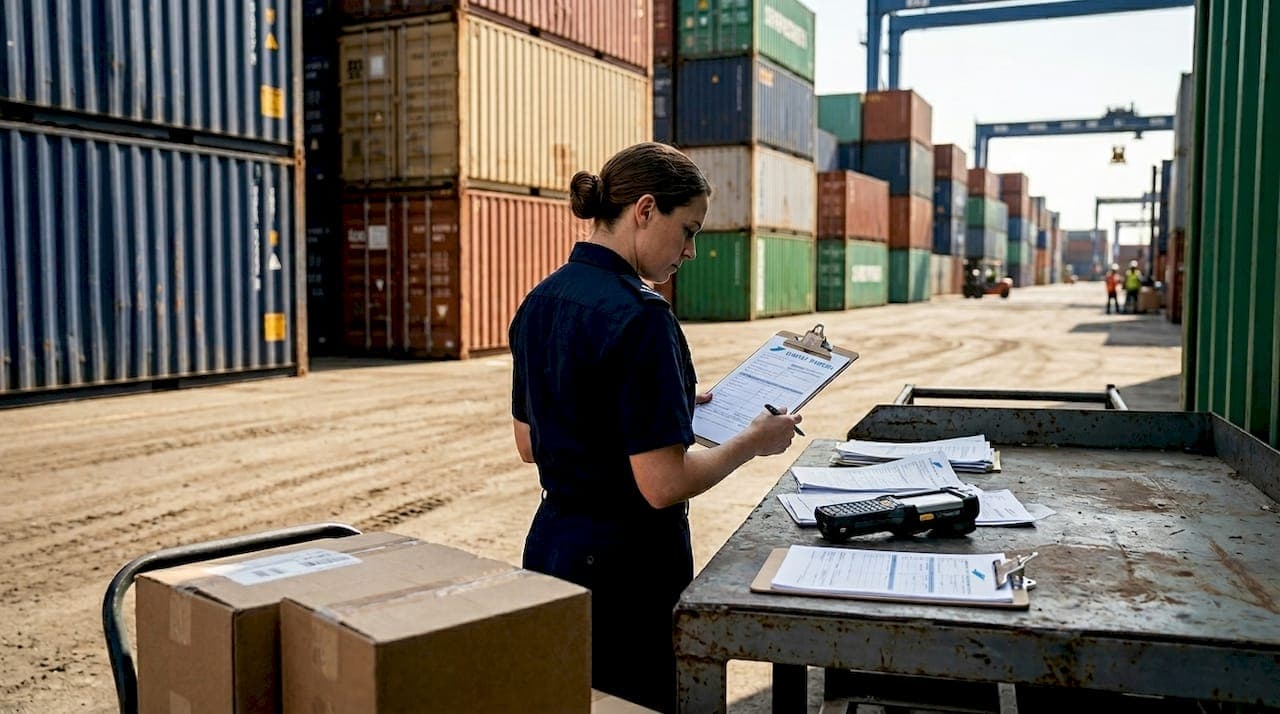
Customs in international shipping is the government-regulated process of inspecting, classifying, and taxing goods as they cross national borders to enforce trade, safety, and tax laws. Every parcel or freight shipment you send abroad passes through this process before it reaches its destination. Agencies like U.S. Customs and Border Protection (CBP) verify shipment documents including declared value, country of origin, and product classification to determine what duties apply. Both CBP and the trading community share responsibility for maximizing compliance with import and export laws. Understanding how this process works is the single most effective way to prevent costly delays and unexpected fees.
What is the role of customs in shipping?
Customs authorities do far more than collect taxes. Their core function is to control the movement of goods across borders by verifying that every shipment complies with the importing and exporting country's laws. This covers trade regulations, product safety standards, intellectual property protections, and national security requirements.
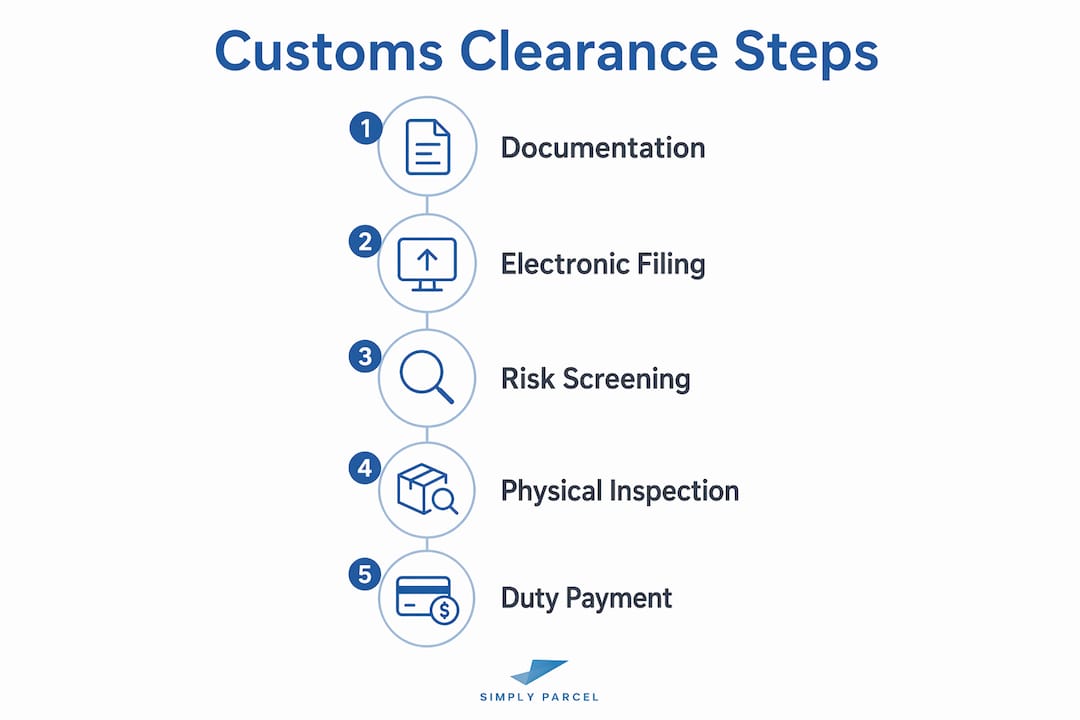
The customs clearance process follows a defined sequence of steps that every international shipment must complete before release:
- Prepare shipment documents. Gather your commercial invoice, packing list, bill of lading or airway bill, and any product-specific certificates such as health or phytosanitary certificates.
- Submit customs entry data. File your shipment details electronically through a customs broker, freight forwarder, or directly via the relevant government portal.
- Customs review. Authorities check your declared classification, origin, and value against their databases and risk profiles.
- Duty and tax assessment. Applicable tariffs, VAT, and fees are calculated based on the Harmonized System (HS) code and declared value.
- Inspection (if triggered). High-risk or flagged shipments undergo physical or documentary inspection before release.
- Shipment release. Once all requirements are satisfied and payments are confirmed, the goods are cleared for delivery.
Common documents required at this stage include:
- Commercial invoice with accurate item descriptions and values
- Packing list detailing contents, weights, and dimensions
- Bill of lading or airway bill as proof of shipment contract
- Certificate of origin for preferential tariff treatment
- Permits or licenses for regulated goods such as food, electronics, or chemicals
Delays most often occur when paperwork is incomplete, values are inconsistently declared, or classification codes are wrong. This means a single data entry error can hold your entire shipment at the border for days.
Pro Tip: Work with a licensed customs broker for your first few international shipments. Brokers understand local filing requirements and can catch documentation errors before they trigger inspections or fines.

Key responsibilities of customs authorities beyond fee collection
Customs agencies perform several functions that directly affect your shipment's safety, legality, and cost. Understanding these responsibilities helps you treat customs as an operational partner rather than a bureaucratic obstacle.
- Trade law enforcement. Customs authorities block counterfeit goods, prohibited items, and shipments that violate trade sanctions or embargoes.
- Consumer protection. Unsafe products, including those that fail safety certifications, are stopped before they enter the domestic market.
- Revenue collection. Tariffs and taxes are assessed using HS codes and declared values, funding government operations and protecting domestic industries.
- Risk-based cargo inspection. Authorities use compliance history, cargo type, and origin data to decide which shipments to physically inspect, rather than checking every container.
- Coordination with partner agencies. Customs works alongside health ministries, agriculture departments, and trade regulators to enforce multi-agency requirements on a single shipment.
- Procedural flexibility during disruptions. India's CBIC, for example, issued Circular No. 09/2026-Customs offering time-bound procedures and fee waivers for cargo affected by maritime disruptions, demonstrating that customs authorities adapt their role during force majeure events.
Customs is no longer just a checkpoint. It is a risk management function that spans your entire supply chain, from supplier documentation to final delivery confirmation.
This broader view of customs responsibilities explains why errors made early in your supply chain, such as a supplier listing the wrong HS code on an invoice, can create compliance failures at the border weeks later.
How technology and regulations are reshaping customs today
Modern customs operations rely heavily on electronic data and risk-based screening rather than manual document review. This shift has significant implications for how you prepare and time your shipments.
The U.S. CBP has proposed a rule requiring electronic export manifest submission at least 24 hours before cargo is loaded onto outbound vessels. This means customs release depends on matching advance electronic manifest data with the physical cargo. Late or missing filings prevent release even when all paper documents are accurate. The timing of your data submission is now as important as the accuracy of your documents.
India's CBIC has taken a parallel approach with its remote clearance program, which avoids mandatory physical boarding of vessels except on a risk-profile basis. Electronic manifests drive the clearance decision, and physical inspections are reserved for flagged shipments. This reduces port dwell times and speeds up cargo release for compliant shippers.
The table below summarizes key technology-driven changes affecting customs procedures across major trade contexts:
| Development | What it means for shippers |
|---|---|
| U.S. CBP electronic export manifest (EEM) | Submit export data 24 hours before vessel loading or risk cargo hold |
| India CBIC remote clearance | Electronic filing replaces physical boarding for most sea cargo |
| Risk-based data screening | Accurate HS codes and declared values reduce inspection probability |
| Advance data submission deadlines | Late filings delay release regardless of document accuracy |
| Commodity code misclassification | Incorrect codes trigger duty errors, VAT miscalculations, and border delays |
Modern customs use data-driven risk screening rather than relying solely on manual inspections, which increases the importance of accurate classification and declaration at the point of filing.
Pro Tip: Never copy HS codes from a supplier's previous invoice without verifying them yourself. Product specifications change, and an outdated code can trigger misclassification penalties under the importing country's tariff schedule.
Common customs clearance challenges and how to avoid delays
Most customs delays are preventable. The problems that hold shipments at the border almost always trace back to documentation errors, timing failures, or coordination gaps between the parties involved in a shipment.
The most frequent issues shippers encounter include:
- Incorrect HS code classification. Using the wrong commodity code leads to incorrect duty calculations and potential penalties. The UK government's trade tariff guidance explicitly warns that misclassification causes delays and incorrect application of duties and VAT.
- Inconsistent declared values. When the commercial invoice value does not match the packing list or purchase order, customs flags the shipment for review.
- Missing certificates or permits. Regulated goods such as food products, medical devices, and certain electronics require additional documentation that must be prepared before shipment, not after.
- Late electronic filings. Advance data submission timing directly affects customs release. Filing after the required window means your cargo waits, regardless of how accurate your documents are.
- Coordination failures between parties. Customs clearance operates alongside berth allocation, crew changes, and port payments. When one party in the chain misses a deadline, cascading delays follow.
- Multi-port compliance assumptions. Companies shipping through multiple ports sometimes assume that documentation accepted at one port will satisfy requirements at another. This assumption causes compliance failures when port-specific rules differ.
To reduce your exposure to these problems, follow these practices:
- Use a licensed customs broker who knows the specific requirements of your destination country.
- Double-check all documents against each other before filing. Values, weights, and descriptions must match across every document.
- File electronic manifests and entry data as early as possible, well ahead of any regulatory deadline.
- Build a compliance checklist for each product category you ship regularly, including required certificates and applicable HS codes.
Pro Tip: If you ship to multiple countries, maintain a destination-specific document checklist. Requirements for Singapore, the U.S., and the UK differ significantly, and a one-size-fits-all approach creates gaps.
How customs procedures compare across major trade regions
Customs modernization is not uniform. The U.S., India, and the UK each approach their customs responsibilities differently, and those differences affect your compliance strategy depending on where you ship.
| Region | Key customs approach | Shipper implication |
|---|---|---|
| United States (CBP) | Electronic manifest filing, compliance-focused, security-driven | Submit EEM data 24 hours before loading; prioritize accurate classification |
| India (CBIC) | Remote clearance, risk-profile inspections, fee waivers during disruptions | Electronic filing drives release; physical inspection reserved for flagged cargo |
| United Kingdom | Commodity code accuracy, date-specific tariff rules, post-Brexit documentation | Use correct 10-digit commodity codes; verify tariff rules for each shipment date |
The U.S. CBP model emphasizes security and electronic compliance, making advance data submission the critical control point. India's CBIC model prioritizes port efficiency through remote clearance, reducing physical bottlenecks for compliant shippers. The UK's approach places heavy weight on commodity code precision, where a single digit error in a 10-digit code can result in the wrong duty rate being applied.
Knowing these regional differences lets you tailor your documentation and filing timelines to each destination. Shippers who treat all customs procedures as identical routinely face avoidable delays and unexpected costs. For a broader view of how these regulations affect your shipping schedule, the 2026 shipping regulations guide from Simplyparcel covers key compliance requirements for small and medium businesses.
Key takeaways
Customs compliance in international shipping requires accurate documentation, timely electronic filing, and destination-specific knowledge to prevent delays and control costs.
| Point | Details |
|---|---|
| Customs verifies and taxes shipments | Authorities check value, origin, and HS code classification before releasing any international cargo. |
| Electronic filing timing is critical | Late manifest submissions delay release even when all paper documents are accurate. |
| Documentation errors cause most delays | Inconsistent values, wrong HS codes, and missing certificates are the top causes of border holds. |
| Regional customs rules differ significantly | U.S., India, and UK each have distinct filing requirements that demand destination-specific preparation. |
| Customs is a risk management function | Modern customs use data screening and compliance history, not just physical inspections, to target shipments. |
Simplyparcel's perspective on treating customs as a strategic priority
After working with shippers across Singapore and beyond, one pattern stands out clearly. The businesses that consistently clear customs without delays are not the ones with the most complex logistics setups. They are the ones that treat documentation as a first-class operational task, not an afterthought.
The conventional advice is to "hire a customs broker and let them handle it." That is necessary but not sufficient. What I have seen work is shippers who understand enough about the process to ask the right questions, verify their own HS codes, and flag inconsistencies before filing. Brokers are experts, but they work with the information you give them. Garbage in, delays out.
The shift toward electronic manifests and data-driven risk screening means customs compliance is now an organization-wide responsibility. Your procurement team's choice of supplier description, your warehouse team's packing list accuracy, and your finance team's invoice values all feed directly into the customs declaration. A disconnect between any of these creates a flag.
The shippers who get caught out most often are those expanding into new markets without updating their compliance processes. What worked for shipping to Australia does not automatically work for shipping to the U.S. or the EU. Invest the time upfront to understand destination-specific requirements. That investment pays back every time a shipment clears without a hold.
— Simply
Ship internationally with confidence using Simplyparcel
Customs compliance starts with having the right shipping partner. Simplyparcel supports individuals and businesses shipping from Singapore with tools that simplify documentation preparation, connect you with experienced courier partners, and give you clear visibility into your shipment's progress. The platform's automatic generation of shipping labels and documentation reduces manual errors that trigger customs delays. Whether you are sending a single parcel or managing regular export volumes, you can get an instant shipping quote and book your shipment in minutes. For a full walkthrough of the international shipping process, Simplyparcel's step-by-step shipping guide covers every stage from booking to delivery.
FAQ
What does customs do in international shipping?
Customs authorities verify shipment documents, classify goods using HS codes, assess applicable duties and taxes, and inspect cargo to enforce trade and safety laws. Both the importing agency and the shipper share responsibility for ensuring compliance with all applicable regulations.
What causes most customs clearance delays?
Incomplete or inconsistent paperwork is the leading cause of customs delays, including incorrect HS codes, mismatched declared values, and missing product certificates. Late electronic manifest submissions can also hold cargo at the border regardless of document accuracy.
How do customs duties affect shipping costs?
Customs duties are calculated based on the declared value and HS code classification of your goods, and they are added on top of your freight charges. Misclassification can result in overpayment or underpayment of duties, both of which create financial and compliance risks.
Do I need a customs broker to ship internationally?
A customs broker is not legally required for all shipments, but using one significantly reduces the risk of filing errors, especially for regulated goods or new destination markets. Brokers understand local requirements and can file electronic manifests and entry data on your behalf within required deadlines.
How does electronic filing affect customs clearance timing?
Advance electronic data submission, such as the U.S. CBP's proposed 24-hour manifest requirement, means your cargo cannot be released until the filed data matches the physical shipment. Filing early and accurately is the most direct way to avoid clearance delays at the port.