
Most businesses assume a freight forwarder is simply someone who books cargo space. That assumption costs time, money, and compliance standing. The role of freight forwarders in international trade is far broader. These professionals, formally known as freight forwarding agents or non-vessel operating common carriers (NVOCCs) in some contexts, coordinate every moving part of a cross-border shipment, from documentation and customs filings to route selection and risk management. Understanding what they actually do gives you a real advantage when shipping internationally.
Table of Contents
- Key takeaways
- The role of freight forwarders: core functions explained
- Customs compliance and cross-border documentation
- Operational advantages for supply chain efficiency
- U.S. export regulations and EEI filing requirements
- Selecting and working with a freight forwarder
- My take on freight forwarders as strategic partners
- Ship smarter with Simplyparcel
- FAQ
Key takeaways
| Point | Details |
|---|---|
| More than transport coordinators | Freight forwarders manage documentation, customs, routing, and carrier negotiations as a single point of contact. |
| Customs compliance stays with you | Forwarders reduce your administrative burden but legal responsibility for import/export compliance remains with the shipper. |
| EEI filings require oversight | In U.S. exports, freight forwarders must file accurate and timely Electronic Export Information under Foreign Trade Regulations. |
| Operational visibility matters | Forwarders provide proactive tracking and contingency planning that protects your production schedules and customer commitments. |
| Choosing the right forwarder is strategic | Technology capability, network reach, and clear fee structures separate good freight forwarding partners from average ones. |
The role of freight forwarders: core functions explained
The most useful way to understand freight forwarders is to recognize what they do not do. They do not own transport assets like ships, planes, or trucks. Instead, they architect your shipment across multiple carriers and modes, acting as the expert coordinator between you and the actual movers of cargo.
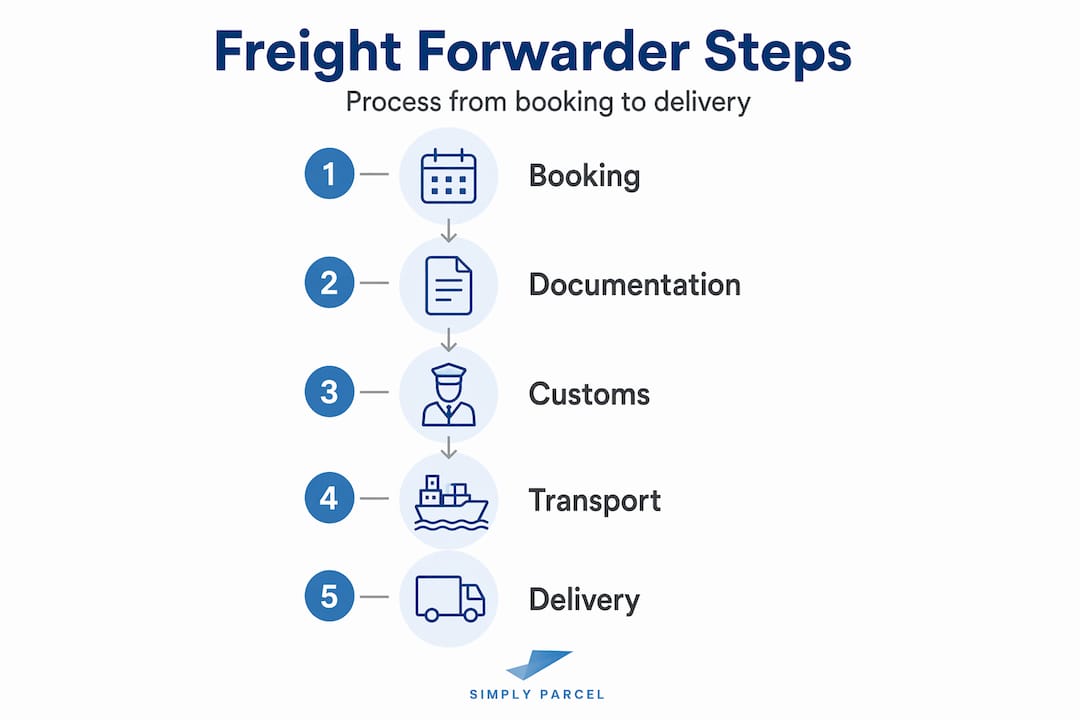
Their core functions span the entire shipment lifecycle:
- Multimodal transport coordination: Forwarders book and manage sea, air, rail, and road legs of a shipment, selecting the best combination based on your timeline and budget.
- Carrier negotiations: Because forwarders move large volumes across many clients, they negotiate rates with carriers that individual shippers rarely access.
- Freight consolidation: If your cargo does not fill a container, forwarders combine it with other shippers' goods into a Less than Container Load (LCL) shipment, reducing your cost significantly.
- Shipment documentation: They prepare and review the bill of lading, commercial invoice, packing list, certificate of origin, and other required trade documents. For ocean shipments, the bill of lading is a negotiable instrument that requires precise handling to avoid cargo release delays.
- Single point of contact: Rather than you managing a carrier, a customs broker, a warehousing provider, and a local delivery agent separately, your forwarder coordinates all of them. You get one person to call.
Pro Tip: When requesting quotes from freight forwarders, ask specifically what documentation services are included. Some forwarders quote transport only, while others bundle customs preparation and compliance advisory. Knowing this upfront prevents surprise fees at the border.
The functions of freight forwarders described above apply whether you are shipping a single pallet or managing recurring bulk freight. The scope scales to your needs, which is what makes this model work for both small businesses and large exporters.
Customs compliance and cross-border documentation
This is where the importance of freight forwarding becomes clearest, and where misunderstandings are most expensive. Customs errors do not just slow your shipment. They can trigger penalties or seizures, and the consequences fall on you, not your forwarder.
Here is what freight forwarders actually handle on the customs side:
- Export declarations and import entries: Forwarders prepare the detailed paperwork required by customs authorities in the origin and destination countries.
- Coordination with licensed customs brokers: For complex regulatory environments, forwarders work alongside or engage licensed customs brokers who hold authority to file directly with customs agencies.
- Security filings: In the United States, for example, ocean imports require an Importer Security Filing (ISF), and exports require Electronic Export Information (EEI) filings through the Automated Export System (AES). Forwarders manage these submissions on your behalf.
- Compliance programs: Experienced forwarders also advise on trade programs like C-TPAT, which can reduce inspection rates and accelerate customs clearance for qualifying businesses.
- Problem resolution: When customs holds occur, forwarders coordinate with brokers and authorities to resolve the issue quickly.
The critical distinction every shipper must understand: freight forwarders assist with compliance as a risk and efficiency function, but they do not absorb your legal obligations. You remain responsible for the accuracy of what you declare.
"Late or inaccurate data submission is one of the most common causes of customs delays. Freight forwarders coordinate detailed document handoffs across multiple specialists to prevent holds and rework, but the shipper must provide accurate information to begin with." CTP, Inc.
If you are new to international shipping documentation, reviewing the required shipping documents for your specific trade lanes before engaging a forwarder will make that first conversation far more productive.
Operational advantages for supply chain efficiency
Beyond documentation, freight forwarding services deliver practical benefits that directly affect your bottom line and your ability to keep promises to customers.
Here is how freight forwarders strengthen your supply chain:
-
Reduced administrative burden. Managing a cross-border shipment independently means coordinating with carriers, tracking multiple service providers, and monitoring compliance deadlines across time zones. A forwarder consolidates all of that under one contract and one point of accountability.
-
Proactive problem solving. When a vessel is delayed or a customs query arises, your forwarder identifies the issue early and proposes alternatives. This means proactive shipment tracking and contingency planning can protect your production schedules and allow you to notify customers before a delay becomes a crisis.
-
Route and mode optimization. Forwarders analyze cost, transit time, and sustainability factors to recommend the best routing. That might mean switching from air to sea for non-urgent cargo, saving significantly on freight costs. Or it might mean a fast-track air option when a deadline is non-negotiable.
-
Risk mitigation. Experienced forwarders maintain networks of backup carriers and alternative routing options. This matters enormously when port congestion, weather events, or geopolitical disruptions close off primary routes.
-
Visibility and communication. Real-time tracking and regular status updates keep you informed. When you are managing customer expectations or production timelines, knowing where your cargo is at any given moment is not optional. It is operational.
Pro Tip: Ask your freight forwarder for a sample disruption response protocol before you commit. How they describe their process for handling a vessel delay or customs hold tells you a lot about their operational maturity.
For a full picture of how these advantages apply to your specific shipping needs, the international shipping step-by-step guide at the Simplyparcel blog walks through each stage in practical terms.
U.S. export regulations and EEI filing requirements
The United States provides a useful case study for understanding the regulatory depth involved in freight forwarding. Under the Foreign Trade Regulations (FTR), any export shipment valued above $2,500 (or requiring an export license) requires an Electronic Export Information (EEI) filing through the Automated Export System (AES).

Freight forwarders or authorized agents may file EEI on behalf of the U.S. Principal Party in Interest (USPPI), but the filing must be accurate, complete, and submitted within precise timeframes. The table below outlines the key components of this responsibility:
| EEI Filing Element | Freight Forwarder Responsibility |
|---|---|
| Authorization | Must have written authorization from the exporter to file as agent |
| Timing | Sea exports: 24 hours before loading. Air exports: 2 hours before departure |
| Data accuracy | Must reflect correct Schedule B commodity codes, values, and quantities |
| Internal Tracking Number (ITN) | Must be obtained and provided to the carrier before export |
| Compliance evidence | Must maintain records of filings for five years post-export |
Assuming your forwarder filed correctly without verifying creates real compliance gaps. The FTR places responsibility on both the exporter and the authorized agent. If your forwarder makes an error and cannot demonstrate proper authorization and documentation, both parties face exposure. Clear written agreements and regular compliance reviews are not optional extras for high-volume exporters.
Selecting and working with a freight forwarder
Choosing a freight forwarding partner is a business decision that affects your cost, compliance standing, and customer experience. The wrong choice shows up in missed deadlines and unexpected fees. The right one becomes a genuine operational asset.
Key criteria to evaluate when selecting a forwarder:
- Specialist expertise: A forwarder with deep experience in your specific trade lane or product category (hazardous goods, perishables, oversized freight) will anticipate problems that generalists miss.
- Technology and visibility tools: Does the forwarder offer a tracking portal or system integration with your inventory management? Real-time visibility is now a baseline expectation, not a premium feature.
- Network reach: Strong carrier relationships in your destination markets mean better rates and more flexibility when disruptions occur.
- Transparent fee structures: Good forwarders itemize their fees clearly, including origin charges, destination charges, documentation fees, and customs disbursements. Vague all-in quotes often hide costs that surface at delivery.
- Communication standards: Agree on reporting frequency and escalation contacts before the first shipment moves. Silence during transit is not a good sign.
Common pitfalls to avoid: giving a forwarder incomplete product information, assuming customs duties are included in quoted rates, and failing to confirm which party is responsible for cargo insurance. These three gaps account for a significant share of shipping disputes.
For practical context on managing costs and complexity, the freight solutions for Singapore overview from Simplyparcel offers useful benchmarks for regional shippers.
My take on freight forwarders as strategic partners
I've spent years watching businesses treat freight forwarders as a commodity. They send out a mass quote request, pick the lowest number, and then wonder why their shipments get held at customs or why rates spike with no warning. That approach misses what freight forwarders actually offer.
What I've found is that the businesses getting the most value from their forwarders treat them like extended members of their operations team. They share forecasts, flag new trade lanes early, and ask for advice before committing to supplier contracts in new markets. That relationship changes what the forwarder can do for you.
Digital transformation has made this even more pronounced. Regulatory environments are more complex now than they were five years ago, and that complexity is increasing. The international shipping challenges that trip up businesses consistently, such as incorrect commodity classifications, missed filing windows, and undeclared restrictions, are all preventable with a well-engaged forwarder. The businesses I've seen navigate supply chain disruptions well almost always had a freight forwarding partner they had built real trust with before the crisis hit.
The unconventional truth is this: your freight forwarder's value is not measured at the point of booking. It is measured the moment something goes wrong.
— Simply
Ship smarter with Simplyparcel
Understanding how freight forwarders work is the first step. Taking action is the next one. Simplyparcel gives businesses and individual shippers in Singapore direct access to competitive international shipping rates, with free pickup, real-time tracking, and clear documentation support built into the platform. Whether you are shipping a single parcel or managing ongoing freight, you can compare and book courier rates in minutes, without the back-and-forth of traditional freight arrangements. For businesses that need detailed freight options tailored to volume and destination, the international shipping quote page lets you get specific figures fast. Simplyparcel removes the friction from cross-border shipping so you can focus on your business.
FAQ
What does a freight forwarder actually do?
A freight forwarder coordinates all stages of an international shipment, including carrier booking, documentation preparation, customs filings, and delivery to the final destination. They act as a single point of contact for the shipper rather than owning any transport assets themselves.
Are freight forwarders responsible for customs compliance?
Freight forwarders assist with customs documentation and filings, but legal compliance responsibility remains with the importer or exporter. Errors in declarations are ultimately the shipper's liability.
What is an EEI filing and why does it matter?
An Electronic Export Information (EEI) filing is required for most U.S. exports valued above $2,500 and must be submitted through the Automated Export System. Freight forwarders can file on the exporter's behalf but require written authorization and must meet strict timing and accuracy standards under the Foreign Trade Regulations.
How do I choose the right freight forwarder?
Prioritize forwarders with verified expertise in your trade lane, transparent fee breakdowns, real-time tracking tools, and strong carrier networks. Always confirm in writing who handles customs filings and whether cargo insurance is included.
Can small businesses benefit from freight forwarding services?
Yes. Small businesses benefit significantly from freight consolidation, which reduces cost per shipment, and from the compliance support that prevents costly customs errors. The benefits of using freight forwarders apply across shipment sizes, not just large-volume exporters.