The bulk freight shipping process is defined as the coordinated movement of large, unpackaged quantities of solid or liquid goods using specialized carriers, equipment, and logistics planning. Unlike standard parcel or container shipping, bulk freight moves commodities like grain, coal, crude oil, and chemicals without individual packaging. Understanding this process gives businesses direct control over cost, compliance, and delivery reliability across international supply chains. For logistics professionals managing high-volume shipments, knowing each phase of the freight transportation process is the difference between on-time delivery and costly operational disruption.
What is the bulk freight shipping process?
Bulk freight shipping is the transport of raw or semi-processed goods in large, loose quantities rather than in boxes, pallets, or containers. The two primary categories are dry bulk, which covers commodities like grain, cement, and coal, and liquid bulk, which includes crude oil, edible oils, and chemicals. Liquid bulk cargo accounts for approximately 30% of global seaborne trade by volume. That figure reflects how central liquid bulk logistics is to global manufacturing and food supply chains.
Specialized equipment defines this shipping mode. Dry bulk moves via hopper vessels, bulk carriers, or pneumatic trailers on land. Liquid bulk requires tanker ships, ISO tank containers, or stainless steel road tankers. The logistics coordination required, covering equipment availability, port scheduling, and regulatory compliance, makes bulk freight fundamentally different from standard freight forwarding. For a broader overview of terminology and cargo categories, the bulk shipping overview from Simplyparcel provides a clear starting reference.

Key preparations before initiating a bulk shipment
Preparation is where most bulk freight operations succeed or fail. Before a single booking is made, you need to assess your cargo type, total weight, and volume with precision. Accurate shipment weight is critical to legal compliance, and even small discrepancies in load estimates cause delays and non-compliance issues that trigger rebooking fees. This is not a step to estimate loosely.
The following preparation requirements apply to nearly every bulk shipment:
- Cargo classification: Identify whether your cargo is dry bulk, liquid bulk, food-grade, or hazardous. Each classification carries distinct handling, labeling, and documentation requirements.
- Weight and volume verification: Confirm gross weight against the legal maximum for the carrier's vehicle class. Overloading causes immediate stoppages at weigh stations.
- Special handling review: Food-grade liquids require tankers with documented cleaning histories. Hazardous materials require Material Safety Data Sheets (MSDS) and compliance with IMDG or DOT regulations.
- Facility readiness: Confirm that your loading site and the receiving site have compatible infrastructure. This includes top-loading access hatches, silo connections, pump systems, or gravity dump platforms.
| Preparation Area | Requirement | Risk if Skipped |
|---|---|---|
| Cargo classification | Identify dry, liquid, food-grade, or hazmat | Wrong carrier assigned, shipment refused |
| Weight verification | Confirm against carrier's legal maximum | Stoppage, fines, rebooking costs |
| Documentation | Bill of lading, MSDS, sanitation certificates | Customs delays, carrier rejection |
| Facility compatibility | Confirm loading and unloading equipment match | Delivery rejection, demurrage fees |
Documentation accuracy is equally non-negotiable. Your bill of lading, weight certificates, and any sanitation or compliance certificates must be prepared before the carrier arrives. Missing paperwork at the point of loading causes scheduling failures that ripple through the entire transit chain.
Pro Tip: Before confirming a booking, call the receiving facility directly and verify their unloading equipment type, hours of operation, and any appointment requirements. This single step prevents the most common cause of bulk freight delivery rejection.
How do you choose the right bulk shipping methods and equipment?
Selecting the right bulk shipping method depends on cargo characteristics, transit distance, and cost tolerance. The table below compares the primary bulk shipping methods used in international freight:
| Method | Cargo Type | Typical Equipment | Key Consideration |
|---|---|---|---|
| Dry bulk vessel | Grain, coal, ore | Bulk carrier, Handysize, Capesize | Port draft and crane compatibility |
| Liquid bulk tanker | Crude oil, chemicals | VLCC, chemical tanker, product tanker | Cargo compatibility and tank lining |
| Pneumatic trailer | Cement, flour, plastic pellets | Pneumatic bulk trailer | Silo connection at destination |
| Hopper trailer | Aggregate, sand, grain | End-dump, side-dump hopper | Road weight limits and dump clearance |
| ISO tank container | Liquid chemicals, food-grade liquids | ISO tank on flatbed or vessel | Certification and cleaning documentation |
Carrier matching is not simply about finding available capacity. Carrier equipment certification must match the shipment's sanitation and commodity requirements to prevent compliance failures and delays. A tanker previously used for industrial chemicals cannot carry food-grade edible oil without a documented decontamination wash and certification. Skipping this verification step leads to shipment refusals at the loading dock.
Cost is directly tied to market conditions. Bulk shipping rates operate on charter contracts rather than fixed schedules, and freight rates are volatile, tied to commodity demand indices like the Baltic Dry Index. When iron ore demand spikes in Asia, dry bulk rates rise globally within days. This means your freight budget must account for rate fluctuation, particularly on longer lead-time shipments.
Pro Tip: When booking bulk ocean freight, request a rate lock or contract clause tied to a specific Baltic Dry Index range. This protects your cost model when commodity cycles shift mid-shipment.
For a detailed breakdown of the cost factors that affect international bulk rates, the analysis at ForwarderOne on freight costs covers the key variables clearly.
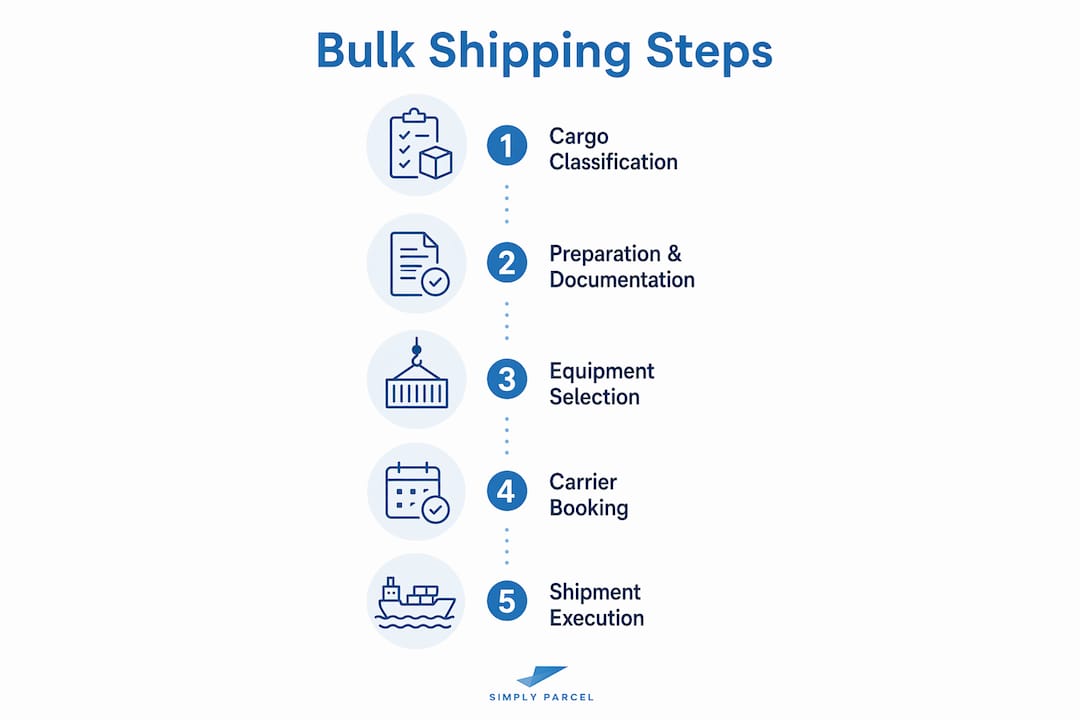
Step-by-step execution of the bulk freight shipping process
Executing a bulk shipment follows a defined sequence. Deviating from this order creates compounding problems at each subsequent stage.
- Request quotes and match carriers. Submit your cargo specifications, including type, weight, volume, origin, and destination, to multiple carriers or a freight broker. Evaluate quotes against equipment compatibility, not just price.
- Confirm carrier certifications. Before signing a contract, verify that the carrier holds the required sanitation certifications, hazmat endorsements, or food-grade compliance documents for your specific cargo.
- Inspect the equipment before loading. For liquid bulk, inspect the tanker's interior for residue, odors, or contamination. For dry bulk, check hopper seals and pneumatic connections. Document the pre-load condition.
- Execute loading using the correct method. Dry bulk loads via conveyor belt, pneumatic blower, or gravity dump. Liquid bulk loads through top-fill hatches or bottom-fill connections with pump systems. Match the loading method to the cargo's flow characteristics.
- Seal and document the shipment. Apply tamper-evident seals, record the final loaded weight, and attach all required documentation to the shipment. The driver or vessel captain must receive a complete document package before departure.
- Monitor transit in real time. GPS and TMS platforms enable better shipment management and proactive issue handling during transit. Use your transport management system to track location, temperature (if applicable), and estimated arrival.
- Coordinate unloading at the destination. Confirm the receiving facility's appointment window 24 to 48 hours before arrival. Verify that unloading equipment is operational and that personnel are scheduled. Equipment and scheduling coordination is critical to maintaining shipment timelines and avoiding demurrage charges.
- Complete delivery documentation. Obtain a signed proof of delivery, record the unloaded weight, and file all certificates with your logistics records for compliance and audit purposes.
The role of a freight forwarder becomes particularly valuable at steps 1 through 3. Understanding how freight forwarders coordinate carrier matching and documentation can save significant time on complex international bulk moves.
Common challenges and cost management in bulk freight shipping
The most frequent operational failure in bulk freight is a mismatch between the receiving site's unloading infrastructure and the carrier's equipment. Last-mile infrastructure mismatches at destinations cause delays and extra fees that are entirely avoidable with upfront verification. A pneumatic trailer arriving at a facility without a compatible silo connection cannot unload. The carrier charges waiting time, and the shipper pays rebooking costs.
Other common challenges include:
- Inaccurate weight estimates: Underestimating cargo weight leads to overloaded vehicles, which face legal stoppages and fines at weigh stations.
- Sanitation non-compliance: Food-grade and kosher certifications require documented cleaning under supervision before bulk liquid loading. Carriers without current certificates face rejection at the loading dock.
- Rate volatility: Bulk freight pricing fluctuates with global commodity cycles. A shipment quoted in January may cost 20 to 30 percent more by March if demand spikes in key markets.
- Documentation gaps: Missing or incorrect paperwork at customs causes holds that can last days, particularly for hazardous or food-grade cargo crossing multiple jurisdictions.
Businesses that plan bulk freight shipments at least three to four weeks in advance consistently secure better rates and more compatible carrier matches than those booking on short notice.
Cost management in bulk shipping requires a combination of early planning, accurate cargo data, and carrier relationships. Working with carriers who specialize in your commodity type reduces the risk of equipment mismatches and compliance failures. For practical guidance on managing international shipping challenges, Simplyparcel's resource library covers the most common pain points with direct solutions.
Pro Tip: Before finalizing any bulk freight booking, send your receiving facility's equipment specifications directly to the carrier and request written confirmation of compatibility. This creates a paper trail and eliminates the most expensive single point of failure in bulk logistics.
Best practices for optimizing bulk freight shipping internationally
Optimizing the bulk freight shipping process internationally requires consistency across four areas: partner selection, visibility, compliance, and strategy review.
Partner selection is the foundation. Choose carriers and freight forwarders with documented experience in your specific commodity. A carrier who regularly moves edible oils understands tanker cleaning protocols, certification timelines, and port requirements in ways that a generalist carrier does not.
Real-time visibility reduces reactive decision-making. TMS platforms and GPS tracking give you the data to act before a delay becomes a missed delivery window. Proactive communication with your carrier and receiving facility throughout transit prevents surprises at the destination.
Regulatory compliance must be treated as a fixed cost, not a variable one. Sanitation certificates, hazmat endorsements, and customs documentation are non-negotiable. Documented kosher or chemical decontamination washes may be required depending on product type, with certificates traveling with shipments for verification. Build certification timelines into your booking schedule.
Strategy review keeps your freight program aligned with market conditions. Review carrier contracts and rate benchmarks quarterly. Track the Baltic Dry Index and relevant commodity freight indices to anticipate cost shifts before they affect your budget.
| Optimization Area | Recommended Practice |
|---|---|
| Carrier selection | Prioritize commodity-specific experience and certification history |
| Shipment visibility | Use TMS with GPS integration for real-time tracking |
| Compliance management | Maintain a documentation checklist per cargo type |
| Cost control | Book early, benchmark rates against market indices quarterly |
| Facility coordination | Confirm unloading compatibility before every booking |
Key takeaways
The bulk freight shipping process succeeds when cargo classification, equipment matching, facility compatibility, and documentation accuracy are treated as fixed requirements rather than flexible guidelines.
| Point | Details |
|---|---|
| Define cargo type first | Dry bulk and liquid bulk require entirely different equipment, certifications, and loading methods. |
| Verify facility compatibility | Confirm unloading infrastructure at the destination before booking to avoid rejection fees. |
| Match carrier certifications | Food-grade and hazmat shipments require documented sanitation certificates before loading. |
| Plan for rate volatility | Bulk freight rates follow commodity demand cycles; book early and benchmark against market indices. |
| Use real-time tracking | TMS and GPS platforms reduce delays by enabling proactive communication throughout transit. |
What experience in bulk freight has taught me
After working with businesses across Singapore and the broader Asia-Pacific region on international bulk shipments, the pattern I see most often is not a failure of knowledge. It is a failure of verification. Shippers know they need the right equipment. They know documentation matters. But under time pressure, they skip the confirmation call to the receiving facility, or they accept a carrier's verbal assurance on sanitation certification without requesting the actual document.
The cost of that shortcut is always higher than the time it would have taken to verify. I have seen shipments turned away at destination facilities because a pneumatic trailer arrived at a site with no silo connection. I have seen food-grade liquid shipments rejected because the tanker's cleaning certificate was three days past its validity window. These are not edge cases. They are the standard failure modes in bulk freight, and they are entirely preventable.
The other lesson that consistently proves true: the cheapest carrier quote is rarely the lowest total cost. Carriers with commodity-specific experience charge more upfront and deliver fewer problems. Businesses that prioritize rate over fit spend more on rebooking, demurrage, and compliance remediation than they saved on the original quote. Build your carrier relationships before you need them urgently, and treat documentation as a logistics asset rather than administrative overhead.
— Simply
Ship bulk freight with confidence through Simplyparcel
Simplyparcel connects businesses in Singapore and across Asia-Pacific with specialized carriers equipped for international bulk freight shipments. Whether you are moving dry commodities or liquid cargo, Simplyparcel's platform gives you access to instant freight quotes and carrier options matched to your cargo type and destination. Real-time shipment tracking keeps you informed at every stage of transit, and the support team is available to help you navigate documentation requirements, carrier certifications, and scheduling coordination. For businesses looking to build a more reliable and cost-effective international freight strategy, Simplyparcel provides the tools and partnerships to make it work.
FAQ
What is bulk freight shipping?
Bulk freight shipping is the transport of large quantities of unpackaged goods, either dry commodities like grain and coal or liquid commodities like crude oil and chemicals, using specialized carriers and equipment. It differs from standard freight in that cargo is loaded directly into vessel holds, tankers, or bulk trailers rather than individual containers or pallets.
What are the main bulk shipping methods?
The primary bulk shipping methods are dry bulk vessels for solid commodities, liquid tankers for oils and chemicals, pneumatic trailers for powders and pellets, hopper trailers for aggregates and grain, and ISO tank containers for liquid cargo requiring intermodal transport.
How is the cost of bulk shipping determined?
Bulk freight rates are set through charter contracts and fluctuate with commodity demand indices like the Baltic Dry Index. Factors including cargo type, vessel availability, port fees, and transit distance all affect the final cost.
Why do bulk shipments get rejected at the destination?
The most common cause of delivery rejection is a mismatch between the carrier's unloading equipment and the receiving facility's infrastructure. Missing or expired sanitation certificates for food-grade or hazmat cargo also trigger rejection at the loading or unloading point.
How can businesses reduce delays in bulk freight shipping?
Businesses reduce delays by verifying facility compatibility before booking, maintaining accurate cargo weight documentation, confirming carrier certifications in advance, and using TMS platforms with real-time GPS tracking to monitor shipments throughout transit.