
Automated booking is the fastest, most reliable way to ship parcels internationally from Singapore. Platforms like Simplyparcel give you instant quotes, automatic label and customs-document generation, and real-time tracking, all without waiting for a business-hours callback. Studies show that businesses adopting self-service booking report roughly 37% more appointments, with about 40% of bookings occurring outside business hours. For Singapore shippers sending parcels to the US or other major markets, that means your shipment can be booked, labeled, and scheduled for pickup at 11 PM on a Sunday.
Here is what you get immediately:
- Instant price comparisons across multiple carriers (UPS, FedEx, DHL, USPS)
- Automatic shipping label and customs document generation
- Pickup scheduling with proof of pickup
- Real-time tracking from handoff to delivery
- Fewer data-entry errors and no missed transit selections
Table of Contents
- Why choose automated booking for international parcels?
- How does the automated booking workflow actually work?
- Who benefits most from automated booking?
- How do you choose the right automated booking platform?
- When automation is not enough
- What does switching to automated booking actually cost?
- Simplyparcel makes automated booking practical for Singapore shippers
- Key Takeaways
- A note from Simplyparcel
- Further reading and useful sources
Why choose automated booking for international parcels?
The core value is time and accuracy. Manual booking means typing addresses, selecting transit speeds, and filling customs forms by hand. Each step is a chance for error. Automation removes those manual steps, replacing hand-typed labels and guesswork with system-generated documents that pull directly from the data you entered at checkout.
24/7 availability is the other major win. You can get a live quote and complete a booking at any hour, without waiting for a courier's office to open. For e-commerce sellers managing orders across time zones, that availability is not a convenience. It is a competitive requirement.
Cost transparency is equally important. Automated platforms display carrier base rates, fuel surcharges, and platform markups in a single quote view. You see the true landed cost before you commit, which prevents surprise charges at pickup or delivery.
Scalability for small businesses is often underestimated. Automation is not an enterprise-only tool. Solo sellers and small SMEs use it to present professionally, capture structured shipment data, and grow volume without hiring additional admin staff.
Statistic: Self-service booking cuts average manual scheduling time for routine shipments to about 8.1 minutes, reducing administrative burden.
Pro Tip: Automated booking systems are also data-collection engines. Every booking captures parcel dimensions, commodity descriptions, and declared values in structured form. That data speeds up customs clearance and gives you an audit trail for every shipment.
How does the automated booking workflow actually work?
The process runs in a straight line from quote to delivery, with automation handling the steps that used to require phone calls and manual paperwork.
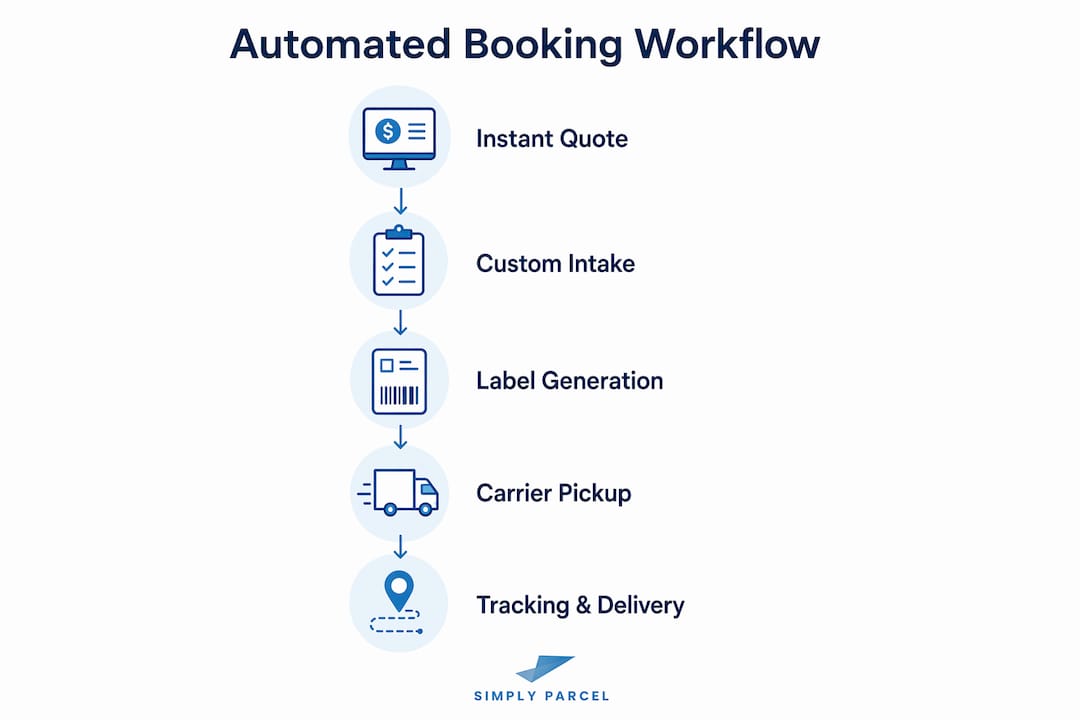
| Workflow Step | Automation Feature |
|---|---|
| Instant quote | Live carrier rate APIs (UPS, FedEx, DHL, USPS) |
| Service selection | Filtered options by speed and price |
| Payment | Integrated online payment processing |
| Label generation | Automatic label creation from booking data |
| Customs documents | Commercial invoice and HS code generation |
| Pickup scheduling | Calendar sync and free pickup booking |
| Tracking | Real-time status updates via courier API |
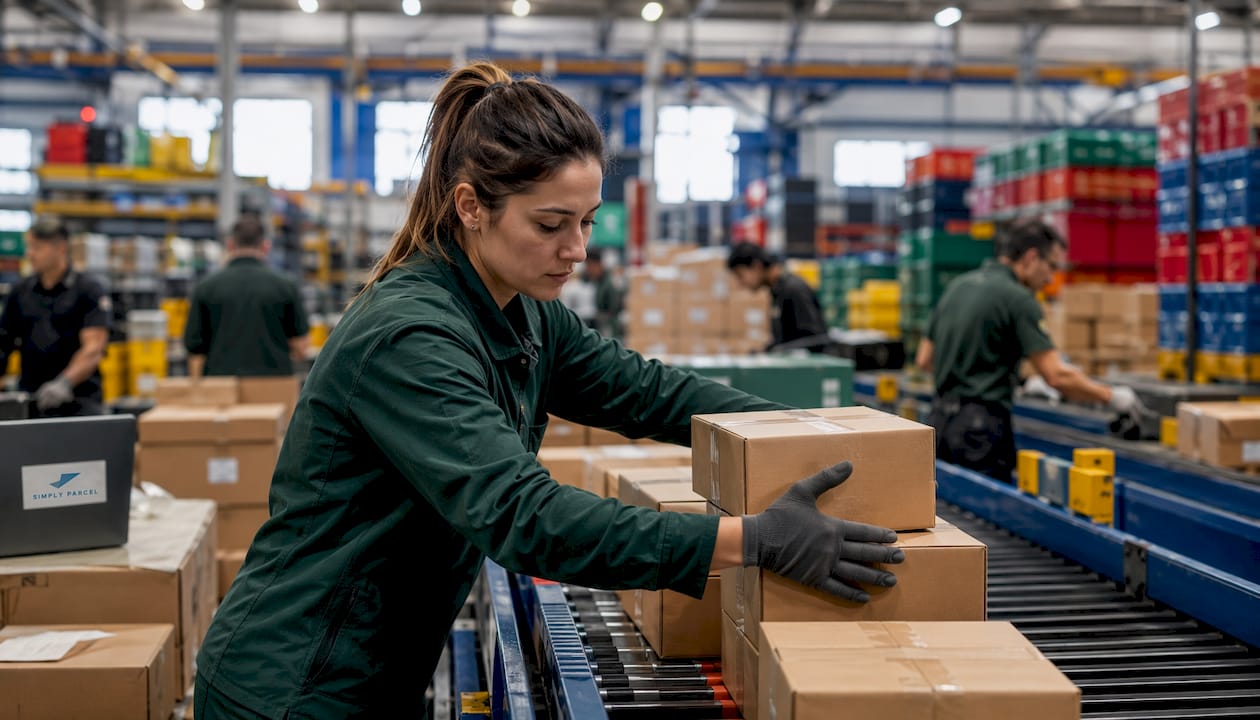
Custom intake forms capture parcel dimensions, commodity details, and customs information at the point of booking. That frontloads the customs work, so documents are ready before the courier arrives. A centralized automated system also eliminates double-booking risk when you manage shipments across multiple channels.
Where human review still helps: restricted items, oversized freight, and shipments requiring special permits. Automation handles the volume. Your team handles the exceptions. That is the right division of labor, and it is how operational teams move from reactive to proactive.
Who benefits most from automated booking?
Automated booking fits a wide range of Singapore shippers. Here are the scenarios where it delivers the clearest return:
- E-commerce sellers shipping dozens of parcels per week gain faster label batching, fewer address errors, and a single dashboard for all shipment statuses. Before automation: printing labels one by one, manually filling customs forms. After: batch-generate labels and documents in minutes.
- Occasional individual shippers (students, expats, personal-effects senders) get a simple, guided form, instant confirmation, and proof of pickup without needing to call anyone.
- SMEs with recurring US shipments benefit from predictable pricing, audit trails, and the ability to compare carriers on every booking rather than defaulting to one.
- Small cross-border wholesalers use multi-carrier comparison and centralized tracking to manage cost and visibility across a higher volume of outbound orders.
The e-commerce shipping workflow for sellers integrating automated booking typically cuts per-shipment admin time to an average of 8.1 minutes, freeing hours each week for order fulfillment and customer service.
How do you choose the right automated booking platform?
Use this checklist before committing to any platform.
- Live rate APIs — Does the platform pull real-time rates from UPS, FedEx, DHL, and USPS? Static rate tables go stale fast.
- Automatic label and customs-document generation — Labels and commercial invoices should generate instantly from booking data, with no manual re-entry.
- Pickup scheduling — Can you schedule a free pickup directly in the platform? Confirm proof-of-pickup is provided.
- Real-time tracking — Shipment status should update via courier API, not manual refresh. Parcel tracking reduces customer support load significantly.
- Payment processing — Secure, integrated payment at checkout. No invoice-later arrangements that delay label generation.
- ERP and inventory integration — For sellers, check for CSV import/export, marketplace connectors, and webhook support.
- Transparent pricing — Platform markup should be visible in the quote, not buried in a post-booking summary.
- Customer support — Confirm support channels (chat, phone, email) and escalation paths for customs issues.
- Data security — Ask where shipment data is stored, who has access, and whether the platform complies with relevant data-protection standards.
Red flags: opaque pricing, no customs document support, no proof-of-pickup option, or tracking that relies on manual status updates.
Pro Tip: Run a dry-run shipment with a low-value parcel before committing to a platform for regular use. Check that labels generate correctly, customs documents populate accurately, and the pickup confirmation arrives promptly. A single test booking reveals more than any feature list.
Reducing shipping costs also depends on choosing a platform that shows true landed cost, including surcharges, before you pay.
When automation is not enough
Automated booking handles the majority of international parcel shipments well. A few situations still require human judgment or specialist support.
- Oversize and heavy freight — Most booking platforms set weight and dimension limits. Shipments beyond those thresholds need a freight forwarder, not a parcel aggregator.
- Restricted and controlled goods — Lithium batteries, certain electronics, food items, and other regulated goods require permit handling and carrier-specific approval. Automation passes through what you enter; it cannot verify permits.
- Complex customs cases — Importers with special licensing, unusual HS codes, or commercial invoices requiring negotiation need a customs broker. Automated document generation covers standard cases, not exceptions.
- Data quality risks — If a customer enters an incorrect address or wrong commodity description, the system generates a label with that error. Well-configured intake forms with validation rules reduce this risk, but they do not eliminate it entirely.
Pro Tip: For shipments involving restricted goods, review the platform's prohibited-items policy before booking. Simplyparcel provides guidance on restricted goods and customs requirements, but for controlled items, confirm carrier acceptance directly before scheduling pickup.
The customs documentation guide covers HS codes and common clearance pitfalls in detail. For a hybrid approach, industry guidance recommends letting automation handle volume while staff manage exceptions and regulatory complexities.
What does switching to automated booking actually cost?
Onboarding timeline varies by integration depth. A basic plug-in booking flow (no ERP connection) typically goes live within a day or two. Deeper integrations with inventory or order-management systems take one to three weeks depending on API complexity.
Typical cost components in an automated international parcel booking:
- Carrier base rate (varies by weight, dimensions, destination, and service speed)
- Fuel and peak surcharges (carrier-applied, shown in the platform quote)
- Optional shipment protection coverage
- Platform service markup (the aggregator's fee, visible in the quote)
- Payment processing fee (usually a small percentage of the transaction)
Illustrative quote breakdown:
| Cost Component | Who Charges It |
|---|---|
| Carrier base rate | UPS / FedEx / DHL / USPS |
| Fuel surcharge | Carrier |
| Shipment protection | Platform or insurer |
| Platform service markup | Booking platform |
| Payment processing | Payment gateway |
Operational ROI questions to ask internally:
- How quickly will labels be generated after payment? (Should be instant.)
- How long does pickup scheduling take? (Same-day or next-day for most platforms.)
- How much admin time per shipment does the current manual process take? (Benchmark against the 8.1-minute manual average.)
- What is the cost of a single mislabeled shipment in rework and delay?
Avoiding shipping delays is directly tied to how well your booking platform validates data and generates accurate documents at checkout.
Simplyparcel makes automated booking practical for Singapore shippers
Skip the back-and-forth with courier offices. Simplyparcel gives you instant international shipping quotes across UPS, FedEx, DHL, and USPS, with automatic label and customs-document generation built into every booking. Free pickup scheduling in Singapore is included, and real-time tracking keeps you and your recipients informed from handoff to delivery.
Whether you ship priority, connect-plus, or economy, pricing is transparent before you pay. No hidden markups revealed after checkout. For e-commerce sellers and SMEs, the platform captures all shipment data at booking, so customs documents are ready when the courier arrives.
The practical next step: run one test shipment on Simplyparcel with a low-value parcel to verify the label generation, pickup confirmation, and tracking flow for your specific destination.
Key Takeaways
Automated booking reliably reduces errors, cuts per-shipment admin time, and gives Singapore shippers 24/7 access to live carrier rates, label generation, and customs documents.
| Point | Details |
|---|---|
| 24/7 quoting and booking | About 40% of bookings happen outside business hours — automation captures demand that manual processes miss. |
| Error reduction | Automatic label and customs-document generation removes the manual steps most likely to cause delays. |
| Small-business scalability | Automation is not enterprise-only; solo sellers and SMEs use it to operate professionally without extra admin staff. |
| Know the limits | Oversize freight, restricted goods, and complex customs cases still need human review or specialist support. |
| Simplyparcel | Offers instant multi-carrier quotes, free pickup scheduling, automatic label generation, and real-time tracking for international shipments from Singapore. |
A note from Simplyparcel
We built Simplyparcel because international shipping from Singapore should not require a phone call, a fax, or a wait until Monday morning. Our platform generates labels and customs documents automatically, schedules free pickups, and tracks every shipment in real time across our courier network. If you have been managing international bookings manually, one test shipment will show you exactly how much time you recover. We invite you to try it.
Further reading and useful sources
Simplyparcel guides (internal):
- Why Automate Shipping Labels: A Guide for Sellers
- Parcel Booking Workflow: A Step-by-Step Guide
- The Role of Customs in Shipping: 2026 Guide
- Common Shipping Mistakes to Avoid in 2026
- What Is Shipment Automation? A Guide for Business Owners
External research and partner resources:
- Self-Service Booking vs Manual Scheduling: Complete 2026 Guide — data on booking volume, time savings, and after-hours demand
- The Role of Automation in Travel: 2026 Guide — partner content on automation trends and 24/7 service models
- Manual Booking vs Travel Automation Software for Agencies — hybrid workflow recommendations and turnaround benchmarks