
Shipping costs are a direct drain on profit margins, and for small businesses and individuals, they represent one of the most controllable line items in your budget. Shipping and fulfillment expenses account for 10–20% of e-commerce revenue, but applying the right combination of packaging optimization, carrier strategy, and contract negotiation can cut those costs by 20–40%. Tools like ShipStation, Shopify Shipping, and Shippo make it easier than ever to compare rates across carriers and identify where your money is going. This guide breaks down exactly how to reduce shipping costs in 2026 using practical, proven methods that work for both individual senders and growing businesses.
How to reduce shipping costs through packaging optimization
Packaging is the fastest place to find savings, and most shippers overlook it entirely. The reason comes down to dimensional weight pricing, which carriers call DIM weight. DIM weight is calculated by multiplying a package's length, width, and height, then dividing by a carrier-specific divisor. Carriers charge whichever is greater: actual weight or DIM weight. If your box is too large for its contents, you pay for air.

Right-sizing your boxes to remove dead space reduces DIM weight-related shipping costs by 30–50%. That is not a marginal improvement. For a business shipping 200 parcels a month, that kind of reduction can translate to thousands of dollars saved annually without changing a single carrier contract.
Here is how to run a practical packaging audit:
- List your top 10 SKUs by shipment volume. These are your highest-leverage targets.
- Measure actual product dimensions and compare them to the box sizes currently used.
- Calculate DIM weight for each using your carrier's divisor (typically 139 for UPS and FedEx domestic).
- Identify gaps where actual weight is far below DIM weight. Those gaps are costing you money.
- Standardize box sizes to 3–5 options that fit your product range tightly.
For soft goods like apparel, accessories, or non-fragile items, switching to poly mailers is one of the most effective cost-saving shipping tips available. Poly mailers reduce costs by 50–66% for eligible products by eliminating DIM weight charges entirely, since they conform to the product shape.
Pro Tip: Run your top SKUs through a free DIM weight calculator before your next carrier invoice cycle. If your DIM weight consistently exceeds actual weight by more than 20%, a packaging redesign will pay for itself within two to three shipment cycles.
| Packaging type | Best for | DIM weight impact |
|---|---|---|
| Standard cardboard box | Fragile or rigid items | High if oversized |
| Poly mailer | Apparel, soft goods | Eliminated |
| Padded envelope | Documents, small electronics | Low |
| Custom-fit box | High-volume SKUs | Minimized |
What carrier strategies effectively reduce shipping costs?
No single carrier is cheapest for every shipment. Multi-carrier shipping is the practice of routing different parcels through different carriers based on weight, destination zone, and service level. Businesses that rely on a single carrier leave significant savings on the table because no carrier wins on price across every route and weight class.
Regional carriers offer substantial discounts within their service zones and should be integrated into any multi-carrier strategy. For example, a carrier that specializes in the Southeast U.S. will often beat national carriers on both price and transit time within that region. You can learn more about how this works in practice through this multi-carrier shipping guide.
When negotiating with carriers, most shippers focus only on base rates. That is a mistake. Carrier contract negotiations should address base rates, fuel surcharges, accessorial fees, and DIM weight thresholds together. Fuel surcharges alone can rise by more than 100% during peak periods, so capping them contractually protects your budget year-round.
Key negotiation targets beyond base rates:
- Fuel surcharge caps: Request a fixed or capped surcharge rate rather than a floating weekly index.
- DIM divisor adjustments: A higher divisor means lower DIM weight charges on bulky, lightweight parcels.
- Accessorial fee waivers: Residential delivery fees, address correction fees, and Saturday delivery surcharges add up fast.
- Minimum DIM weight thresholds: Negotiate a minimum package size below which DIM pricing does not apply.
Small volume shippers can still secure meaningful carrier discounts by demonstrating growth potential and consolidating volume on fewer carriers. Even a 2–3% discount on base rates can save thousands annually at moderate shipment volumes.
Pro Tip: Never compare carriers on base rates alone. Build a total landed cost spreadsheet that includes surcharges, DIM weight, and accessorial fees for your three most common shipment profiles. The carrier with the lowest headline rate is rarely the cheapest in practice.
Tools like ShipStation and EasyPost provide real-time rate comparison across multiple carriers, letting you apply routing logic automatically. This removes guesswork and makes cost-effective shipping methods accessible even to small operations without a dedicated logistics team.
How do shipping zones affect your costs, and how can you reduce them?
Shipping zones are the geographic bands carriers use to calculate delivery costs. Zone 1 is the closest to your origin point, and Zone 8 is the farthest. Every zone step up adds cost. A parcel shipped from Singapore to a Zone 7 or Zone 8 destination can cost two to three times more than the same parcel shipped to Zone 2. Understanding how shipping zones work is foundational to any serious cost-reduction strategy.
Shipping from a single coastal fulfillment center to customers on the opposite coast results in consistently high zone charges. The structural fix is to place inventory closer to your buyers. Third-party logistics providers (3PLs) with distributed warehouse networks make this accessible to small businesses that cannot afford multiple owned facilities.
Here is how to audit your zone exposure and act on it:
- Export 90 days of order data and map delivery addresses by region.
- Identify your top three destination clusters. These are where your buyers actually live.
- Calculate the average zone for your current shipments. If your average is Zone 5 or above, distributed fulfillment will save you money.
- Evaluate 3PL options with nodes in your top destination regions.
- Model the cost difference between your current setup and a two-node fulfillment model before committing.
Zone skipping is another tactic worth understanding. It involves consolidating parcels headed to a specific region and injecting them into the carrier network at a local hub, bypassing long-haul zone charges. Zone skipping works best when you have sufficient volume to a single region, typically 50 or more parcels per week to one destination zone.
| Shipping zone | Typical distance (U.S.) | Relative cost index |
|---|---|---|
| Zone 1–2 | Under 150 miles | Low |
| Zone 3–4 | 150–600 miles | Moderate |
| Zone 5–6 | 600–1,200 miles | High |
| Zone 7–8 | Over 1,200 miles | Very high |
How to audit your shipping invoices and sustain long-term savings
Reducing shipping costs is not a one-time project. It requires ongoing monitoring to protect the savings you have already negotiated and to catch new cost drivers before they compound. Monthly invoice audits and SKU-level cost analysis identify overcharges and billing errors that quietly erode your margins.
Carrier invoices are complex documents. Contractual discounts are frequently misapplied, and accessorial fees are added without clear justification. Logistics professionals recommend quarterly invoice reviews at minimum to protect negotiated savings. For high-volume shippers, monthly reviews are worth the time.
Follow these steps to build a sustainable audit process:
- Download your carrier invoice data in CSV format for the past 30 days.
- Sort by surcharge type to identify which fees are growing fastest.
- Compare applied discounts against your contract terms line by line.
- Flag shipments where DIM weight was charged but actual weight was close to DIM weight. These may indicate packaging opportunities.
- Track zone distribution month over month. A shift toward higher zones signals a change in your customer geography or fulfillment location.
- Document all discrepancies and submit formal claims to your carrier account manager within the dispute window, which is typically 30 days.
Pro Tip: Set a calendar reminder to review your carrier contract 90 days before its renewal date. Carriers rarely volunteer better terms at renewal. You need to initiate the conversation with data, specifically your shipment volume trends, zone distribution, and competitor rate benchmarks.
Shipping policy also plays a role in cost management. Free shipping thresholds set 10–20% above average order value increase order size by 10–15%, which helps offset the cost of subsidized shipping. Treating your shipping policy as a pricing decision, not just a logistics decision, keeps your margins intact while improving conversion.
Key takeaways
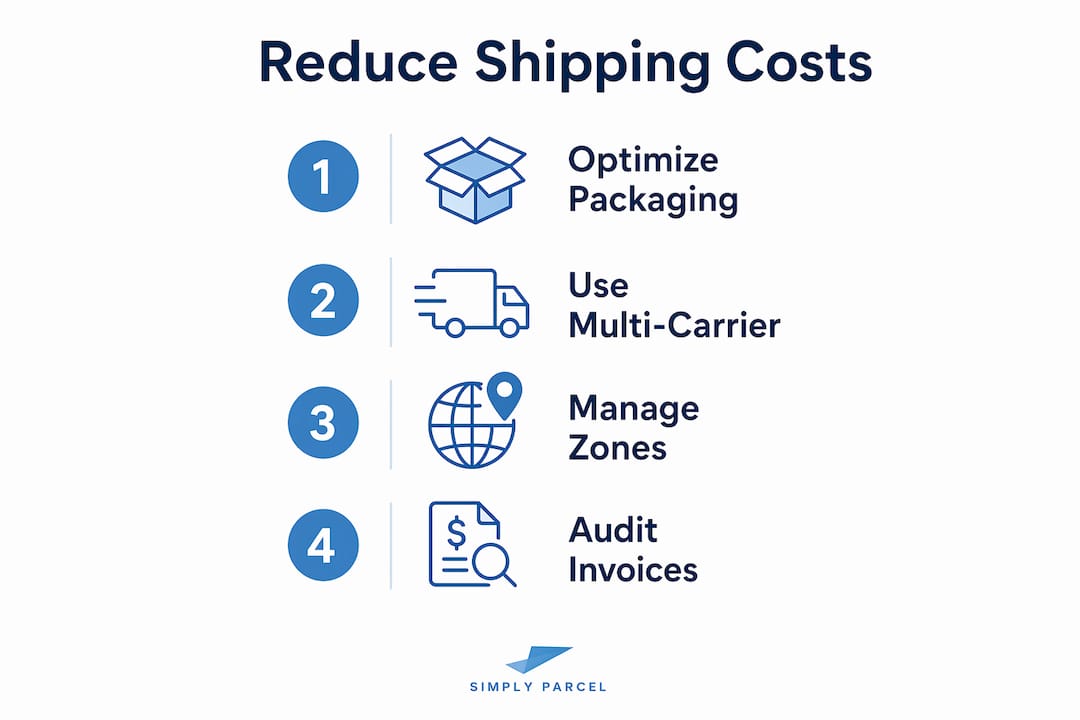
Reducing shipping costs requires a combination of packaging discipline, multi-carrier routing, zone management, and regular invoice auditing applied consistently over time.
| Point | Details |
|---|---|
| Optimize packaging first | Right-sizing boxes cuts DIM weight charges by 30–50%, the fastest single operational saving. |
| Negotiate beyond base rates | Address fuel surcharges, accessorial fees, and DIM divisors in every carrier contract. |
| Reduce zone exposure | Map your customer geography and use 3PLs or zone skipping to lower average shipping zones. |
| Audit invoices regularly | Monthly or quarterly reviews catch billing errors and protect discounts already negotiated. |
| Use multi-carrier routing | No single carrier wins on every route; tools like ShipStation and EasyPost automate the comparison. |
What most shippers get wrong about cutting costs
After working with shippers across a wide range of volumes and industries, the pattern I see most often is this: businesses focus on getting a better rate from their existing carrier and stop there. They negotiate a 5% discount on base rates, feel satisfied, and move on. Six months later, fuel surcharges have climbed, DIM weight exposure has grown, and the savings have been quietly consumed.
The shippers who sustain real cost reductions treat packaging, carrier selection, zone management, and invoice auditing as a connected system, not four separate tasks. Fixing your packaging reduces your DIM weight exposure. Reducing your DIM weight exposure improves your negotiating position with carriers. Improving your carrier terms only holds if you audit invoices to confirm those terms are being applied correctly.
Small businesses also underestimate their leverage. You do not need to ship 10,000 parcels a month to negotiate meaningful terms. Demonstrating consistent volume growth and a willingness to consolidate shipments on fewer carriers is often enough to open a real conversation. The shipping tips for small businesses that actually move the needle are rarely complicated. They require attention and follow-through more than they require scale.
The other thing worth saying plainly: comparing only base rates is one of the most common and costly mistakes in shipping management. Total landed cost, which includes surcharges, DIM weight, and accessorial fees, is the only number that matters. Build that calculation into your carrier evaluation process and you will make better decisions every time.
— Simply
Ship smarter with Simplyparcel
If you are based in Singapore and looking for a practical way to compare courier rates and reduce your international shipping expenses, Simplyparcel is built for exactly that. The platform gives you instant access to multiple courier partners through a single interface, so you can compare real rates across service levels including economy, connect-plus, and priority options without contacting each carrier separately. You can get an instant shipment quote in minutes and book pickup, generate shipping labels, and track your parcel all in one place. Visit Simplyparcel to find the most cost-effective option for your next international shipment.
FAQ
What is the fastest way to reduce shipping costs?
Optimizing your packaging to eliminate dead space is the fastest single change you can make. Right-sizing boxes reduces dimensional weight charges by 30–50% without requiring any carrier negotiation.
How do I negotiate better rates with shipping carriers?
Prepare shipment volume data, zone distribution reports, and competitor rate benchmarks before approaching your carrier. Negotiate fuel surcharge caps, DIM divisor adjustments, and accessorial fee waivers in addition to base rate discounts.
What is dimensional weight and why does it matter?
Dimensional weight (DIM weight) is calculated from a package's physical size rather than its actual weight. Carriers charge whichever is higher, so oversized packaging for lightweight products significantly increases your shipping bill.
Can small businesses really get carrier discounts?
Yes. Even modest volume with demonstrated growth potential is enough to negotiate meaningful terms. A 2–3% discount on base rates can save thousands of dollars annually at moderate shipment volumes.
How often should I audit my shipping invoices?
Logistics professionals recommend monthly audits for active shippers and quarterly reviews at minimum. Regular audits catch misapplied discounts and billing errors before they accumulate into significant losses.