
A parcel booking workflow is the systematic process of capturing shipment details, scheduling pickup, routing parcels through sorting facilities, and completing final delivery with verified proof of handover. Getting this process right determines whether your parcel arrives on time, undamaged, and at the cost you expected. For individuals sending gifts abroad and businesses managing regular export orders, a well-structured shipping workflow management process is the difference between a smooth operation and a costly mess. Platforms like Simplyparcel, LOG-NET, and Floship have built their core value around making this process faster, more accurate, and far less manual.
What does a strong parcel booking workflow require?
Before you place a single booking, you need the right inputs. Booking begins with capturing accurate shipment details: pickup and delivery addresses, parcel dimensions and weight, and how urgently the parcel needs to arrive. Missing or incorrect details at this stage cause delays, surcharges, and failed deliveries down the line.
Here is what you need to have ready before starting any booking:
- Sender and recipient details: Full name, address including postal code, and a working phone number for both parties
- Parcel dimensions and weight: Measure length, width, and height in centimeters; weigh the parcel on a flat scale
- Delivery urgency: Decide between priority, standard, or economy service based on your timeline and budget
- Packaging: Use a box that fits the contents snugly, with adequate padding to prevent movement during transit
- Labeling: Print labels clearly, attach them flat on the largest face of the parcel, and avoid covering seams or closures
On the tools side, an online booking system removes the guesswork. Platforms like Simplyparcel let you compare courier rates, select a service tier, and generate shipping labels automatically. Multi-carrier TMS systems like LOG-NET go further, automating carrier allocation across air, sea, and land modes. For businesses with high shipment volumes, integrated shipment management software connects your sales channels directly to courier networks, cutting manual data entry almost entirely.
Pro Tip: Weigh your parcel after packaging it, not before. Packaging materials add more weight than most people expect, and underreporting weight leads to billing adjustments that delay dispatch.
How does the parcel booking process work step by step?
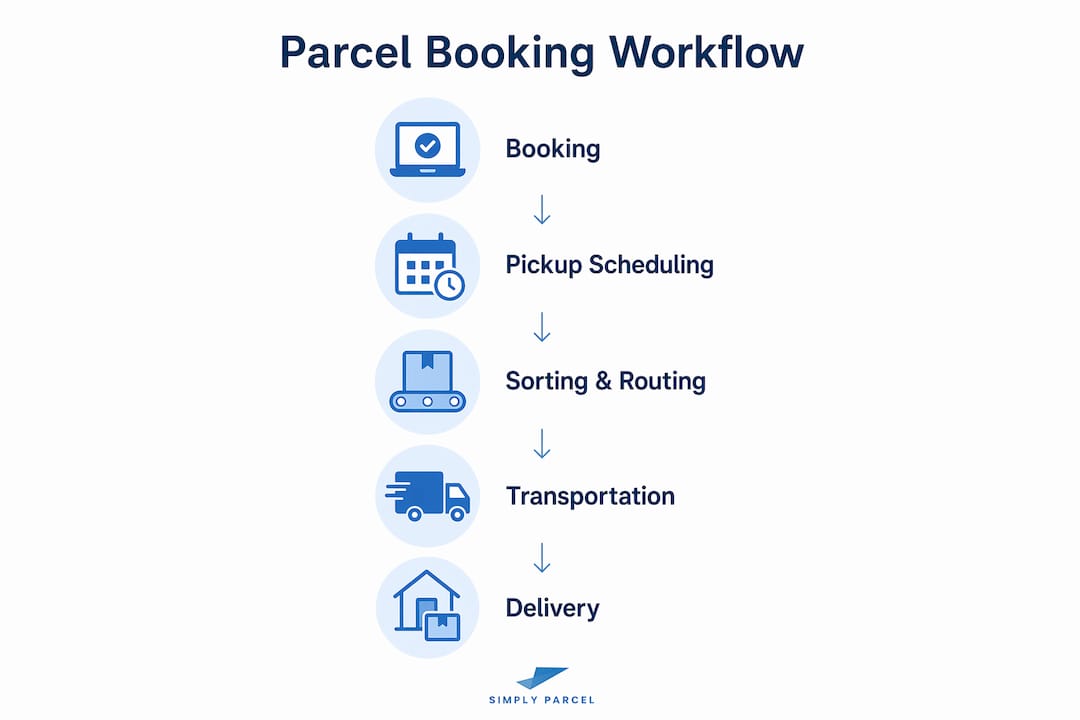
The parcel delivery process follows five core stages. Each stage has specific tasks and common failure points worth knowing before you ship.
Step 1: booking and order creation
You place your booking through an online platform, mobile app, or customer service channel. At this stage, you enter all shipment details, select your courier and service level, and pay for the shipment. The system generates a booking reference and, in most cases, a printable shipping label. Errors made here, such as a wrong postal code or an underestimated weight, travel through every subsequent stage and are expensive to correct.
Step 2: pickup scheduling and courier assignment
After booking, a courier is assigned to collect your parcel. The assigned courier verifies the parcel's condition at pickup and confirms delivery instructions. For express services, pickup timing is especially critical. If you miss the pickup window, your parcel may not make the next dispatch cycle, adding a full day or more to the transit time.
Step 3: sorting, routing, and dispatch
Once collected, your parcel moves to a sorting center or depot. Parcels are organized by destination to determine the most efficient delivery route and dispatch sequence. This stage is largely automated in major courier networks. Errors here are rare but can occur when labels are damaged or barcodes are unreadable, which is why label placement and print quality matter at the booking stage.
Step 4: transportation and in-transit management
Your parcel moves through planned routes via road, air, or sea depending on the service selected. Real-time tracking and exception alerts help manage delays during transit. Systems using API integrations provide live location data and predictive arrival estimates. For senders, this is where parcel shipment tracking becomes your primary tool for staying informed without contacting the courier directly.
Step 5: final delivery and proof of completion
The courier delivers the parcel to the recipient, verifies identity or obtains a signature where required, and records digital proof of delivery. The sender receives a status update confirming completion. If delivery fails because no one is home or the address is incorrect, the parcel enters a redelivery or return cycle that adds cost and time for everyone involved.
The table below summarizes the key tasks and common mistakes at each stage:
| Stage | Key Task | Common Mistake |
|---|---|---|
| Booking | Enter accurate shipment details | Wrong address or underreported weight |
| Pickup | Confirm parcel condition and instructions | Missing the pickup window |
| Sorting | Route parcel by destination | Damaged or unreadable label |
| Transit | Monitor tracking and manage exceptions | Ignoring delay alerts until too late |
| Delivery | Obtain proof of delivery | Incorrect recipient contact details |
Pro Tip: Set up tracking notifications the moment your booking is confirmed. Catching an exception alert early, such as a customs hold or a missed scan, gives you time to act before it becomes a full delivery failure.
What are the best practices for optimizing your shipping workflow?
A well-run shipping workflow management process does not happen by accident. These practices separate businesses that ship reliably from those that spend hours resolving avoidable problems.
- Replace email coordination with structured execution fields. Structured execution platforms with clearly defined tasks, status points, and escalation rules reduce communication chaos and improve coordination across all shipment partners. Ad hoc email threads lose critical details and slow response times.
- Automate wherever possible. Digital platforms like Floship connect selling channels with global couriers, automating cross-border order fulfillment and routing. Automation reduces manual entry errors and frees your team to handle exceptions rather than routine tasks.
- Use multi-carrier systems for cost control. Locking into a single courier limits your flexibility. Multi-carrier tools compare rates and transit times across providers, letting you choose the best option for each shipment based on urgency and budget.
- Set realistic delivery windows. Promising customers a two-day delivery when your courier's standard service takes four days creates disputes. Match your service selection to actual transit timelines and communicate clearly with recipients.
- Review delivery performance regularly. Track your on-time delivery rate, exception frequency, and cost per shipment monthly. Patterns in the data reveal which routes, couriers, or parcel types generate the most problems.
Consistent review of your delivery data is the single most underused tool in logistics management. Most businesses only look at performance after something goes wrong. Looking at it monthly, before problems compound, is what separates efficient shippers from reactive ones.
You can also reduce delays significantly by following proven shipping tips around packaging, labeling, and courier selection before each dispatch cycle.
How do domestic and international parcel workflows differ?
The core stages of the parcel booking workflow apply to both domestic and international shipments. The differences lie in documentation, compliance, and transit complexity.
International shipments require additional documentation, customs declarations, and involve longer transit times compared to domestic shipments. Cross-border routing adds complexity around duties, taxes, and regulatory compliance that domestic shipments simply do not face.
| Factor | Domestic Shipping | International Shipping |
|---|---|---|
| Documentation | Shipping label only | Commercial invoice, customs declaration, packing list |
| Transit time | 1–5 business days | 5–21 business days depending on destination |
| Customs clearance | Not required | Required at destination country |
| Duties and taxes | Not applicable | Varies by country, product type, and declared value |
| Tracking visibility | High, end-to-end | Variable, may drop during customs processing |
| Courier selection | Any local carrier | Requires internationally licensed courier |
For international bookings, you must declare the contents accurately, including a description of goods and their value. Underdeclaring value to reduce duties is a customs violation that can result in seizure, fines, or permanent bans from certain markets. Choose a courier that specializes in international logistics and has established customs clearance relationships in your destination country. Simplyparcel, for example, works with major international courier partners and provides clear guidance on documentation requirements for shipments out of Singapore.
The advantages of parcel tracking become especially important for international shipments, where a parcel can sit in customs for days without an update unless you have a system that flags the delay automatically.
Key takeaways
A well-executed parcel booking workflow depends on accurate inputs at the start, structured processes at every stage, and consistent performance monitoring after delivery.
| Point | Details |
|---|---|
| Start with complete information | Accurate addresses, weight, and dimensions prevent delays and billing disputes at every stage. |
| Follow the five-stage process | Booking, pickup, sorting, transit, and delivery each have specific tasks and failure points to manage. |
| Automate to reduce errors | Multi-carrier platforms and integrated booking systems cut manual entry and improve routing accuracy. |
| Adapt for international shipments | Cross-border shipping requires customs documentation, accurate value declarations, and specialist couriers. |
| Monitor performance consistently | Reviewing on-time rates and exception data monthly reveals problems before they become costly patterns. |
What i have learned running parcel workflows at scale
The most common mistake I see is treating the booking stage as a formality. Shippers rush through address entry, guess at parcel weight, and skip packaging checks because the booking interface makes it feel simple. That simplicity is deceptive. Every error at the booking stage multiplies downstream. A wrong postal code does not just delay one parcel. It ties up customer service time, triggers a redelivery fee, and damages the recipient relationship.
The second thing I have learned is that email-based coordination is a liability, not a system. When shipment instructions, exception alerts, and delivery confirmations all live in someone's inbox, nothing is trackable and nothing is accountable. Structured execution tools, where tasks have owners, deadlines, and status fields, change this completely. The shift from email to structured workflow tools is not a technology upgrade. It is a reliability upgrade.
Finally, the businesses that ship most efficiently are not the ones with the biggest budgets. They are the ones that review their data. They know their average transit time by route, their exception rate by courier, and their cost per kilogram by service tier. That knowledge lets them make decisions based on evidence rather than habit.
— Simply
Ship smarter with Simplyparcel
Simplyparcel gives individuals and businesses in Singapore a faster, clearer way to manage every stage of the parcel delivery process. The platform lets you compare courier rates across major international carriers, book pickups online, generate shipping labels automatically, and track your shipments in real time. Whether you are sending a single parcel overseas or managing regular export orders, Simplyparcel handles the complexity so you can focus on what matters. Get an instant shipment quote and book your next parcel in minutes, with transparent pricing and no hidden fees.
FAQ
What is a parcel booking workflow?
A parcel booking workflow is the end-to-end process of capturing shipment details, scheduling pickup, routing the parcel through sorting facilities, managing transit, and completing delivery with verified proof of handover. It applies to both domestic and international shipments.
What information do i need to book a parcel?
You need the sender and recipient's full addresses and phone numbers, the parcel's dimensions and weight after packaging, and your preferred delivery speed. Accurate details at this stage prevent delays and billing adjustments later.
How does international parcel booking differ from domestic?
International shipments require a commercial invoice, customs declaration, and accurate goods valuation, none of which are needed for domestic bookings. Transit times are also longer, and tracking visibility may drop during customs processing.
How can i reduce errors in my shipping workflow?
Use an online booking system that auto-generates labels and validates address formats, and weigh parcels after packaging. Replacing manual email coordination with structured execution tools also significantly reduces missed instructions and delayed responses.
What is proof of delivery and why does it matter?
Proof of delivery is a digital or physical record confirming that the recipient received the parcel, usually including a signature or photo. It protects both sender and courier in the event of a delivery dispute or damage claim.