
Sending a parcel overseas sounds straightforward until you realize the commercial invoice is missing a VAT number, your HS code is wrong, and your shipment is sitting at a port somewhere waiting for customs clearance. The reality is that international shipping involves regulations, documentation requirements, and classification systems that catch even experienced shippers off guard. This guide walks you through everything you need to know, from gathering the right paperwork and classifying your goods correctly, to booking your shipment and tracking it to delivery. Follow these steps and you will avoid the mistakes that cost businesses real money every year.
Table of Contents
- Key takeaways
- Your international shipping guide: the essentials first
- Step by step workflow for booking an international shipment
- Common mistakes and how to avoid them
- Tracking, verification, and post-shipment best practices
- What I have learned from watching shippers get this wrong
- Ship smarter with Simplyparcel
- FAQ
Key takeaways
| Point | Details |
|---|---|
| Documentation accuracy matters | Missing or incorrect fields on invoices cause customs rejections and costly delays. |
| HS codes must be verified | Misclassifying goods can trigger penalties of 20 to 40% of the goods' value. |
| Early compliance saves money | Validating documents and restricted party screening at order creation prevents last-minute problems. |
| ISF filing has a hard deadline | For U.S.-bound ocean cargo, ISF must be filed at least 24 hours before vessel loading. |
| Tracking and recordkeeping matter post-shipment | Monitoring your shipment and maintaining audit-ready records protects you if issues arise later. |
Your international shipping guide: the essentials first
Before you book anything or hand a parcel to a courier, you need the right paperwork. Missing or incomplete documentation is one of the most common reasons shipments get held at customs. Think of your documents as the story you are telling every customs official along the route. If the story has gaps, they will stop to ask questions.
The core documents you need
Here is what belongs in every international shipment package:
- Commercial invoice: This is the most critical document. It must include seller and buyer details, a full description of goods, declared value, currency, country of origin, payment terms, and the HS code for each item.
- Packing list: A detailed breakdown of what is inside each box, including dimensions, weights, and quantities. It must match the commercial invoice exactly.
- Bill of lading or airway bill: The contract between shipper and carrier. For ocean freight, this is the bill of lading. For air, it is the airway bill.
- Certificate of origin: Required by many countries to determine applicable duty rates, especially under free trade agreements.
- Import/export licenses: Required for restricted goods such as electronics with encryption, food products, pharmaceuticals, and certain chemicals.
Getting your commercial invoice right
Standard invoice templates often fall short. Destination-specific fields like EORI numbers for shipments entering the EU or VAT registration numbers for the UK are frequently missing, which leads to outright customs rejection. Always research the import rules of your destination country before generating your invoice.
Pro Tip: Create a destination-specific invoice template for each major market you ship to. This prevents you from relying on a one-size-fits-all template that will get flagged in countries with stricter import requirements.
HS codes and why they matter
The Harmonized System (HS) code is a globally standardized product classification number. All 207 countries use the first six digits universally, but national extensions beyond those six digits vary and directly affect duty rates and regulatory compliance. Getting this number wrong is not a minor oversight.

| HS Code segment | Length | Purpose |
|---|---|---|
| Chapter | 2 digits | Broad product category |
| Heading | 4 digits | Narrower product group |
| Subheading | 6 digits | Universal international classification |
| National extension | 8–10 digits | Country-specific tariff and regulation |
You must verify the correct HS code for every product you ship. The Simplyparcel blog covers essential shipping documentation in detail if you want a deeper reference for Singapore-based senders specifically.
Step by step workflow for booking an international shipment
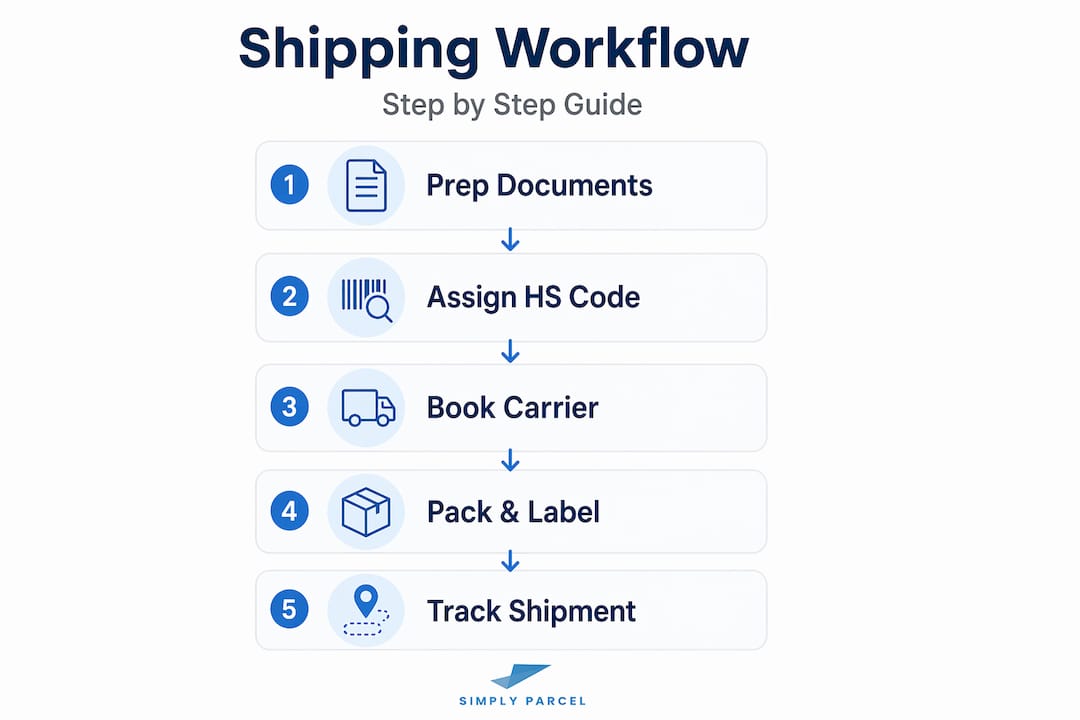
Once your documents are in order, you move into the operational phase. Here is the step by step shipping process that keeps things on track:
-
Choose your shipping method. Air freight is faster and suits high-value or time-sensitive goods. Sea freight is more economical for bulky or heavy shipments. Consider the trade-off between transit time and cost carefully before committing.
-
Select a service tier. Carriers typically offer priority, standard, and economy options. Priority shipments can move in two to five business days internationally. Economy can take two to four weeks. Match the service to your delivery promise and budget.
-
Package your goods correctly. Use double-walled boxes for fragile items. Fill all void space with appropriate cushioning material. Label each box with both origin and destination addresses on the outside, and include a copy of the packing list inside. For international shipments, also attach the commercial invoice to the outside of the outermost package.
-
Classify your product using the General Rules of Interpretation (GRI). The six GRI rules must be applied in strict order for accurate HS classification. GRI 1 requires you to read the section and chapter notes before anything else. Skipping ahead to GRI 3 or 4 without completing GRI 1 and 2 is the most common classification error. U.S. penalties for getting this wrong range from two to four times the unpaid duties.
-
File your Importer Security Filing (ISF) if shipping by ocean to the U.S. The ISF must include ten core data elements including stuffing location and HTS classification. It must be submitted before loading.
-
Submit all documents to your carrier or freight forwarder. Use a structured checklist to confirm every required document is complete, correctly filled out, and consistent across all forms.
-
Book and confirm pickup. Confirm your pickup date and collection window with the carrier. Retain confirmation numbers and copies of all submitted documents.
Pro Tip: Use a digital document management folder for every shipment. Name it by destination country and shipment date. This makes audit responses and follow-up queries much faster to handle.
Choosing between air and sea freight
| Factor | Air freight | Sea freight |
|---|---|---|
| Transit time | 2 to 7 days | 2 to 6 weeks |
| Cost per kg | Higher | Lower |
| Ideal for | High-value, urgent goods | Bulk, heavy, or low-value goods |
| Carbon footprint | Higher | Lower per unit weight |
| Tracking frequency | Real-time updates | Less frequent |
Common mistakes and how to avoid them
Even experienced shippers make errors that cause delays or financial penalties. Knowing where things go wrong gives you a real advantage in this step by step parcel shipping process.
-
Wrong HS code assignment. This is the most expensive mistake. Misclassification penalties can reach 20 to 40% of the goods' value. If you regularly ship high-value items, consider applying for a binding ruling from your national customs authority. A binding ruling is a legally enforceable classification decision that protects you from reclassification for years.
-
Late ISF filing. For U.S. ocean imports, failing to meet the 24-hour ISF deadline is a primary cause of cargo holds, exams, and civil fines. Do not treat ISF as a formality you can file the night before loading.
-
Document discrepancies. Inconsistencies between the commercial invoice, packing list, bill of lading, and entry summaries are a common trigger for customs inspections. If the declared weight on the packing list differs from the bill of lading by even a small margin, that mismatch can cause a hold.
-
Skipping restricted party screening. Before shipping, check that your buyer, end-user, and any intermediaries are not on restricted trade lists. Running compliance checks at order creation is far more effective than catching problems at the dock.
-
Ignoring destination country requirements. Each country has unique import rules. Some require pre-shipment inspections. Others have labeling requirements in the local language. Assuming that what works for one destination applies to another is a frequent and avoidable mistake.
Pro Tip: Build a compliance review step directly into your order intake process. When a new order comes in, run a quick check on destination-country import requirements before the shipment is even packed. Early validation significantly reduces compliance failures and the costs they bring.
Tracking, verification, and post-shipment best practices
Getting a parcel into a carrier's hands is not the end of your responsibility. What happens after booking is where many shippers lose visibility and control.
-
Track your shipment actively. Real-time tracking tools let you spot delays, missed scans, or customs holds early. Do not wait for a problem to surface before logging in to check.
-
Respond quickly to customs queries. If your shipment is held for inspection or documentation review, a fast and accurate response is critical. Delays in responding extend the hold and may escalate into formal examinations, which cost more time and money.
-
Keep records for at least five years. Most customs authorities require importers and exporters to retain shipment records for five years. Store digital copies of every invoice, packing list, bill of lading, and ISF filing by shipment date and destination.
-
Conduct a post-shipment review. After delivery, check whether duties paid matched your estimate. If there is a significant discrepancy, review your HS code assignment and consider whether a binding ruling is appropriate for future shipments of the same product.
Pro Tip: Set up a simple spreadsheet tracking every international shipment by date, destination, carrier, HS code used, and declared value. This becomes your reference library for future shipments and your first line of defense during a compliance audit.
Following these international shipping best practices consistently is what separates shippers who operate with confidence from those who are always reacting to the last problem.
What I have learned from watching shippers get this wrong
I have seen the same patterns repeat. A business ships for months without a problem, then one customs authority flags an HS code that has been wrong since day one. The back duties, penalties, and legal fees add up fast. The worst part is that the error was avoidable with thirty minutes of proper classification research at the start.
The thing most shippers underestimate is the hidden cost of under-documentation. A missing EORI number on an invoice does not just slow down one shipment. It can freeze a buyer relationship, trigger a compliance review, and cause a ripple of problems across your entire order queue.
What actually works is building compliance into the beginning of the shipping workflow, not the end. When you validate documentation at order intake rather than at the dock, you catch problems when they are still cheap to fix. Technology helps here. Platforms that auto-generate labels, pre-fill required fields, and integrate with carrier systems remove a lot of the manual error risk.
Selecting reliable shipping partners matters just as much as your own internal process. A partner who provides clear tracking, transparent pricing, and responsive support when something goes wrong is worth more than the cheapest available rate. I have watched businesses choose the lowest-cost option and spend three times that saving on delays and recovery costs.
Regulations change. Duty rates shift. New destination country requirements appear with little warning. The shippers who stay ahead of this are the ones who invest in staying informed and who build flexibility into their processes rather than assuming that what worked last year still applies today.
— Simply
Ship smarter with Simplyparcel
If you are based in Singapore and want to put this international shipping workflow guide into practice without managing multiple carrier relationships yourself, Simplyparcel makes the process straightforward. The platform lets you compare courier options, lock in competitive rates, and book your shipment in minutes. Simplyparcel handles label generation and documentation automatically, so you reduce manual entry errors from the start. Whether you are sending a single parcel or managing regular export volumes, the platform covers priority, economy, and connect-plus service tiers to fit different timelines and budgets. Free pickup is included, and you get real-time tracking from collection to delivery. Visit Simplyparcel to get an instant quote and start shipping with confidence.
FAQ
What documents do I need for international shipping?
The core documents are a commercial invoice, packing list, and bill of lading or airway bill. Depending on the destination and product type, you may also need a certificate of origin, import or export licenses, and destination-specific identifiers like EORI or VAT numbers.
What is an HS code and why does it matter?
An HS code is a standardized product classification number used by customs authorities worldwide. Getting it wrong can result in penalties ranging from two to four times unpaid duties, plus shipment delays.
When do I need to file an ISF?
ISF filing applies to ocean cargo bound for the United States and must be submitted at least 24 hours before the cargo is loaded onto the vessel. Missing this deadline results in civil fines and cargo holds.
How do I avoid customs delays?
Make sure all your shipping documents are consistent with each other, use the correct HS code for every item, and verify destination-country import requirements before shipping. Running compliance checks early in the order process is the most effective prevention strategy.
How long should I keep international shipping records?
Most customs authorities require exporters and importers to retain shipping records for at least five years. Store digital copies of every invoice, packing list, and carrier document organized by shipment date and destination.