
An ecommerce shipping workflow is a repeatable, standardized sequence that moves every order from receipt through picking, packing, labeling, dispatch, and tracking to the customer's door. A well-built workflow is the single most reliable way to hit 99%+ order accuracy while cutting rework costs by 60–80%. The industry standard for this process is the pick-pack-ship model, a term used by logistics professionals and standards bodies like GS1 to describe stage-gated fulfillment. Simplyparcel applies these same principles to international shipping, giving e-commerce managers a clear framework to follow.
What are the key stages of the ecommerce shipping workflow?
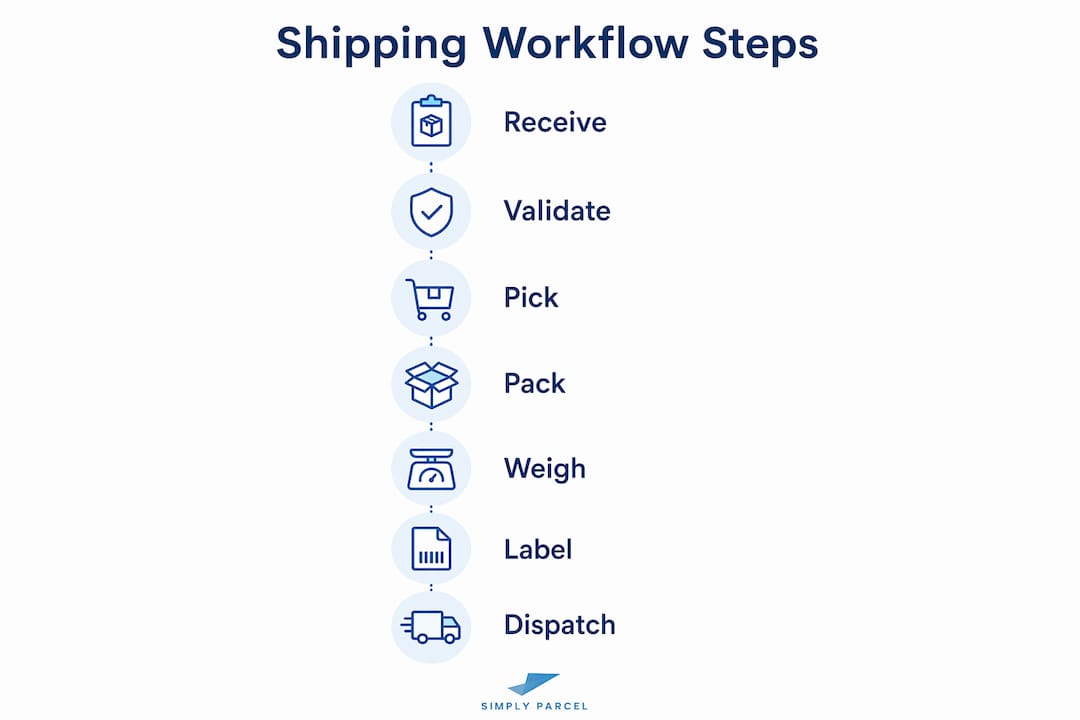
The order fulfillment workflow runs in a fixed, repeatable sequence: receive, validate, pick, pack, weigh, label, dispatch, and track. Each stage feeds the next, so a mistake at any point compounds downstream. Treating the process as one connected system, rather than a set of separate tasks, is what separates high-performing operations from those constantly firefighting errors.
The pick stage
Picking is where most errors begin. A picker locates the item in the warehouse, scans its barcode, and the warehouse management system (WMS) confirms the match before the picker moves on. Barcode scanning at this stage drops mispick rates from 1–3% down to 0.1–0.3%. That difference sounds small until you calculate the cost of reshipping, customer refunds, and lost trust at scale.
The pick stage works best when orders are batched by bin proximity and promise date. Batching by bin location cuts travel time across the warehouse floor. Sorting within that batch by promise date keeps your most urgent orders at the front of the queue.
- Scan every item before placing it in the pick tote.
- Use a WMS that rejects unscanned items before the order advances.
- Batch picks by bin location, then sort by order promise date.
- Flag any item that does not scan as a hold, not a skip.
Pro Tip: Set your WMS to enforce a hard stop if a barcode scan does not match the order. Soft warnings get ignored under pressure; hard stops do not.
The pack stage

Packing is the last human checkpoint before a parcel leaves your facility. The packer scans each item into the box, confirming contents match the order. Photo verification at the packing station provides undeniable proof for insurance claims and speeds dispute resolution when a customer reports a wrong or missing item. For high-value or damage-prone goods, a photo record is not optional.
After scanning, the packer weighs the sealed box. Weight verification catches missing items and prevents carrier surcharges from dimensional weight miscalculations. The box is then sealed and moved to the label station.
- Scan each item into the box before sealing.
- Photograph the open box contents for high-value orders.
- Weigh every sealed parcel and record the result.
- Reject any parcel whose weight falls outside the expected range.
The ship stage
At the ship stage, the label is printed, applied, and scanned one final time. That final scan associates the tracking number with the order record in your system. This fixed sequence of weigh, label, scan, and dispatch is what gives customers accurate tracking from the moment the parcel leaves your hands. Any parcel dispatched without a final scan creates a tracking gap that generates customer service tickets.
Pro Tip: Standardize your packaging to 3–5 box sizes. Standard box sizes cover 90% of orders and cut the time a packer spends deciding which box to use, which is one of the most underestimated sources of delay at the pack station.
What tools and technologies support an efficient ecommerce shipping workflow?
The right tools remove guesswork and enforce the stage gates your workflow depends on. Every operation running more than a handful of orders per day needs a defined technology stack.
| Tool | Core function |
|---|---|
| Warehouse management system (WMS) | Directs picks, enforces scan gates, tracks inventory in real time |
| Order management system (OMS) | Receives orders, validates payment, routes to fulfillment |
| Barcode scanners | Confirm item identity at pick and pack stages |
| Label printers | Print carrier labels with embedded tracking data |
| Postage and rate software | Compares carrier rates and selects the best option per order |
| Weighing scales | Verify parcel weight before label generation |
A WMS and OMS can run as separate platforms or as one integrated system. Separate systems give you flexibility to swap one without rebuilding the other. Integrated systems reduce the number of data handoffs, which is where sync errors typically appear.
Scan-to-verify technology adds only 5–10 seconds per order. That time cost is negligible compared to the cost of processing a return, reshipping an item, or issuing a refund. The math is straightforward: a few seconds of scanning prevents minutes of rework per error.
Carrier selection and label printing belong inside your workflow software, not in a separate browser tab. When your OMS pulls live carrier rates and prints the label in one step, you eliminate manual rate shopping and reduce the chance of applying the wrong label to the wrong parcel. Simplyparcel integrates carrier comparison and label generation into a single booking flow, which removes that manual step entirely for international shipments.
Pro Tip: Connect your parcel tracking system directly to your OMS so tracking updates reach customers automatically. Manual tracking updates are a hidden time drain that automation eliminates completely.
How can automation and AI improve shipping process efficiency and error handling?
Automation belongs in your workflow after you have stabilized each stage, not before. The signal to automate is repeated friction at a specific point, not order volume alone. If the same type of error keeps appearing at the same stage, that is the right place to add automation. Adding technology to a broken process only makes the process break faster.
Once your stages are stable, automation delivers real gains. Rule-based triggers handle the predictable work: routing orders to the correct pick zone, selecting the cheapest qualifying carrier, printing labels in batch, and sending tracking notifications. These tasks follow fixed logic and require no human judgment.
AI-powered agents take automation further by handling exceptions that rule-based systems cannot. These agents autonomously contact carriers, reconcile missing documents, and resolve shipment holds without waiting for a human to notice the problem. AI agents reduce manual coordination by 70% and speed issue resolution by 90%. That shift turns reactive shipping management into proactive control.
The practical difference is significant. A rule-based system flags a delayed shipment and sends you an alert. An AI agent detects the delay, contacts the carrier, retrieves an updated ETA, and updates the customer record before you have even seen the notification. Agentic automation handles the entire exception loop with minimal human input.
- Automate rule-based tasks first: carrier selection, label printing, tracking notifications.
- Use AI agents for exception types that require multi-step resolution.
- Assign a human owner to each exception category as a fallback.
- Stabilize every workflow stage before adding any automation layer.
- Review automation logs weekly to catch new error patterns early.
What are common challenges and best practices to maintain and scale ecommerce shipping workflows?
Scaling a shipping operation exposes every weakness in your current process. The challenges that cause the most damage are not dramatic failures. They are small, repeated mistakes that compound as volume grows.
The most common problems are weak handoffs between stages, manual data entry, and inconsistent packaging decisions. A weak handoff happens when a completed pick tote sits waiting for a packer with no clear signal that it is ready. Manual data entry introduces errors every time a human types a tracking number, weight, or address. Inconsistent packaging means packers make different decisions for the same product, which creates unpredictable weight and dimension data.
Fixing these problems requires clear ownership and defined rules. Assign one person or team as the owner of each exception type, with a service level agreement (SLA) for resolution time. An unowned exception is an exception that waits until someone notices it, which is often too late.
- Assign an owner and SLA to every exception type in your workflow.
- Replace manual data entry with barcode scans or system integrations wherever possible.
- Standardize packaging to 3–5 box sizes and post the selection guide at every pack station.
- Review accuracy rates, cycle times, and exception volumes on a weekly cadence.
- Use shipping cost reduction reviews to catch carrier rate drift before it erodes your margins.
Regular review is the practice that keeps a workflow from drifting. Accuracy rates, cycle times, and exception volumes all change as your product mix and order volume shift. A workflow that performed well at 200 orders per day may develop new bottlenecks at 500. Weekly metrics reviews catch that drift before it becomes a crisis.
Pro Tip: Build a simple exception log that records the type, stage, and resolution time for every error. After four weeks, patterns become visible. Those patterns tell you exactly where to focus your next improvement effort.
Key takeaways
A well-structured ecommerce shipping workflow built on scan-verified stage gates, the right technology stack, and targeted automation is the most reliable path to consistent order accuracy and lower fulfillment costs.
| Point | Details |
|---|---|
| Stage-gated accuracy | Scan verification at pick and pack stages cuts mispick rates to below 0.3%. |
| Photo verification value | Photographing packed orders protects against insurance claims and speeds dispute resolution. |
| Automate friction, not volume | Add automation where the same error repeats, not simply because order volume grows. |
| AI exception handling | AI agents reduce manual coordination by 70% and resolve shipping exceptions 90% faster. |
| Standardize packaging | Limiting box sizes to 3–5 options covers 90% of orders and speeds packing decisions. |
What I have learned from watching workflows break and scale
The most expensive mistake I see e-commerce managers make is adding technology to a workflow that has not been stabilized first. A new automation layer does not fix a broken handoff. It just executes the broken handoff faster and at higher volume.
The operations that scale well share one trait: they treat shipping as one connected system, not a collection of tasks owned by different people. When pick, pack, and ship are managed as separate departments with no shared accountability, errors fall into the gaps between them. When they run as one sequence with shared metrics, errors surface immediately and get fixed at the source.
Photo verification is the most underused tool I see in mid-sized operations. Managers often skip it because it feels like extra work. But the first time a high-value customer disputes a shipment and you can show a timestamped photo of the packed box, the value becomes obvious. That photo closes the dispute in minutes instead of days.
AI-driven exception handling is the change I am most confident about for 2026 and beyond. The shift from "we got an alert" to "the system already resolved it" is not incremental. It changes how your team spends its time and what your customers experience when something goes wrong. Build the stable workflow first. Then let the AI agents handle the exceptions.
— Simply
Simplyparcel and your shipping workflow
Simplyparcel gives e-commerce managers a direct way to act on the workflow principles covered here. The platform compares courier rates, generates shipping labels, and provides real-time tracking across major international carriers, all from a single booking interface. You can get an instant shipping quote without committing to a carrier, which makes carrier selection a data-driven step rather than a habit. For businesses shipping internationally from Singapore, Simplyparcel's free pickup service and transparent transit timelines remove two of the most common friction points in the dispatch stage. Visit Simplyparcel to see how the platform fits into your current fulfillment process.
FAQ
What is an ecommerce shipping workflow?
An ecommerce shipping workflow is the end-to-end sequence of steps that moves an order from receipt through picking, packing, labeling, dispatch, and delivery. A standardized workflow with scan-verified stage gates achieves over 99% order accuracy.
How does barcode scanning improve order accuracy?
Barcode scanning at the pick and pack stages reduces mispick rates from 1–3% down to 0.1–0.3%. The scan confirms item identity in real time before the order advances to the next stage.
When should I add automation to my shipping process?
Add automation when the same friction point repeats at a specific stage, not simply because order volume increases. Stabilize each workflow stage first, then apply rule-based automation to predictable tasks and AI agents to complex exceptions.
What is the benefit of photo verification at the pack station?
Photo verification creates a timestamped record of packed box contents. That record provides proof for insurance claims and resolves customer disputes faster than any other method, particularly for high-value or damage-prone items.
How many box sizes should I standardize to?
Standardizing to 3–5 box sizes covers 90% of orders and reduces the time packers spend choosing packaging. Fewer options at the pack station means faster decisions and more consistent dimensional weight data for carrier billing.