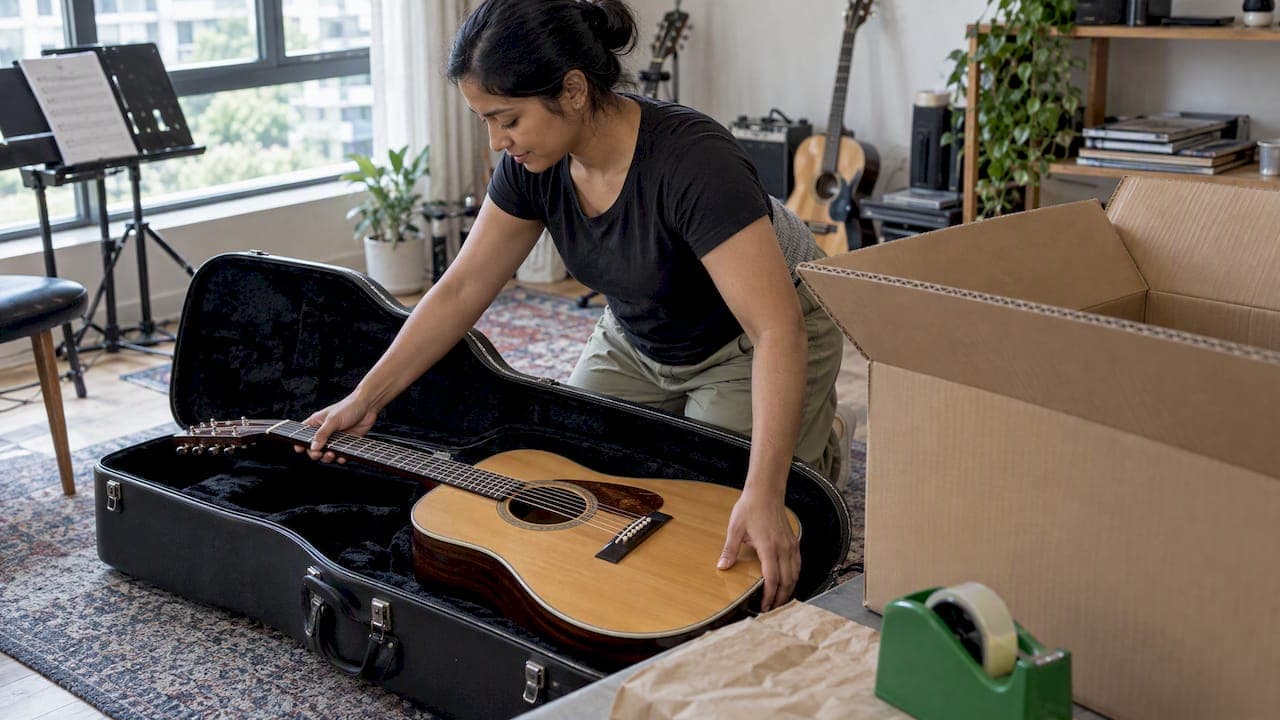
To ship a musical instrument overseas, pack it in its hard case, put the case inside an oversized box with cushioning on every side, declare it accurately for customs, and choose a service speed and protection level that match its value. Done in that order, a guitar, violin or keyboard can cross borders safely. This guide walks through each step for senders in Singapore, from packing materials to customs paperwork, and shows where booking fits in.
TL;DR
- Loosen guitar strings slightly (unless the maker says otherwise), secure loose parts, fill empty space in the case, and use a box larger than the case so the case "floats" in cushioning.
- Never rely on the case alone. A hard case is the inner layer, and the outer box and padding take the knocks.
- Declare the instrument honestly on the customs invoice: description, quantity, value, weight and country of origin. Expect duty and tax at the destination.
- Instruments with ivory, tortoiseshell, Brazilian rosewood or similar materials may need a CITES document before they leave.
- Compare speed tiers and add protection coverage for anything you could not easily replace.
Table of Contents
- Why instruments are harder to ship than ordinary parcels
- Step 1: Prepare the instrument
- Step 2: Pack it so the case never takes the hit
- Step 3: Check customs, duty and CITES before you book
- Perspective: what we see when instruments travel
- Step 4: Choose the right service and add protection
- Book your instrument shipment with Simply Parcel
- A final checklist before pickup
- FAQ
- Sources
Why instruments are harder to ship than ordinary parcels
A guitar neck is a long, thin lever attached to a body under string tension. A violin has a thin top and a delicate bridge. A keyboard has electronics and sometimes batteries. A drum kit is heavy and awkward. None of these behave like a box of books.
On an international trip the parcel is handled more than on a domestic one: pickup, sorting at a Singapore hub, air transfer, destination customs, local sorting and final delivery. Each handoff is a chance for a drop or a stack of heavy parcels on top. That is why the packing advice in this article is stricter than for general goods. If you want the general rules first, our guide to parcel packaging best practices covers boxes, tape and labels for any item.

The Incorporated Society of Musicians makes the same basic point: instruments are expensive and delicate, so it is worth taking time to pack them carefully before anything leaves your home.
Step 1: Prepare the instrument
Preparation takes ten minutes and prevents most damage.
Guitars and other stringed instruments
Gibson's packing guide says to loosen the strings to relieve tension on the neck and headstock, secure any loose hardware, fill voids in the case with non-scratching material, and stabilize the body, neck and headstock so nothing can move. Makers differ on how much to loosen, so check the instructions from your manufacturer or the repair shop that will receive the instrument. For a vintage or high-value guitar, ask the luthier who services it.
Practical points:
- Remove or tape down anything that can rattle: tuners that are loose, a capo, a slide, spare strings, picks.
- Pad under the headstock so the neck does not flex when the case is knocked.
- Fill gaps beside the body with soft, non-abrasive material such as a clean cloth or acid-free tissue. Avoid anything that could mark a finish, especially on nitrocellulose lacquer.
- Put cables, straps and pedals in a separate small bag, not loose in the case compartment where they press against the body.
Violins, violas and cellos
Loosen the strings only if your luthier recommends it, and take the bridge advice from them too, since a bridge that shifts can damage the top. Remove the shoulder rest and loose rosin. Use a rigid case with a snug fit, and ensure the instrument does not move inside when you shake the closed case gently. For a cello, a hard case is the minimum; many players add a padded flight-style outer layer.
Keyboards, digital pianos and amplifiers
Remove detachable stands, pedals and power supplies and pack them separately. Keep the original box and foam if you have them, since they were designed for the item. If you do not, wrap the unit in layers of padding and protect the keys, knobs and screens. For amplifiers, protect the speaker grille and tubes with rigid cardboard panels. Our electronics shipping checklist goes deeper on electronics for Singapore senders.
Drums, brass and woodwinds
Break a drum kit into its parts: shells, hardware, cymbals, pedals. Wrap shells individually in padding, remove the heads only if the maker advises it, and pack hardware in a separate sturdy box so metal does not contact shells. Brass and woodwind instruments belong in their fitted cases. Remove mouthpieces from the instrument, and pad them separately so they do not dent the bell or scratch the body.

Step 2: Pack it so the case never takes the hit
The most common mistake is thinking that a hard case is enough. A case is a protective layer, but it is designed to be carried by a person, not thrown onto a conveyor belt.
The method Gibson describes is to place the case inside an oversized, sturdy box and suspend it with bubble wrap or wadded paper, then tape the openings and put the label on the top end. Gibson prefers that you do not use packing peanuts, which can settle and leave the case unsupported.
A packing sequence you can follow
- Prepare the instrument and close the case. Check it for rattles.
- Wrap the closed case in a layer of bubble wrap or paper to protect the surface.
- Choose a box that leaves roughly 3 inches of space on every side of the case. Our fragile item packaging guide explains why 3 inches of cushioning and a 4-foot drop test are a good benchmark.
- Put a firm layer of padding on the bottom, lower the case in, and pack the sides and top with bubble wrap or crumpled kraft paper until the case cannot shift when you shake the box.
- Seal all seams with strong packing tape, using the H pattern on the top and bottom.
- Attach the label on the top end of the box and mark "Fragile" and the orientation arrows. Keep a second copy of the label and invoice inside the box.
A moving-industry guide on packing fragile items with 3 inches of cushioning makes a similar point: cushioning thickness matters more than the number of layers, and some items are worth handing to professionals.
Box size for a guitar
Guitar-specific boxes exist and save time. As one example, U-Haul lists a guitar shipping box with interior dimensions of 20 x 8 x 50 inches, designed for an acoustic guitar in its case and rated 44 ECT with a 275 burst strength. That is a US product, and in Singapore you will usually source a similar box from a packaging supplier or build one from double-wall corrugated board. The principle is the same: an interior sized for the case plus room for padding, and a strong board rating.
Shipping a guitar without a case
This is the riskiest option and best avoided. If you have no choice, wrap the guitar thoroughly in soft padding, add a rigid shell around the neck and body, and place it in a first box. Then double-box: put that box inside a larger one with padding between the two. Buying a proper case is almost always cheaper than repairing a cracked neck.
Step 3: Check customs, duty and CITES before you book
Paperwork delays instruments more often than damage does. A box held at destination customs can sit for days, and an incorrect description can lead to a seizure.
What to put on the customs declaration
For shipments entering the United States, U.S. Customs and Border Protection says the declaration must include a full, accurate English description, quantity, purchase price, weight and country of origin, and that misleading details are illegal and may lead to seizure or fines. Other countries ask for similar information, and a good habit is to write "used acoustic guitar, spruce top, mahogany back" rather than "gift" or "samples".
A few rules of thumb:
- State the real value, even if the instrument is secondhand or a gift. Our guide to gift customs thresholds explains how value rules work and why a vague label can cause trouble.
- If you are sending your own instrument to yourself abroad as part of a move, read what "personal effects" means for U.S. shipments before you choose that label. It has strict conditions.
- Include the serial number and brand on the invoice for valuable items. It also helps with insurance claims.
The Incorporated Society of Musicians notes that duty and tax will probably be payable in the destination country. Ask the recipient to check the local rules and to expect a bill, and decide before shipping who pays it. For the wider picture, see the role of customs in shipping.
CITES: when the wood or material matters
Some instruments contain materials from protected species: ivory (old piano keys, bow tips or inlays), tortoiseshell, certain exotic woods. Shipping across borders may then need a CITES permit before the parcel leaves. The ISM advises that instruments with endangered-species materials such as ivory or tortoiseshell require a CITES permit before shipping.
Wood is where many guitar owners get confused. In 2019, the CITES parties voted to exempt finished musical instruments, parts and accessories made with Dalbergia rosewood from permit requirements, with the change taking effect on November 26, 2019. The exemption does not cover Brazilian rosewood, which is under much stricter protection. If your instrument has Brazilian rosewood, ivory or any other listed material, contact the relevant authority in Singapore and in the destination country before booking, and do not ship until the documents are in hand. Instruments with no such materials are usually simple to ship.
Batteries in electronic gear
Effects pedals, keyboards and amplifiers may contain lithium batteries, and air carriers apply dangerous goods rules to them. IATA's 2023 trends paper notes that growth in consumer electronics with lithium batteries requires strict adherence to dangerous goods rules to avoid packages being rejected or confiscated. Remove loose batteries where possible and declare any that stay installed. Our laptop shipping guide shows how this works for another battery-powered item.
Perspective: what we see when instruments travel
We handle international parcels from Singapore every day through multiple courier partners, and we see the same pattern with instruments. Packing quality decides the outcome more than the speed tier you choose. A well-packed guitar on an economy service usually fares better than a badly packed one on the fastest service, because the handling chain is similar in every case.
Our advice is to pick the service on timing and budget, not on the belief that faster means gentler. If the instrument is needed for a gig, an exam or a start date at a school, priority is sensible because it gives a clearer transit window. If it is a long-distance move and nobody needs the instrument next week, economy often makes more sense. We would also say this: do not skip protection coverage on an instrument you could not replace for the same price, and do not skip an accurate description on the invoice, because customs delays cost more than any saving from a vague label.
— SP
Step 4: Choose the right service and add protection
Costs for instruments depend on a few factors you control and a few you do not.
| Factor | Why it matters |
|---|---|
| Weight and box size | Carriers charge on the greater of actual weight and volumetric weight, and an oversized box can cost more than the instrument weighs |
| Destination | Distance, zone and remote-area rules change the price |
| Speed tier | Faster services generally cost more than slower ones |
| Protection coverage | Adds a cost based on declared value |
| Duty and tax | Paid at the destination, usually by the receiver |
The oversized box that protects the instrument also drives the volumetric charge, so there is a tradeoff. Do not try to save money by shrinking the cushioning on a valuable instrument. Save by choosing the right speed and comparing carriers.
Priority, Connect Plus or Economy
On Simply Parcel you can compare three speed tiers for the same parcel:
- Priority: for time-sensitive shipments such as a performance, a recital or a job start.
- Connect Plus: a middle option between speed and cost.
- Economy: for flexible deadlines and a tighter budget.
If you want to understand the difference between two of the faster services, read our comparison of FedEx International Priority and Connect Plus. Whichever you pick, check the transit timeline shown at checkout and allow extra days for customs.
Insurance and what it requires
Carrier liability for lost or damaged parcels is usually limited, so a valuable instrument should carry extra coverage for its declared value. Keep these items in a folder before you ship:
- Photos of the instrument from all sides, including any existing marks.
- A receipt, appraisal or invoice showing value.
- Photos of the packing stages and the sealed box.
- The tracking number and the delivery confirmation.
Take photos again when the recipient opens the box, and tell them not to discard the packaging until any claim is settled. Coverage terms differ by provider, so read what is excluded, since poor packing is a common reason a claim is questioned.
Book your instrument shipment with Simply Parcel
If you are ready to send, get a shipping quote and compare Priority, Connect Plus and Economy for your box size and destination. We offer free pickup at your doorstep in Singapore, automatic generation of labels and customs documents, and real-time tracking, and you can add optional protection coverage. There is no monthly volume commitment, so it works for one guitar or a regular flow of instruments from a shop. You can also read more about Simply Parcel before you book.
A final checklist before pickup
- Strings loosened as the maker advises, loose parts secured, case voids filled.
- Case closed and wrapped, placed in an oversized box with cushioning on every side.
- Shake test passed: nothing moves or rattles.
- Customs invoice matches the contents: description, quantity, value, weight, origin.
- CITES materials checked, and permits obtained if needed.
- Batteries removed or declared.
- Protection coverage chosen and photos taken.
- Label attached to the top end, with a copy inside the box.
FAQ
What is the best way to ship a musical instrument overseas?
Use the instrument's hard case, then place the case inside a larger, sturdy box with bubble wrap or paper around every side. Loosen strings if the maker advises it and secure loose parts. Choose a courier service with tracking and add protection coverage for the declared value.
Can I ship a guitar internationally without a case?
You can, but it is the highest-risk option. Wrap the whole guitar in thick padding, build a rigid shell around the neck and body, and double-box it with padding between the two boxes. If the guitar is valuable, buying a hard case first is the better choice.
Do I need a CITES permit to ship a guitar?
Only if it contains protected materials. Finished instruments with Dalbergia rosewood have been exempt since November 2019, but Brazilian rosewood is not, and ivory or tortoiseshell parts typically need a permit. Check with the authorities in both countries before you book.
Who pays duty and tax on an instrument sent abroad?
Usually the receiver pays duty and tax at the destination, though that depends on the shipping terms you choose. Agree in advance who covers it, and make sure the invoice shows the true value. Rules and thresholds vary by country, so ask the recipient to check locally.
Should I insure a musical instrument I am shipping?
Yes, if replacing it would be costly or impossible. Declare the real value, keep receipts or an appraisal, and photograph the instrument and packing before pickup. Those records support a claim if something goes wrong.
Sources
- Gibson instrument packing guide
- Shipping delicate instruments, Incorporated Society of Musicians
- Internet Purchases, U.S. Customs and Border Protection
- Rosewood Musical Instruments Exempted from Requiring CITES Permits, Taylor Guitars
- Guitar Shipping Box, U-Haul
- Transport of dangerous goods by air, IATA