
Sending a parcel overseas from Singapore sounds simple until you see the final price. Many senders are caught off guard when a straightforward shipment ends up costing two or three times the original quote. The culprit is usually not the base rate. It is a combination of fuel surcharges, residential delivery fees, customs charges, and dimensional weight calculations that silently inflate your bill. DIM weight alone can double or triple costs without any warning. This guide gives you a clear, practical roadmap so you can ship smarter, avoid costly surprises, and get your parcels delivered reliably.
Table of Contents
- What you need before shipping internationally
- Step-by-step: How to ship a parcel internationally
- Avoiding common mistakes and extra costs
- How to verify, track, and resolve shipping issues
- What most guides miss about international shipping costs
- Ready to simplify your international shipping?
- Frequently asked questions
Key Takeaways
| Point | Details |
|---|---|
| Check quote details | Always review the breakdown of surcharges, dimensional weight, and all fees before booking any international shipment. |
| Choose economy wisely | Opt for economy shipping and consolidate parcels for non-urgent deliveries to maximize cost savings. |
| Verify and track shipments | Keep shipment documentation and track your parcel proactively to resolve any issues quickly. |
| Negotiate for best rates | Small businesses can negotiate corporate rates and benefit from transparent pricing when dealing with international couriers. |
| Avoid common cost traps | Double-check DIM weight and destination-specific surcharges to prevent surprise charges. |
What you need before shipping internationally
With the real cost pitfalls in mind, let's look at what you will need before you can ship a parcel overseas.
Before you pack a single item, gather everything required for a smooth and cost-effective shipment. Missing one document or misjudging one measurement can delay your parcel or trigger unexpected fees at customs.
Essential items and information to prepare:
- Sturdy packing materials (boxes, bubble wrap, packing tape)
- A reliable scale to measure actual weight in kilograms
- A tape measure to record length, width, and height in centimeters
- Full recipient name, address, phone number, and email
- A completed customs declaration form (CN22 or CN23 depending on parcel value)
- Commercial invoice for business shipments
- Knowledge of prohibited or restricted items in the destination country
One area that trips up many Singapore senders is the difference between actual weight and volumetric weight (also called dimensional weight or DIM weight). Couriers charge based on whichever is higher. A lightweight but bulky item like a foam cushion can cost significantly more to ship than its actual weight suggests. Understanding this from the start sets your cost expectations correctly.
It also pays to familiarize yourself with key terms before comparing quotes. A good shipping terminology guide will help you decode courier jargon like "fuel surcharge," "remote area surcharge," and "dutiable value."
When you request quotes, make sure each one shows a full breakdown. The critical factors to compare are:
| Cost Factor | What It Means | Why It Matters |
|---|---|---|
| Fuel surcharge | A percentage added for fuel costs | Changes frequently, often 15 to 30% of base rate |
| Dimensional weight | Calculated from parcel dimensions | Can exceed actual weight for bulky items |
| Duties and taxes | Import taxes charged by destination country | Can be billed to sender or recipient |
| Residential delivery fee | Extra charge for home addresses | Often $3 to $10 per parcel |
| Remote area surcharge | Fee for hard-to-reach destinations | Can add $20 or more to certain locations |
Always compare full quotes that include all of these factors, not just the base shipping rate. A quote that looks cheap upfront can become the most expensive option once surcharges are added.
Pro Tip: Before you start packing, check the official prohibited items list for your destination country. Shipping restricted goods can result in confiscation, fines, or your parcel being returned at your expense.
Step-by-step: How to ship a parcel internationally
Now that you are ready with your essentials, let's walk step-by-step through the shipping process.
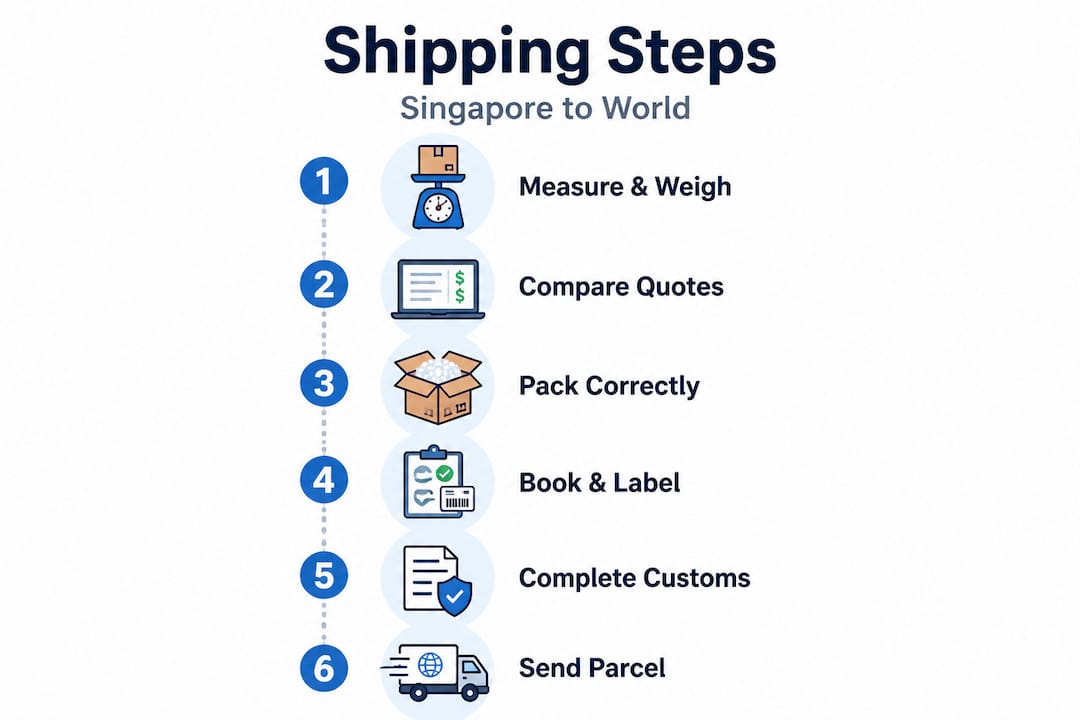
Step 1: Measure and weigh your parcel accurately
Measure the length, width, and height of the packed box in centimeters. Weigh the final packed parcel in kilograms. Calculate dimensional weight using this formula: (Length x Width x Height) divided by 5,000. Compare this to your actual weight and note the higher value. That is what couriers will use to price your shipment.
Step 2: Request and compare multiple quotes
Never book with the first courier you find. Use an aggregator platform to compare quotes from multiple services at once. Look at the complete cost breakdown, not just the headline price. Pay close attention to transit times for each service level.
Key service tiers to consider:
| Service Type | Typical Transit Time | Best For | Estimated Cost Level |
|---|---|---|---|
| Priority/Express | 1 to 3 business days | Urgent documents, time-sensitive goods | Highest |
| Connect-Plus | 3 to 7 business days | Regular parcels, moderate urgency | Mid-range |
| Economy | 7 to 20 business days | Non-urgent items, cost-sensitive senders | Lowest |
For cost-conscious senders, economy shipping tips can help you get reliable delivery at a fraction of express prices. If you are sending multiple parcels to the same destination, consolidating them into one shipment often reduces the per-unit cost significantly. Couriers reward volume, and grouping shipments is one of the most effective ways to cut costs.
Step 3: Pack your parcel properly
Use a sturdy outer box with no pre-existing damage. Wrap fragile items individually with bubble wrap. Fill empty spaces with packing peanuts or crumpled paper to prevent movement. Seal all edges firmly with strong packing tape. Write or print the recipient address clearly on the outer surface.
Step 4: Book and generate your shipping label
Once you have selected your courier and service, complete the online booking. You will enter parcel dimensions, weight, sender and recipient details, and declared value. A shipping label and any required customs documents will be generated automatically. Print these clearly on white paper. Avoid using colored paper or inkjet prints that may fade.
Step 5: Complete customs documentation carefully
Customs forms must match your parcel contents exactly. Undervaluing goods or using vague descriptions like "gift" or "miscellaneous items" can lead to delays, fines, or seizure. Write specific descriptions such as "cotton t-shirt, used" or "ceramic coffee mug, new." State the accurate value in USD or SGD as required. For business senders, attach a commercial invoice that matches the customs form.
Step 6: Hand over your parcel or schedule a pickup
Most courier platforms offer free pickup from your home or office. Schedule this when booking. If you prefer, drop off at a designated service point. Keep your booking confirmation and tracking number safe. Review options for best international couriers to match the right service to your specific destination.
Pro Tip: Always request a quote breakdown that shows every individual fee before confirming your booking. A single surcharge you did not account for can add 20 to 40% to your expected cost.
For non-urgent goods, consider using economy services and grouping multiple orders going to the same region. This approach, combined with corporate rate negotiation for regular senders, is one of the most effective ways to reduce shipping spend over time.
Avoiding common mistakes and extra costs
Even with the process mapped out, mistakes can happen. Here is what to watch for and avoid.
Some of the most expensive shipping errors are also the most preventable. Understanding where money typically leaks out of a shipment budget gives you a clear advantage.
Common mistakes Singapore senders make:
- Measuring the box before adding packing materials, resulting in an underestimated volumetric weight
- Accepting the first quote without checking if surcharges are included
- Leaving customs forms blank or incomplete, causing customs holds
- Ignoring residential delivery fees when shipping to home addresses overseas
- Forgetting to declare the correct value of goods, which can delay clearance
- Not keeping a copy of the customs declaration and commercial invoice
The most expensive single mistake is underestimating dimensional weight. A large, lightweight box shipped to the United States or Europe can be billed at three to four times what you expected.
"Dimensional weight often doubles or triples shipping costs unexpectedly. Always request a full cost breakdown before you finalize your booking." This is not an edge case. It affects a significant portion of international shipments, especially e-commerce parcels containing clothing, electronics packaging, or household goods.
Use a DIM weight calculator before you commit to any box size. Sometimes switching to a slightly smaller box or repacking more tightly reduces your volumetric weight and saves meaningful money. Small adjustments in how you pack can genuinely change the final price.
Pro Tip: Before booking, use an online DIM weight calculator and compare the result to the actual weight of your parcel. If the volumetric weight is significantly higher, consider downsizing your box or repacking to reduce empty space.
Residential delivery fees are another silent cost. Many senders compare courier rates based on business address delivery but then ship to a home address. The fee difference can add $5 to $15 per parcel, which adds up quickly for small businesses sending regular orders. Check courier comparison advice that accounts for address-type differences before you choose your carrier.
It is also worth noting that the cheapest base rate does not always mean the lowest final cost. A courier with a low headline rate may apply high fuel surcharges, handling fees, or remote area charges. Always compare the fully landed cost, which is the total amount charged after every fee is added.
How to verify, track, and resolve shipping issues
Finally, once your parcel is on its way, here is how to stay confident and manage any hiccups that arise.
Sending a parcel internationally does not end at the handover. The period between dispatch and delivery requires active monitoring, especially for high-value shipments or time-sensitive deliveries.
Steps to verify and track your shipment:
- Save your tracking number immediately after booking confirmation
- Use your courier or aggregator platform to check tracking status daily
- Set up email or SMS notifications if the platform offers them
- Note expected delivery windows and flag any deviation early
- Keep a copy of your booking confirmation, customs forms, and commercial invoice
Use reliable shipment tracking tools to monitor your parcel at every stage. Most international couriers provide scan-by-scan updates showing when a parcel leaves Singapore, clears origin customs, arrives at the destination country, clears destination customs, and is out for final delivery. Each of these stages can introduce a delay.
What to do if your parcel is delayed:
- Check the tracking status for a specific reason or customs hold note
- Contact your courier using your tracking number and shipment documentation
- If a customs hold is indicated, your recipient may need to provide identity documents or pay import duties before release
- For parcels with no movement for five or more business days, escalate the issue to the courier's customer service team
What to do if your parcel is lost:
- File a formal claim with the courier within the time limit stated in their terms (usually 30 to 60 days from dispatch)
- Provide proof of shipment, declared value, and a copy of your invoice
- If you purchased shipping insurance at booking, submit your insurance claim simultaneously
Good documentation is your best protection. Senders who keep organized records resolve issues faster and recover losses more easily. Before confirming your shipment, also verify that all surcharges and negotiated rates are clearly reflected in your booking confirmation. Any discrepancy is easier to address before dispatch than after.
Pro Tip: Create a simple folder on your device for each shipment containing the tracking number, booking confirmation, customs declaration, and recipient details. If anything goes wrong, you will have everything you need in one place.
What most guides miss about international shipping costs
With all these practical steps covered, let us look at why the real secret to savings goes deeper than just picking a courier.
Most shipping guides spend the majority of their time helping you choose between Courier A and Courier B. They compare logos, brand reputations, and transit times. That is useful, but it misses the bigger picture. In our experience, the senders who save the most money are not necessarily those who find the cheapest courier. They are the ones who understand how costs are constructed and use that knowledge at every stage.
The most impactful insight we can share is this: the quote breakdown is more valuable than the courier brand. A well-known courier with a transparent, itemized quote is almost always a better choice than a budget carrier with a low headline rate that hides fees. Hidden charges are not just annoying. They undermine your ability to price your products correctly if you are a small business, or budget your shipping spend accurately if you are an individual sender.
There is also a widespread belief that small businesses cannot negotiate rates. That is incorrect. Couriers regularly offer better rates for SMEs that commit to a volume of shipments per month, even at relatively modest quantities. If you are sending five to ten parcels a month internationally, it is worth calling or emailing your preferred courier to ask about corporate pricing. The worst they can say is no.
Combining three strategies consistently produces the best outcomes: comparing fully costed quotes (not just base rates), consolidating shipments where possible, and tracking every surcharge over time to spot patterns. When you notice that a particular route always triggers a remote area surcharge, you can plan for it or find an alternative carrier for that destination. This proactive approach turns shipping from a cost center into a managed, predictable expense.
Ready to simplify your international shipping?
If you are ready to put this guide into practice, here are some helpful next steps.
Simply Parcel makes international shipping from Singapore straightforward and transparent. You can compare quotes from multiple major couriers in one place, with full fee breakdowns that include fuel surcharges, dimensional weight, and residential delivery fees. No hidden costs. No surprises. From there, you can request a shipment quote instantly and move directly to booking with free pickup from your address. Need to review parcel dimensions and service options? You can check all the details through the instant quote details page before committing. Whether you are an individual sending a gift or a small business managing regular exports, Simply Parcel gives you the tools to ship smarter and spend less.
Frequently asked questions
What documents do I need to ship internationally from Singapore?
You need the recipient's full details, a customs declaration form, and proof of shipment. For business parcels, a commercial invoice is also required, and you should compare full quotes including duties and taxes before booking.
How do I avoid unexpected shipping charges?
Compare quotes that display every fee line by line, and always check your DIM weight calculation before confirming. DIM weight can double or triple your expected cost if you do not account for it upfront.
Is economy shipping reliable for international parcels?
Yes, economy shipping is dependable for non-urgent items and offers significant savings when timelines are flexible. You can use economy services most effectively by consolidating multiple shipments heading to the same region.
What should I do if my international parcel is delayed?
Check your tracking status for a customs hold or delivery exception, then contact the courier with your tracking number and documentation. Providing accurate records at booking makes it much easier to resolve issues quickly.
Can small businesses negotiate better shipping rates?
Yes, businesses sending regular volumes can often negotiate corporate rates and reduce costs further by consolidating shipments. Even moderate monthly volumes are often enough to qualify for discounted pricing with major couriers.