You can ship electronics overseas safely if you do five things: check the lithium battery rules, declare accurate customs paperwork with the right HS code, back up and power down the device, pack it to a double-box standard, and choose a carrier that clears customs well. Miss any one of these and you risk a seizure, a fine, or a shipment stuck in a bonded warehouse for weeks.
Here's your immediate action list:
- Check battery classification against UNECE/IATA dangerous goods rules before you book anything.
- Declare the full replacement value and the correct HS code (laptops typically use 8471.30).
- Back up your data, wipe sensitive files, and power the device off completely.
- Pack to a double-box standard with real cushioning, not just a single mailer box.
- Book through a customs-clearing service like Simply Parcel that auto-generates your documentation.
Key Takeaways
Shipping electronics overseas safely depends on correct battery classification, accurate customs paperwork, and packaging that meets carrier double-box standards.
| Point | Details |
|---|---|
| Battery classification first | Check whether your device falls under UN3481 rules before booking any shipment. |
| Accurate paperwork prevents delays | Use the correct HS code and declare full replacement value on every invoice. |
| Double-box for protection | Cushion devices with 2 to 3 inches of padding inside an outer box. |
| Choose the right Incoterm | Use DDP for company-to-employee shipments to avoid surprise duty bills. |
| Simply Parcel streamlines booking | The platform auto-generates labels and invoices and compares carriers in one place. |
Table of Contents
- What to Check Before You Pack Your Electronics
- How to Pack Electronics for International Shipping
- What Are the Lithium Battery Rules for Shipping?
- What Documents Do You Need to Ship Electronics?
- Air vs. Sea: Which Shipping Option Fits Your Electronics?
- How Does Insurance Work for Electronics Shipments?
- Pre-Shipment Checklist Before You Hand Off the Parcel
- How Simply Parcel Simplifies Electronics Shipping From Singapore
- Ship Your Next Device With Confidence
- Sources
What to Check Before You Pack Your Electronics
Before you tape a single box, verify three things: legality at the destination, the physical condition of the device, and whether you need extra paperwork.
Some countries restrict used electronics, ban certain radio-frequency devices, or require import licenses for anything with a battery or transmitter. A quick check against the destination country's customs website saves you from a shipment sitting in limbo. Devices with damaged casings, swollen batteries, or active recall notices cannot ship at all. Swollen lithium cells are a known fire risk in transit, and industry safety guidance is unambiguous that damaged cells should be pulled from circulation entirely, not shipped.
If you're sending devices for a business, personal shipments and commercial ones follow different rules. A single used laptop going to a relative is treated differently than ten refurbished phones going to a distributor, which may need an export permit or commercial invoice with a tax ID.
Before packing, run through this quick prep list:
- Back up all data and log out of cloud accounts.
- Remove the SIM card and any external storage.
- Power the device off completely, don't leave it in sleep mode.
- Charge the battery to roughly one third, a safer state for transit than full charge.
Pro Tip: Photograph the device's serial number and condition before it goes into the box. If a claim ever comes up, that photo is your first piece of evidence.
How to Pack Electronics for International Shipping
Good packaging is what actually stops your laptop or phone from arriving in pieces, and international carriers use consistent standards for a reason.
Follow this sequence for most devices:
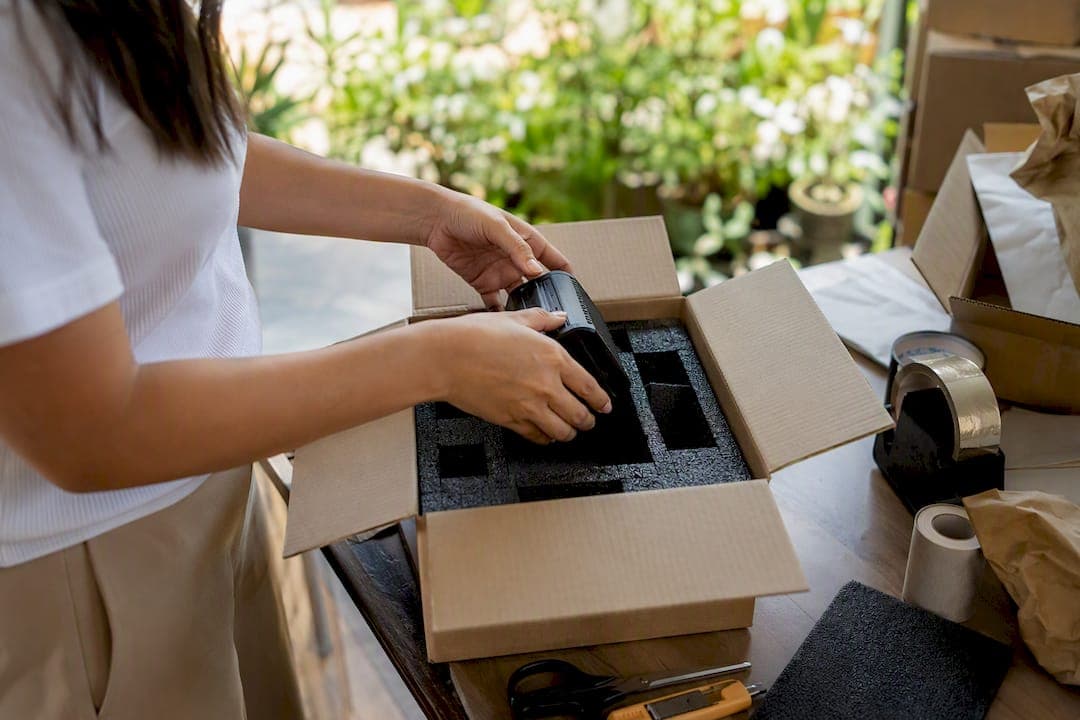
- Wrap the device individually in an anti-static bag, especially for laptops, desktops, and circuit boards.
- Add a layer of bubble wrap or foam around the device, filling any gaps so nothing can shift.
- Immobilize the device inside an inner box, it should not move when you shake the box gently.
- Place the inner box inside a larger outer box with at least 2 to 3 inches of cushioning on all sides, a standard carrier guidance recommends for laptops.
- Seal the outer box using the H-taping method, reinforcing all seams.
A few device-specific notes matter here. Smartphones need extra padding around the screen since cracked glass is the most common damage claim. Monitors and desktop towers need corner protection and should never rest directly on a box seam. External battery packs and power banks need the same anti-static wrapping as the main device, and chargers or cables should travel in the same shipment, packed separately in a side pocket or small pouch so they don't scratch the screen.
Skip foam peanuts. They shift during transit and don't protect corners or screens the way rigid foam blocks do.
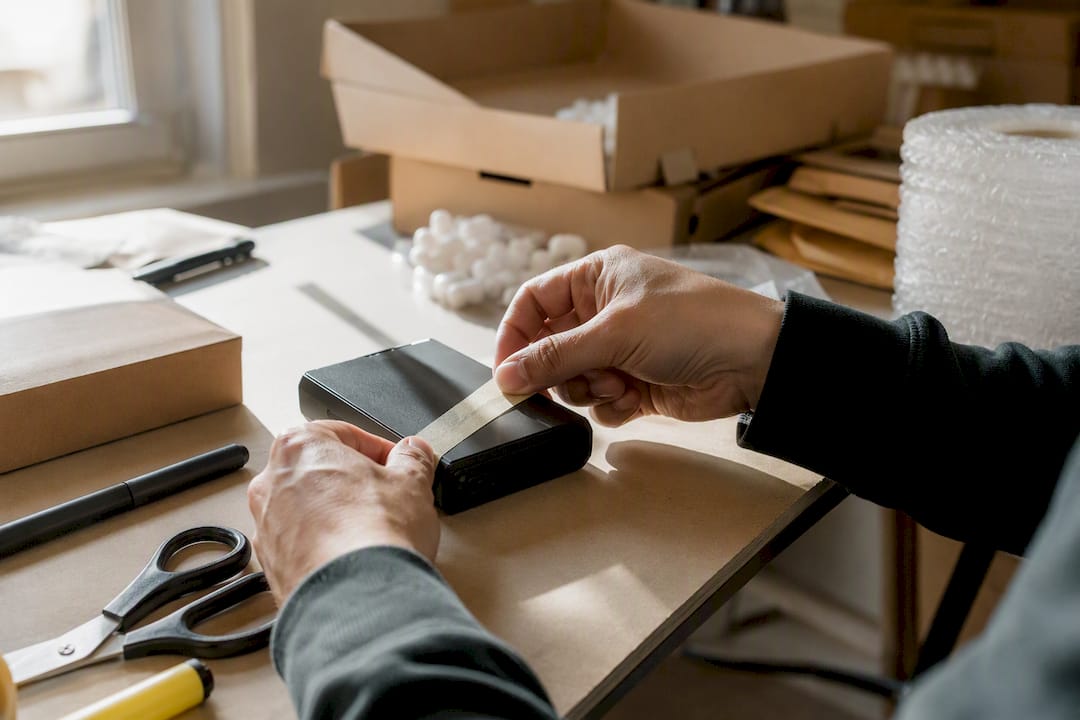
Pro Tip: Tape over power buttons so devices can't switch on mid-transit. A phone that powers on inside a sealed box can drain its battery or overheat.
What Are the Lithium Battery Rules for Shipping?
Lithium batteries are the single biggest reason electronics shipments get flagged, refused, or rerouted through dangerous goods handling.
Lithium-ion batteries installed in equipment fall under classification UN3481, and the UNECE Dangerous Goods manual sets specific packing instructions for this category, with lighter rules applying when the battery stays installed in the device rather than shipped loose. Most consumer laptop and phone batteries fall under a 100 watt-hour threshold, which qualifies for simpler handling than higher-capacity cells.
Your shipment becomes a full dangerous goods case, with extra paperwork and often a dedicated DG service, when any of these apply:
- The battery is loose or shipped as a spare, not installed in the device.
- The cell is damaged, swollen, or subject to a manufacturer recall.
- The battery exceeds 100 Wh.
Damaged or recalled batteries are not just restricted, they're barred from air transport outright, and safety guidance on lithium-ion risk treats correct classification as the single biggest lever for avoiding in-transit fires. Always declare the battery type and watt-hour rating to your carrier upfront, and never remove a battery just to ship it as a separate spare. Keeping it installed is almost always the simpler, safer path.
What Documents Do You Need to Ship Electronics?
Every international electronics shipment needs a commercial invoice, and getting it right is what keeps your package moving instead of sitting in a customs queue.
Your invoice needs the full item description (make, model, serial number), the correct HS code, the full replacement value, country of origin, and a stated purpose (gift, personal use, or commercial sale). For laptops, HS code 8471.30 is the commonly used classification, and vague descriptions like "electronics" are one of the most common causes of customs delays.
You'll also need to pick an Incoterm. DDP (Delivered Duty Paid) means you cover duties upfront, which is strongly recommended when a company ships a device to an employee abroad, since nobody wants a new hire fielding a surprise customs bill on day one. DAP (Delivered at Place) leaves duties to the recipient, which works fine for personal shipments where the receiver expects it.
If you're unsure which HS code applies, most customs authorities offer an official classification ruling request, worth using for anything outside a standard laptop or phone.
Pro Tip: Never under-declare value to save on duties. It's a false declaration, and the consequences run from seizure to fines that dwarf whatever duty you were trying to dodge.
| Point | Details |
|---|---|
| Commercial invoice | Include make, model, serial number, HS code, and full replacement value. |
| HS code accuracy | Use 8471.30 for laptops; request an official ruling if a code is unclear. |
| Incoterm choice | Choose DDP for company-to-employee shipments to avoid surprise duty bills. |
| Declared value | State full replacement value; undervaluing risks seizure and fines. |
Air vs. Sea: Which Shipping Option Fits Your Electronics?
Speed and value should drive your choice of shipping mode, not just price per kilogram.
Express air is the better call for anything with real resale value, a business laptop, a shipment of ten phones, because it clears customs faster and reduces the window where a device sits in a warehouse. Sea freight, whether LCL or FCL, only makes sense for bulk, low-value consignments where the savings outweigh weeks of transit time. Guidance on international electronics shipping generally points senders toward air for anything time-sensitive or high-value.
| Factor | Express Air | Sea Freight |
|---|---|---|
| Typical speed | Days | Weeks |
| Best for | High-value or urgent electronics | Bulk, low-value consignments |
| Customs handling | Faster clearance | Slower, more manual review |
| Relative cost | Higher per kilogram | Lower per kilogram at volume |
Your total cost isn't just freight. Expect duties and VAT calculated on declared value, a possible lithium battery surcharge, fuel or remote-area fees, and dimensional weight charges if your box is bulky but light. For anything high-value or shipped in bulk, working with a courier service that handles customs clearance directly, rather than a bare-bones postal option, cuts the odds of a hold at the border.
How Does Insurance Work for Electronics Shipments?
Carrier liability, the baseline compensation built into most shipping rates, almost never covers the real replacement cost of a laptop or phone. That gap is why declared value and optional insurance matter.
Set your declared value to match actual replacement cost, not the discounted price you paid used. A lowball declared value means a lowball payout if something breaks. If the carrier offers additional cargo or parcel insurance, buy it for anything over a few hundred dollars.
If a shipment arrives damaged, act fast:
- Photograph the damage and the packaging immediately, before you move anything.
- Keep all original packaging until the claim is fully resolved.
- File the claim with your tracking number, the invoice, and the photos attached.
Pro Tip: Claims move faster when your packaging matches carrier standards. An adjuster who sees proper double-boxing and cushioning is far more likely to approve a payout than one who sees a single thin envelope.
Pre-Shipment Checklist Before You Hand Off the Parcel
Run through this before the parcel leaves your hands:
- Data backed up and device wiped or encrypted
- Battery charged to a safe transit level, ideally around one third
- Serial numbers recorded and photographed
- Commercial invoice completed with correct HS code and full value
- Device double-boxed with adequate cushioning
- Fragile and "this side up" labels applied
- Declared value set and insurance arranged if needed
- Shipping term chosen, DDP or DAP
- All carrier documentation attached to the parcel
If any line item is unclear, a customs broker, your carrier's support line, or a platform like Simply Parcel can walk you through it before you commit to a booking.
How Simply Parcel Simplifies Electronics Shipping From Singapore
Simply Parcel handles the paperwork layer that trips up most first-time senders: online booking, automatic shipping labels, commercial invoice generation, HS-code assistance, pickup scheduling, and side-by-side carrier comparisons.
Pre-filled documents and partner carrier integrations reduce the odds of a rejected invoice or a mismatched HS code, which is often what stalls a shipment at customs. That said, no platform can waive a country's import permit requirements or approve an inaccurate declaration. Simply Parcel helps you prepare correctly. It can't substitute for a required license.
Pro Tip: If you're shipping from Singapore, check whether your electronics category needs a TradeNet export permit before you book, some categories require one even for a single unit.
What We See Go Wrong Most Often
The three recurring mistakes are vague paperwork, under-packing fragile devices, and mishandling battery declarations. If you're shipping a company laptop to an employee abroad, default to DDP. A duty surprise at their door is a rough way to start a new job.
Ship Your Next Device With Confidence
Simply Parcel gives you one place to compare carriers, generate a commercial invoice with the right HS code, and book a pickup, instead of juggling three different courier websites and hoping the paperwork lines up. That matters most for electronics, where one vague description or missing battery declaration can hold a shipment at the border for weeks. Whether you're sending a single laptop to family overseas or a batch of company phones to new hires, the platform pulls quotes from multiple carriers so you can match speed and cost to what you're actually shipping. Get an instant shipping quote and see your options before you commit to a carrier.