The most reliable way to ship fragile items is to use a correctly sized, sturdy box, add 3 inches of cushioning on every side, double-box high-value or awkward-shaped pieces, buy insurance that matches the item's worth, and photograph everything before sealing. This approach follows ISTA testing guidance and UPU postal packing rules, and you can book and track a shipment like this through Simply Parcel.
TL;DR:
- Use static protective wrap for electronics, and separate glass or liquid containers individually; international parcels also require absorbent material around bottles and accurate customs declarations.
- Use two boxes for heavy, oddly shaped, or irreplaceable items, centering the cushioned inner box with about 3 inches of padding between them.
- Oversized packaging can raise dimensional weight charges and let contents shift; compare quotes by actual and dimensional weight before choosing a box or courier.
- USPS discontinued its dedicated fragile handling service in 2022, and carriers may deny claims when packing fails their standards, so retain receipts and packing evidence.
Table of Contents
- Choose the right box: size, strength and when to use double-wall
- Wrap and cushion each item: materials and the 3-inch rule
- Double-boxing and special inner packaging techniques
- Seal and secure the package: tape patterns and weight guidance
- Labeling, orientation and documentation for fragile shipments
- Insurance, tracking, and claims: protecting value and avoiding denials
- International considerations: customs, liquids, anti-static and airline rules
- Testing, standards and pro tips: ISTA, 4-foot drop test, and non-obvious hacks
- Dimensional weight and how box size affects cost
- Choosing the right courier service based on handling of fragile items
- Step-by-step guide to preparing fragile items for international shipping with Simply Parcel
- Tips for tracking and monitoring fragile shipments in transit
- How to schedule and arrange parcel pickup for fragile packages
- Estimated shipping times and transit duration for fragile items under different service levels
- Why careful packing matters
- How Simply Parcel can help handle fragile shipments
- FAQ
- Sources
Choose the right box: size, strength and when to use double-wall
Your box should fit the item snugly enough to leave about 3 inches of empty space on every side for cushioning, never more. A box that is too large lets contents shift during transit, and one that is too small leaves no room for padding at all.
- Pick double-wall corrugated boxes for anything heavy, stacked, or likely to sit at the bottom of a pallet.
- Choose a box with a weight rating suitable for your packed shipment, box included.
- Skip reused or damaged boxes. Check flutes and corners for creases, soft spots, or old tape residue that weakens the structure.
A sound box is the foundation of everything that follows. Even perfect cushioning cannot compensate for a box that crushes under its own weight limit, and Shopify's packing guidance points to the same standard: strong materials first, padding second.
Wrap and cushion each item: materials and the 3-inch rule
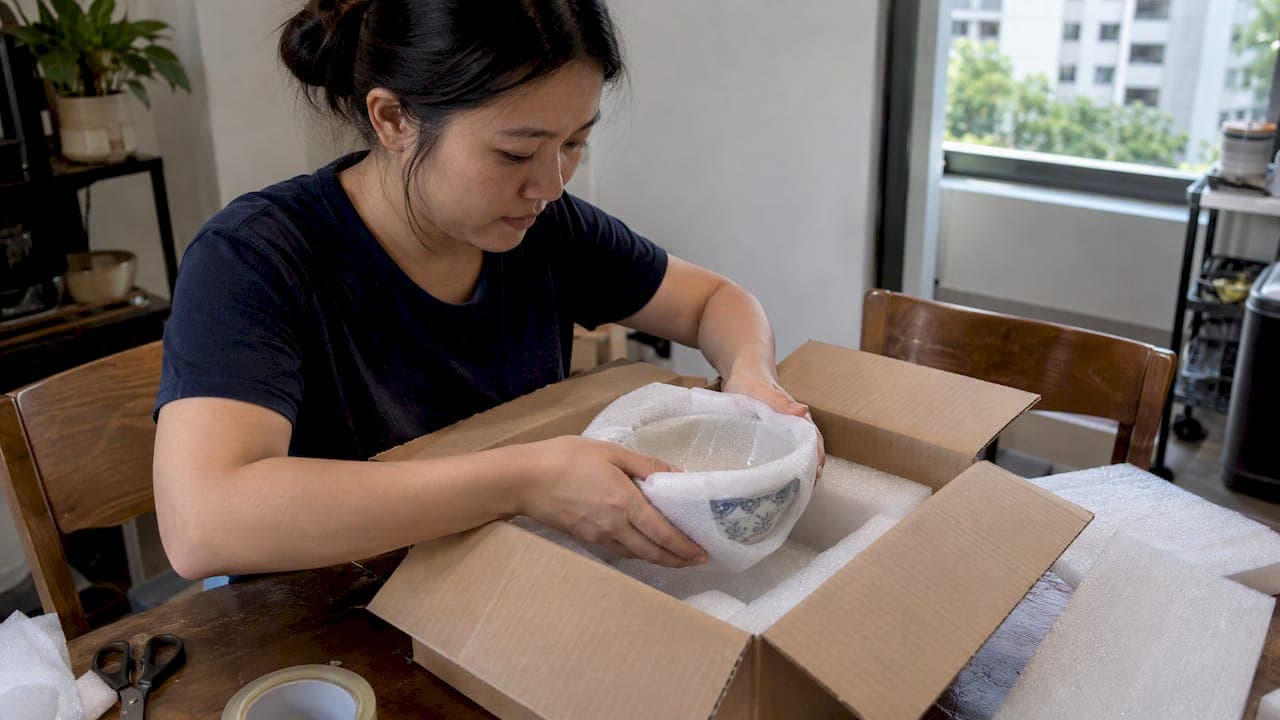
Wrap every fragile item individually before it goes anywhere near the box. Bubble wrap, foam sheets, and kraft paper each work well, and electronics need anti-static wrap specifically, since regular bubble wrap can carry a static charge that damages circuit boards.
- Wrap each item on its own and secure the wrap with tape so it cannot unravel in transit.
- Fill remaining space with packing peanuts, air pillows, or foam until you reach roughly 3 inches of cushioning on all sides, a benchmark Shopify and most carriers reference directly.
- Stuff hollow items like vases or mugs with crumpled paper, and separate multiples with cardboard partitions so they cannot knock against each other.
Pro Tip: Shake the sealed box gently before taping the final seam. If you hear or feel anything shifting, add more cushioning until the contents stay still.
Double-boxing and special inner packaging techniques
Double-boxing earns its place when the item's value or fragility justifies the extra step: heavier pieces, oddly shaped objects that don't sit flat, or anything irreplaceable. The idea is simple: a fully cushioned inner box sits centered inside a larger outer box, with another 3 inches of cushioning filling the gap between the two.
- Center the inner box so no side touches the outer box directly.
- Secure the inner box with cushioning firm enough to stop it from sliding when the outer box tips or rotates.
- Use partitions, molded foam, or bottle inserts when shipping sets of glasses, jars, or ornaments so each piece stays isolated from its neighbors.
This method costs a bit more in materials, but it is the difference between a stemware set arriving intact and arriving as gravel.
Seal and secure the package: tape patterns and weight guidance
Run tape in an H-pattern across the top and bottom seams, covering every flap junction, and reinforce the bottom corners since that's where weight concentrates during stacking.
- Use heavier, reinforced tape for anything over a few pounds, standard cellophane tape won't hold a loaded box.
- Avoid overpacking or compressing your cushioning. Compressed padding transfers impact straight through to the item instead of absorbing it.
- Add cardboard bracing inside the box for items prone to shifting even with cushioning in place.
A well-sealed box keeps its shape through handling, stacking, and the inevitable drop.
Labeling, orientation and documentation for fragile shipments
Clear labeling tells handlers what they're dealing with before they even open the box, and good documentation protects you if something still goes wrong.
- Mark "Fragile" and "This Side Up" on at least two sides of the box, plus the top, so the label is visible no matter how the package sits.
- Photograph the item and the packaging materials before you seal the box, and keep those photos along with your receipts as evidence if you need to file a claim.
- Fill out customs forms accurately for international shipments, declaring the true value and contents rather than rounding down.
Insurance, tracking, and claims: protecting value and avoiding denials
Match your declared insurance value to what the item would actually cost to replace, not a rounded guess. Standard carrier liability is often limited, and USPS confirms it discontinued its dedicated Special Handling, Fragile service in 2022, recommending careful packing plus purchased insurance as the real safeguard instead.
- Buy declared-value insurance that reflects replacement cost, especially for anything irreplaceable or custom-made.
- Document your packing process with photos of materials and the sealed box, since claims are frequently denied when packing doesn't meet carrier standards.
- Use tracking on every fragile shipment, and add optional shipment protection where your booking platform offers it.
Insurance only pays out when the paperwork backs up the claim, so keep your evidence organized before you need it.
International considerations: customs, liquids, anti-static and airline rules
Cross-border fragile shipments carry a few extra rules worth checking before you book. UPU postal guidance requires that multiple fragile receptacles inside one package be wrapped or separated individually, and liquids need absorbent material placed between the primary container and the outer packaging.
- Wrap each liquid or glass receptacle on its own, and include absorbent padding around bottles or jars as required by postal rules.
- Use anti-static cushioning for electronics, and account for temperature and pressure changes during air transit on sensitive components.
- Complete customs documentation accurately and check the destination country's restricted or prohibited item list before you finalize your booking.
For a deeper walkthrough of customs steps and documentation, our guide on sending packages overseas covers the paperwork side in more detail.
Testing, standards and pro tips: ISTA, 4-foot drop test, and non-obvious hacks
ISTA recommends testing packaging with representative production samples rather than one-off prototypes, and a drop test can help assess whether a packing setup survives rough handling.
Pro Tip: For mirrors or sheet glass, apply painter's tape in a star pattern across the surface and pad the corners with foam. If the glass cracks, the tape keeps shards contained instead of scattering.

Keep a simple log of what materials you used and photograph the finished box from several angles. That record becomes useful fast if you ever need to support an insurance claim.
Dimensional weight and how box size affects cost
Carriers typically charge based on whichever is greater: the actual weight of your package or its dimensional weight, a calculation based on the box's length, width, and height. A bigger box, even one that's mostly empty space, can push your shipment into a higher price bracket.

This matters directly for fragile items, because the instinct is often to grab the largest box available "to be safe." But oversizing works against you twice: it costs more under dimensional weight pricing, and it gives contents more room to shift, which raises damage risk rather than lowering it.
The fix is the same 3-inch cushioning rule from earlier, applied with intention. Choose a box that's large enough for the item and its protective padding, nothing more. If you're shipping several small fragile pieces, a snug box with internal partitions usually beats one oversized box with loose peanuts, both for protection and for cost.
When you compare quotes, check whether the rate is based on actual weight, dimensional weight, or both, since this affects which box size actually saves you money. Our parcel packaging best practices guide breaks down material choices that help you hit that snug fit without adding bulk.
Choosing the right courier service based on handling of fragile items
Not every courier handles fragile freight the same way, and the service level you pick affects how many times your package gets sorted, stacked, and transferred before arrival. Fewer transfer points generally mean fewer chances for rough handling.
When comparing courier options, look at a few practical signals: whether the carrier offers purchasable insurance beyond a basic liability cap, whether tracking updates are frequent enough to flag problems early, and whether the service has clear guidance on packing fragile goods (a sign that handlers are trained to look for fragile labeling in the first place).
Price matters too, but the cheapest option often routes through more hubs and handoffs, which adds risk for breakable items. A mid-tier or priority service that limits handling touches can be worth the difference for anything irreplaceable.
Through Simply Parcel, you can compare multiple courier partners side by side on rate, transit time, and service level before you commit, so you're not choosing blind or defaulting to whichever option shows up first. That comparison step is especially useful for fragile shipments, where the right carrier choice does as much work as your packing job.
Step-by-step guide to preparing fragile items for international shipping with Simply Parcel
Once your item is packed, cushioned, and sealed following the steps above, getting it booked for international transit is straightforward.
- Enter your shipment details and destination on our quote page to compare rates across courier partners.
- Select a service level, Priority, Connect Plus, or Economy, based on how quickly the item needs to arrive and your budget.
- Add optional shipment protection.
- Let the platform auto-generate your shipping label and customs documentation, filled out accurately with true contents and value.
- Schedule a doorstep pickup at a time that works for you, no drop-off required.
Our detailed pro guide on packaging fragile items for international shipping walks through packing specifics for items crossing borders, including customs value declarations that match what you've wrapped and boxed.
Tips for tracking and monitoring fragile shipments in transit
Tracking a fragile shipment is about more than knowing where it is, it's your early warning system if something looks off. Check scan updates at each major checkpoint rather than waiting for a final delivery notification, since a long gap between scans or a status that jumps backward can signal a handling delay worth following up on.
Check tracking updates, especially at customs clearance for international shipments, which is often where fragile goods sit longest without movement. If a scan shows the package at a sorting facility for an unusually long time, a quick check-in with the carrier can catch a problem before it becomes a damage claim.
Keep your tracking number paired with the photos and documentation from your packing process. If a claim becomes necessary, having both the transit history and the packing evidence in one place speeds up resolution considerably. Real-time tracking through your booking platform also removes the guesswork of calling a carrier hotline for status updates.
How to schedule and arrange parcel pickup for fragile packages
Arranging pickup for a fragile shipment works the same way as any parcel, with one added step: timing it so the package isn't sitting out in extreme heat, cold, or rain while waiting for collection.
Book your pickup window after your box is fully packed, cushioned, and sealed, not before, so you're not rushing the packing process to meet a driver's schedule. Choose a pickup slot with enough buffer that you can do a final shake test and double-check labeling without feeling rushed.
Free doorstep pickup removes the need to haul a heavy, fragile box to a drop-off counter, which is itself a handling risk you can skip entirely. Through Simply Parcel's booking flow, you arrange a pickup after confirming your service level and documentation, and a courier partner collects from your address.
Estimated shipping times and transit duration for fragile items under different service levels
Transit time depends on the service level you choose, and fragile items don't require a different timeline from standard cargo as long as they're packed to the same durability standard. Priority Shipping moves fastest, suited to urgent or time-sensitive fragile goods where you want the fewest days in transit and, generally, fewer handling touches along the way.
Connect Plus Shipping sits in the middle, balancing speed and cost for shipments that aren't urgent but still benefit from a more direct routing than the cheapest option offers. Economy Shipping takes longer and typically involves more consolidation points, which is worth factoring in if your item is especially delicate, since more transfers mean more handling overall.
Exact transit days vary by destination and courier partner, so the clearest way to see timing for your specific route is to compare options directly on our shipping services page, where Priority, Connect Plus, and Economy are listed side by side with their respective courier partners.
Why careful packing matters
Careful packing can help reduce the risk of damage as international parcels move through customs and multiple carrier handoffs. Careful preparation reduces both breakage and the friction of filing a claim afterward. We built our booking and documentation tools around that same principle, helping you get the paperwork and pickup right the first time.
— SP
How Simply Parcel can help handle fragile shipments
Once your item is wrapped, cushioned, and sealed, the rest comes down to picking a service and getting it collected. We let you compare rates across courier partners for Priority Shipping, Connect Plus Shipping, and Economy Shipping in one place, so you can match speed and cost to how fragile and urgent your shipment actually is.

- Compare courier partner rates and transit times before you commit to a service level.
- Book a free doorstep pickup instead of carrying a fragile box to a counter.
- Get auto-generated shipping labels and customs documentation filled out from your shipment details.
- Track your parcel in real time and add optional shipment protection to match declared value.
If you've got a fragile shipment ready to go, get a quote and review your packaging against the steps above before you book.
FAQ
What is the best way to ship a fragile item?
Use a sturdy, correctly sized box with about 3 inches of cushioning on every side, following the benchmark referenced in industry packing guidance. Double-box high-value or oddly shaped items, seal seams with an H-tape pattern, and label the package "Fragile" on multiple sides before adding insurance that matches the item's replacement value.
How much does it cost to ship a fragile item?
Cost depends on the courier, destination, and service level you choose, along with your package's dimensional weight, which is based on box size rather than just actual weight. You can compare current rates across courier partners and service levels directly on our shipment quote page.
Which company is best for shipping fragile items?
The right choice depends on your route, budget, and how quickly you need the item to arrive, since different courier partners handle transfers and fragile labeling differently. Comparing multiple courier partners side by side, rather than defaulting to one carrier, is the most reliable way to match your shipment to a service suited for breakable goods.
Can I mail fragile items through USPS?
Yes, though USPS discontinued its dedicated Special Handling, Fragile service in 2022 and now recommends thorough packing plus purchased insurance instead of a special fragile designation. Priority Mail International also includes limited automatic insurance, with additional coverage available for higher-value merchandise.
Do I need extra insurance for fragile international shipments?
It's worth matching your declared insurance value to the item's actual replacement cost rather than relying on a carrier's default liability limit, which is often lower than an item's worth. Keeping photos of your packing process also helps, since claims are frequently denied when packing doesn't meet carrier standards.
Sources
- ISTA, Your Alliance in Transport Packaging, is the world leader in Performance Tests for Packaged-Products
- Upu
- How to Ship Fragile Items: 6 Packing Tips (2025) - Shopify
- 323 Priority Mail International Insurance | Postal Explorer
- Fragile handling dropped – USPS Employee News