To ship artwork overseas, pack it so the surface never touches anything, match the service to the piece's size and value, declare the true value on the customs paperwork, and insure it for that value. Small and medium works travel well by international courier. Large, heavy or irreplaceable pieces belong with a specialist art shipper. This guide walks you through each step in order.
TL;DR
- Works 48 inches or more on any side need a wooden crate. Smaller paintings need a rigid, well-cushioned box with nothing pressing on the surface.
- Ordinary parcel services stop making sense above roughly 150 cm on the longest side or 30 kg. Use a specialist shipper for valuable or irreplaceable work.
- Declare the full value and keep photos and proof of value. Standard carrier liability is usually tied to weight, not to what the piece is worth.
- Duties and VAT follow the destination country's rules, and the buyer is usually charged on delivery unless you arrange payment in advance.
- Compare speeds and prices before you book, then track the shipment until the recipient confirms the artwork is unharmed.
Table of Contents
- Decide first: courier or specialist shipper?
- Pack the artwork so nothing touches the surface
- Choose a shipping method: air, sea and speed
- What does it cost to ship a painting overseas?
- Customs paperwork for artwork
- Duties, VAT and who pays
- Insure the artwork for its real value
- Our perspective
- Book your artwork shipment from Singapore
- Track the shipment and confirm delivery
- FAQ
- Sources
Decide first: courier or specialist shipper?
The size, value and fragility of the piece decide the route, not the destination.
| Situation | Usual best route |
|---|---|
| Prints, drawings and small works on paper | International courier, flat and rigid packaging |
| Medium framed or canvas paintings | International express or standard courier, boxed or crated |
| Large, heavy or very valuable pieces, museum loans, major collections | Specialist art shipper with museum-grade crating |
This matches guidance from ArtSume, which suggests postal services for prints and small works, express couriers for medium or large paintings, and specialist shippers for valuable or irreplaceable pieces. Specialists offer white-glove handling and custom crating, which is why they suit museum loans and serious collectors.
There is also a physical limit. One gallery-academy guide puts it at about 150 centimeters on the longest side, or 30 kilograms, beyond which ordinary parcel services are no longer an option. If your piece is over that, skip to the specialist route.
For very high-value or awkward pieces, a specialist moving and handling service with experience in single-item transport can be worth asking about, because they handle bulky and delicate objects every week.
Pack the artwork so nothing touches the surface
Packing is where most damage is prevented. Treat the steps below as a baseline, then adjust for the medium.
- Document first. Photograph the front, back, corners and any existing marks in good light. Write a short condition report and sign and date it.
- Protect the surface. Use acid-free or archival material in direct contact with the work. Fine-art shipping guidance in our research notes that bubble wrap should not touch painted surfaces, so put a clean barrier layer between them.
- Cover the corners. Corners take most knocks. Use rigid corner protectors on framed work.
- Glazing needs care. For framed pieces under glass, tape the glass in a cross pattern or use acrylic glazing, so a crack does not scrape the artwork. The protective film options for international shipping are worth a look when you want a temporary cover on a surface.
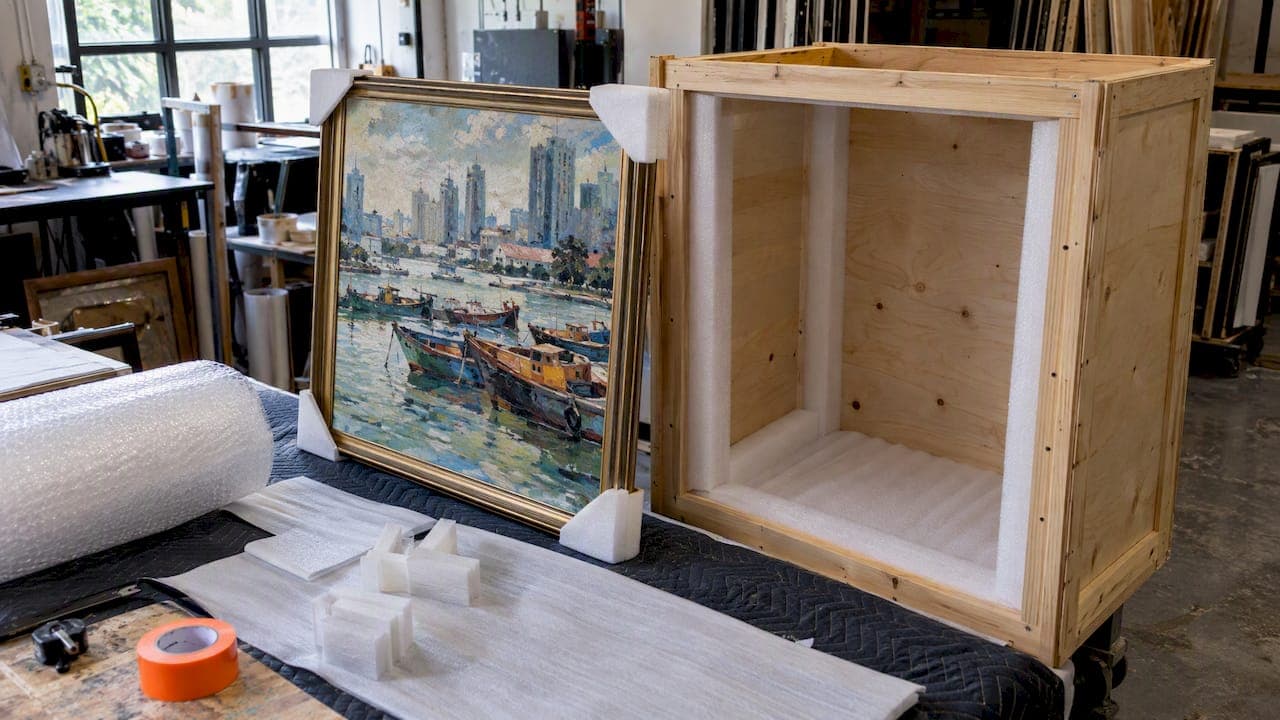
- Use a rigid outer box or crate. The artwork should sit in the center with firm cushioning on every side. We cover cushioning depth and drop testing in our guide to shipping fragile items, and our parcel packaging best practices apply here too.
- Crate large pieces. Saatchi Art's packaging guidance states that artwork 48 inches or more on any one side must go in a wooden crate. Many sellers and galleries use a similar rule.
- Label clearly. Mark the outside as fragile and add the destination address on a label inside the package as well.
Packaging should follow the specific risk of the work. As Madeleine Leaver of Artlogic puts it in a guide for galleries, the choice depends on material sensitivity and environmental needs rather than a generic formula. A thick oil painting, a pastel and a framed photograph each fail in different ways.
Special cases
- Unframed canvas: Remove the work from the stretcher only if you know how. Otherwise keep it stretched and box it with rigid boards front and back.
- Works on paper: Keep them flat between rigid boards, in a sleeve, inside a waterproof wrap.
- Pastel, charcoal and wet-looking oil: Make sure nothing presses on the surface at all. Let oils cure fully before wrapping.
- Sculpture: Immobilize the piece inside the box so it cannot shift, and protect any protruding parts separately.
Choose a shipping method: air, sea and speed
Air transport is the usual choice for high-value items. Sea freight is an option for large, heavy works that are impractical or too expensive to fly, though fragile cargo then needs protection from humidity and temperature swings, according to the Canadian Conservation Institute. Insurers have also traditionally charged sea transits two to three times the air rate and may exclude rust, oxidation and climatic conditions, so check cover before choosing the slow route.
For most single paintings sent by courier, the real choice is speed. Standard international shipping generally takes 1 to 4 weeks, while express takes 3 to 5 days and costs more, and customs can add time. On Simply Parcel you pick from three speeds:
- Priority: the fastest option, for time-sensitive deliveries.
- Connect Plus: a middle option between speed and cost.
- Economy: the lowest cost, with longer transit.
For a fuller breakdown, read Express vs. Economy shipping and the comparison of two express services. We also compare Priority and Connect Plus in detail.
A practical rule: choose economy for a low-value print where a delay is only an inconvenience. Choose priority or connect-plus for an original, a commission with a deadline, or a gift with a date.
What does it cost to ship a painting overseas?
Cost depends on the size and weight of the finished package (box or crate included), the packing materials, and the service level. Dimensional weight matters: a large, light, flat package is billed for its volume, not its scale weight.
To give a sense of the range, one art-selling platform reports that a framed 18x24 inch print of 2.2 kg sent from the US to the UK runs from $70 to $120 by postal service up to $200 to $350 or more by premium express. Treat that as an indication of the spread between slow and fast, not a quote. Rates from Singapore will differ by route and weight.

The quickest way to see your own price is to enter the destination and the measured package size in our instant quote tool. Measure the packed parcel, not the bare canvas, because the carrier bills the packed dimensions. Our expat shipping cost tips show how to compare options sensibly.
Customs paperwork for artwork
Customs looks at what the item is, what it is worth and why it is crossing the border. A clear commercial invoice or proforma helps in every case.
What to put on the paperwork
- A plain description: "original oil painting on canvas, framed", with the medium, dimensions and artist.
- The real value: the sale price for a sold work, or a realistic value for a gift or a piece sent for exhibition.
- The reason for shipping: sale, gift, exhibition or return.
- Country of origin and the sender and recipient details.
Under-declaring to cut the duty or to look cheaper creates trouble in customs and weakens any later insurance claim. Our guides to the shipping documentation process and international shipping step by step cover the forms in more depth. Simply Parcel generates the shipping label and customs documentation automatically when you book.
Export rules at origin. Many shipments need no export permit, but there are exemptions and exceptions for controlled goods, and Singapore Customs explains when a Customs export permit is needed. If you ship from Singapore, check that page for your item.
Cultural goods and antiques. Some countries regulate the movement of older or culturally significant objects. Italy, for example, may require a certificate of free circulation or a self-declaration for objects of cultural interest, depending on age or economic value. If your piece is old, or a family heirloom, ask the destination country's culture or customs authority before you ship.
Duties, VAT and who pays
VAT and duties follow the rules of the destination country. According to Visual Artists Ireland, the recipient is usually charged on delivery unless payment is arranged in advance.
This surprises buyers. A collector who has already paid for a painting can face a separate bill at the door and may refuse the parcel. Before shipping:
- Tell the buyer which charges may apply and who pays.
- Check the destination's rules for art, since rates and thresholds differ by country.
- If the buyer should not pay on delivery, ask about prepaying duties at booking.
Send the buyer the tracking number and the commercial invoice, so they can answer customs questions quickly if asked.
Insure the artwork for its real value
This is the step people skip, and it is the one that matters most when something goes wrong.
Standard carrier liability is often modest. One law firm's overview of fine-art transit says reimbursement for damaged or lost art is typically weight-based, at about $0.60 per pound, not the value of the work. For a painting that is worth far more than it weighs, that gap is large.
What to do:
- Declare the full value on the shipment. Our explainer on declared value shows what it means and when to insure.
- Add protection coverage. Simply Parcel offers optional additional protection on shipments. Consider third-party art insurance for high-value originals, as ArtSume advises.
- Keep your evidence. Before pickup, keep dated photos, the signed condition report and proof of value such as an invoice or appraisal. Claims depend on this documentation.
- Inspect on arrival. Ask the recipient to photograph the packaging and the work before and after unpacking, and to keep all the packaging until any claim is closed.
For valuable work, Chubb recommends using reputable art shippers rather than general movers, who can also advise on customs and tax rules.
Our perspective
Most artwork shipments that go wrong share the same causes: packaging that was too thin for the size of the piece, a declared value far below the real one, and a buyer surprised by import charges. None of these needs a specialist budget to fix.
We built Simply Parcel so that an artist, a student sending a painting home, or an expat moving a few pieces does not need to negotiate with several couriers. You compare priority, connect-plus and economy options side by side, book a free pickup at your door, and get the label and customs documents generated for you. There is no monthly volume commitment, so a single painting is as welcome as a regular stream of orders from an online shop. Our approach is to give you clear rates and transit times before you pay, so the decision about speed and cost is yours and not a surprise.
For most framed paintings and prints, packed well and declared honestly, a courier with real-time tracking is a sound route. For the largest and most valuable pieces, we would still tell you to talk to a specialist handler about crating first.
— SP
Book your artwork shipment from Singapore
Once the piece is packed and measured, you can compare Priority, Connect Plus and Economy for your destination, book a free pickup and receive your label and documents in one flow. Start with our international shipping options or go straight to an instant quote.

New to the process? Our about page explains who we are and how the platform works.
Track the shipment and confirm delivery
Tracking turns a long wait into a series of checkpoints. After booking, you receive a tracking number and can follow the parcel from pickup through export, transit, customs clearance and final delivery.
- Watch for a customs hold. A pause at the destination border often means the carrier needs an invoice, a value or a description. Reply quickly and the parcel moves on.
- Tell the recipient the expected window. They can be home for delivery and ready for any duty payment.
- Confirm on arrival. Ask for photos of the unopened box and of the artwork once unpacked. Do this the same day, because claims have time limits set by the carrier.
- Keep everything. Save the tracking record, invoice and photos until the recipient confirms the piece is undamaged.
FAQ
Can I ship a painting overseas without a crate?
Often yes, for smaller works. A rigid box with firm cushioning and a barrier over the surface is common for pieces under 48 inches on every side. At 48 inches or more on any side, crating is required by some sellers' rules and is the safer choice anyway.
How long does international artwork shipping take?
Standard services generally take one to four weeks, and express services take three to five days. Customs checks can add time, so allow extra if the painting is a gift with a date.
Will the recipient have to pay duties or VAT?
Usually the destination country charges them, and the recipient is typically billed on delivery unless payment is arranged in advance. Warn the buyer ahead of time and check the local rules for artwork.
Should I insure artwork I send abroad?
Yes. Carrier liability is often calculated by weight rather than value, so declare the full value and add protection coverage. Keep photos, a condition report and proof of value in case you need to claim.
Which speed should I pick for a painting?
Choose economy for low-value prints where time is flexible. Choose priority or connect-plus for originals, deadlines and gifts. Compare all three in a quote for your exact destination and package.
Sources
- Packaging Your Artwork, Saatchi Art Help Center
- Shipping and Crating Artwork: A Guide for Art Galleries, Artlogic
- How to Ship Artwork Safely: Packing, Carriers, and Insurance, ArtSume
- Features of Effective Packaging and Transport for Artwork, Canadian Conservation Institute
- Sustainable Shipping Campaign, Gallery Climate Coalition
- Shipping your work: packing, pricing and not losing money, OnlineGallery Academy
- International Art Shipping Guide for Artists, OnlineGallery
- Export Procedures, Singapore Customs
- Carta Doganale per chi viaggia, Agenzia delle Dogane e dei Monopoli
- Importing and Exporting Your Work, Visual Artists Ireland
- What You Should Know About Fine Art Transit Insurance, Flaster Greenberg
- 5 Steps to Protecting Your Art Collection, Chubb