
Declared value is the monetary amount you state to the carrier as your shipment's worth. It sets the carrier's maximum liability if your goods are lost or damaged in transit, and it can increase your shipping fees. FedEx describes declared value as the amount representing their maximum liability for a shipment, while DHL notes the term applies both to the value stated for carrier liability and the value declared to customs.
At a glance:
- What it is: A monetary figure you declare to the carrier that caps what they will pay you if something goes wrong.
- What it does: Affects your shipping fee, sets the carrier's liability ceiling, and may be used to inform customs duty calculations, though declared value for carriage and customs value are distinct and must be stated accurately to avoid compliance risks.
- What to do: Declare accurately, attach supporting documents, and buy third-party insurance for high-value shipments.
Table of Contents
- What does declared value actually do for your shipment?
- How does declared value differ from customs value?
- Declared value vs. insurance: why they are not the same thing
- How carriers set declared-value fees and limits
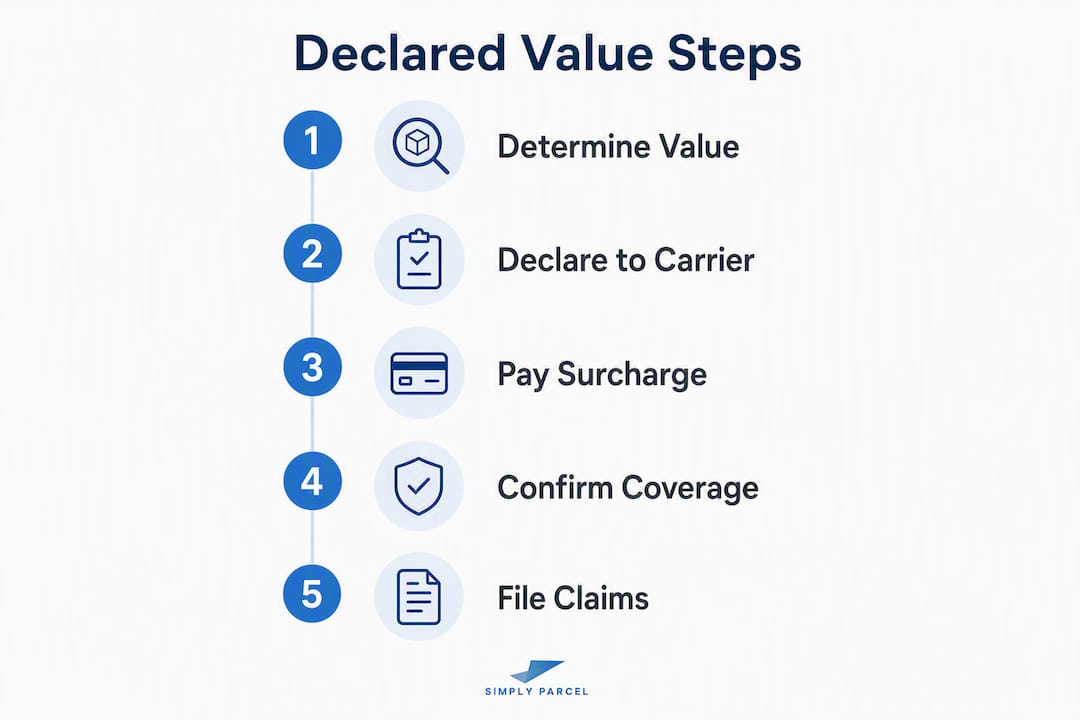
- How to declare value correctly on forms and invoices
- How to file a declared-value claim: steps and required evidence
- Common mistakes that lead to denied claims or customs penalties
- When should you buy third-party insurance instead of relying on declared value?
- Key Takeaways
- Simplyparcel's take on declaring value the right way
- Useful sources and further reading
What does declared value actually do for your shipment?
Declared value serves two main practical functions for every shipment: it defines the carrier's contractual liability ceiling and influences your shipping cost. It is not always the same as the customs value, which is separately determined for import duties and taxes. Mixing these can create compliance risks.
On the liability side, the carrier's obligation to compensate you stops at the declared amount. If you declare a lower value than the actual worth of your item, the carrier's liability is limited to the declared amount, regardless of the item's full value. Higher declared values usually trigger a surcharge because the carrier is accepting greater financial exposure.
- Shipping cost: Carriers charge a fee, often calculated per $100 of declared value, to cover the added risk.
- Liability ceiling: The declared amount is the hard cap on what the carrier will pay under the contract of carriage.
- Indirect losses excluded: Declared value coverage is contract-limited and typically excludes lost profits or business interruption.
Pro Tip: Carrier undeclared liability defaults are often quite low. Even a small declaration fee can meaningfully raise your protection on moderately priced goods.
How does declared value differ from customs value?
These two figures look similar but serve different purposes, and mixing them up creates real compliance risk.
Declared value for carriage is what you tell the carrier. It sets the liability cap and may affect your shipping rate. Customs value is what customs authorities use to calculate import duties and taxes. Mismatching these values can trigger customs delays, requests for documentation, penalties, or audits.
- When the transaction price equals the replacement cost, both figures should be identical.
- Intentionally declaring a low customs value while declaring a high carrier value is a red flag. Customs agencies can treat this as under-declaration or fraud.
- Overstating customs value leads to overpayment of duties; understating it risks penalties and shipment holds.
The safest approach: use the actual transaction or replacement value consistently across all documents. Defensible, consistent documentation protects you in both a carrier claim and a customs review.
Declared value vs. insurance: why they are not the same thing
This is the distinction most shippers get wrong. Declared value is a contractual liability cap. Insurance is a separate indemnity contract.

When you declare value, the carrier only pays if it is found liable under the contract of carriage. That means you may need to prove the carrier caused the loss, navigate contractual defenses, and accept the declared ceiling as your maximum recovery. Declared value coverage is contract-limited and often excludes indirect losses such as lost revenue or consequential damages.
Third-party cargo insurance works differently. It covers a broader set of perils, including theft, natural disasters, and events outside the carrier's direct control, and it typically pays on proof of loss rather than proof of carrier fault.
- Small-item shipments: Declaring value is usually sufficient. The fee is low and the risk is manageable.
- High-value shipments: Third-party insurance simplifies claims, covers more perils, and removes the burden of proving carrier negligence.
Pro Tip: For fragile, unique, or high-value goods, review a third-party policy's exclusions and claim timelines before shipping. Carrier liability and insurance are not interchangeable, and the difference matters most when you actually need to file.
How carriers set declared-value fees and limits
Carriers use a few standard pricing patterns for declared value surcharges. Understanding these helps you budget accurately and avoid surprises at booking.

International transport conventions such as the Montreal Convention (air freight), CMR (road), and Hague-Visby rules (sea) set default liability limits by transport mode. To exceed those limits, you must explicitly declare a higher value, pay a surcharge, and provide supporting documentation.
| Fee type | How it is calculated | Documentation required |
|---|---|---|
| Per-$100 surcharge | A flat rate applied for every $100 of declared value above the default | Commercial invoice, proof of purchase |
| Flat surcharge band | A fixed fee that applies within a declared-value range | Commercial invoice |
| Convention default limit | Set by treaty (e.g., Montreal Convention for air) | No extra docs needed at the default |
| High-value declaration | Carrier-specific threshold requiring additional paperwork | Invoice, packing list, sometimes appraisal |
FedEx requires you to enter the declared value when creating your shipping label and sets a maximum liability tied to that declared amount. DHL applies similar rules, with declared value entered on the air waybill or booking form and supporting invoices required for higher amounts. Both carriers cap their liability at the declared figure.
How to declare value correctly on forms and invoices
Accuracy at this step protects you in both a customs review and a carrier claim. Carriers often require invoices or proof when higher values are declared, so having documents ready before you book saves time.
Document checklist:
- Commercial invoice with itemized values and currency clearly stated
- Packing list matching the invoice line items
- Proof of value: original receipt, purchase order, or appraisal for unique goods
- Insurance policy certificate, if applicable
Formatting tips:
- Use a single consistent currency throughout all documents.
- Round values sensibly; avoid suspiciously round numbers that invite scrutiny.
- Keep copies of every document, including the air waybill or bill of lading, for at least 12 months after shipment.
For a deeper look at documentation formats, Simplyparcel's shipment value declaration guide and international parcel labeling guide cover the exact fields carriers and customs expect.
Pro Tip: State the basis for your declared amount on the invoice: "transaction value" or "replacement cost." This one line makes your documentation far more defensible if a claim or customs query arises.
How to file a declared-value claim: steps and required evidence
Acting quickly and methodically after a loss or damage event is what separates a successful claim from a denied one.
- Notify the carrier immediately. Most carriers require notification within a short window after delivery or expected delivery. Missing this deadline can forfeit your right to claim.
- Secure the goods and packaging. Do not discard damaged packaging. Carriers often require it for inspection.
- Gather your evidence. You will need: original commercial invoice, proof of declared value, timestamped photos of damage, air waybill or bill of lading, and packing list.
- File the formal claim. Submit through the carrier's claims portal or in writing, attaching all documents. Reference the declared value stated on the shipment.
- Track the timeline. Carriers have contractual and sometimes statutory deadlines for responding. Follow up in writing if you receive no response within the carrier's stated window.
- Escalate if needed. If the carrier denies or underpays the claim, you may have recourse through arbitration, small claims court, or your third-party insurer.
Pro Tip: Submit claims via a method that creates a timestamp and paper trail, such as email or a carrier's online portal. Verbal notifications rarely count as formal filing.
Common mistakes that lead to denied claims or customs penalties
These errors appear repeatedly in shipments that get held, penalized, or result in denied claims. Avoiding them takes minutes; recovering from them can take weeks.
- Undervaluing to save on duties or fees. Customs agencies compare declared values against market data. A value that looks artificially low can trigger an audit or a fraud investigation.
- Inconsistent values across documents. If your air waybill states $300 but your commercial invoice states $800, customs will flag the discrepancy. Both documents must match. Review common shipping documentation errors before you book.
- Assuming declared value equals insurance. A carrier paying out under declared value still requires you to prove their liability. That process can be slow and the outcome is not guaranteed.
- Missing carrier-specific declaration rules. Some carriers require declared value in a specific currency, placed in a specific field on the waybill. Check the carrier's policy before completing the form.
- Specialty items. For collectibles and graded items, valuation can be complex. PSA, for example, uses an estimated post-grading value in some workflows. Always verify item-specific guidance before declaring.
When should you buy third-party insurance instead of relying on declared value?
Experts recommend third-party insurance for high-value shipments because carrier declared-value limits, contractual defenses, and documentation requirements often complicate recovery. A separate policy simplifies the process and broadens the perils covered.
Use these criteria to decide:
- Shipment value exceeds typical carrier caps. If your goods are worth more than the carrier's maximum declared-value limit, insurance fills the gap.
- High-risk route or fragile goods. Routes with higher loss rates, or items that are irreplaceable or fragile, warrant broader coverage.
- Indirect losses matter to you. Business interruption or lost margin from a delayed shipment falls outside carrier liability but may be covered by a cargo policy.
- You want a simpler claims process. Insurance pays on proof of loss; carrier liability requires proof of fault.
When moving high-value items, proper packing documentation and a clear valuation record strengthen both your insurance claim and any carrier dispute.
Pro Tip: Compare claim timelines and exclusion lists between the carrier's declared-value terms and any third-party policy before you commit. The cheapest option at booking is rarely the cheapest option after a loss.
Key Takeaways
Declared value sets the carrier's maximum liability and must match your customs value to avoid penalties, delays, or denied claims.
| Point | Details |
|---|---|
| Declared value definition | The monetary amount you state to the carrier, capping what they will pay if goods are lost or damaged. |
| Effect on cost and liability | Higher declared values usually increase shipping fees and raise the carrier's contractual liability ceiling. |
| Not the same as insurance | Declared value requires proving carrier fault; third-party insurance pays on proof of loss and covers more perils. |
| Match your customs value | Inconsistent values across documents can trigger customs audits, penalties, or shipment holds. |
| Check carrier-specific rules | FedEx and DHL each have their own declaration fields, surcharge structures, and documentation requirements. |
Simplyparcel's take on declaring value the right way
Declared value is one of those details that feels minor until something goes wrong. The practical rule is straightforward: declare the true transaction or replacement value, attach the documents that prove it, and buy third-party insurance whenever the shipment value or risk level warrants it. Skipping the declaration to save a small surcharge fee is rarely worth the exposure.
Simplyparcel helps shippers get this right from the start. When you get an instant quote through the platform, the booking flow guides you through value declaration, generates your shipping label and customs documentation automatically, and connects you with courier partners whose policies align with your shipment type. For more guidance, the Simplyparcel blog covers international shipping step by step with practical checklists you can use before every booking.
Useful sources and further reading
- FedEx Declared Value and Limits of Liability — carrier policy on how FedEx treats declared value for liability and label entry
- DHL Freight Connections: What Is Declared Value? — DHL's glossary covering both carrier and customs uses of the term
- DutyGlobal: Declared Value Glossary — legal distinction between carrier declared value and customs value
- LegalClarity: What Does Declared Value Mean for Shipping? — explanation of contractual limitations and exclusions
- DocShipper: Declared Value for Carriage — international transport conventions and surcharge structures
- U.S. Customs and Border Protection: Customs Value — primary U.S. government source on customs valuation rules
- Simplyparcel: What Is Shipment Value Declaration? — practical guide to documentation and formatting for declared value