
For most Singapore senders, the fastest affordable route is to compare economy and express courier quotes side by side, then book with Delivered Duty Paid (DDP) when shipping anything of real value.
- Cheapest option: economy air courier for a small parcel, typically lasting one to two weeks door to door.
- Fastest option: express air courier for the same parcel, usually taking a few days door to door.
Pro Tip: A pallet or small freight shipment (LCL) often costs several hundred dollars depending on weight and lane, with transit ranging from a few days by air freight to several weeks by sea.
Key Takeaways
Choosing between economy and express courier service, backed by correct customs paperwork, determines both your shipping cost and how fast your parcel clears US customs.
| Point | Details |
|---|---|
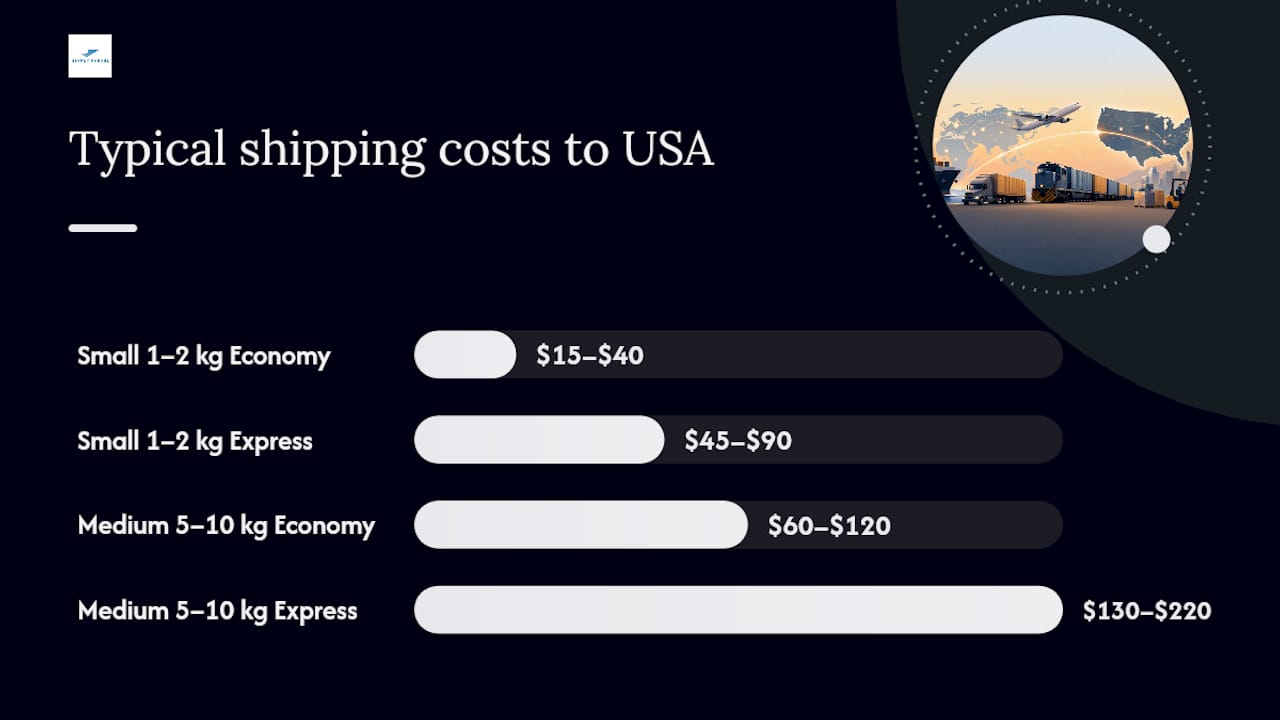
| Match speed to urgency | Economy air runs 7–14 days for $15–$40 on small parcels; express runs 2–4 days for $45–$90. |
| Get documentation right | A commercial invoice with an accurate description, HS code, and declared value prevents most customs holds. |
| Consider DDP for value shipments | Prepaying duties through DDP reduces recipient refusals and speeds up clearance. |
| Watch dimensional weight | Carriers bill by volumetric weight when it exceeds actual weight, so measure before you book. |
| Compare and book with Simply Parcel | Simply Parcel lets you compare courier rates, generate labels and customs documents, and track shipments in one platform. |
Table of Contents
- What Does International Shipping to the USA Actually Cost?
- Which Shipping Method Fits Your Shipment?
- What Customs Documents Does Your USA Shipment Need?
- How Should You Pack a Parcel Bound for the USA?
- How Do Tracking and Insurance Protect Your Shipment?
- How Can You Lower Your Shipping Cost Without Cutting Corners?
- What's the Booking Checklist Before You Ship?
- What Do Singapore Shippers Get Wrong Most Often?
- Get an Instant Quote and Book Your Shipment Today
- Sources
What Does International Shipping to the USA Actually Cost?
Price depends on weight, size, and how fast you need it there. A small parcel weighing 1–2 kg typically costs $15–$40 on economy air and $45–$90 on express courier services. A medium box in the 5–10 kg range runs $60–$120 economy and $130–$220 express, depending on the carrier and destination state.
For bulk or commercial freight, pallet and less-than-container-load (LCL) shipments land between $300 and $900, with heavier loads pushing higher. These figures move with fuel surcharges and seasonal demand, so treat them as planning ranges rather than fixed quotes.
Transit times split into three bands:
- Economy air: 7–14 days, the default for non-urgent parcels and small business shipments.
- Express air courier: 2–4 days, best for time-sensitive documents or high-value goods.
- Ocean freight (LCL/FCL): 20–35 days, the standard for pallets and bulk commercial cargo.
Pro Tip: Dimensional weight can quietly inflate your bill. Carriers charge based on whichever is higher: actual weight or volumetric weight (length × width × height ÷ a divisor set by the carrier). A light but bulky item like a pillow or a lampshade often costs more to ship than a dense item of the same physical size.
Which Shipping Method Fits Your Shipment?
The right method depends on urgency, size, and budget, not just what feels familiar.
- National postal services (like Speedpost) suit small, non-urgent parcels under a few kilograms. They're the cheapest option but come with weight caps and slower tracking updates.
- Express couriers offer time-definite, door-to-door delivery with full tracking. Companies like DHL promote next-possible-business-day options for businesses that need speed guaranteed, and the premium is worth paying when a missed deadline costs more than the shipping fee.
- Economy air and consolidation work well for medium-sized shipments where you can tolerate a week or two of transit in exchange for a lower rate.
- Ocean freight makes sense once you're shipping pallets or full container loads and time isn't the constraint. It's the cheapest per-kilogram option by a wide margin, but only if you can plan weeks ahead.
Match the method to the shipment, not the other way around. A single wrong choice, like paying express rates for a non-urgent restock order, is the most common way Singapore sellers overspend.
What Customs Documents Does Your USA Shipment Need?
Every commercial shipment into the USA needs a clean paper trail. Missing or vague documentation is the number one cause of customs holds.
- Commercial invoice with an accurate, plain-English description of the goods (not a brand name alone).
- HS code (Harmonized System code) that classifies the product for tariff purposes.
- Country of origin for each item in the shipment.
- Quantity and declared value per item, stated honestly.
- Sender and recipient contact details, including phone number and email.
Simply Parcel's documentation guide for Singapore SMEs breaks these down in more detail, including how to word descriptions so customs officers don't flag them for review.
Who pays the import duty matters too. Under a DDU (Delivered Duty Unpaid) arrangement, the US recipient pays duties and taxes on delivery, which often leads to refusals or delays when the recipient wasn't expecting a bill. Under DDP (Delivered Duty Paid), the sender prepays those costs upfront, and Paket International notes this approach reduces refusal rates and customs holds significantly for e-commerce sellers.

Pro Tip: Fill in the HS code even when it feels optional. Carrier guides consistently point to correct HS codes and complete descriptions as the biggest single factor in whether a shipment clears customs on the first try.
How Should You Pack a Parcel Bound for the USA?
Good packaging protects your goods and keeps your shipping cost predictable. Use a box sized close to your actual item, add internal cushioning like bubble wrap or air pillows, and seal every seam with proper packing tape rather than household tape. Practical step-by-step packaging guidance covers labeling placement and box selection in more depth.
- Measure length, width, and height before you book. Carriers bill dimensional weight when it exceeds actual weight, which can double the cost of bulky, lightweight items.
- Avoid shipping lithium batteries loose, aerosols, perfumes with high alcohol content, and counterfeit goods. All are frequently restricted or outright banned for US import.
Pro Tip: Shipping a prohibited item doesn't just risk a fine. It usually means the parcel gets held, returned, or destroyed, and you lose both the goods and the shipping fee.
How Do Tracking and Insurance Protect Your Shipment?
Carrier liability, declared value, and third-party insurance are three different things, and confusing them is a common mistake. Basic carrier liability usually covers only a small fixed amount, regardless of what the item is worth. Declaring a higher value at booking extends that protection, while third-party insurance covers gaps the carrier won't touch, like accidental damage in transit.
- Buy extra coverage for anything fragile, high-value, or irreplaceable, since standard liability rarely covers full replacement cost.
- Keep photos of the packed item, your receipts, and your full tracking history so you can file a claim within the carrier's claim window, which is often just a few weeks.
How Can You Lower Your Shipping Cost Without Cutting Corners?
Comparing quotes across multiple couriers on one platform, rather than calling each carrier separately, usually surfaces the cheapest reliable option in minutes instead of hours. Aggregators also let you see the price gap between economy and express side by side, so you're choosing with full information instead of guessing.
- Consolidate small orders into one shipment instead of sending several parcels separately; you pay one base fee instead of several.
- Measure accurately and pick flat, efficient packaging to avoid paying for dimensional weight you don't need.
- Avoid peak periods like the weeks before major US holidays, when surcharges climb and transit times stretch.
Pro Tip: If your shipment isn't urgent, ask about consolidated air or sea options. Consolidation and smarter routing can cut freight costs by roughly 10% for repeat shippers, and the savings compound the more regularly you ship.
Simply Parcel's guide to affordable international shipping from Singapore walks through more of these cost levers if you're shipping regularly.
What's the Booking Checklist Before You Ship?
- Measure and weigh your parcel, including box dimensions, not just the item.
- Choose your service tier based on how urgent the shipment really is: economy, express, or freight.
- Prepare your commercial invoice with an accurate description, HS code, and declared value.
- Decide on DDP if you're shipping commercial goods or anything of meaningful value.
- Book pickup or drop-off through your chosen platform.
- Attach all documents and print your labels before pickup.
- Track the shipment through to delivery and keep records until it arrives.
For labels, use full English descriptions, the complete US delivery address with ZIP code, and the recipient's phone number and email. Have your HS code, invoice, supplier contact, and declared value ready before you start the booking form. It saves you from stopping mid-booking to hunt for a missing detail.
What Do Singapore Shippers Get Wrong Most Often?
The mistake we see most is treating customs paperwork as an afterthought instead of the first step. Senders fill in a vague product description, skip the HS code, or guess at a declared value, and then wonder why the parcel sits in customs for a week.
Pro Tip: Get the HS code right and consider DDP for anything commercial. Both moves cut refusal and delay rates more than any packaging upgrade ever will.
Get an Instant Quote and Book Your Shipment Today
Simply Parcel gives you one place to compare economy and express rates across multiple courier partners, instead of requesting quotes from each carrier separately. You get instant pricing, automatic label and customs document generation, DDP support to avoid recipient surprises, and real-time tracking on every shipment you book.
- Start by getting an instant shipping quote to see your cheapest and fastest options side by side.
- Once you've picked a service, book your pickup and pay online in a few minutes.
If you're shipping to the USA this month, get your quote now and lock in a rate before peak surcharges apply.
Sources
- How to prepare parcels for courier: UK step-by-step guide
Confirm your HS code and country-of-origin details against current rules before you lock in your commercial invoice.