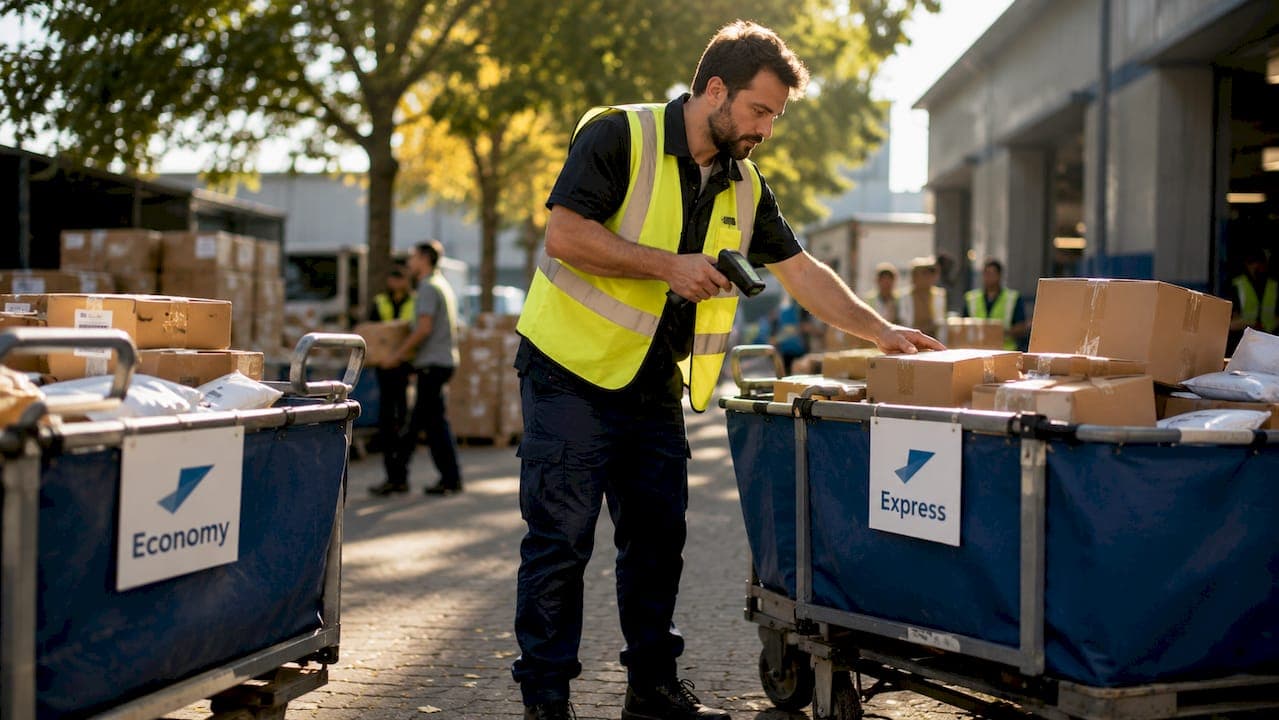
The difference between express and economy shipping comes down to three things: speed, cost, and service level. Express shipping prioritizes fast delivery, typically within 1–5 business days, using dedicated air cargo and priority customs clearance. Economy shipping trades speed for savings, consolidating shipments and using ground or sea transport to cut costs by as much as 50–65%. Simplyparcel offers both methods for international shipments from Singapore, making it straightforward to compare options and pick the right fit for your package, timeline, and budget.
How do express and economy shipping differ in speed and tracking?
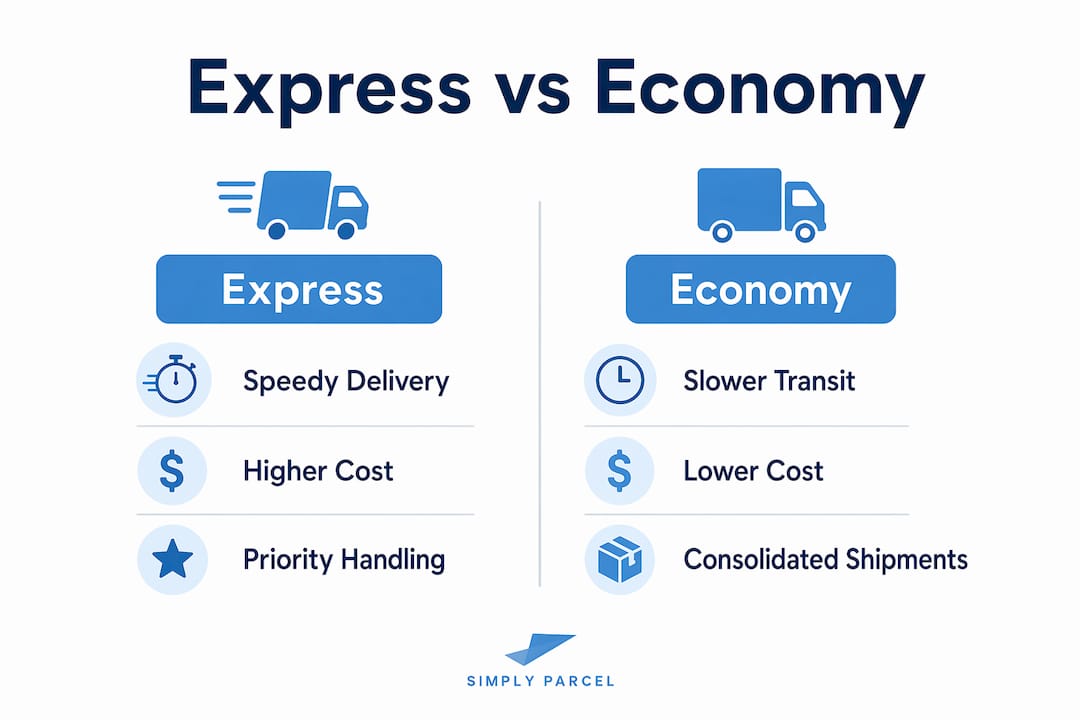
Speed is the most visible difference between the two methods. Express delivers internationally in 2–5 business days, while economy typically takes 7–15 business days for the same route. Domestically, express can arrive in 1–2 days; economy shipping domestically runs 5–10 business days depending on the carrier and destination.
The reason for that speed gap is infrastructure. Express services use dedicated air cargo lanes and move packages through customs individually, with priority processing. Economy shipments travel in batches, sharing cargo space and waiting for consolidated customs clearance. That batch model is efficient and affordable, but it adds days to the timeline.

Tracking is where the two methods diverge in ways most shippers do not expect. Express tracking updates scan by scan, giving you a real-time view of exactly where your package sits at any moment. Economy tracking works well during the long-haul portion of the journey, but tracking granularity drops once the parcel transfers to a local postal service for final-mile delivery. That handoff is normal, but it can create a gap in visibility that worries recipients.
Key differences at a glance:
- Express transit time: 1–2 days domestic, 2–5 days international
- Economy transit time: 5–10 days domestic, 7–15 days international
- Express tracking: Real-time, scan-by-scan updates throughout the journey
- Economy tracking: Frequent updates during long haul, reduced visibility at final mile
- Express SLA: Money-back guarantees if delivery windows are missed
- Economy SLA: No delivery guarantee in most cases
Pro Tip: If your recipient is anxious about delivery timing, choose express or share the Simplyparcel shipment tracking page so they can monitor progress directly.
What are the cost differences between express and economy shipping?
Express shipping costs 2 to 3 times more than economy for the same package weight and route. That premium reflects the dedicated air cargo, priority handling, and customs brokerage built into the service. For a small business shipping regularly, that cost difference compounds quickly across dozens or hundreds of orders per month.
Economy shipping closes that gap through consolidation. Carriers group multiple shipments together, fill cargo space efficiently, and pass the savings to shippers. The result is a cost reduction of 50–65% compared to express for the same parcel. That is a significant margin advantage for businesses shipping non-urgent goods.
Weight and volume also shift the math. For shipments over 200 kg, economy or sea freight becomes far more cost-effective than express, even when accounting for the longer transit time. Express remains the better value for parcels under 30 kg where speed matters.
| Shipment type | Express transit | Economy transit | Typical cost difference |
|---|---|---|---|
| Small parcel (under 5 kg) | 2–5 days international | 7–15 days international | Express costs 2–3x more |
| Medium parcel (5–30 kg) | 2–5 days international | 7–15 days international | Express costs 2–3x more |
| Bulk freight (200+ kg) | 2–5 days international | 7–15 days international | Economy or sea freight preferred |
| Domestic small parcel | 1–2 days | 5–10 days | Express costs 2–3x more |
Pro Tip: Calculate your cost per shipment across a full month, not just per order. Switching non-urgent orders to economy can free up budget to cover express costs on the shipments that genuinely need speed.
The declared value of your shipment also matters. A package worth $2,000 delayed by two weeks in economy transit carries a real cost in customer dissatisfaction or lost business. Paying the express premium on high-value goods is often the more economical decision when you factor in the full risk picture.
What are the reliability and handling differences between express and economy?
Reliability is where express shipping earns its premium most clearly. Express shipments receive priority handling at every stage: dedicated sorting, priority loading, and faster customs clearance that can reduce clearance time by 1–3 days compared to batch processing. That priority chain reduces the chance of delays caused by congestion, weather, or customs backlogs.
Economy shipments move through a different system. They share cargo space with other packages, wait for batch customs processing, and receive secondary priority when cargo space is limited. That model works well most of the time, but it creates more exposure to delays when any part of the chain slows down.
The practical difference shows up in reliability rates:
- Express services deliver within the stated window at a rate of 92–98%
- Economy services deliver within the stated window at a rate of 80–90%
That 10–18 percentage point gap matters most for time-sensitive shipments. For a gift arriving before a birthday or a product sample reaching a buyer before a trade show, economy's delay exposure is a real risk.
Express shipping functions as reliability insurance for high-value or time-sensitive parcels. The money-back SLA is not just a marketing promise. It is a contractual buffer that shifts the financial risk of delay from the shipper to the carrier. For goods where a late delivery means a lost sale or a damaged relationship, that buffer has measurable value.
The multi-carrier approach addresses this directly. Businesses that route high-value or urgent orders through express and standard orders through economy get the reliability where they need it without paying the premium across the board.
How should you choose between express and economy shipping?
The right choice depends on four factors: urgency, declared value, package weight, and your customer's expectations. Here is a practical framework for making that call.
- Choose express when urgency is non-negotiable. Documents, legal contracts, product samples, and time-sensitive gifts all belong in express. If a late delivery costs you a client or a sale, the express premium is worth it.
- Choose express for high-value goods. Items with significant declared value carry more financial risk in transit. Express priority handling and the money-back SLA reduce that exposure.
- Choose economy for non-urgent personal shipments. Gifts, personal items, and packages where the recipient has flexibility on timing are ideal for economy. The economy shipping benefits are real: 50–65% savings with reliable, if slower, delivery.
- Choose economy for bulk e-commerce orders. If you are shipping large volumes of standard products and your customers expect 7–14 day delivery, economy is the right default. The savings at scale are substantial.
- Use a multi-carrier strategy for mixed order profiles. Regional carriers save 20–40% on certain routes compared to global express networks. Routing by order type rather than using one method for everything is the most cost-efficient approach for growing businesses.
Pro Tip: Set a simple internal rule: any order above a set value threshold ships express automatically. Any order below that threshold ships economy unless the customer requests faster delivery. That rule alone removes most of the guesswork from daily shipping decisions.
Freight consolidation is another tool worth understanding. Consolidating multiple economy shipments into a single cargo movement reduces per-unit cost further and can improve tracking consistency by keeping packages within one carrier network longer.
Small businesses benefit most from reviewing their shipping mix regularly. Shipping tips for small business cost control consistently point to the same finding: businesses that match shipping method to order type rather than defaulting to one method save significantly without sacrificing customer satisfaction.
Key Takeaways
Express shipping is the right choice when speed, reliability, and high declared value matter. Economy shipping wins on cost for non-urgent parcels, with savings of 50–65% compared to express on the same route.
| Point | Details |
|---|---|
| Speed gap is significant | Express delivers in 2–5 days internationally; economy takes 7–15 days on the same route. |
| Cost premium is real | Express costs 2–3 times more than economy for the same package weight and destination. |
| Tracking differs at final mile | Economy tracking loses granularity when transferred to local postal services for last-mile delivery. |
| Reliability favors express | Express delivers within stated windows 92–98% of the time; economy ranges from 80–90%. |
| Match method to shipment type | Use express for urgent or high-value goods; use economy for bulk, non-urgent, or personal shipments. |
The shipping decision most businesses get wrong
After working with shippers across a wide range of order types, the most common mistake I see is treating shipping method as a fixed setting rather than a variable. Businesses pick express because it feels safer, or they pick economy because it is cheaper, and then they apply that choice to every single shipment regardless of what is inside the box or when it needs to arrive.
The smarter approach is to treat express and economy as tools in a kit, not as competing options where one wins. A business shipping 200 orders a month might route 30 of them through express because those customers paid for fast delivery or the goods are high-value. The other 170 go economy, and the savings fund the express premium on the urgent ones. That hybrid model is what I have seen work best in practice.
Customer communication matters just as much as the method itself. When you choose economy, tell the customer upfront. Set the expectation clearly, share the tracking link, and the longer transit time rarely causes problems. The complaints come when customers expect express speed and get economy timing without any warning.
Simplyparcel makes this kind of comparison straightforward. You can see both options side by side, with real pricing and transit times, before you commit to anything. That transparency is what good shipping decisions are built on.
— Simply
Simplyparcel makes comparing shipping options simple
Simplyparcel gives you a clear side-by-side view of express and economy shipping quotes for your specific parcel, route, and timeline. You enter your shipment details once and get transparent pricing across multiple carrier options, so you can match your delivery urgency to your budget without guessing. The platform handles label generation, pickup booking, and tracking in one place, removing the manual work from international shipping. Whether you are sending a single parcel or managing regular business shipments, get an instant quote and see exactly what each shipping method costs for your next shipment.
FAQ
What is the main difference between express and economy shipping?
Express shipping delivers faster, typically in 2–5 business days internationally, using dedicated air cargo and priority customs clearance. Economy shipping takes 7–15 business days and consolidates shipments to reduce cost by 50–65%.
Is express shipping always worth the extra cost?
Express is worth the premium for urgent deliveries, high-value goods, and shipments where a delay has real financial consequences. For non-urgent parcels, economy delivers reliable results at a fraction of the price.
Does economy shipping have real-time tracking?
Economy shipping provides tracking during the long-haul portion of transit, but updates become less frequent once the parcel transfers to a local postal service for final-mile delivery. Express tracking remains scan-by-scan throughout the full journey.
What happens if an express shipment is late?
Most express services include a money-back SLA that compensates the shipper if the delivery window is missed. Economy services generally offer no such guarantee, which is a key reason express costs more.
How do I choose the right shipping method for my business?
Use express for orders above a set value threshold or with time-sensitive deadlines, and use economy for standard, non-urgent shipments. A multi-carrier strategy that routes by order type rather than applying one method to everything delivers the best balance of cost and reliability.