
The shipping documentation process is the systematic preparation and management of all required paperwork that enables international shipments to clear customs and move through the global logistics chain. Get it right, and customs clears in 1–5 days. Get it wrong, and your cargo sits at the port while costs accumulate. Whether you are an individual sending a parcel abroad or a business exporting goods regularly, understanding this process is the single most effective way to protect your shipment from avoidable delays. The core standards governing this process include Harmonized System (HS) codes, Incoterms, and the requirements of destination country customs agencies.
What are the essential documents in the shipping documentation process?
Every international shipment requires a specific set of documents. Each one serves a distinct legal or logistical purpose, and together they form your shipping documentation checklist.
The three core documents are the Commercial Invoice, the Packing List, and a transport document. The Commercial Invoice anchors customs processes and must include detailed product descriptions, HS codes, declared values, country of origin, and the applicable Incoterms. Customs authorities use it to assess duties and taxes. The Packing List breaks down the contents of each package by quantity, weight, and dimensions. It does not assign value to goods, but it must match the Commercial Invoice exactly.

Transport documents vary by shipping mode. The Bill of Lading for sea freight is a negotiable document that can act as a title to the goods. The Air Waybill used for air freight is non-negotiable and functions as a receipt and contract of carriage. Choosing the wrong document type or leaving fields incomplete creates legal exposure for the shipper.
Beyond the core three, many shipments require additional paperwork depending on the destination and product type.
- Certificate of Origin: Proves where goods were manufactured. Required for preferential tariff treatment under trade agreements.
- Export Declaration: A government filing that records the export transaction. Required in most countries for commercial shipments above a value threshold.
- Import/Export Licenses: Mandatory for controlled goods such as electronics, chemicals, or food products.
- Dangerous Goods Declaration: Required when shipping hazardous materials under IATA or IMDG regulations.
| Document | Purpose | Responsible Party | When Prepared |
|---|---|---|---|
| Commercial Invoice | Duty assessment and customs clearance | Exporter | Before cargo pickup |
| Packing List | Cargo verification and weight/dimension check | Exporter/Warehouse | Before cargo pickup |
| Bill of Lading | Title document for sea freight | Carrier/Freight Forwarder | After cargo loading |
| Air Waybill | Receipt and contract for air freight | Carrier | At cargo acceptance |
| Certificate of Origin | Tariff preference and trade compliance | Exporter/Chamber of Commerce | Before shipment |
| Export Declaration | Government export record | Exporter/Customs Broker | Before cargo departure |
Pro Tip: Cross-check every document against the others before submission. The product description, quantity, and value must be identical across your Commercial Invoice, Packing List, and transport document.
How to prepare shipping documents: step-by-step
Preparing shipping paperwork is not a last-minute task. The process starts well before cargo is ready to move, and each step builds on the one before it.
-
Build a master dataset. Create a single reference file containing your product descriptions, HS codes, unit values, total weights, and dimensions. One master dataset controls all downstream documents and prevents the data mismatches that cause customs holds. Every document you prepare pulls from this file.
-
Draft the Commercial Invoice. Use your master dataset to populate the invoice. Include the buyer and seller details, a specific product description (never write "parts" or "samples"), the declared value in the transaction currency, the country of origin, and the agreed Incoterms. A vague description is the most common reason customs authorities flag a shipment for inspection.
-
Prepare the Packing List. List each carton or pallet separately with its contents, gross weight, net weight, and dimensions. Match every line item back to the Commercial Invoice. If the invoice shows 200 units and the Packing List shows 198, customs will hold the shipment.
-
Obtain and complete transport documents. Contact your carrier or freight forwarder to initiate the Bill of Lading or Air Waybill. Provide your master dataset details so the carrier populates the document correctly. Review the draft before it is finalized.
-
Prepare conditional documents. Determine whether your shipment requires a Certificate of Origin, Export Declaration, or any licenses. Apply for the Certificate of Origin through your local Chamber of Commerce early, as processing times vary. File the Export Declaration with the relevant government authority before cargo departure.
-
Conduct a final document review. Lay all documents side by side and verify that names, addresses, quantities, values, and HS codes are consistent across every page. This review catches errors before they reach customs.
Pro Tip: Complete your document package at least 48 hours before the cargo is scheduled to leave the origin facility. This gives you time to correct errors without delaying the shipment.
How to coordinate documentation handoffs for customs clearance
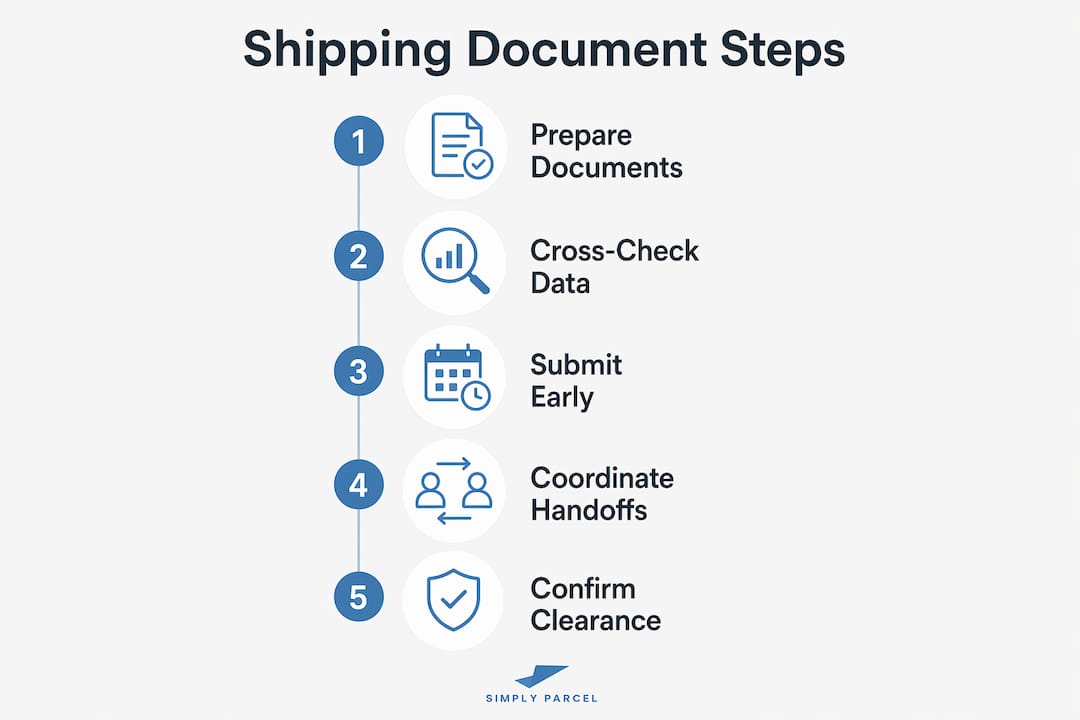
Preparing documents accurately is only half the job. Getting them to the right parties at the right time determines whether your shipment clears customs without a hold.
The key players in this coordination are the exporter, the freight forwarder, and the customs broker. Each has a defined role. The exporter prepares and owns the Commercial Invoice and Packing List. The freight forwarder arranges transport and often manages the Bill of Lading or Air Waybill on the exporter's behalf. The customs broker files the import declaration at the destination. Understanding freight forwarder responsibilities prevents gaps in accountability.
Timing is the most common coordination failure. Finalized documents should reach your freight forwarder well before the cargo arrives at the port or airport. This window allows the broker to review, query, and correct any issues before the customs filing deadline. Submitting documents at the last minute removes any buffer for corrections.
Version control is a non-negotiable discipline. Only one final approved document set should be submitted to customs. Multiple versions of the same invoice or packing list circulating among parties create confusion and can result in penalties.
- Assign one person internally to own the final document package.
- Use a shared folder or document management system with clear version labels.
- Confirm receipt with your freight forwarder and customs broker in writing.
- Set a hard internal deadline for document finalization that is at least 24 hours before the carrier's cutoff.
Pro Tip: Even when your freight forwarder files documents on your behalf, you remain legally responsible for their accuracy. Review every document before it leaves your hands.
What common mistakes cause shipping documentation failures?
Documentation errors fall into two categories: data errors and timing errors. Both cause delays, but data errors are more damaging because they can trigger inspections, fines, or seizure of goods.
Inconsistent data across documents is the leading cause of customs delays. A mismatch between the declared value on the Commercial Invoice and the figure on the Export Declaration signals a potential undervaluation to customs authorities. Similarly, a weight discrepancy between the Packing List and the Bill of Lading raises red flags. Missing documents are actually less common as a root cause than mismatched data.
Vague product descriptions cause immediate customs holds. Writing "electronic components" instead of "printed circuit boards for industrial control systems, HS code 8534.00" gives customs officers no basis for duty assessment. They will hold the shipment until the exporter provides clarification, which can take days.
Timing errors compound data errors. Late document submission means the customs broker has no time to query discrepancies before the cargo arrives. The result is a customs hold that delays delivery and incurs storage fees at the port or airport.
Dos and don'ts for documentation accuracy:
- Do use specific, technical product descriptions on every document.
- Do verify HS codes with a licensed customs broker before the first shipment.
- Do finalize documents before cargo leaves the origin facility.
- Don't make last-minute changes to declared values or quantities without updating all related documents.
- Don't rely on your freight forwarder to catch errors. They file what you provide.
- Don't reuse document templates from previous shipments without updating all fields.
For a broader look at common shipping mistakes that affect customs clearance, the patterns are consistent: vague data, late submission, and poor version control account for the majority of avoidable delays.
Key Takeaways
Accurate, complete, and timely shipping documentation is the single most reliable way to prevent customs delays and protect your international shipments from costly holds.
| Point | Details |
|---|---|
| Master dataset controls everything | Build one reference file for HS codes, values, and descriptions before drafting any document. |
| Commercial Invoice is the anchor document | It must include specific descriptions, HS codes, Incoterms, and declared values to pass customs. |
| Consistency across documents matters most | Data mismatches between invoice, packing list, and transport docs cause more delays than missing paperwork. |
| Early handoff prevents last-minute failures | Submit finalized documents to your freight forwarder at least 24 hours before the carrier cutoff. |
| Exporters own legal responsibility | You are accountable for document accuracy even when a freight forwarder or customs broker files on your behalf. |
Why documentation discipline is the real competitive advantage
After working with international shippers across a wide range of shipment types and destinations, the pattern is clear: the businesses that ship reliably are not the ones with the most complex logistics setups. They are the ones that treat documentation as an operational process, not an administrative afterthought.
The most common mistake I see is treating the Commercial Invoice as a formality. Shippers fill it out quickly, use vague descriptions, and assume the freight forwarder will sort out any issues. That assumption is wrong and expensive. The exporter is legally accountable for every figure on that document, regardless of who files it.
What actually works is building a master dataset before the first shipment and updating it every time a product, value, or supplier changes. That single discipline eliminates the majority of customs holds I have observed. Pair it with a hard internal deadline for document finalization, and you remove the timing errors that compound data problems.
The shippers who struggle are almost always the ones who treat documentation as the last step. The ones who succeed treat it as the first. Getting your shipping documentation right from the start is not just about compliance. It is the foundation of a reliable international shipping operation.
— Simply
How Simplyparcel supports your international shipments
Simplyparcel is a Singapore-based shipping platform that makes international courier booking straightforward for individuals and businesses alike. When you book through Simplyparcel, the platform automatically generates shipping labels and documentation, reducing the manual work involved in preparing paperwork for each shipment. You can compare courier options, select the service speed that fits your timeline and budget, and book a free pickup, all in one place. For businesses managing regular exports, Simplyparcel's real-time tracking and courier integrations keep every shipment visible from origin to delivery. Get an instant shipping quote and see how Simplyparcel can take the complexity out of your next international shipment.
FAQ
What documents are required for international shipping?
The core must-have shipping documents are the Commercial Invoice, Packing List, and a transport document such as a Bill of Lading or Air Waybill. Depending on the destination and product type, you may also need a Certificate of Origin, Export Declaration, or import/export licenses.
How long does customs clearance take with correct documentation?
Customs clearance for international shipments typically takes 1–5 days when all required documents are accurate and complete. Errors or missing information extend this window significantly.
Who is responsible for shipping document accuracy?
The exporter is legally responsible for the accuracy of all shipping documents, even when a freight forwarder or customs broker prepares and files them. Delegating the filing does not transfer legal accountability.
What is the most common cause of customs delays?
Inconsistent data across documents, such as a value on the Commercial Invoice that does not match the Export Declaration, causes more customs delays than missing paperwork. Vague product descriptions are the second most frequent trigger for customs holds.
How early should I submit shipping documents to my freight forwarder?
Submit your finalized document package to your freight forwarder well before cargo arrives at the port or airport. A minimum of 24–48 hours before the carrier's cutoff gives the customs broker time to review and correct any issues before the filing deadline.