
Courier rates come down to four things: chargeable weight (the greater of actual or volumetric weight), shipping zone, chosen service level, and applicable surcharges or taxes. Carriers calculate volumetric weight using length times width times height in centimeters, divided by 5,000. Once you know these four levers, any quote becomes readable, and aggregators can show you the all‑in total instead of a base rate that hides the rest.
TL;DR:
- Chargeable weight is the higher of actual weight or volumetric weight, with the latter calculated by dividing the parcel's volume in cubic centimeters by 5,000.
- Shipping zones are determined by destination distance and complexity, with remote areas and cross-border shipments often incurring additional fees.
- Service levels, such as express or economy, multiply the base rate and may be subject to negotiable contract discounts for regular shippers.
- Additional surcharges like fuel, remote area, oversize handling, and restricted goods premiums can increase total costs by 15 to 30 percent and vary frequently.
- Using an all-in quoting platform helps compare carriers, reveals surcharges upfront, and reduces surprises compared to relying on separate base rates and fee estimates.
Table of Contents
- Quick Checklist: The 7 Factors That Determine Your Courier Bill
- Weight, Volumetric Weight, and Chargeable Weight: How to Calculate Them
- What Does 'Zone' Mean in Courier Pricing?
- Express vs. Economy: How Service Level Changes Your Base Rate
- Surcharges and Hidden Fees to Watch For
- How to Read a Courier Quote: A Worked Example
- Practical Ways to Reduce Courier Costs
- How an Aggregator Like Simply Parcel Shows You the Real Price
- How Special Handling Affects Your Courier Rate
- What Is Dimensional Weight and Why Does It Drive Pricing?
- Flat Rate vs. Weight-Based vs. Distance-Based Pricing
- How Peak Season Changes Courier Pricing
- A Note on Pricing Transparency
- Get an Instant Quote and Compare Rates Before You Book
- Sources
Quick Checklist: The 7 Factors That Determine Your Courier Bill
Before you accept any quote, run it against this checklist. Most billing surprises trace back to one of these seven items being skipped, misread, or assumed away.
- Chargeable weight: carriers bill whichever is higher, actual weight or volumetric weight, not just what your parcel weighs on a bathroom scale.
- Dimensions and the volumetric formula: length × width × height in centimeters, divided by 5,000, converts box size into a comparable weight figure.
- Zone and destination: shipping to a neighboring country costs less than shipping across an ocean, and cross-border parcels often carry customs handling on top.
- Service level: express and priority services cost more per kilogram than economy or standard tiers.
- Retail vs. contract rates: the price a walk-in customer pays rarely matches what a business with regular volume negotiates.
- Surcharges: fuel surcharges, remote-area delivery fees, oversize handling, and restricted-commodity premiums commonly add to the total charge.
- Taxes and customs: GST and duty can apply depending on the goods and destination, and you should confirm whether your quote already includes them or whether it lists them separately.
Run through this list on your next quote and you will spot exactly which line item is inflating the number.
Weight, Volumetric Weight, and Chargeable Weight: How to Calculate Them
Every courier price starts with a number, and that number is rarely the weight on your kitchen scale. The industry standard formula is length × width × height in centimeters, divided by 5,000, which produces the volumetric weight in kilograms. Carriers then bill whichever figure is larger: the actual weight or the volumetric weight. This is called chargeable weight, and it is the single most misunderstood line on any invoice.
Here's why this matters more than most shippers realize. A large, light box, think a lampshade or a stack of foam packaging, takes up truck and cargo-hold space regardless of how little it weighs. Carriers price for space, not just mass, so a bulky parcel gets billed on its volume instead of its scale weight.
Once chargeable weight is determined, carriers round it up to their billing slab, typically to a half-kilogram or kilogram increment depending on carrier policy. That rounding step is where the first kilogram tends to carry a disproportionate share of fixed costs: handling, customs paperwork, and terminal processing. As shipment weight climbs, those fixed costs get spread across more kilograms, which is why the per-kilogram rate typically decreases as parcels get heavier.
Here's how three different package sizes play out under the same formula:
Notice the second and third rows: the box is bulkier than it is heavy, so volumetric weight wins and sets the price. Only the first row, a dense, compact parcel, gets billed on actual weight.
Pro Tip: Shaving even one centimeter off a box dimension can push your shipment into a lower billing slab, since carriers round volumetric weight upward before charging. Measure twice, trim your packaging if you can, and check the carrier's rounding rule before you book.
For a deeper walk-through of divisor choices and how they change your total, our guide on volumetric weight calculation covers the math in more detail.
What Does 'Zone' Mean in Courier Pricing?
Zones group destinations by distance and delivery complexity, and they set your base rate before anything else gets added. A parcel to a neighboring country sits in a lower zone than one crossing multiple borders or oceans, and the zone number usually maps directly to a price tier on the carrier's rate card.
Two effects show up here that catch shippers off guard:
- Remote-area premiums: delivery to a rural address or an island outside a carrier's standard network often triggers an extra fee, sometimes called an extended-area surcharge.
- Cross-border customs load: even within the same general region, a shipment that crosses a border adds documentation and clearance steps that a domestic parcel never sees.
- Zone boundaries aren't always intuitive: two cities that seem geographically close can sit in different zones if one requires a different customs process or a different last-mile carrier.
Before booking, check the carrier's zone map or ask for a specific zone lookup rather than guessing based on distance alone. Our breakdown of what a shipping zone actually costs walks through how to read one of these maps and match your destination to the right tier.
Express vs. Economy: How Service Level Changes Your Base Rate
The service level you pick sets a multiplier on top of your chargeable weight and zone. Express or priority services guarantee faster transit, sometimes next-day or two-day delivery, and price that speed into the base rate. Economy or standard services take longer, often a week or more for international routes, but charge noticeably less per kilogram for the same package.
That tradeoff is straightforward on paper, but two things complicate it in practice:
- Retail rates aren't contract rates. A business shipping dozens of parcels a week can often negotiate a lower per-kilogram price than what shows up on a public rate card, and an aggregator makes it easy to see both side by side.
- Advertised per-kilogram figures often reflect bulk shipping tiers. When a carrier markets a rate of a few dollars per kilogram, that number typically reflects shipments of 50 kilograms or more, not the single 3-kilogram parcel a home seller is sending. Small parcels absorb a disproportionate share of fixed handling costs, so the effective rate on a light shipment runs well above the headline figure.
If you're shipping occasionally, economy service on a light, well-packed parcel is usually the better value. If you're shipping regularly, ask about contract pricing, or use a platform that already shows contract-level rates alongside retail ones.
Surcharges and Hidden Fees to Watch For
A base rate rarely tells the whole story. Most courier invoices carry a handful of add-on fees that can push the final total 15 to 30 percent above the headline number, depending on the shipment. Here's what typically shows up:
- Fuel surcharge: presented as a percentage of the base rate, this fluctuates with oil prices and gets adjusted by carriers on a rolling basis rather than staying fixed.
- Remote-area or extended-area fee: applies when the pickup or delivery address falls outside a carrier's standard service zone.
- Oversize handling: triggered when a package exceeds standard dimensional limits, even if its chargeable weight is otherwise modest.
- Commodity premium: certain goods, batteries, liquids, or restricted items, carry an extra handling charge because they require special processing or documentation.
- Pickup fee: scheduling a carrier to collect from your address can cost more than dropping the parcel off yourself.
- Re-delivery charge: if the recipient isn't available and the courier attempts a second delivery, that trip sometimes gets billed separately.
Fuel surcharges are the most volatile line on this list because carriers adjust them monthly or even weekly in response to fuel markets, so the percentage you see quoted today may not match what you're billed a few weeks later.
The only reliable way to avoid a surprise total is to ask directly: is this quote all-in, or base-only? A base-only figure looks attractive until the surcharges land, and by then you've already committed to the shipment.
How to Read a Courier Quote: A Worked Example
Numbers make more sense with a real calculation attached to them. Here's a full walk-through, from raw package dimensions to a final payable amount.
Starting inputs: a box measuring 40 × 30 × 25 centimeters, weighing 4.5 kilograms actual, shipping internationally on a standard economy service.
- Calculate volumetric weight: 40 × 30 × 25 = 30,000 cubic centimeters, divided by 5,000, equals 6.0 kg.
- Determine chargeable weight: compare 4.5 kg actual against 6.0 kg volumetric. The carrier bills the greater figure, so chargeable weight is 6.0 kg.
- Apply the per-kilogram rate: at a hypothetical economy rate of $12 per kilogram, the subtotal is 6.0 × $12 = $72.
- Add surcharges: a fuel surcharge of 8 percent adds $5.76. A remote-area fee, if applicable, might add a flat $8.
- Add GST: Singapore's Goods and Services Tax may apply depending on the shipment type and destination; check whether your quote already folds this in.
- Sum the total: $72 + $5.76 + $8 = $85.76 before any applicable tax.
| Line item | Amount |
|---|---|
| Base rate (6.0 kg × $12) | $72 |
| Fuel surcharge (8%) | $5.76 |
| Remote-area fee | a remote-area fee, if applicable, can add a flat charge |
| Subtotal | $85.76 |
One more step matters here: carriers typically re-weigh and re-measure your parcel at their hub before it ships, and the final invoice can shift from the initial quote if their measurement differs from yours. Weigh and measure carefully before booking to keep that adjustment as small as possible. For a broader template you can reuse across different package types, see our guide on how to calculate shipping costs.
Practical Ways to Reduce Courier Costs
Small adjustments to how you pack and book a shipment routinely save more than hunting for a marginally cheaper carrier, as explained in how Pulse Merch handles shipping with ease. Here's what actually moves the number:
- Pack tight: use a box sized to your item rather than a larger one with padding filling the gaps, since every extra centimeter feeds directly into the volumetric formula.
- Consolidate shipments: combining several smaller parcels into one larger shipment often pushes you into a cheaper per-kilogram tier.
- Choose slower service for non-urgent parcels: economy service on a well-packed box beats express on a poorly packed one almost every time.
- Compare drop-off against pickup: dropping a parcel off at a courier point can avoid the pickup fee that scheduled collection adds.
- Negotiate contract rates: if you're shipping consistently, even a modest weekly volume, ask carriers or an aggregator about contract pricing instead of paying retail every time.
- Compare all-in totals, not base rates: a platform that shows the full total, surcharges included, saves you from comparing apples to oranges across carriers.
Pro Tip: Measure and round your package dimensions before you book, not after. A parcel that gets re-measured at the hub and comes in larger than you estimated can bump your chargeable weight into the next slab, and you'll pay the difference regardless of what your original quote said.
For a longer list of tactics geared toward regular shippers, our guide on reducing shipping costs for small businesses goes further into volume negotiation and packaging strategy.
How an Aggregator Like Simply Parcel Shows You the Real Price
Reading a courier quote shouldn't require a calculator and a checklist every time you ship. Simply Parcel applies the exact logic covered above and puts it in front of you before you commit to a booking.
- Compares multiple carriers side by side, so you see chargeable weight, zone pricing, and service level differences across providers in one place instead of requesting separate quotes.
- Books pickups online, removing the back-and-forth of scheduling a collection window with a carrier directly.
- Generates shipping labels and customs documentation automatically, cutting down on the paperwork errors that cause delays or unexpected fees at customs.
- Provides real-time tracking, so you know where a shipment stands without emailing a carrier's support line.
- Surfaces contract-level pricing where available, which matters given that advertised per-kilogram rates usually reflect bulk tiers that don't apply to a small or occasional shipment.
That combination means the surcharges and slab effects described earlier in this guide show up in your quote upfront, not as a surprise after you've already paid.
How Special Handling Affects Your Courier Rate
Fragile items and restricted goods add cost because they add risk and process, not because carriers arbitrarily mark them up. A fragile shipment, glassware, electronics, framed art, often requires extra packaging materials and careful handling at each transfer point, and carriers may charge a handling premium to cover the additional care and liability.

Hazardous or restricted materials carry a steeper premium. Items like batteries, aerosols, certain chemicals, or flammable liquids require special documentation, specific packaging standards, and sometimes a separate transport stream that keeps them isolated from standard cargo. That extra handling shows up as a commodity premium on your invoice, and in some cases a carrier will decline the shipment entirely if it falls outside what their network is licensed to move.
Before shipping anything unusual, ask directly whether your item falls into a restricted or hazardous category. Declaring it upfront avoids a much worse outcome: a parcel held at customs or returned mid-transit because it wasn't packaged or documented to the required standard. If you're unsure whether an item qualifies, checking with the courier or an aggregator's support team before booking is faster and cheaper than resolving a rejected shipment after the fact.
What Is Dimensional Weight and Why Does It Drive Pricing?
Dimensional weight, more commonly called volumetric weight in courier pricing, measures how much space a package occupies rather than how heavy it is. Carriers calculate it because cargo space on a truck, plane, or ship is a fixed, limited resource, and a large, light box costs the carrier the same space as a smaller, heavier one that would generate more revenue per trip.
The practical impact on pricing is direct. Once volumetric weight exceeds actual weight, which happens with anything bulky and lightly packed, foam, oversized apparel, inflatable products, that higher figure becomes your chargeable weight, and your price rises accordingly. This is precisely why two shippers sending boxes that weigh the same on a scale can receive very different quotes: the one with a bulkier box pays for the space it takes up, not the mass it carries.
Understanding dimensional weight before you book, rather than after receiving a quote that seems too high, lets you make a real decision: repack into a smaller box, split the shipment, or accept the volumetric charge because resizing isn't practical for that item.
Flat Rate vs. Weight-Based vs. Distance-Based Pricing
Courier pricing generally follows one of three models, and knowing which one applies to your shipment changes how you should shop for the best rate.
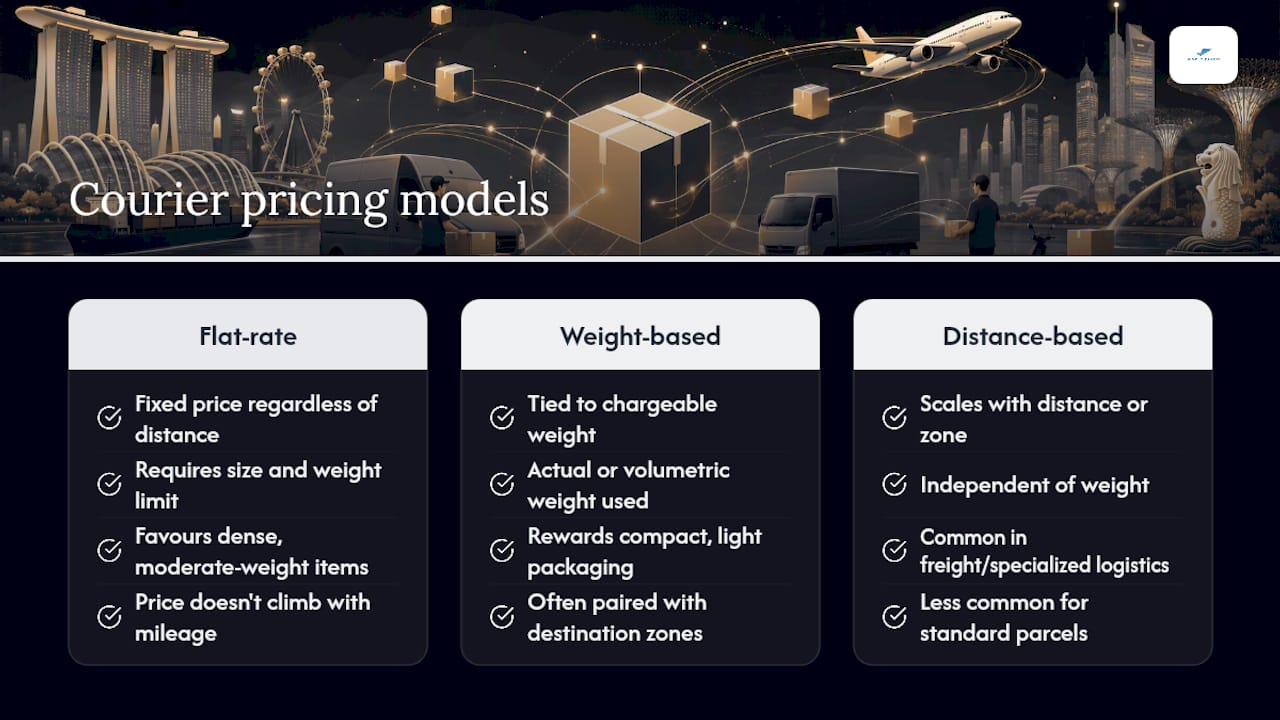
Flat-rate pricing charges a fixed price regardless of distance, as long as the package fits within a set size and weight limit. This model favors shippers sending dense, moderately heavy items over long distances, since the price doesn't climb with mileage.
Weight-based pricing ties the cost directly to chargeable weight, actual or volumetric, whichever is greater, and this is the dominant model for most international parcel and document shipping. It rewards compact, light packaging and penalizes bulky, low-density boxes regardless of how far they're traveling.
Distance-based pricing scales cost with the geographic distance or zone between origin and destination, independent of weight, and it's more common in freight and specialized logistics than in standard parcel courier services.
Most consumer and small-business courier shipments blend weight-based pricing with a zone structure that reflects distance, which is why understanding both chargeable weight and destination zones together gives you the clearest read on any quote.
How Peak Season Changes Courier Pricing
Courier rates aren't static across the calendar year. Demand spikes around major shopping periods, holiday seasons, and year-end shipping rushes, and carriers respond with peak surcharges layered on top of standard rates.
These seasonal adjustments show up for a straightforward reason: courier networks have finite capacity, trucks, planes, sorting facilities, and staff, and when shipping volume surges well beyond normal levels, carriers charge more to manage the strain and prioritize capacity. Peak surcharges typically appear as a percentage add-on or a flat per-shipment fee during defined windows, separate from the fuel surcharge and other standard fees already on your invoice.
If your shipment isn't time-sensitive, booking just before or after a peak window, rather than during it, can avoid this extra cost entirely. For businesses planning regular shipments around predictable peak periods, building in a buffer for these surcharges when budgeting for the quarter prevents an unpleasant surprise on the invoice. Checking whether a quote already accounts for seasonal pricing, or whether it will be added later, is worth confirming any time you're booking close to a known peak period.
A Note on Pricing Transparency
Courier pricing looks complicated because carriers have historically made it complicated. Base rates, surcharges, and taxes get presented separately, and the customer is left to add them up and hope nothing was missed. That's the exact problem an all-in quote is meant to solve, and it's the standard we think every shipper deserves before they commit to a booking.
If your shipment is straightforward, run the numbers yourself using the formulas in this guide. If it involves unusual dimensions, restricted goods, or a destination you're unfamiliar with, comparing all-in quotes across carriers, or reaching out to a support team that can walk through the specifics with you, saves more time than parsing five separate invoices on your own.
— Simply
Get an Instant Quote and Compare Rates Before You Book
An online shipping platform offers an alternative to requesting quotes from multiple carrier websites and comparing invoices by hand. It provides chargeable weight, zone pricing, service level, and surcharges calculated together in one all-in total, so the number you see upfront reflects your total cost. Such platforms may compare multiple courier partners side by side, provide online pickup booking, generate shipping labels and customs documentation automatically, and offer real-time shipment tracking from drop-off to delivery.
If you're ready to see what your own package costs across carriers, get an instant shipment quote and compare your options before you commit to a booking.
Sources
- Courier service companies in Singapore — Clickpost
- How international courier charges are calculated — CargoCharges
- Understanding courier charges: what you need to know — ShipScience