
Shipping a parcel internationally from Singapore should be straightforward. But if you have ever tried to find the best rate on your own, you know the reality: open one courier's website, get a quote, then open another, repeat the process, lose track of which browser tab had the better deal, and eventually just pick one out of frustration. For small business owners sending goods abroad regularly, that process multiplied across dozens of shipments per month becomes a serious drain on time and money. A courier aggregator solves this problem directly, and this article will walk you through exactly what it is, why it matters, and how real businesses are using it to ship smarter.
Table of Contents
- What is a courier aggregator?
- Top benefits of courier aggregators for Singapore shoppers and businesses
- How courier aggregators compare to direct courier accounts
- Case studies: Courier aggregators in action
- Why the real value of courier aggregators goes beyond savings
- Experience Singapore's easiest all-in-one shipping aggregator
- Frequently asked questions
Key Takeaways
| Point | Details |
|---|---|
| Easy rate comparison | Courier aggregator platforms let you compare and book shipments with multiple couriers from a single dashboard. |
| Big savings for all | Most shoppers and businesses save money—sometimes up to 60%—by using an aggregator instead of going direct. |
| Not just for large companies | You do not need to ship large volumes to enjoy better rates, making aggregators perfect for individuals and small businesses. |
| Know potential limits | Some edge cases include hidden fees, subscription costs, and limits to partnered couriers—always check before committing. |
| Empowering small players | Aggregators offer flexibility and convenience, letting you focus on growth rather than paperwork and logistics headaches. |
What is a courier aggregator?
With shipping confusion in mind, let's define what a courier aggregator actually is and how it simplifies things.
At its core, a courier aggregator is a platform that connects businesses and shoppers to multiple courier services through a single interface, allowing comparison of rates, booking, tracking, and management without separate accounts with each courier. Instead of juggling three or four different logins, you access everything from one dashboard.
Think about what that means in practice. You enter your parcel dimensions, weight, and destination once. The platform instantly pulls live rates from its courier partners and lines them up side by side. You pick the option that fits your budget and timeline, book, and the system generates your shipping label and documentation automatically. No phone calls, no waiting for quotes via email, no manually filling in the same sender details over and over.
"A courier aggregator removes the fragmentation from international shipping. You get centralized control over rates, booking, tracking, and documentation without maintaining separate relationships with each carrier."
Here is what a well-built courier aggregator typically handles for you:
- Rate comparison across multiple courier partners in real time
- Online booking with automatic label and documentation generation
- Shipment tracking in one place, so you are not checking five different carrier portals
- Pickup scheduling, often at no extra charge
- Order management so you can view and manage past and current shipments
Who uses these platforms? Mostly two groups. First, individual online shoppers or consumers sending personal items abroad, such as gifts, returned purchases, or care packages. Second, small business owners who export products regularly and need to keep shipping costs predictable and manageable. Both groups benefit from courier tracking benefits that come built into the platform, including real-time updates that reduce customer service queries.
The real-life problem this solves is clear. Imagine you run a small online store shipping to customers in Australia, Malaysia, and the UK. Without an aggregator, you might maintain separate accounts with three carriers, each with different rate cards, different label formats, and different tracking portals. An aggregator collapses that into a single workflow, saving you meaningful time on every single shipment.

Top benefits of courier aggregators for Singapore shoppers and businesses
Now that you know what a courier aggregator is, let's look at why people are switching and what advantages you could be missing.
The most immediately visible benefit is cost savings. Because aggregator platforms pool shipment volumes across all their users, they can negotiate bulk-discounted rates with courier partners. Those savings get passed on to you, even if you only ship a handful of parcels per month. Shipping aggregators can deliver cost savings via aggregated volumes and comparisons of up to 60% in some cases, with no volume commitments required and better rates than direct booking for low-volume shippers.
That last point is especially relevant in Singapore's small business landscape. Most direct courier contracts require you to commit to a minimum monthly shipment volume before you qualify for discounted rates. Very few small businesses or individual shippers can meet those thresholds consistently. An aggregator gives you access to negotiated rates without any minimum commitment, which is a genuine advantage for businesses in growth mode or those with seasonal shipping patterns.
Beyond cost, here are the benefits Singapore shippers consistently rate highest:
- One-stop management: Compare, book, and track all shipments from a single platform without switching between carrier websites
- Transparent pricing: See the full cost upfront, including fuel surcharges and handling fees, before you confirm
- Automatic documentation: Labels, invoices, and customs declarations generated instantly, reducing paperwork errors
- Flexible service tiers: Choose between priority, economy, or mid-range options depending on urgency and budget
- Free or low-cost pickups: Many aggregators, including platforms serving Singapore, offer free door-to-door pickup rather than requiring you to drop parcels at a service point
- No volume lock-in: Ship one parcel this week and ten next week without penalty
💡 Pro Tip: Some aggregator platforms run time-limited flash deals on specific routes or courier services. Check your platform's promotions tab before booking, especially for popular routes like Singapore to Malaysia or Singapore to Australia. Even a small percentage discount adds up over multiple shipments.
When you combine cost transparency with the ability to compare courier rates across multiple carriers at once, you eliminate the guesswork that leads to overpaying. Many shippers discover they have been paying 20 to 30 percent more than necessary simply because they always defaulted to one familiar carrier. The aggregator shows you every option, and the decision becomes informed rather than habitual.
For businesses managing e-commerce stores, the integration advantages extend even further. Many aggregator platforms connect directly with online store systems, so your order data flows automatically into the shipping workflow without manual data entry.
How courier aggregators compare to direct courier accounts
With the benefits clear, many ask: Why not just go directly to a courier? Let's break down how aggregators really stack up.
The honest answer is that it depends on your volume and shipping patterns. Here is a clear comparison:
| Factor | Courier aggregator | Direct courier account |
|---|---|---|
| Rate access | Bulk-negotiated rates, no minimum | Discounted rates only at high volumes |
| Setup complexity | Single account, instant access | Separate accounts per courier |
| Booking process | Compare and book in one step | Log into each carrier separately |
| Shipment tracking | Unified dashboard for all shipments | Separate portals per carrier |
| Label generation | Automatic, standardized | Varies by carrier |
| Flexibility | Switch couriers per shipment | Locked into one carrier's ecosystem |
| Volume commitment | None required | Often required for discounts |
| Coverage | Limited to platform's partner couriers | Full coverage of chosen carrier |
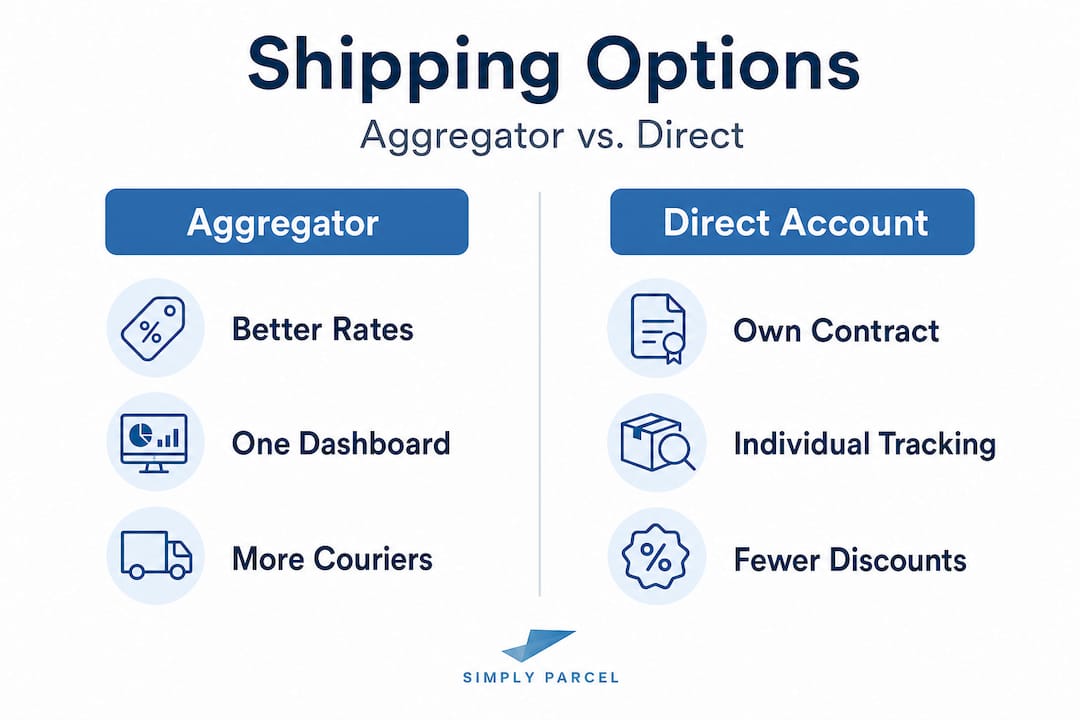
The table makes the trade-offs visible. For low to mid-volume shippers, aggregators offer clearly superior convenience and cost access. For high-volume businesses shipping hundreds of parcels daily on consistent routes, a direct contract with a single carrier can eventually offer better per-shipment rates if you meet their volume thresholds. There are also edge cases where aggregators are not ideal: very high-volume shippers who negotiate direct contracts, situations involving P.O. boxes or hotel addresses, or routes where the platform's partner couriers do not have strong coverage.
If you currently use a direct courier account and want to switch to an aggregator, here is how to do it without disrupting your shipping operations:
- Audit your current shipping costs: Pull your last three months of invoices and calculate your average cost per shipment by destination.
- Create an aggregator account: Most platforms have no setup fee and take less than ten minutes to register.
- Run test quotes: Enter your typical shipment details and compare the aggregator's rates against your current costs.
- Run a parallel period: Use both systems for two to four weeks to confirm reliability and delivery performance before fully switching.
- Transfer your shipment history: Download or export records from your old accounts so you have complete documentation.
- Cancel or pause direct accounts: Once satisfied, simplify your billing by consolidating to the aggregator.
💡 Pro Tip: Before committing to any aggregator, check whether the platform charges a monthly subscription fee on top of per-shipment costs. Some platforms offer genuinely free access while earning through the courier partnerships themselves. Others layer in subscription tiers with additional features. Read the pricing page carefully and calculate total cost including any platform fees before switching.
For Singapore businesses evaluating their pickup and cost strategies, the free pickup benefit offered by many aggregators is often the deciding factor. Dropping parcels at a service center adds time and transport costs that quietly erode savings.
Case studies: Courier aggregators in action
Understanding the comparison is easier with numbers. Here is what aggregators have delivered in real businesses.
Case study 1: Shiprocket and Indian SMEs
Shiprocket, one of Asia's largest courier aggregator platforms, serves over 400,000 sellers and has built its model around reducing return-to-origin (RTO) rates, one of the most costly problems for e-commerce businesses. RTO occurs when a shipment fails to deliver and gets sent back, costing the seller the shipping fee both ways. By intelligently routing shipments through the best-performing carrier on a given route, aggregators reduce RTO and the associated losses. For sellers shipping hundreds of orders per month, even a 5 percent reduction in RTO translates to thousands of dollars saved annually.
Case study 2: Southeast Asian aggregators and Singapore-relevant savings
In Southeast Asia, platforms facilitating over 7 million parcels have demonstrated consistent cost advantages compared to booking directly with major carriers or national postal services. The savings are most pronounced on international routes where direct booking rates are highest.
| Platform type | Typical users | Key advantage | Reported savings potential |
|---|---|---|---|
| Regional aggregator | SMEs and individuals | Bulk rate access, single dashboard | 20 to 60 percent vs. direct rates |
| Direct carrier account | High-volume enterprise | Dedicated account manager, custom SLAs | Best at 500+ shipments per month |
| National postal service | Individuals, low-value items | Wide acceptance, low minimums | Low cost but slow transit times |
What does this mean for Singapore users specifically?
- Singapore's e-commerce export market continues to grow, particularly toward Malaysia, Indonesia, Australia, and the UK
- Small businesses selling on platforms like Shopee, Lazada, or Etsy benefit directly from aggregator rate access
- The cost gap between aggregator rates and direct carrier rates is widest on long-haul international routes
- Aggregators that include free pickup eliminate the need to travel to a drop-off point, saving time and local transport costs
For anyone looking at Singapore courier options side by side, the data consistently shows that aggregators outperform direct booking for typical small business and individual shipping volumes. And for those new to the process, step-by-step guidance on how to book a pickup makes getting started simple and approachable.
Why the real value of courier aggregators goes beyond savings
The savings numbers are compelling, but there is a more strategic reason to use a courier aggregator that most articles skip over.
Agility. Not just cost agility, but operational agility. When you are not locked into a single carrier's ecosystem, you can experiment freely. If one courier's performance drops on a key route, you switch without renegotiating a contract or losing your discount tier. That flexibility is a genuine competitive advantage for small businesses that need to protect their customer experience without the leverage of enterprise shipping volumes.
We see this play out particularly clearly in Singapore's growing e-commerce segment. A small business owner selling handmade goods internationally cannot afford to have a carrier fail during peak season. An aggregator lets you pre-identify backup carriers and switch routing in minutes, not days. That kind of resilience used to be reserved for large logistics teams.
There is also an admin burden consideration that gets underestimated. Every hour a business owner spends comparing rates, chasing tracking updates, or filing claims with individual carriers is an hour not spent on marketing, product development, or customer service. An aggregator with shipping workflow integration compresses that admin time dramatically, and the time savings compound over months.
Finally, consider the learning curve advantage. Aggregator platforms collect data on carrier performance across routes and timeframes. Some surface this data directly to users through delivery time estimates or carrier ratings. That information helps you make smarter shipping decisions over time, which further improves your customer satisfaction scores and reduces late delivery complaints. The real value is not just in the shipment you book today. It is in the shipping operation you build over the next year.
Experience Singapore's easiest all-in-one shipping aggregator
Ready to put what you have learned into action? Here is how you can get started with no risk.
Simply Parcel is Singapore's purpose-built courier aggregator platform, designed for exactly the scenarios covered in this article. Whether you are an individual sending a parcel abroad or a small business managing regular international shipments, the platform gives you one-click access to rate comparisons across major courier partners, automatic label and documentation generation, real-time tracking, and free pickup scheduling. There are no volume commitments and no complex setup. You can get a shipping quote in under a minute, or go straight to booking with instant shipping quotes that show you every available option for your specific parcel and destination. Start comparing rates today and see exactly how much you could save on your next international shipment.
Frequently asked questions
Can I use a courier aggregator without a business account?
Yes, most courier aggregators allow individuals to compare, book, and manage shipments without needing a business registration. Aggregator platforms are designed for both individual consumers and businesses, requiring only a personal account to access rate comparisons and booking tools.
Do courier aggregators really offer better rates than going direct?
For most individuals and small businesses, aggregators offer lower rates because they negotiate bulk discounts across many users. Savings of up to 60 percent compared to direct booking are possible, particularly for low-volume shippers who cannot qualify for direct carrier discounts on their own.
Are there any downsides to using a courier aggregator?
Some aggregators charge subscription fees, have limited courier partners, or restrict delivery to P.O. boxes or hotels. Platforms are also not ideal for very high-volume shippers who can negotiate better rates directly through enterprise carrier contracts.
What types of couriers are typically included on aggregator platforms?
Aggregator platforms partner with a variety of local and international couriers, but coverage is limited to partnered carriers only. Each aggregator platform connects to a specific network of courier services, so it is worth confirming that your preferred destination countries are covered before registering.