
Unexpected fees. A package stuck in customs. A delivery that arrives two weeks late when you promised your client three days. These are the real frustrations that come with picking the wrong international courier, and they happen more often than they should. Whether you are sending a birthday gift to a relative in Australia or shipping product samples to a buyer in Europe, the courier you choose directly affects your costs, your timeline, and your reputation. This guide gives you a practical, step-by-step process to find the right international courier from Singapore, without the guesswork.
Table of Contents
- What to consider before starting your courier search
- Compare top international courier options available in Singapore
- Check courier reliability, tracking, and customer support
- Understand pricing structures, hidden charges, and documentation
- Our take: Why process beats price in courier selection
- Ship smarter from Singapore with Simply Parcel
- Frequently asked questions
Key Takeaways
| Point | Details |
|---|---|
| Clarify shipping needs | Define what, where, and how fast you need to ship to streamline your search. |
| Always compare couriers | Review multiple providers to get the best rates, speed, and coverage for your package. |
| Check tracking and support | Reliable couriers offer robust tracking and responsive customer service, especially for issues in transit. |
| Beware hidden fees | Understand surcharges and documentation to avoid surprises at payment or customs. |
| Follow a proven process | A structured approach leads to fewer shipment issues and greater peace of mind. |
What to consider before starting your courier search
Before you compare a single price or read a single review, you need to get clear on what you are actually shipping. Many senders skip this step and end up picking a courier that looks affordable on the surface but is poorly matched to their actual needs. As shipping tips from Simply Parcel confirm, identifying your shipping needs upfront is the first step to finding a cost-effective courier.
Start with these four core questions:
- What are the size and weight of your package? Couriers calculate prices differently. Some charge by actual weight, others by volumetric weight (which accounts for the physical space a package takes up, even if it is light). A large but lightweight box can cost more than a dense, heavy one depending on the courier's formula.
- Where are you shipping to? Not every courier covers every destination. Shipping to major cities in the US or UK is straightforward, but sending to less common destinations like parts of Africa, South Asia, or remote Pacific islands can dramatically reduce your options and increase costs.
- How fast does it need to arrive? You will generally choose between priority (fastest, priciest), connect-plus (mid-range speed and cost), and economy (budget-friendly, longer transit time). Matching speed to need prevents you from overpaying for urgency you do not actually have.
- Does your shipment have special requirements? Fragile items need proper cushioning and possibly extra insurance. High-value items such as electronics or jewelry require declared value coverage. Regulated items like batteries, cosmetics, or food products may need specific documentation or face restrictions in certain countries.
Pro Tip: Use a tape measure and a scale before you look at any courier quotes. Having exact dimensions and weight ready will make every comparison faster and more accurate. You can also review a detailed international shipping guide to understand what requirements apply to your specific destination.
Taking 10 minutes to answer these questions upfront saves you hours of back-and-forth later. It also prevents the unpleasant surprise of booking a courier only to discover your parcel does not qualify for the service you selected.
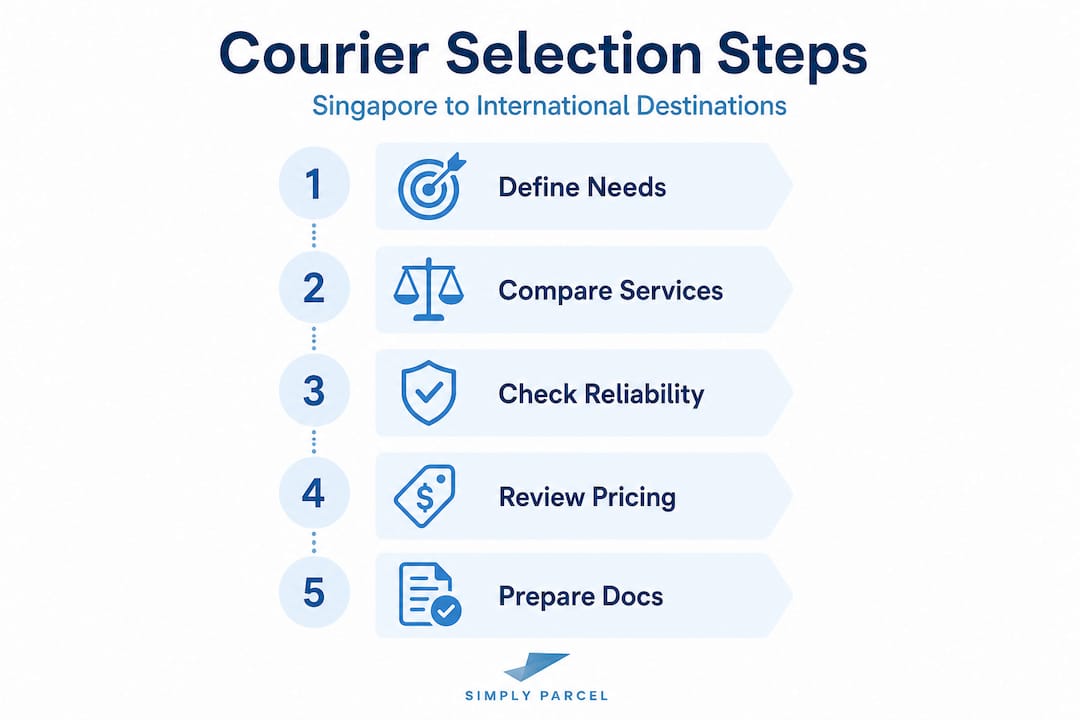
Compare top international courier options available in Singapore
Once you know your shipping priorities, you can start comparing providers head-to-head. This is where most senders either do their best work or make their biggest mistakes. Comparing couriers saves money and reduces delivery stress, as courier comparison research confirms. Senders who take the time to compare options across multiple factors consistently report lower costs and fewer problems.
When evaluating couriers, focus on these factors:
- Base price and volumetric weight formula
- Estimated transit time to your target destination
- Countries and regions covered
- Service reputation and online ratings
- Insurance and liability options
- Pickup availability and convenience
Here is a simplified comparison of what to look for across different service tiers commonly available to Singapore senders:
| Feature | Priority service | Connect-plus service | Economy service |
|---|---|---|---|
| Typical transit time | 1 to 3 business days | 3 to 7 business days | 7 to 14 business days |
| Relative cost | Highest | Mid-range | Lowest |
| Best for | Urgent documents, time-sensitive goods | Regular parcels, small business orders | Non-urgent personal items, bulk samples |
| Tracking quality | Full real-time updates | Standard tracking milestones | Basic dispatch and delivery confirmation |
| Insurance availability | Usually included or available | Usually available | Often limited |
For a deeper look at how specific providers stack up, the best courier services comparison covers major options available to Singapore senders in detail. If you run a small business and want to connect your order management to courier bookings, reading about courier integration tips can also help you save time on repeat shipments.
One commonly overlooked factor is destination surcharges. A courier may advertise a low base rate but then apply a surcharge for deliveries outside of major metropolitan areas. Always request a full quote that includes all applicable fees before making your final decision.
Check courier reliability, tracking, and customer support
Beyond price and basic delivery times, the reality of shipping depends heavily on reliability and service quality. A courier that delivers on time 70% of the time is not actually a bargain, no matter how low the upfront price looks. Reliability is measured in three ways: on-time delivery rates, tracking quality, and the responsiveness of customer support.

On-time delivery rates are the most important metric. Look for couriers that publish or can share their delivery performance data. If a courier cannot or will not share this information, that itself tells you something.
Tracking quality matters more than many senders realize. Knowing exactly where your package is at any moment reduces anxiety and helps you manage expectations with recipients. As tracking feature insights show, tracking features are essential for shipment peace of mind and performance. Poor tracking means you are left guessing, and your recipient is left waiting without information.
Here is a breakdown of what different tracking levels actually provide:
| Tracking type | What you see | Best suited for |
|---|---|---|
| Basic tracking | Dispatch and final delivery confirmation only | Low-value, non-urgent personal items |
| Standard milestone tracking | Key checkpoints: departed, in transit, customs cleared, delivered | Regular parcels, small business orders |
| Real-time tracking with alerts | Continuous location updates, proactive SMS or email notifications | High-value goods, time-sensitive deliveries |
Customer support availability is the third pillar of reliability. What happens when your package is held up at customs? What if the recipient was not home for delivery? A courier with 24/7 support or a dedicated account manager for small businesses can resolve these issues quickly. A courier that only offers email support with a 48-hour response window will leave you frustrated and helpless during urgent situations.
Pro Tip: Before booking any courier, send a test inquiry to their customer support channel. How fast they respond and how clearly they answer tells you a lot about how they will perform when a real problem arises. You can also review your postage options for Singapore to understand which courier types are best suited for different kinds of international mail.
A good rule of thumb: if a courier scores well on all three reliability factors, a slightly higher price is almost always worth it. The cost of a delayed or lost shipment, in money, time, and customer trust, far exceeds a few extra dollars on the base rate.
Understand pricing structures, hidden charges, and documentation
With your shortlist in hand, it is time to take a closer look at what you will pay and what paperwork you must prepare. Pricing in international shipping is not always straightforward, and documentation errors are one of the top reasons shipments get delayed or returned.
How couriers calculate your cost:
Couriers typically price shipments using one of four models. Actual weight charges you based on the physical weight of your parcel. Volumetric weight (also called dimensional weight) calculates cost based on the package's length, width, and height, then divides by a standard divisor. You are usually charged whichever is higher. Zone-based pricing means your cost changes depending on how far the destination is from Singapore. Service tier pricing adds a premium for faster delivery options.
Common hidden charges to watch for:
- Fuel surcharges (usually a percentage added on top of the base rate)
- Remote area delivery fees (applied when delivering to postcodes outside major urban centers)
- Residential delivery surcharges (some couriers charge extra to deliver to homes versus business addresses)
- Customs clearance fees (charged when the courier handles import duties on the recipient's behalf)
- Oversize or overweight penalties (applied when a parcel exceeds standard dimensions or weight limits)
Documents you typically need for international shipments:
- Commercial invoice (required for all international parcels, listing item descriptions, quantities, and values)
- Packing list (a detailed breakdown of package contents, weights, and dimensions)
- Air waybill or bill of lading (the transport contract generated when you book your courier)
- Certificate of origin (required by some destination countries for certain goods)
- Special permits (required for regulated items such as pharmaceuticals, food products, or electronics with lithium batteries)
Proper documentation is not optional. Missing or incorrect paperwork is one of the leading causes of customs holdups, which can add days or even weeks to your delivery timeline.
As detailed in the guide to required shipping documentation, proper shipping documentation is crucial for avoiding customs holdups. Getting this right from the start protects your shipment and your business relationships.
Pro Tip: Always double-check the declared value on your commercial invoice. Underdeclaring to save on duties is illegal in most countries and can result in seizure of your goods. Accurate declarations protect you legally and ensure smooth customs clearance.
Our take: Why process beats price in courier selection
After working through the practical steps above, it is worth reflecting on what actually makes shipping successful in real life. Here is something we have observed consistently: the senders who get the best outcomes are not the ones who found the lowest rate. They are the ones who followed the most consistent process.
This might feel counterintuitive in a market where price comparison tools are front and center. But the evidence from senders in Singapore, from individuals mailing gifts to small businesses shipping orders regularly, points clearly in one direction. Rushing to the cheapest option without checking reliability, tracking quality, and documentation requirements leads to problems. And those problems cost more to fix than the savings ever justified.
Consider a common scenario: a small business owner finds a budget courier offering rates 20% below the market average. They book quickly, skip the documentation checklist, and send out a batch of product samples to a potential buyer in Germany. The shipment is held at customs for two weeks due to a missing certificate of origin. The buyer loses interest. The business owner pays a customs storage fee and eventually has the package returned. The "cheap" shipment ended up costing three times more than a properly managed one would have.
The answer is not to always choose the most expensive courier. It is to evaluate international courier reliability as carefully as you evaluate price, and to use a structured process every single time you ship. That means clarifying your shipment needs first, comparing couriers on all relevant factors, verifying policies on hidden fees and insurance, and preparing all documents correctly before you book. A reliable courier with clear pricing, good tracking, and solid support will almost always deliver a better total experience than a discount option that looks attractive on the surface.
Transparency is the quality that matters most in a courier. If a provider clearly explains its pricing, its transit times, and its process for handling customs or delays, that is a sign they will manage your shipment professionally.
Ship smarter from Singapore with Simply Parcel
Ready to put this guide into action? Simply Parcel makes the entire process straightforward. You can get instant courier quotes for your specific destination, weight, and service tier in seconds, with no hidden surprises. The platform compares multiple courier partners so you can see real price and transit time differences side by side. Once you book, shipment tracking solutions give you real-time visibility from pickup to delivery. Simply Parcel also guides you through documentation requirements, so your paperwork is correct before your parcel leaves Singapore. Whether you ship occasionally or manage regular orders for your business, get a shipping quote today and start shipping with confidence.
Frequently asked questions
How can I find the cheapest international courier from Singapore?
Compare major couriers for your destination, weight, and speed needs using online tools. As courier comparison shows, comparing couriers saves money and reduces delivery stress for senders.
What documents are required for international shipping?
Most shipments need a commercial invoice, packing list, and air waybill, plus special permits for regulated goods. According to guidance on shipping documentation, proper documentation is crucial for avoiding customs holdups.
How do I track my international shipment?
Use your courier's online tracking page or app to see delivery updates in real time. Tracking features are essential for shipment peace of mind and help you respond quickly if delays occur.
Are there extra charges for remote delivery locations?
Yes, many couriers add remote area surcharges for deliveries outside major cities, and these fees are not always visible in the initial quote. Always request a full itemized quote before confirming your booking.
What if my package is high-value or fragile?
Choose a courier that offers declared value coverage and specialized handling for fragile or high-value items. Confirming insurance options before you book is the best way to protect your shipment and give yourself peace of mind.