
Sending a parcel internationally from Singapore sounds simple until you actually try to do it. Prices vary widely between couriers, transit times are rarely straightforward, and the fine print in service agreements can catch you off guard. Many individuals and small businesses end up paying more than they should, simply because they booked with a familiar name without checking what else was available. This article breaks down how the courier landscape in Singapore actually works, what separates direct couriers from comparison platforms, and how making one small change to your shipping process can save you real money on every shipment.
Table of Contents
- Understanding the courier landscape in Singapore
- Direct couriers vs. courier comparison platforms: Key differences
- Real savings and less hassle: The benefits of comparing couriers
- When is courier comparison the right choice?
- The common mistake: Relying on "big names" without comparing
- Ship smarter with transparent courier comparison
- Frequently asked questions
Key Takeaways
| Point | Details |
|---|---|
| Transparency equals savings | Comparing couriers helps you avoid hidden costs and overpaying by revealing all fees upfront. |
| Flexibility for every shipper | Courier comparison is perfect for low to mid-volume senders who need to avoid long-term contracts. |
| Instant, apples-to-apples results | With comparison tools, you can instantly see true, up-to-date options for every shipment. |
| No need for massive volume | Unlike direct contracts, courier comparison works even if you send just one or two parcels a month. |
| Simple, stress-free shipping | A comparison platform lets you manage everything easily, saving time and reducing logistics headaches. |
Understanding the courier landscape in Singapore
Singapore sits at the center of one of the world's busiest trade corridors, which means there is no shortage of courier options for international shipping. You will find global giants like DHL, FedEx, and UPS operating directly, alongside regional players and a growing number of digital platforms that aggregate multiple services under one roof.
But having more options does not automatically make choosing easier. In fact, it often makes things more confusing. Each courier structures its pricing differently. Some charge by actual weight, others by volumetric weight (calculated using the parcel's dimensions rather than its physical mass). Surcharges for fuel, remote areas, and residential delivery can add 15 to 30 percent on top of the base rate. Unless you know exactly where to look, these fees stay hidden until after you have committed.
Here is what the main categories of shipping options look like for Singapore senders:
- Direct couriers: Large carriers that handle their own logistics end to end. Best for high-volume shippers with negotiated contracts.
- Freight brokers: Intermediaries who negotiate rates on your behalf, usually for larger or more complex shipments.
- Courier comparison platforms: Online tools that let you view and book from multiple couriers in one place, with transparent pricing and no minimum order requirements.
- Local courier aggregators: Singapore-specific services that focus on last-mile delivery within the region.
As industry observers note, comparing couriers directly is difficult without a dedicated tool because each carrier presents its pricing and service terms in different formats. Direct couriers tend to serve massive volumes best, while comparison platforms are the smarter fit for low to mid-volume senders with variable needs and no interest in being locked into a contract.
For individuals sending gifts abroad, small e-commerce sellers fulfilling overseas orders, or startups testing new export markets, a comparison platform gives you the clearest picture of what you are actually paying and what you are getting in return. You can find more practical guidance on the shipping tips blog to help you navigate these decisions.
Direct couriers vs. courier comparison platforms: Key differences
With the main delivery options identified, it is crucial to see how each method measures up side by side. The choice between going direct and using a comparison platform is not just about price. It is about control, flexibility, and how much time you want to spend managing your shipping.
| Feature | Direct courier | Courier comparison platform |
|---|---|---|
| Pricing transparency | Varies; often requires a quote | Instant, visible upfront |
| Minimum order quantity (MOQ) | Often required | Typically none |
| Contract required | Usually for best rates | No |
| Multiple carrier options | No | Yes |
| Flexibility per shipment | Limited | High |
| Time to book | Longer (negotiation, account setup) | Fast (minutes) |
| Best for | High-volume, contract shippers | Individuals and small businesses |
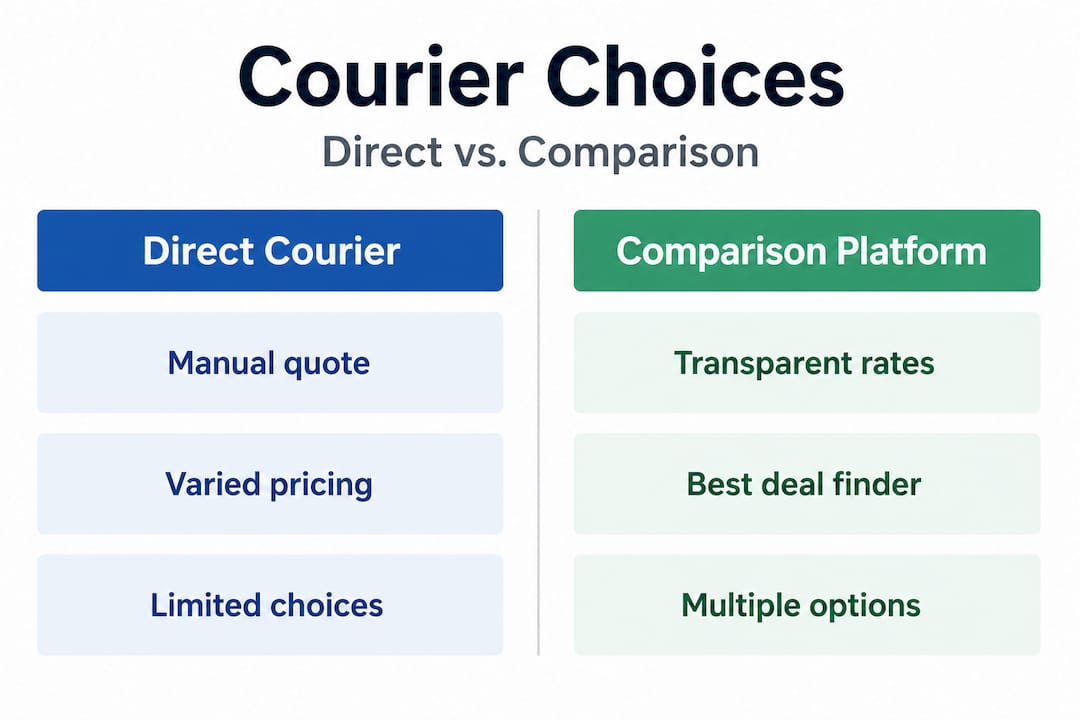
Going direct with a courier makes the most sense when you ship hundreds of parcels every month and have the leverage to negotiate a custom rate. At that scale, a dedicated account manager and a locked-in price per kilogram can work in your favor.
For everyone else, the comparison approach wins on almost every point. Here is why:
- You see real prices from multiple couriers before you commit to anything.
- You are not tied to one carrier's service quality or pricing changes.
- You can choose a faster, pricier option for urgent shipments and a slower, cheaper one for non-urgent goods, all from the same platform.
- There is no account setup, no sales call, and no waiting for a quote to come back by email.
As industry analysis confirms, comparing couriers on an apples-to-apples basis is genuinely difficult without the right tools. A comparison platform does that work for you automatically.
Pro Tip: Before booking any shipment, use cost comparison tools to enter your parcel's exact weight and dimensions. Even a small difference in how you measure can shift the price significantly, so getting an accurate quote upfront prevents surprises at pickup.
Real savings and less hassle: The benefits of comparing couriers
Having seen what sets comparison sites apart, it is time to quantify the real-world impact on both your wallet and peace of mind. The savings from courier comparison are not theoretical. They show up on every shipment when you consistently check your options rather than defaulting to one carrier.
Consider a practical example. A small Singapore-based online seller ships a 2 kg parcel to Australia. Without comparing, they book with the first carrier they think of and pay SGD 45. A quick check on a comparison platform might show the same service level from a different carrier for SGD 28. That is a 38 percent difference on a single parcel. Multiply that across 50 shipments a month and the savings become significant.
Here is a simplified look at how price differences can stack up:
| Destination | Parcel weight | Direct courier estimate | Comparison platform best rate | Potential saving |
|---|---|---|---|---|
| Australia | 2 kg | SGD 45 | SGD 28 | SGD 17 |
| United Kingdom | 1 kg | SGD 38 | SGD 25 | SGD 13 |
| United States | 3 kg | SGD 72 | SGD 52 | SGD 20 |
| Malaysia | 0.5 kg | SGD 18 | SGD 12 | SGD 6 |
These are illustrative figures, but they reflect real patterns in the market. The gap between the most expensive and least expensive option for the same shipment is often 20 to 40 percent.
Beyond price, here are the four most practical benefits of using a courier comparison platform:
- Instant visibility: You see all available rates in seconds, without making phone calls or filling out contact forms.
- Time savings: No need to research individual couriers, create accounts on multiple platforms, or wait for quotes to arrive by email.
- Budget accuracy: When you know the exact cost before you ship, you can price your products correctly and avoid absorbing unexpected fees.
- No lock-in: As experts point out, comparison platforms are ideal for senders with variable needs and no MOQ, meaning you are never forced to ship a minimum number of parcels to maintain access to competitive rates.
Explore the full range of courier service options available to Singapore senders to see how different speed tiers and carriers compare for your most common destinations.
When is courier comparison the right choice?
Now you know what you get from comparing, but is it universally the best option? Here is how to decide which path fits your needs.
The honest answer is that courier comparison is the right choice for the vast majority of people shipping internationally from Singapore. The exceptions are relatively narrow, and they almost always involve very high shipping volumes.
Comparison platforms are the right fit if you:
- Send parcels abroad occasionally or irregularly, even just a few times a month.
- Run a small e-commerce business and need to keep shipping costs predictable.
- Are a startup or individual who cannot commit to a monthly minimum shipment volume.
- Want the freedom to choose a faster service for urgent orders and a cheaper option for standard ones.
- Have shipments going to multiple countries with different weight and size profiles.
- Want to avoid being affected when a single courier raises its rates.
Direct contracts may make more sense if you:
- Ship more than 200 to 300 parcels per month consistently to the same destinations.
- Have a dedicated logistics team to manage carrier relationships and renegotiate contracts regularly.
- Need highly customized service agreements, such as specific pickup windows or specialized handling for fragile goods at scale.
For most individuals and small businesses in Singapore, those high-volume thresholds are simply not where they operate. As industry guidance confirms, direct couriers are better suited for massive volumes with negotiated contracts, while comparison platforms are the smarter choice for low to mid-volume senders with variable needs.
Pro Tip: If you are unsure which tier you fall into, start with a comparison platform. You can always transition to a direct contract later if your volume grows. There is no downside to starting with flexibility. Get a shipment quote now to see what your current options look like before committing to anything.
The common mistake: Relying on "big names" without comparing
Here is an observation we see repeatedly in the Singapore shipping market: most senders, whether individuals or small business owners, default to the most recognizable courier brand without ever checking if it is actually the best option for their specific shipment.

This is understandable. Big names feel safe. You have heard of them, you trust their branding, and you assume that market leadership translates directly into the best value for every shipment. But that assumption is costing you money.
The reality is that major couriers price their services to capture the widest possible market, not to give every small shipper the best deal. Their rates are often set with large enterprise customers in mind. When you book as an individual or a small business without a negotiated contract, you are typically paying retail rates that have significant margin built in.
What makes this worse is that comparing couriers without tools is genuinely difficult. Each carrier uses different terminology, different weight calculation methods, and different surcharge structures. Without a platform that standardizes all of that information, most senders give up trying to compare and just go with the name they recognize.
The shift we encourage is simple: make comparison a habit, not a one-time action. Every time you ship internationally, spend 60 seconds checking your options. You do not need to switch couriers every time. Sometimes the big name will genuinely offer the best rate for your specific parcel and destination. But you will only know that if you check.
Comparison platforms also protect you from rate creep. When a single courier quietly increases its surcharges, you will notice immediately because the price will no longer be competitive. That visibility alone is worth building into your regular shipping process.
We have seen this play out with small e-commerce sellers who assumed their go-to courier was unbeatable, then discovered through a comparison tool that they had been overpaying by 25 to 35 percent for over a year. The compare courier prices tool takes less than a minute to use, and the shipping tips blog offers ongoing guidance to help you stay informed as the market changes.
Ship smarter with transparent courier comparison
Ready to turn insight into action? Simply Parcel makes courier comparison straightforward for individuals and small businesses in Singapore. Instead of guessing which carrier offers the best rate for your next international parcel, you can use the shipment quote tool to see real prices from multiple couriers in seconds. No account setup, no minimum volumes, and no long-term commitments required. Whether you are sending a personal gift to a friend overseas or fulfilling customer orders across multiple countries, you can get instant quotes and book your preferred service in just a few clicks. Simply Parcel offers priority, connect-plus, and economy shipping options so you always have a choice that fits both your timeline and your budget.
Frequently asked questions
How does a courier comparison platform save me money?
By showing you upfront costs from multiple couriers side by side, you can immediately spot the most cost-effective option for each shipment instead of defaulting to a single carrier. Platforms like these are especially valuable for low-mid volume senders with no MOQ requirements who need flexibility without lock-in.
Is courier comparison better than going direct for small businesses?
For most small businesses and individuals without negotiated shipping contracts, comparison sites offer better flexibility, pricing transparency, and no minimum commitments. Direct couriers are better suited for high-volume shippers with the leverage to negotiate custom rates.
Do I need to commit to one courier when using a comparison site?
No, comparison platforms let you choose a different courier for every shipment based on price, speed, or destination without any long-term contract. This no lock-in approach is one of the key advantages for variable-volume senders.
What is MOQ, and why does it matter for shipping?
MOQ stands for minimum order quantity, and some direct couriers require you to ship above a set number of parcels each month to access their best rates. Comparison platforms have no MOQ requirements, making them accessible whether you ship once a month or every day.