
Shipping a parcel overseas from Singapore should be straightforward. But the moment you request your first quote, you're faced with a wall of charges, surcharges, and conditions that can make the final cost look very different from what you expected. Whether you're a small business owner sending products to customers in Europe or an individual mailing a gift to family in Australia, understanding how international shipping costs work is the single most reliable way to keep your spending under control. This guide walks you through everything you need, from understanding fee structures to comparing quotes and avoiding costly mistakes.
Table of Contents
- What drives international shipping costs from Singapore?
- Tools, details, and documents needed before comparing shipping options
- Step-by-step: How to compare and select the most affordable international shipping option
- Avoiding common mistakes and cutting hidden costs
- Why most international shipping savings are found before you even ship
- Affordable international shipping made simple with Simply Parcel
- Frequently asked questions
Key Takeaways
| Point | Details |
|---|---|
| Break down costs | Understand every fee—fuel, DIM weight, and duties add up quickly. |
| Standardize details | Gather accurate measurements and documentation before comparing quotes. |
| Compare like-for-like | Always use the same shipment info and fee breakdown for each quote. |
| Avoid hidden charges | Watch for surprise surcharges and clarify them before confirming your shipment. |
| Preparation equals savings | The most affordable results come from being prepared, not from last-minute bargain hunting. |
What drives international shipping costs from Singapore?
After establishing why you need to master international shipping costs, let's break down the main elements you'll encounter on any quote.
International shipping quotes are rarely as simple as "price per kilogram." Most carriers apply several layers of charges, and each one can meaningfully affect what you pay. Getting familiar with these components gives you real control over your shipping budget.

The core cost components
Every quote you receive will typically include some combination of the following:
- Base rate: The standard charge based on the weight and destination zone of your parcel.
- Fuel surcharge: A variable fee that carriers adjust regularly based on fuel prices. This can add 10% to 30% or more on top of the base rate.
- DIM weight charge: DIM weight (dimensional weight) is a pricing method that calculates a "volumetric" weight based on the parcel's size. Carriers charge based on whichever is higher, the actual weight or the DIM weight. A light but large box often ends up costing far more than expected because of this.
- Remote area surcharge: Deliveries to rural or less accessible destinations often attract an extra fee. This applies even if you're shipping to a major country but the final delivery address is outside a metro area.
- Residential delivery fee: Some carriers charge more for deliveries to home addresses compared to commercial addresses.
- Duties and taxes: Import duties and taxes are applied at the destination country. These depend on the item's declared value, the HS code (Harmonized System code, a standardized international product classification number), and the destination country's import rules.
- Brokerage fees: Customs brokerage is the service that handles import clearance. Some carriers include this, others charge separately.
To get a truly accurate picture of what you'll pay, you need to compare full breakdowns including fuel surcharges, DIM weight, residential and remote fees, duties, taxes, and brokerage across every option. Using our shipping terminology guide can help you decode any unfamiliar terms quickly.
Understanding DIM weight in practice
Here's a simple example. Say you're sending a lightweight foam product that weighs 1.5 kg but measures 40 cm x 40 cm x 30 cm. Most carriers apply a divisor of 5,000 for air freight. The DIM weight calculation would be: (40 x 40 x 30) / 5,000 = 9.6 kg. Even though your parcel physically weighs 1.5 kg, you'd be charged for 9.6 kg. That's a significant difference.
Key insight: Always calculate DIM weight before comparing quotes. If you only enter the actual weight, you may get a quote that doesn't reflect what you'll actually be charged at pickup.
| Cost component | What it depends on | Who pays |
|---|---|---|
| Base rate | Weight, destination zone | Shipper |
| Fuel surcharge | Current fuel index | Shipper |
| DIM weight | Parcel dimensions | Shipper (if higher than actual) |
| Remote area surcharge | Delivery address location | Shipper |
| Duties and taxes | Item value, HS code, destination | Recipient or shipper (Incoterms dependent) |
| Brokerage fee | Carrier policy, customs complexity | Shipper or recipient |
For a fuller breakdown of how these costs interact, the complete guide for Singapore senders is a practical reference worth bookmarking.
Tools, details, and documents needed before comparing shipping options
Once you know what drives costs, prepare your shipment information for fair comparison.
Walking into a quote comparison without your shipment details ready is one of the most common reasons people end up with inaccurate prices. When you provide incomplete or estimated information, carriers fill in the gaps in ways that tend to favor their own margins. The result is surprise charges after the fact.
What shipment details you need
Before requesting any quotes, have the following ready:
- Parcel dimensions: Measure length, width, and height in centimeters. Be precise, rounding up to the nearest centimeter.
- Actual weight: Use a reliable scale and record the weight in kilograms.
- Item description: A clear, specific description of what's inside. "Electronics" is too vague; "USB keyboard, new in box" is better.
- Declared value: The fair market value of the item in Singapore dollars or the destination currency.
- HS code: This six-digit code identifies your product for customs purposes. You can look it up through the Singapore Customs TradeNet portal. Getting this right affects duty calculations.
- Incoterms: Incoterms (International Commercial Terms) define who is responsible for shipping costs, insurance, and duties at each stage of the journey. The most common are DDP (Delivered Duty Paid, meaning the shipper handles all costs) and DAP (Delivered At Place, meaning the recipient pays duties on arrival).
- Destination address: Include full postal code and whether it's a residential or commercial address.
Pro Tip: Use a digital kitchen scale for parcels under 5 kg and a luggage scale or postal scale for heavier items. Even a 200-gram difference can push your parcel into the next weight bracket and change your quote significantly.
To help you gather shipment details accurately and consistently, use the same input format across every quote request you make. This standardizes your comparisons so you're evaluating the same shipment across different carriers.
Essential documents and tools
| Document or tool | Purpose | When you need it |
|---|---|---|
| Commercial invoice | Declares item value and contents for customs | All international shipments |
| Packing list | Itemizes contents for multi-product shipments | When shipping multiple items |
| HS code | Classifies goods for duty calculation | All commercial shipments |
| Shipping label | Identifies sender, recipient, and tracking | Generated at booking |
| Certificate of origin | Proves where goods were manufactured | When preferential duty rates apply |
| Digital scale | Accurate weight measurement | Before requesting any quote |
| Measuring tape | Precise dimensions for DIM weight | Before requesting any quote |
If you're sending non-urgent goods, it's worth exploring economy shipping options once you have your full shipment details ready. Economy services trade speed for cost savings, which suits many personal and small business shipping needs.
Step-by-step: How to compare and select the most affordable international shipping option
Now that you've got your information handy, it's time to start comparing your options.
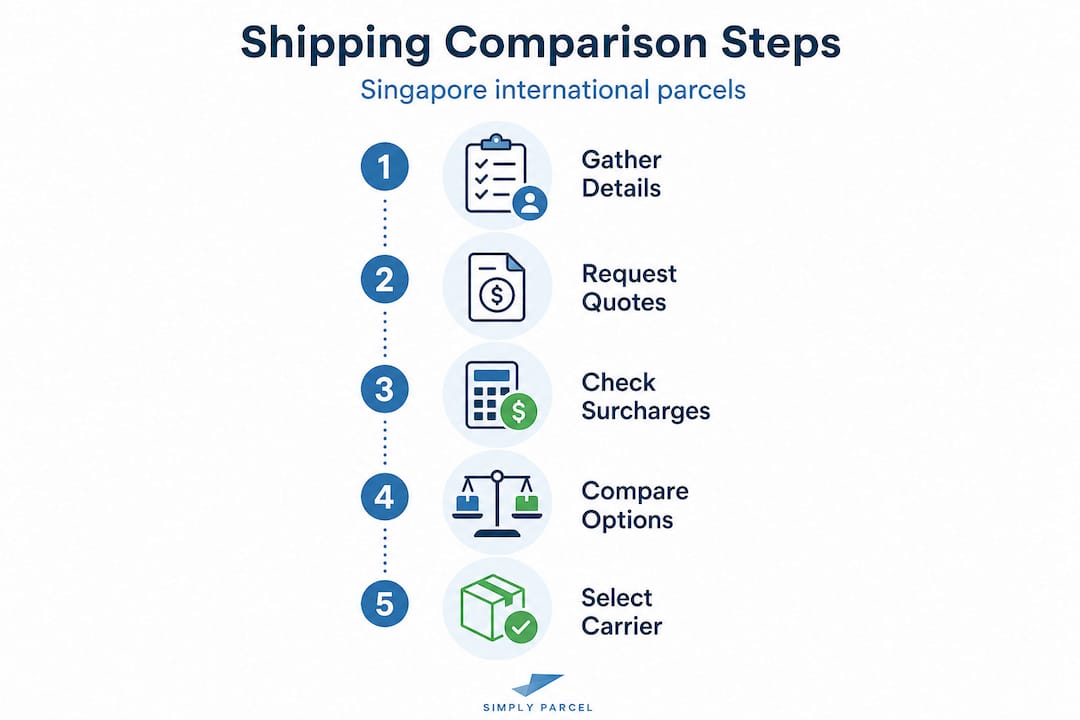
Many shippers pick the first quote that looks reasonable, then regret it when unexpected charges appear on their invoice. A structured comparison process protects you from that. Here's how to do it properly.
The comparison workflow
-
Record your full shipment details using the list above. Write them down or enter them into a spreadsheet. Having a fixed reference point prevents you from accidentally comparing different inputs across quotes.
-
Request quotes from multiple carriers. Use a shipping aggregator or visit carrier websites. Make sure you're entering the same dimensions, weight, destination, and declared value for every quote.
-
Request full fee breakdowns, not just the headline price. Ask specifically for the base rate, fuel surcharge, DIM weight charge, remote area fees, and any destination country taxes or brokerage fees that are included or excluded.
-
Compare transit times alongside cost. A quote that's $5 cheaper but takes four extra days may not suit your customer's expectations. Map this out clearly before deciding.
-
Verify service reliability. Check whether the carrier provides real-time tracking, has a customer service channel you can reach, and has a clear claims process for lost or damaged parcels.
-
Confirm pickup availability. Some carriers charge for pickup while others offer it free. Factor this into your total cost calculation.
-
Check insurance options. Basic liability coverage is often minimal. If you're shipping high-value goods, confirm whether enhanced coverage is available and at what cost.
Pro Tip: When comparing quotes, always compare shipping quotes using the same DIM weight figure. If one carrier shows a lower price but is calculating from a different weight, you're not comparing equivalent services.
A structured comparison table helps you stay objective when evaluating multiple options:
| Carrier | Base rate | Fuel surcharge | DIM weight applied | Remote surcharge | Est. transit time | Tracking included |
|---|---|---|---|---|---|---|
| Carrier A | SGD 45 | SGD 12 | Yes (9.6 kg) | No | 3-5 days | Yes |
| Carrier B | SGD 38 | SGD 15 | Yes (9.6 kg) | SGD 8 | 5-7 days | Yes |
| Carrier C | SGD 52 | SGD 10 | No (1.5 kg) | No | 2-3 days | Yes |
Looking at the full picture, Carrier C's higher headline rate may actually reflect an incorrect weight calculation that will be corrected at invoicing. A detailed breakdown prevents this kind of misjudgment. Review the guide on affordable shipping from Singapore for more context on price ranges by destination.
Before finalizing any carrier, it's worth reading independent reviews and checking service histories. Our coverage of best courier services covers what to look for in a reliable international courier from Singapore.
Avoiding common mistakes and cutting hidden costs
Smart shippers not only compare prices, they proactively avoid common cost traps.
Most budget overruns in international shipping aren't caused by carriers acting in bad faith. They're caused by shippers providing incomplete information or not understanding how certain fees are triggered. The true costs of shipping only become visible when you look at every line item, not just the quoted total.
Common mistakes to avoid
- Inaccurate dimensions: Underestimating parcel size leads to DIM weight adjustments at billing. Always measure after packing, not before.
- Ignoring the HS code: Using the wrong HS code can lead to incorrect duty calculations or customs holds. Take five minutes to verify the correct code through an official source.
- Misunderstanding Incoterms: If you ship DAP and your customer isn't expecting to pay duties on arrival, they may refuse the parcel. This results in return shipping costs for you.
- Overlooking remote area surcharges: Just because a parcel is going to the United States or the United Kingdom doesn't mean it's going to a standard delivery zone. Remote area fees apply to thousands of postal codes within large countries.
- Assuming the cheapest quote is the best value: A carrier with lower base rates may have less reliable tracking, slower customer service responses, or higher rates of customs-related delays.
Remember: A shipment that's delayed at customs, returned, or lost costs far more than the savings from picking the cheapest option without doing proper due diligence.
Practical strategies to cut costs
- Use flat-rate or fixed-weight shipping tiers when your parcel falls just under a bracket limit. Repacking to trim a few grams can drop you into a lower tier.
- Consolidate shipments if you're a small business sending multiple orders to the same region. Fewer, larger shipments often cost less per kilogram than many small ones.
- Book in advance when possible. Last-minute shipping almost always costs more.
- Ask about volume discounts. If you ship regularly, carriers and aggregators often offer negotiated rates once you reach a certain monthly volume.
- Use economy services for non-time-sensitive shipments. The transit time may be longer, but the savings can be substantial for items that don't need to arrive urgently.
For more information on how to find and use transparent shipping rates, especially as a small to medium business in Singapore, that resource breaks down how to hold carriers accountable for the prices they quote upfront.
Why most international shipping savings are found before you even ship
Most guides on saving money with international shipping focus on finding discounts or switching carriers. That's useful, but it addresses the symptom rather than the root cause of overspending.
In our experience working with Singapore shippers, the majority of avoidable cost overruns come from one source: insufficient preparation. A shipper who requests a quote with rough dimensions and an approximate weight is not comparing prices. They are comparing initial estimates that will be revised upward once the parcel is actually processed.
The conventional wisdom is that you save money by shopping around for cheaper carriers. The reality is that shopping around only works when you're providing consistent, accurate inputs across every quote request. Without that standardization, every quote is based on different assumptions, and you can't trust the comparison.
Documentation matters just as much as price research. Shippers who have their HS code ready, understand their Incoterms, and know whether the destination is a remote area zone walk into the process with an enormous advantage. They're comparing real, complete costs rather than incomplete estimates.
There's also a longer-term value to preparation. When you build a reliable shipment data template for your most common parcel types, you stop repeating the research work every time. Each shipment becomes faster and cheaper to plan, and you have a historical record that helps you negotiate better rates with carriers over time.
The shipping benefits for SMEs in Singapore are real and substantial. But they only materialize consistently when the underlying process is solid. Price hunting without preparation is how shippers end up paying more, not less.
Affordable international shipping made simple with Simply Parcel
Having learned how to ship smarter, here's a partner to make it even easier.
Simply Parcel is built for exactly this kind of structured, cost-conscious shipping. As a Singapore-based shipping aggregator, we give you the tools to enter your shipment details once and see real, comparable quotes from multiple courier partners, complete with breakdowns that include surcharges and fees. You can get an instant shipping quote in minutes using accurate inputs, so you're always comparing complete costs rather than estimates. Our platform also handles shipping label generation and booking in one place, with free pickup available for eligible shipments. If you're ready to see what affordable courier services look like with full transparency, start your comparison today and ship with confidence.
Frequently asked questions
What is the most affordable way to ship small packages internationally from Singapore?
Economy shipping options are typically the most affordable for small packages, particularly when you compare quotes using complete and accurate shipment details including DIM weight and all applicable surcharges.
How do I avoid hidden fees when shipping internationally?
Always request a full fee breakdown that includes fuel surcharges, DIM weight calculations, remote delivery fees, and brokerage charges before confirming your booking, so you know the total cost upfront.
Why do shipping quotes vary so much for the same destination?
Carriers use different pricing formulas, DIM weight divisors, and surcharge structures, so the same parcel can generate significantly different totals depending on how each carrier calculates weight, zone, and add-on fees.
What documents do I need to ship internationally from Singapore?
You will typically need a commercial invoice, an accurate shipping label, the correct HS code for your item, and a completed packing list for multi-item shipments, with all details matching what was declared at booking.