
Digital logistics platforms centralize data, automate orchestration, and expose real-time visibility across planning, execution, and settlement, enabling faster decisions and measurable cost and sustainability gains. The single biggest outcome: organizations that pair platform technology with strong data architecture and change management consistently improve agility and reduce end-to-end cost-to-serve.
At a glance:
- Visibility: Real-time tracking across every shipment leg and mode, reducing exception resolution time
- Orchestration and automation: Automated tendering, document generation, and workflow routing that cut manual effort
- Analytics and settlement: Predictive planning, performance reporting, and automated billing that close the loop on every transaction
According to a McKinsey survey of more than 260 logistics leaders, over 85% report that digital projects added measurable value, yet more than 40% say implementations took longer than expected. The gap between expectation and delivery almost always traces back to data quality, integration complexity, and organizational change readiness.
Table of Contents
- What is a digital logistics platform and how does it differ from traditional logistics?
- What core capabilities should you expect from a digital logistics platform?
- How do digital logistics platforms create measurable business value?
- Which organizations benefit most from digital logistics platforms?
- How do you evaluate and shortlist a digital logistics platform?
- What does a realistic platform implementation look like?
- How do you measure platform ROI and track success?
- Where are digital logistics platforms headed?
- Key Takeaways
- A practitioner's perspective on platform adoption
- Simplyparcel makes cross-border shipping simpler from day one
- Useful sources for further research and due diligence
What is a digital logistics platform and how does it differ from traditional logistics?
A digital logistics platform is a shared infrastructure where data from multiple companies is combined, processed, and delivered digitally to improve the performance of the logistics chain for all users. That definition, drawn from the PLATO research project, is deliberately broad because the category covers four distinct archetypes, each solving a different operational problem.
The four platform archetypes:
- Matching platforms connect transport supply (carrier capacity) with demand (shipper orders), ranging from digital freight brokerages to full forwarding services
- Visibility platforms provide a complete view of locations, statuses, and events across all shipments and modes
- Administration platforms handle document generation, customs compliance, and regulatory filing
- Insights platforms deliver analytics and predictive intelligence from shared data across the network
Most platforms launch with one core service and expand into adjacent categories over time. A visibility tool often adds matching features once it has reliable event data; an administration platform may layer in analytics once document flows are digitized.
The contrast with traditional logistics is sharpest at the data layer:
| Dimension | Traditional logistics | Digital logistics platform |
|---|---|---|
| Data flow | Siloed, manual handoffs between systems | Shared, real-time across organizations |
| Planning | Batch updates, spreadsheet-based | Continuous, event-driven |
| Execution | Phone, email, and fax coordination | Automated workflows and API triggers |
| Settlement | Manual invoice matching, slow reconciliation | Automated billing and digital proof of delivery |
| Transparency | Limited visibility beyond your own system | End-to-end visibility for all stakeholders |

Two factors separate leading platforms from the rest: data standards (whether the platform uses open, interoperable formats) and data sovereignty (whether you retain ownership and portability of your data). The PLATO gap analysis found that shippers and carriers pay far less attention to these two dimensions than academics and policymakers do, which creates real lock-in risk during vendor selection.
What core capabilities should you expect from a digital logistics platform?
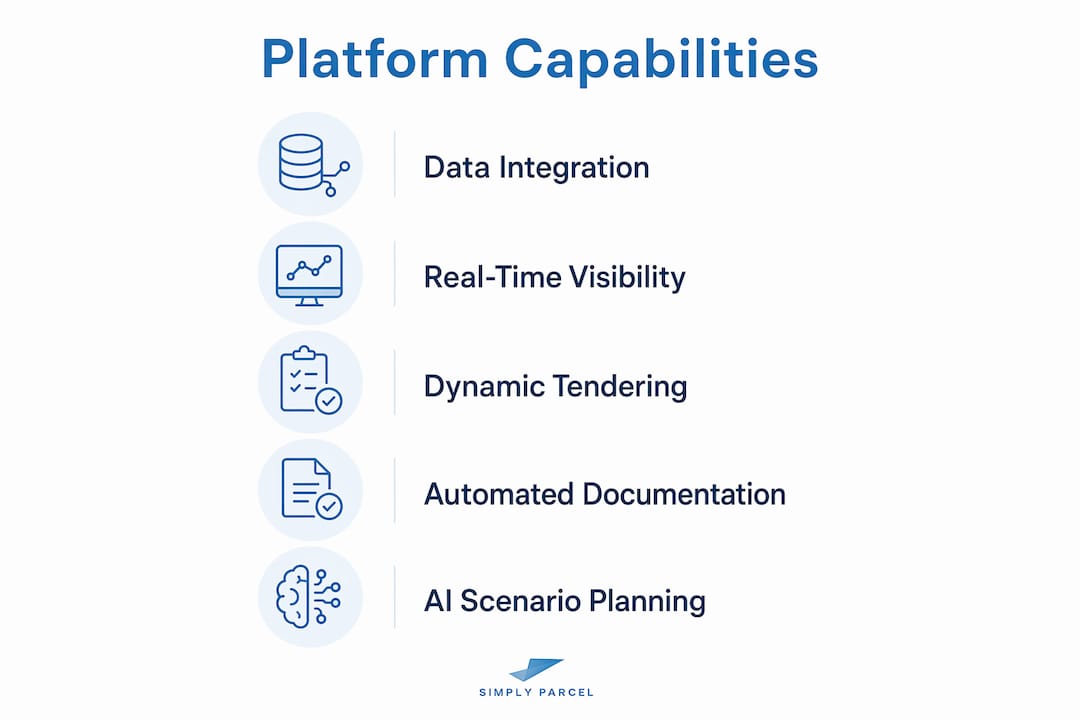
The technical foundation of any credible platform covers six functional areas. Understanding each one helps you evaluate vendors against your actual operational gaps rather than their marketing claims.
- Real-time visibility and event streaming: Continuous location and status updates across all modes, feeding exception alerts and ETA recalculations automatically
- Orchestration and workflow automation: Rules-based routing of shipments, tasks, and approvals, including dynamic tendering to carriers based on cost, capacity, and service level
- Matching and marketplace functions: Connecting shipper demand with available carrier capacity, often with rate comparison and instant booking
- Administration and document automation: Generating bills of lading, customs declarations, and compliance documents without manual re-keying, which is where administration platforms deliver the fastest time-to-value for cross-border shippers
- Analytics and predictive planning: Dashboards, KPI tracking, and scenario modeling that turn operational data into forward-looking decisions
- Integrations: Pre-built connectors and open APIs for TMS, WMS, OMS, ERP, and carrier systems
A practical integration example: when a visibility feed detects a port delay, a connected TMS can automatically re-tender the inland leg to an alternative carrier, notify the consignee, and update the ETA in the OMS, all without a human touching a keyboard. That closed loop is what separates a platform from a tracking tool.
Pro Tip: Start your integration sequencing with visibility first, then add one orchestration use case before expanding further. Visibility data is the foundation every other capability depends on, and a working visibility layer gives you the baseline metrics you need to prove ROI on subsequent integrations.

Industry surveys report growing interest in generative AI for scenario analysis and document automation, but these capabilities add integration complexity. Build a stable data layer before layering AI features on top.
How do digital logistics platforms create measurable business value?
Capabilities only matter when they translate into outcomes your finance team can verify. The table below maps core platform functions to the business results decision-makers typically target.
| KPI | Capability driver | Typical improvement target |
|---|---|---|
| On-time delivery (OTD) rate | Visibility + exception management | Meaningful uplift from baseline |
| Cost per shipment | Automated tendering + carrier matching | Reduction through competitive rate access |
| Inventory carrying cost | Predictive ETA accuracy + demand signal sharing | Lower safety stock requirements |
| Document processing time | Administration automation | Significant reduction in manual processing hours |
| Carbon per shipment | Route optimization + load consolidation | Reduction through eco-friendly routing |
| Exception resolution time | Real-time alerts + automated rerouting | Faster response versus manual monitoring |
Research on automation and data integration confirms that automation has the strongest positive effect on supply-chain performance, with data integration as a significant secondary driver. Critically, digital transformation as an organizational change amplifies the value of both.
Key insight: Visibility platforms deliver a clear, measurable benefit by giving logistics service providers and shippers the real-time information they need to act on transport progress and milestone events, directly improving KPIs related to on-time delivery and exception resolution. The value is not theoretical — it shows up in reduced variance across the metrics that matter most to operations leaders.
The McKinsey analysis also notes that three-quarters of digital transformations in logistics fail to achieve all stated goals. The common thread in the failures is not bad technology. It is the absence of a clear value-first strategy, a data architecture that supports integration, and the organizational capability to act on new information.
For ecommerce and retail operations specifically, logistics platform adoption accelerates fulfillment speed and reduces carrier dependency, two outcomes that directly affect customer satisfaction scores.
Which organizations benefit most from digital logistics platforms?
The use cases where platforms deliver the clearest value cluster around five operational problems. If your business faces any of these, a platform investment is likely justified.
Global visibility for multi-leg shipments is the most universal use case. Retailers, manufacturers, and 3PLs managing ocean, air, and road legs across multiple geographies need a single pane of glass for status and exception management. Without it, exception resolution relies on email chains and carrier portals that update on different schedules.
Dynamic tendering and spot matching suits shippers with variable volumes or seasonal peaks. A matching platform surfaces available capacity in real time, compares rates, and books automatically, removing the manual broker call cycle. This is particularly valuable for multi-carrier shipping strategies where you want rate competition without operational overhead.
Customs and document automation is the highest-priority use case for cross-border shippers. Administration platforms generate compliant customs declarations, commercial invoices, and certificates of origin from structured shipment data, cutting document preparation time and reducing clearance delays.
Warehouse-to-last-mile orchestration connects inbound receiving, pick-and-pack, and outbound carrier selection in a single workflow. For 3PLs and fulfillment centers, this eliminates the manual handoff between WMS and carrier booking systems.
Analytics-driven route optimization benefits any operation with enough shipment volume to identify patterns. Insights platforms surface lane performance, carrier reliability scores, and cost-per-lane benchmarks that inform annual carrier negotiations and network design.
On SME adoption: The PLATO research is direct on this point: SMEs lag behind in platform adoption because they struggle to see the value and to identify a starting point for digitalization. Connectivity gaps and limited digital maturity compound the problem. The recommended path for smaller shippers is to start with a single, high-visibility use case rather than attempting a broad transformation.
Platformisation creates service-oriented architectures enabling smaller firms to specialize while accessing broader logistics networks, but many platforms are still designed primarily for large shippers. SMEs need to ask vendors directly whether their onboarding process and pricing model accommodate lower shipment volumes.
How do you evaluate and shortlist a digital logistics platform?
A structured evaluation protects you from selecting a platform that looks capable in a demo but underperforms in production. Work through this checklist before you issue an RFP or commit to a pilot.
- Core capability fit: Does the platform cover your primary use case (visibility, matching, administration, or insights) with depth, not just a checkbox feature?
- Integration posture: Does it offer open APIs with documented endpoints, standard data formats, and pre-built adapters for your TMS, WMS, or ERP? Avoid platforms that require custom point-to-point integrations for every connection.
- Data ownership and exportability: Can you export your full data set at any time, in a standard format, without vendor assistance? This is the data sovereignty question the PLATO research flags as critically underexamined.
- Security and compliance: Does the platform meet the security standards relevant to your industry (SOC 2, ISO 27001) and the regulatory requirements of your operating markets, including US customs and trade compliance?
- Scalability and throughput: Can the platform handle your peak shipment volumes without degraded latency? Ask for documented throughput benchmarks, not just architectural claims.
- SLA and support model: What are the guaranteed uptime commitments? Is there a dedicated implementation team or just a help desk? What is the escalation path for integration failures?
- Ecosystem partners and marketplaces: Does the platform connect to the carriers, freight forwarders, and logistics partners you already use, or does it require you to change your carrier relationships?
Key questions to ask in vendor demos: What data formats do you support natively? What is the typical latency between a physical event and a platform update? How do you handle integration errors and retries? What does onboarding take in calendar weeks? What is the rollback process if the integration fails in production?
Red flags to watch for: A closed data model with no export capability. Integrations built as fragile one-off connections rather than managed adapters. No defined metrics for success and no change-management support included in the implementation plan. A recent MDPI study found that institutional pressure to adopt platforms, without parallel investment in internal capability, can produce neutral or negative short-term performance outcomes. Vendor enthusiasm is not a substitute for your own readiness.
What does a realistic platform implementation look like?
Most platform rollouts follow five phases. The timelines below are realistic for mid-market to enterprise shippers; SMEs with simpler integration requirements may move faster.
| Phase | Activities | Typical timeline |
|---|---|---|
| Assess | Baseline current KPIs, map data sources, identify integration gaps | 4–6 weeks |
| Pilot | Deploy one use case (usually visibility) with a subset of lanes or carriers | 6–12 weeks |
| Integrate | Connect TMS, WMS, or carrier APIs; validate data quality | — |
| Scale | Expand to full lane coverage and additional use cases | 3–6 months |
| Optimize | Tune automation rules, add analytics, and embed into operating cadence | Ongoing |
Before you start, confirm these preconditions are in place: clean, structured shipment data in a consistent format; API access credentials for your existing systems; documented stakeholder alignment on success metrics; and a training plan for the operations team who will use the platform daily.
The most common implementation pitfalls are data quality problems that surface only after integration begins, legacy systems that lack API access and require expensive middleware, and organizational resistance from teams who see the platform as a threat to their current workflows. The McKinsey analysis recommends a data lake architecture as the foundation for durable platform value, because it decouples data from individual system dependencies.
Pro Tip: Start your pilot with visibility and one orchestration use case on a single trade lane or carrier relationship. A narrow, well-instrumented pilot generates the before-and-after data you need to build the internal business case for full rollout, and it surfaces integration problems at a scale you can actually fix.
For practical pre-launch preparation, a shipping checklist approach, adapted to your platform's specific integration requirements, helps teams avoid the most common documentation and data-readiness gaps.
How do you measure platform ROI and track success?
Measurement starts before go-live. Without a documented baseline, you cannot demonstrate value to stakeholders or identify where the platform is underperforming.
Primary KPIs to track from day one:
- On-time delivery (OTD) rate: The single most visible performance indicator for shippers and their customers
- Dwell time: How long shipments sit idle at terminals, warehouses, or border crossings
- Cost per shipment: Total landed cost including carrier fees, handling, and document processing
- Asset and capacity utilization: Load factor and vehicle fill rates where applicable
- Document processing time: Hours from shipment creation to compliant document set
- Carbon per shipment: Emissions intensity, increasingly required for sustainability reporting
For baselining, pull 90 days of historical data across each KPI before the pilot launches. A simple ROI calculation compares the cost of the platform (licensing, implementation, integration, training) against the measurable savings in cost per shipment, exception resolution labor, and document processing time over a 12-month period. Most organizations see initial cost savings within 3–6 months of a successful pilot; full ROI on a broader rollout typically materializes within 12–18 months, depending on integration complexity and volume.
Assign metric ownership clearly. Operations owns OTD and dwell time. Finance owns cost per shipment and total platform cost. Sustainability or ESG teams own carbon per shipment. Review KPIs monthly during the first year, then quarterly once the platform is stable. Stakeholder reporting should connect platform metrics to business outcomes, not just technical uptime.
Where are digital logistics platforms headed?
Three trends are reshaping the platform category and should influence your architectural and vendor decisions today.
Platformisation as a business model shift is accelerating. As academic analysis shows, platforms are enabling firms to specialize in what they do best while accessing integrated logistics networks for everything else. This changes the competitive logic: your advantage increasingly comes from how well you orchestrate your network, not just how efficiently you operate your own assets.
Generative AI for scenario planning and document automation is moving from pilot to production for larger shippers. The practical near-term applications are exception scenario modeling ("if this vessel misses the port window, what are the cost and time impacts of each rerouting option?") and automated generation of customs documents from structured shipment data. These capabilities add integration complexity, so a clean data architecture is a prerequisite, not an afterthought.
Edge telemetry and IoT device data are expanding the event streams that feed visibility platforms. Sensor data from containers, pallets, and vehicles is becoming a standard input, enabling condition monitoring (temperature, humidity, shock) alongside location tracking.
On sustainability: Shippers, transport operators, and freight forwarders increasingly treat sustainability performance as a competitive differentiator, not just a compliance requirement. Digital platforms contribute directly through carbon accounting tools, route optimization that reduces empty miles, and load consolidation features that improve fill rates. Regulatory pressure in the US and globally will make carbon-per-shipment reporting a standard expectation within the next few years.
For architecture decisions, prefer platforms with open APIs, support for standard data models, and active partner ecosystems. Closed platforms that lock your data in proprietary formats carry growing risk as the regulatory and competitive environment demands greater interoperability. Delivery optimization at the last mile is one area where open platform architectures are already delivering measurable gains for logistics managers.
Key Takeaways
Digital logistics platforms deliver durable value only when technology, data architecture, and organizational change are treated as a single program, not three separate workstreams.
| Point | Details |
|---|---|
| Platform archetypes matter | Matching, visibility, administration, and insights platforms solve different problems — match the archetype to your primary pain point before evaluating vendors. |
| Data ownership is non-negotiable | Confirm data exportability and open API access before signing any contract; closed data models create long-term lock-in risk. |
| Change management drives ROI | Over 85% of digital logistics projects add measurable value, but more than 40% take longer than expected — the gap is almost always organizational, not technical. |
| Measure before you launch | Baseline OTD, cost per shipment, and document processing time 90 days before go-live so you can demonstrate ROI within 12–18 months. |
| Simplyparcel for cross-border shipping | Simplyparcel's aggregator model gives shippers instant access to multiple carrier rates, automated documentation, and real-time tracking without a complex enterprise integration. |
A practitioner's perspective on platform adoption
The conversation around digital logistics platforms often focuses on enterprise transformation, and that framing leaves out something worth saying plainly: the biggest practical gains for many shippers are not in the headline capabilities. They are in the unglamorous work of getting data clean, getting integrations stable, and getting your team to actually use the new tools consistently.
From the perspective of international parcel and cross-border shipping, the value of a well-designed platform shows up most clearly in two places. First, documentation. Automated generation of customs declarations and shipping labels removes a category of error that causes delays and costs money, every time. Second, carrier access. A marketplace aggregator that connects you to multiple carriers in a single booking flow gives you rate competition and service-level choice without the overhead of managing individual carrier contracts.
The research is consistent on one point that practitioners often learn the hard way: institutional pressure to digitize, whether from regulators, customers, or competitors, can actually hurt short-term performance if your organization is not ready to absorb the change. The answer is not to slow down adoption. It is to invest in readiness in parallel: data quality, training, and clear metric ownership before the platform goes live.
For shippers evaluating where to start, the incremental path works. Begin with visibility on your highest-volume trade lane. Add document automation for your most complex customs destination. Measure both. Then expand.
Simplyparcel makes cross-border shipping simpler from day one
If you are managing international parcel shipments and want the practical benefits of a digital logistics platform without a months-long enterprise integration project, Simplyparcel offers a direct path. The platform connects you to multiple major courier partners in a single booking flow, generates shipping labels and customs documentation automatically, and provides real-time shipment tracking across all your orders. You get rate comparison, service-level choice, and documentation support without building your own carrier integrations.
Simplyparcel suits individual shippers, e-commerce sellers, and SMEs who need reliable cross-border shipping with transparent pricing and no long-term contracts. It is a practical starting point for organizations that want to experience the core benefits of platform-based logistics, including carrier matching, automated documentation, and shipment visibility, before committing to a larger enterprise platform investment.
Get an instant shipping quote and see how Simplyparcel compares rates across carriers for your next international shipment.
Useful sources for further research and due diligence
These sources support procurement decisions, internal business cases, and RFP evidence. They are listed in order of relevance for decision-makers evaluating platform investments.
-
PLATO Final Report (SmartPort / Tilburg University): The most comprehensive taxonomy of digital logistics platform archetypes available. Includes a decision support tool for SMEs and a gap analysis covering data standards, sovereignty, and adoption barriers. Use this when building an internal classification framework or evaluating vendor claims against platform categories.
-
McKinsey: Digital Logistics — Into the Express Lane: Survey-based analysis of 260+ logistics leaders covering adoption rates, implementation challenges, and the role of data architecture and change management in achieving ROI. Use this to set realistic expectations in internal business cases and to frame the organizational change requirements for leadership.
-
MDPI: Impact of Digital Technology, Automation, and Data Integration on Supply Chain Performance: Academic study confirming that automation has the strongest positive effect on supply-chain performance, with data integration as a significant secondary driver. Useful for quantitative evidence in RFPs and board presentations.
-
MDPI: Impact of Digital Transformation on Business Performance of Logistics Enterprises: Examines how institutional pressure affects adoption outcomes and why internal capability investment must accompany platform rollout. Relevant for change-management planning and risk sections of business cases.
-
Springer: Platformisation and Business-Model Shifts in Logistics: Academic analysis of how platformisation changes competitive dynamics and business models, with specific attention to SME versus large-shipper dynamics. Use when evaluating long-term strategic implications of platform vendor selection.
-
PLOS One: Impact of Digital Logistics on Regional Economic Growth: Empirical study on the broader economic effects of digital logistics adoption, covering AI, IoT, and machine learning applications in supply chain management. Useful background for sustainability and economic impact sections of proposals.
-
Digital Platforms and the Second Logistics Revolution (DIGIT Research): Research project examining how digital platforms are reshaping logistics industry structure and competitive dynamics. Provides useful framing for strategic discussions about platform ecosystems and market concentration risks.
When building an internal business case or RFP, use the PLATO report for platform taxonomy and the McKinsey survey for adoption benchmarks. Pair the MDPI studies for academic evidence on performance outcomes and change-management requirements.