Ecommerce logistics is defined as the coordinated process of managing inventory, order fulfillment, shipping, and returns to deliver orders on time and at a cost that protects your margins. The role of logistics in ecommerce goes far beyond moving boxes. It determines whether customers come back, whether your cash flow stays healthy, and whether your business can grow without breaking. Last-mile delivery alone accounts for up to 53% of total shipping costs. That single figure shows how much financial weight sits inside your fulfillment operation. Supply chain management in ecommerce is not a back-office task. It is a direct driver of revenue and customer loyalty.
What are the main components of ecommerce logistics?
Ecommerce logistics covers five core functions. Each one affects the others. A failure in any single area cascades through the rest of your operation.
- Warehousing: Physical storage of your products before orders arrive. Poor warehouse layout slows picking times and raises labor costs per order.
- Inventory management: Tracking stock levels in real time to prevent stockouts and overselling. Inaccurate counts tie up cash and disappoint customers.
- Order fulfillment: The process of picking, packing, and preparing an order for shipment. Slow fulfillment delays delivery windows and erodes trust.
- Shipping and carrier selection: Choosing the right carrier for each shipment based on cost, speed, and destination. The wrong carrier choice raises costs without improving service.
- Last-mile delivery: The final leg from a distribution hub to the customer's door. This phase is the most expensive and the most visible to your customer. You can read a full breakdown of last-mile delivery costs and why they matter so much.
- Returns and reverse logistics: Processing refunds, restocking returned goods, and managing customer expectations. Returns rates in some ecommerce categories reach 30–40%, making this a function you cannot afford to handle poorly.
These components are interdependent. A delay in receiving stock at the warehouse pushes back fulfillment. A fulfillment error drives a return. A slow return process costs you a customer. Understanding the chain helps you find where your biggest losses hide.
Pro Tip: Map your average order cycle from purchase to delivery and identify the single step with the most variability. That step is where your biggest efficiency gain lives.

How do logistics challenges affect ecommerce profitability?
Logistics problems rarely announce themselves loudly. They compress margins quietly, one small failure at a time.
Inefficient logistics handovers represent 13–19% of total logistics costs. That means coordination failures between your supplier, warehouse, and carrier are costing you money before a single package reaches your customer. Most businesses focus on the shipping rate they negotiate. They ignore the operational drag that eats into every order.
"Poor logistics processes cause layered problems: slow receiving, mislabeling, high shipping costs, and poor returns management all compress margins quietly over time. Every small shipping or inventory mistake aggregates to reduce profits and customer satisfaction."
Shipping delays carry a direct cost to repeat purchase rates. Fast shipping and returns management are key determinants of whether a customer buys from you again. A single bad delivery experience is often enough to send a customer to a competitor permanently. The impact on customer lifetime value is larger than most marketing budgets can recover.
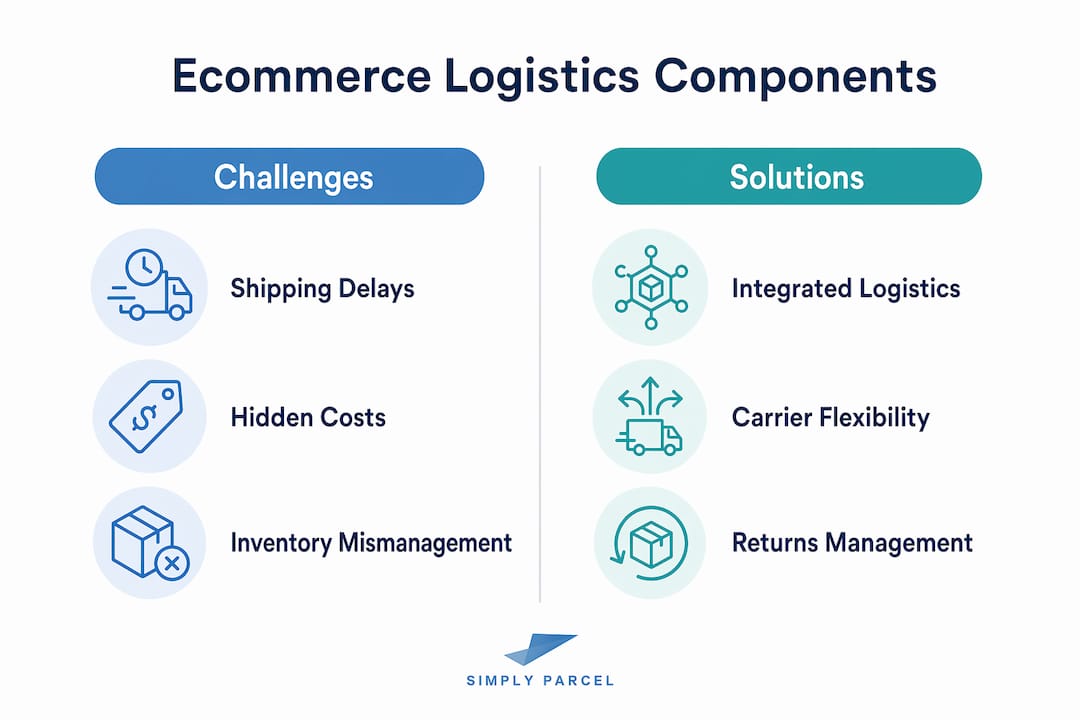
Hidden costs make the problem worse. Fuel surcharges, dimensional weight fees, and carrier rate increases erode profits silently. Many ecommerce businesses price their products without accounting for these variables, then wonder why margins shrink as volume grows.
| Logistics problem | Business impact |
|---|---|
| Inefficient handovers | 13–19% of total logistics costs added per order |
| Last-mile delivery failures | Customer brand switching and lost repeat revenue |
| High return rates (30–40% in some categories) | Reverse logistics costs and reduced net margin |
| Inventory inaccuracies | Stockouts, overselling, and capital tied up in unsold goods |
| Hidden shipping fees | Silent margin erosion across all order volumes |
Inventory mismanagement locks up cash in unsold stock, reducing your ability to reinvest in growth. This is one of the most underappreciated ways logistics affects your business finances. When your warehouse holds too much of the wrong product, your cash cannot move. Growth stalls.
What are the best practices for ecommerce logistics?
Fixing logistics problems requires both process discipline and the right technology. The following steps reflect what high-performing ecommerce operations do differently.
- Implement a Warehouse Management System (WMS). A WMS tracks inventory location, movement, and quantity in real time. It reduces picking errors and speeds up fulfillment. Without one, your team is guessing.
- Add an Order Management System (OMS). An OMS routes orders to the right fulfillment location automatically. Automated systems integrating OMS, WMS, and transportation management improve inventory accuracy and cut manual processing costs.
- Use a multi-carrier strategy. Relying on a single carrier creates a single point of failure. Rotating carriers based on destination, weight, and speed gives you flexibility and cost control.
- Place inventory close to demand. Distributed fulfillment and multi-carrier strategies reduce shipping costs and improve delivery reliability. Stock near your highest-volume customer regions cuts last-mile distance and cost.
- Automate returns processing. Build a returns portal that generates labels, tracks incoming stock, and triggers refunds without manual intervention. Clear return policies also reduce the volume of customer service contacts.
- Audit your shipping costs regularly. Review carrier invoices line by line each month. Dimensional weight charges and fuel surcharges change frequently. You can also check how to avoid shipping delays to keep your delivery windows tight.
Pro Tip: Before selecting a carrier for international orders, compare total landed cost, not just the base rate. Fuel surcharges and remote area fees often add 15–25% to the quoted price.
Understanding your full ecommerce shipping workflow from order receipt to final delivery is the foundation for knowing where to apply these fixes.
How does integrated logistics give ecommerce businesses a competitive edge?
Integrated logistics is defined as a coordinated approach that connects warehousing, order routing, transportation, and returns through shared data and standardized workflows. The goal is to manage the entire fulfillment network as one system rather than a collection of separate steps.
Most ecommerce businesses run fragmented operations. Their warehouse system does not talk to their carrier platform. Their returns process is manual. Their inventory data lags by hours or days. Each gap creates errors, delays, and costs.
| Fragmented logistics | Integrated logistics |
|---|---|
| Siloed warehouse and shipping data | Unified real-time visibility across all functions |
| Manual order routing decisions | Automated routing based on stock location and carrier rates |
| Reactive returns handling | Automated returns portal with instant label generation |
| Single carrier dependency | Multi-carrier selection based on cost and destination |
| Inventory counted periodically | Continuous inventory tracking with low-stock alerts |
An integrated approach improves on-time delivery rates by reducing the handover failures that slow orders down. It also reduces split shipments, which occur when an order ships from multiple locations because inventory is not coordinated. Split shipments raise costs and confuse customers.
The resilience benefit is significant. When one carrier faces delays or one warehouse is at capacity, an integrated system reroutes automatically. A fragmented operation requires manual intervention, which takes time you do not have during peak seasons. Integrated logistics connects fragmented warehouse, shipping, and returns functions via unified data to optimize the entire network rather than isolated steps.
For businesses shipping internationally, this coordination matters even more. Cross-border orders involve customs documentation, multiple carriers, and longer transit windows. A unified system catches errors before they become delays. You can compare international shipping options to find the right carrier and service level for each destination.
Logistics is a profit center, not a cost center
Treating logistics as a support function is one of the most expensive mistakes an ecommerce business can make. I have seen businesses spend heavily on marketing to acquire customers, then lose those customers permanently because a single delivery went wrong. The acquisition cost is wasted. The customer is gone.
Logistics is an underrated but crucial profit function that shapes acquisition efficiency, margins, and customer lifetime value. When your fulfillment is reliable, your return customer rate rises. When your return customer rate rises, your cost per acquisition falls. The math is straightforward, but most businesses do not connect these dots until they are already losing money.
The businesses that win in ecommerce treat logistics as a competitive advantage. They invest in systems, audit their costs proactively, and build carrier relationships that give them flexibility. They also understand that logistics acts as a cash flow gatekeeper. Poor management traps capital in inventory and delays, limiting your ability to reinvest and grow.
My advice is to review your logistics operation the same way you review your marketing spend: with data, with regularity, and with a clear view of what each dollar is producing. The returns are real.
— Simply
Simplyparcel helps ecommerce businesses ship smarter
Ecommerce sellers in Singapore and beyond need a shipping partner that gives them cost control, carrier flexibility, and real-time visibility without complexity. Simplyparcel is a shipping aggregator that lets you compare and book courier services for international shipments in one place. You get automatic label generation, free pickup, and clear transit timelines across priority, economy, and connect-plus service levels. Whether you ship five parcels a week or five hundred, Simplyparcel scales with your volume. Get an instant shipping quote and see how much you can save on your next international shipment. You can also explore the full Simplyparcel platform to find the right service level for your business.
FAQ
What is the role of logistics in ecommerce?
Ecommerce logistics covers inventory management, order fulfillment, shipping, and returns. It directly determines delivery speed, cost per order, and whether customers buy from you again.
Why does last-mile delivery cost so much?
Last-mile delivery accounts for up to 53% of total shipping costs because it involves the most stops, the most variability, and the highest risk of failed delivery attempts.
How do returns affect ecommerce profitability?
Returns rates in some categories reach 30–40%, making reverse logistics a significant cost. Efficient returns processing reduces refund costs and retains customer confidence.
What is integrated logistics in ecommerce?
Integrated logistics connects warehousing, order routing, transportation, and returns through shared data and automated workflows. It reduces errors, cuts costs, and improves delivery reliability across the entire fulfillment network.
How can ecommerce businesses reduce hidden shipping costs?
Audit carrier invoices monthly for fuel surcharges, dimensional weight fees, and remote area charges. Using a multi-carrier platform lets you compare total landed costs and select the most cost-effective option for each shipment.
Key takeaways
Logistics is a direct driver of ecommerce profitability, customer retention, and cash flow, not a background support function.
| Point | Details |
|---|---|
| Last-mile delivery dominates costs | It accounts for up to 53% of total shipping costs and is the most common point of failure. |
| Handover inefficiencies drain margins | Coordination failures between suppliers, warehouses, and carriers add 13–19% to logistics costs. |
| Returns are a competitive differentiator | With return rates reaching 30–40% in some categories, automated reverse logistics protects margins and loyalty. |
| Integrated systems outperform fragmented ones | Unified OMS, WMS, and carrier management reduce errors, split shipments, and manual intervention. |
| Inventory management controls cash flow | Poor stock management traps capital and limits your ability to reinvest in growth. |