
Multi-carrier shipping is defined as a logistics strategy that connects your business to multiple carriers through a single, centralized platform, giving you the flexibility to select the best carrier for every shipment based on cost, speed, and destination. Rather than locking into one courier relationship, you build a portfolio of carrier options and route each parcel through the most suitable service. Platforms like VESYL and eHub make this possible by consolidating carrier accounts, automating label creation, and centralizing tracking into one workflow. For logistics managers and business owners shipping internationally, this approach directly addresses the cost inflexibility and service gaps that come with single-carrier dependency.
What is multi-carrier shipping and how does it work operationally?
Multi-carrier platforms function as a single cockpit. You connect multiple carrier accounts to one system, and the platform handles the decision logic, documentation, and visibility across all of them. The result is that your team stops logging into separate carrier portals and starts managing everything from one place.

The core of how multi-carrier shipping works is routing logic. When an order comes in, the system evaluates a set of if/then rules to determine the best fulfillment path. Shipping routing logic selects the fulfillment location, carrier account, and service level by considering packaging constraints, delivery promises, and cost targets simultaneously. A shipment going to a rural address in Australia might route to a regional carrier with better last-mile coverage, while an express order to Tokyo routes to a premium international service.
Here is how a typical multi-carrier workflow runs from order to delivery:
- Order received. The platform pulls order data including destination, weight, dimensions, and delivery deadline.
- Eligibility filtering. The system removes carriers that cannot meet the service requirement, such as those without coverage for the destination zone.
- Promise protection check. The routing logic confirms which remaining carriers can meet the delivery date commitment.
- Cost comparison. Among eligible, promise-compliant carriers, the system selects the lowest-cost option or applies a pre-set preference rule.
- Label generation. The platform automatically produces the correct label and documentation for the selected carrier.
- Tracking activation. Real-time tracking is activated across the carrier network and surfaced through a unified dashboard.
Automation rules sit on top of this process. You can set policies such as "always use economy for shipments under 1 kg to Southeast Asia" or "escalate to priority service if the order value exceeds $500." These rules reduce manual decision-making and apply your shipping policy consistently at scale.
Pro Tip: Start with three to five routing rules that cover your highest-volume lanes before adding complexity. A simple, well-tested rule set outperforms an elaborate one that breaks under edge cases.
What are the advantages and potential challenges of multi-carrier shipping?
Multi-carrier shipping delivers four core advantages that single-carrier models cannot match.
- Cost optimization through rate shopping. Comparing rates across carriers on every shipment captures savings that compound over time. Even a modest reduction per parcel adds up significantly across thousands of monthly shipments.
- Improved delivery performance. Routing to the carrier with the strongest track record for a specific lane improves on-time delivery rates and reduces customer complaints.
- Carrier risk diversification. Carrier diversification has shifted from a contingency plan to a core design principle. When one carrier faces a service disruption, weather delay, or surcharge spike, you have alternatives ready to absorb the volume.
- Operational resilience. Blended networks that mix regional and national carriers give you the flexibility to match service level and cost to each order's specific needs, rather than forcing every shipment through one carrier's pricing structure.
The challenges are real and worth planning for. Setup requires time and technical integration work, particularly if you are connecting multiple carrier APIs or syncing with an existing warehouse management system. Ongoing management adds operational complexity because you are now monitoring performance across several carrier relationships instead of one. Contract negotiation also becomes more involved since you need agreements that reflect your actual routing patterns and volume splits.
The most common mistake is treating multi-carrier as a simple rate-shopping exercise. True value comes from carrier orchestration, which is the continuous coordination of carriers, rules, and performance data to avoid late deliveries and unnecessary cost. Without orchestration, you accumulate carrier relationships without the control to manage them effectively.
"Carrier selection now resembles financial portfolio management, balancing risk and reward to achieve flexibility and performance." — Inbound Logistics
How to build an effective multi-carrier shipping strategy
Building a multi-carrier strategy is a structured process. Rushing into carrier contracts without a defined framework creates the operational chaos that makes multi-carrier feel harder than it is.
Follow these steps to build a strategy that holds up under real shipping volume:
- Define your shipment and delivery profile. Analyze your order data by destination zone, weight band, delivery speed requirement, and order value. This profile determines which carrier types you actually need.
- Set service and performance guardrails. Decide the minimum acceptable transit time, maximum acceptable damage rate, and on-time delivery threshold for each shipping tier before you evaluate any carrier.
- Build your carrier portfolio. Select carriers that cover your primary lanes with complementary strengths. A Singapore-based shipper, for example, might combine a global express carrier for priority shipments with a regional economy carrier for standard parcels to Southeast Asia.
- Negotiate contracts that reflect routing reality. Carrier contracts should account for how volume will actually split across services. Committing to unrealistic volume thresholds on a single carrier undermines the flexibility you are building.
- Layer your routing logic. Layered routing rules integrate eligibility filters, promise protection, and cost-performance decisions in sequence. Each layer narrows the carrier options until the system reaches a clear, defensible choice.
- Measure KPIs consistently. Track on-time delivery rate, cost per shipment by lane, damage and loss rate, and carrier compliance against contracted service levels. These metrics tell you when to adjust routing rules or renegotiate terms.
- Plan for disruptions. Build contingency routing rules for peak surcharge periods, weather events, and carrier capacity constraints. Disruption planning is what separates a resilient multi-carrier operation from one that scrambles every peak season.
Pro Tip: Review your routing rules quarterly, not annually. Carrier performance shifts with seasons, network changes, and pricing updates. A rule that was optimal in Q1 may be costing you money by Q3.
The table below shows the key performance indicators you should track and what each one tells you about your operation.
| KPI | What it measures | Why it matters |
|---|---|---|
| On-time delivery rate by carrier | Percentage of shipments delivered within the promised window | Identifies underperforming carriers before they damage customer experience |
| Cost per shipment by lane | Average carrier cost for a specific origin-destination pair | Reveals where routing rules can be adjusted for savings |
| Damage and loss rate | Frequency of claims per carrier | Flags carriers that increase liability and erode margin |
| Carrier compliance rate | Adherence to contracted service levels | Supports renegotiation and contract enforcement |
How does multi-carrier shipping compare with single-carrier shipping?
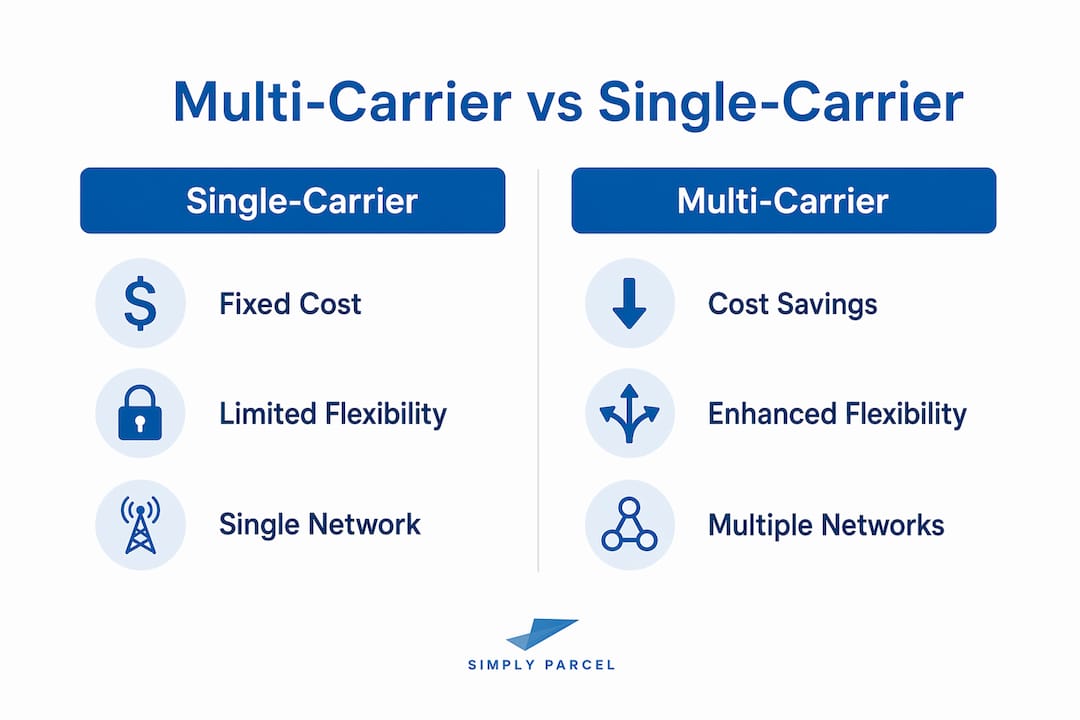
Single-carrier shipping means routing all shipments through one provider regardless of destination, cost, or service fit. It is simpler to manage but carries significant structural risks that grow as your shipping volume increases.
The table below contrasts both approaches across the dimensions that matter most to logistics managers.
| Factor | Single-carrier shipping | Multi-carrier shipping |
|---|---|---|
| Cost flexibility | Fixed rate structures with limited negotiation leverage | Rate shopping across carriers captures savings on every lane |
| Service coverage | Limited to one carrier's network and service tiers | Access to regional, national, and global carriers matched to each shipment |
| Disruption risk | High. One carrier failure affects all shipments | Distributed. Volume shifts to alternative carriers during disruptions |
| Operational complexity | Low. One portal, one invoice, one relationship | Higher. Requires platform integration and ongoing carrier management |
| Scalability | Constrained by one carrier's capacity and pricing | Scales by adding carriers as volume and destination mix grows |
Shippers relying on blended networks consistently outperform single-carrier operations on cost and delivery reliability. The operational complexity of multi-carrier is real, but multi-carrier shipping software and platforms like eShipz reduce that complexity by centralizing management, tracking, and analytics in one place. For businesses shipping internationally from Singapore, the ability to compare courier options before committing to a carrier on each shipment is a direct cost control mechanism, not just a convenience.
Key takeaways
Multi-carrier shipping is a carrier orchestration system, not just a rate comparison tool, and its value depends entirely on the quality of your routing logic, carrier portfolio, and ongoing performance management.
| Point | Details |
|---|---|
| Multi-carrier shipping definition | A strategy connecting multiple carriers through one platform to optimize cost, speed, and coverage per shipment. |
| Routing logic is the core mechanism | Layered if/then rules filter carriers by eligibility, delivery promise, and cost before selecting the best option. |
| Carrier orchestration beats rate shopping | Continuous coordination of rules and performance data prevents late deliveries and cost drift over time. |
| Single-carrier reliance creates structural risk | One carrier failure or surcharge spike affects every shipment with no alternative routing available. |
| KPI measurement drives improvement | Tracking on-time rate, cost per lane, and damage rate by carrier enables data-driven routing adjustments. |
Simplyparcel's take on multi-carrier shipping in 2026
The businesses that struggle most with multi-carrier shipping are the ones that treat it as a one-time setup. They connect three carriers, build a few routing rules, and assume the work is done. Six months later, one carrier's performance has dropped, a new surcharge has eroded their cost savings, and their routing rules still reflect conditions from the day they launched.
What actually works is treating your carrier network the way a fund manager treats a portfolio. You set your allocation based on current conditions, you monitor performance continuously, and you rebalance when the data tells you to. Carrier orchestration is the term the industry uses for this, and it is a more accurate description of what mature teams actually do than "multi-carrier shipping."
The other risk I see consistently is what you might call multi-carrier exposure without control. A business adds five carriers because it sounds like more flexibility, but without clear routing rules and performance thresholds, they end up with five carrier relationships generating inconsistent results and no clear accountability. More carriers do not automatically mean better shipping. Better routing logic and tighter performance management do.
For businesses shipping internationally, the international shipping challenges around customs, transit variability, and carrier coverage make a disciplined multi-carrier approach even more valuable. The goal is not to use every carrier available. The goal is to use the right carrier for each shipment, every time, with the data to prove it is working.
— Simply
Ship smarter with Simplyparcel's multi-carrier platform
Simplyparcel gives you access to multiple courier partners through a single platform, so you can compare rates, generate labels, and track shipments without switching between systems. The platform is built for businesses shipping internationally from Singapore, with options spanning priority, economy, and connect-plus services to match every shipment profile and budget. You get transparent pricing, free pickup, and real-time tracking across all carriers in one place. Whether you are managing a handful of weekly parcels or scaling up bulk freight, Simplyparcel removes the manual overhead of carrier management. Get an instant shipping quote and see how multi-carrier shipping solutions can reduce your cost per shipment today.
FAQ
What is the multi-carrier shipping definition?
Multi-carrier shipping is a logistics strategy that connects a business to multiple carriers through one centralized platform, enabling rate comparison, automated label generation, and unified tracking across all carrier accounts.
How does multi-carrier shipping work in practice?
The platform applies routing logic to each order, filtering carriers by eligibility, delivery promise, and cost before automatically selecting the best option and generating the required shipping label and documentation.
What are the main advantages of multi-carrier shipping?
The primary advantages are cost savings through rate shopping, improved delivery performance by routing to the strongest carrier per lane, and resilience against carrier disruptions through diversified carrier relationships.
What is carrier orchestration and why does it matter?
Carrier orchestration is the continuous coordination of carriers, routing rules, and performance data to maintain cost and service targets over time. It goes beyond simply having multiple carriers and is what separates effective multi-carrier strategies from ones that drift out of control.
How is multi-carrier shipping software different from a standard carrier portal?
Multi-carrier shipping software connects all your carrier accounts in one system, automates routing decisions, and provides unified tracking and analytics. A standard carrier portal only gives you access to one carrier's services and data.