
If you run a small business that ships internationally, you already know the process is rarely simple. But shipping regulations for SMEs have grown significantly more complex in 2026, with new EU customs duties, digital compliance platforms, and shifting U.S. import rules all landing at once. The good news is that compliance is absolutely manageable at the SME level. You do not need a corporate legal team to get it right. What you need is a clear picture of what has changed, what documents you need, and where your costs will be affected. This guide gives you exactly that.
Table of Contents
- Key Takeaways
- Shipping regulations for SMEs in 2026: What has changed
- Documentation and customs compliance steps
- Cost implications and how to optimize your logistics
- Leveraging digital systems and expert partnerships
- My take on shipping compliance for SMEs
- How Simplyparcel helps SMEs ship smarter
- FAQ
Key Takeaways
| Point | Details |
|---|---|
| New EU duty rules hit small parcels hard | A €3 per item charge on low-value e-commerce imports starts July 1, 2026, affecting mixed-product shipments most. |
| HS code accuracy is non-negotiable | Misclassifying products leads to customs holds, fines, and delayed shipments that hurt your reputation. |
| Incoterms determine who pays duties | Choosing between DDP, DAP, or EXW directly affects your compliance burden and your customer's experience. |
| Digital platforms are now mandatory in some markets | EU waste shipment compliance requires digital submission via DIWASS from May 21, 2026 onward. |
| Proactive partnerships reduce compliance risk | Working with customs brokers and reliable logistics providers gives SMEs a real competitive edge. |
Shipping regulations for SMEs in 2026: What has changed
The phrase "shipping regulations" covers a broad range of legal frameworks. In formal trade terminology, this falls under customs compliance and trade facilitation law. Understanding both terms matters because different jurisdictions use different language, and your carrier will use the industry terms when something goes wrong.
Three major regulatory shifts are directly affecting small business shipping guidelines right now.
The EU Waste Shipment Regulation and DIWASS platform
From May 21, 2026, EU waste shipments subject to the Prior Informed Consent (PIC) procedure must be processed digitally through the DIWASS platform. Paper submissions are still allowed for non-hazardous, green-listed waste until December 31, 2026, but that window closes fast. If your business ships electronics, batteries, or recyclable materials to EU destinations, this affects you directly.
The new EU de minimis customs duty
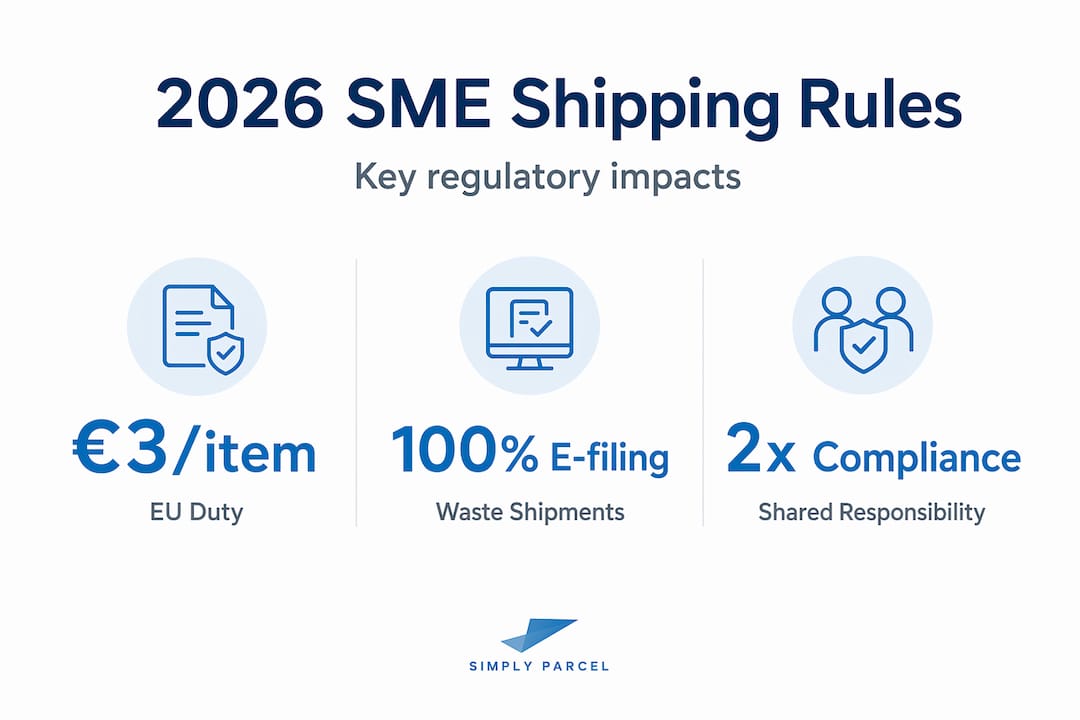
This is the change most SMEs are not prepared for. Starting July 1, 2026, the EU imposes a €3 duty per item on low-value e-commerce consignments. The key word is per item, not per parcel. If you send a package containing three different product types, you could be looking at €9 in duties plus handling fees before your customer receives anything. For SMEs selling affordable goods to European buyers, this fundamentally changes your landed cost math.
U.S. Customs and Border Protection shared responsibility
The U.S. CBP frames import/export compliance as a shared duty between businesses and their carriers. That means you cannot hand off a parcel and assume compliance is someone else's problem. SMEs shipping to or from the United States need to understand their own obligations, not just rely on the carrier to sort it out.
Pro Tip: If you ship electronics internationally, review the product-specific regulations for electronics before booking. Hazmat classifications, battery restrictions, and CE marking requirements vary significantly by destination and can result in rejected shipments.
Documentation and customs compliance steps
Getting your paperwork right is where most SMEs either win or lose at customs. The common assumption is that filling in a form is straightforward. In practice, HS code misclassification is one of the leading causes of customs holds and unexpected fines for small businesses.
Here is a practical step-by-step process to build solid documentation habits.
-
Prepare your commercial invoice correctly. Include the buyer and seller details, a full description of each item, the declared value, country of origin, and the applicable HS code for every product line.
-
Build an internal product-to-HS code mapping table. List every product you ship, its correct 6-digit HS code (or the destination country's full tariff code), and the person responsible for maintaining accuracy. Review this table quarterly or whenever you add new products.
-
Create a packing list that mirrors the invoice. Discrepancies between your invoice and packing list trigger manual review at customs. Match quantities, weights, and descriptions exactly.
-
Determine your export license requirements. Most consumer goods do not need a formal export license, but dual-use technology, certain chemicals, and some electronics do. Check your national trade authority's control list before shipping.
-
Choose your Incoterms deliberately. This is the decision most SMEs make last, but it should come first. Review the table below to understand what each term means for your compliance obligations.
| Incoterm | Who pays duty | Who clears customs | Best for |
|---|---|---|---|
| DDP (Delivered Duty Paid) | Seller | Seller | Full control, predictable buyer experience |
| DAP (Delivered at Place) | Buyer | Buyer | Lower seller obligation, but buyer may refuse delivery |
| EXW (Ex Works) | Buyer | Buyer | Minimal seller involvement, higher buyer risk |
Incoterms DDP and DAP shift the compliance burden in very different directions. If you ship DDP to EU customers, you are responsible for collecting and remitting duties. If you ship DAP, your customer handles it, which can create a poor delivery experience if they are caught off guard by unexpected fees.
Pro Tip: Refer to Simplyparcel's guide on shipping documentation for SMEs to get a checklist of every document you need before your first international shipment.
You should also maintain detailed SOPs, document retention schedules, and version control for your compliance records. Customs authorities in most markets can audit shipments up to three to five years after the fact.
Cost implications and how to optimize your logistics
The regulatory changes in 2026 are not just compliance issues. They are cost issues. And for SMEs operating on tighter margins, the numbers add up faster than you might expect.
Here is where the €3 per item EU duty gets complicated for mixed-product sellers. Say you sell curated gift sets containing a candle, a notebook, and a skincare item. Each of those falls under a different tariff classification. That is potentially €9 in customs duties plus carrier handling fees on a single parcel. If your average order value is €30, you have just added 30% in hidden costs that either you absorb or your customer pays.
There are practical ways to manage this.
-
Pre-calculate landed costs before pricing. Use a landed cost calculator that factors in duties, import taxes, customs brokerage fees, and last-mile delivery. Simplyparcel's resource on transparent shipping rates walks through how to structure this for Singapore-based exporters.
-
Consider EU warehousing for high-volume markets. Storing inventory inside the EU and fulfilling orders domestically eliminates per-item customs events entirely. Warehousing inside the EU also improves delivery speed and simplifies returns, which affects customer satisfaction as much as cost.
-
Simplify your SKU mix for export. If regulatory costs are eating your margin on multi-category parcels, consider whether you can streamline what you ship together. A single-category parcel carries one duty event, not three.
-
Review your Incoterms against your margin model. DDP gives customers a clean checkout experience but transfers all duty risk to you. If your EU sales volume is growing, run the numbers on both DDP and DAP scenarios before committing to one approach.
| Cost factor | DDP impact | DAP impact |
|---|---|---|
| Duty payment | Seller absorbs upfront | Buyer pays on delivery |
| Customer experience | Predictable, no surprises | Risk of refusal or confusion |
| SME cash flow | Higher upfront exposure | Lower upfront cost |
| Return processing | More complex | Simpler for seller |
Digital tools and automated shipping manifests are becoming increasingly relevant here. Automation reduces manual classification errors, flags incomplete invoices before submission, and keeps your duty calculations current as tariff schedules change.

Leveraging digital systems and expert partnerships
Compliance is not something you set up once and forget. The regulatory environment for freight regulations affecting SMEs is actively evolving, and staying ahead of it requires both the right tools and the right relationships.
For EU waste shipments, DIWASS submissions are mandatory and form part of the end-to-end shipment workflow. That means your operations team needs to know who submits which documents at which stage of the chain. If your supply chain involves multiple parties, assign clear ownership of each submission step. Confusion here leads directly to shipment delays and non-compliance penalties.
Beyond waste shipments, integrating customs data with your order management system pays off quickly. When your product catalog is already mapped to HS codes and your invoicing software auto-populates customs declarations, you eliminate a category of human error entirely.
Here is when you should bring in a customs broker:
- Your shipments exceed $2,500 in value regularly (U.S. formal entry threshold)
- You are entering a new market with unfamiliar tariff rules
- You ship products in regulated categories like chemicals, medical devices, or electronics
- You have received a customs hold or fine in the past
A good broker does more than clear your shipments. They flag classification issues, notify you of regulatory changes affecting your product categories, and represent you in disputes. For SMEs with limited compliance staff, that relationship replaces an entire internal function.
Pro Tip: Set a calendar reminder every quarter to review trade compliance updates from the EU Commission, U.S. CBP, and your key destination markets. Regulations change without much fanfare, and a missed update can turn a compliant shipment into a costly one.
You can also review Simplyparcel's step-by-step shipping guide for a practical walkthrough of how to structure your international shipping process from start to finish.
My take on shipping compliance for SMEs
I have seen a lot of small businesses treat customs compliance as something to figure out after they have already booked a shipment. That approach almost always creates problems. The classification errors, the wrong Incoterms on a contract, the missing export license for a regulated product, these are not bureaucratic inconveniences. They are real costs. Missed deliveries, customs fines, and frustrated customers all trace back to decisions that were made too quickly or not made at all.
What I have found consistently is that the SMEs who get this right are not the ones with the biggest budgets. They are the ones who invest a small amount of time upfront. Building a product-to-HS code mapping system takes maybe a day the first time. After that, it runs itself. The same goes for choosing Incoterms. Once you understand what DDP actually commits you to, you can price accordingly and have a transparent conversation with your customers.
The digitization of compliance, DIWASS being one example, is genuinely good news for SMEs. It creates a paper trail that protects you as much as it satisfies regulators. I would encourage you to see digital compliance tools as your ally rather than extra work.
The SMEs that grow internationally are the ones who treat regulation as a baseline to build on, not a wall to avoid. Get your documentation solid, know your costs before you promise them to a customer, and partner with people who fill the gaps in your expertise.
— Simply
How Simplyparcel helps SMEs ship smarter
Staying on top of international shipping requirements is much easier when you have the right partner. Simplyparcel is built specifically to support SMEs shipping internationally from Singapore, with transparent pricing, automatic documentation generation, and access to multiple trusted courier partners. You can compare and book courier services in minutes, with clear visibility into transit times, duties, and shipping costs before you commit. Whether you are shipping to the EU under new de minimis rules or exporting to the U.S. under CBP guidelines, Simplyparcel gives you the tools to ship confidently. Get an instant shipping quote today and see exactly what your next international shipment will cost, with no surprises.
FAQ
What are the main shipping regulations SMEs need to know in 2026?
The biggest changes in 2026 include the EU's new €3 per item customs duty on low-value e-commerce imports (starting July 1), mandatory digital submission via DIWASS for EU waste shipments (from May 21), and ongoing U.S. CBP shared compliance requirements between businesses and carriers.
What documents does an SME need for international shipping?
At minimum, you need a commercial invoice, a packing list, and the correct HS codes for every product. Depending on your destination and product type, you may also need export licenses, certificates of origin, and for EU waste shipments, DIWASS submissions.
How does the EU de minimis duty change affect mixed-product parcels?
The new €3 duty applies per tariff classification item inside a parcel, not per parcel. A package with three different product categories could incur three separate duty charges, significantly raising the landed cost for both seller and buyer.
When should an SME use a customs broker?
You should consider a customs broker when your shipments regularly exceed formal entry thresholds, when you are entering a new market, when you ship regulated products, or when you have previously encountered customs holds or fines.
What is the difference between DDP and DAP Incoterms for SMEs?
DDP (Delivered Duty Paid) means the seller is responsible for paying all duties and clearing customs, giving the buyer a predictable experience. DAP (Delivered at Place) puts the duty payment and clearance responsibility on the buyer, which can lead to delivery refusals if the buyer is unprepared.