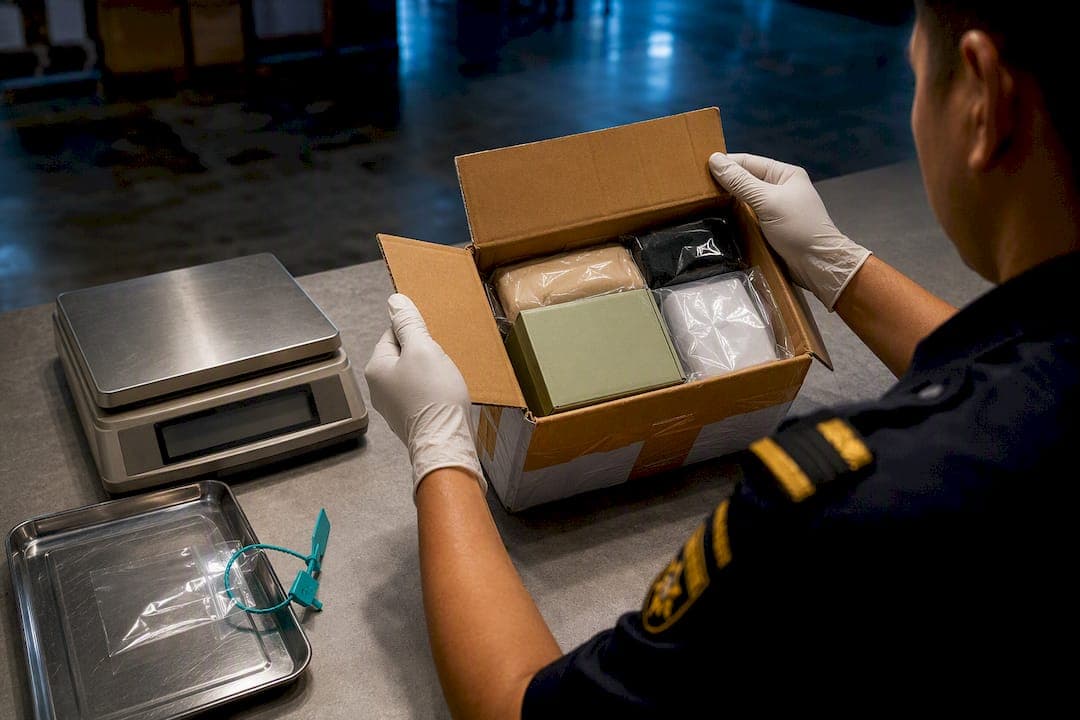
Indonesia's de minimis for import duty is a low amount per shipment. Below that value, duty is waived, but almost nothing else is. Value-added tax still applies, so most cross-border parcels arriving in Indonesia end up owing something at the border. Couriers typically clear the shipment and bill the recipient directly, which means the person opening the box is usually the one who pays.
TL;DR:
- Most parcels just above USD 3 will face duty charges around 7.5%, plus 12% VAT that applies to nearly all imports regardless of value.
- Declared values significantly below USD 3 do not exempt shipments from VAT, which is levied on the combined product, freight, and insurance costs.
- Shipping categories like used clothing, samples, or gifts may involve additional restrictions, complicating customs clearance even if the value is low.
- Accurate, consistent documentation and HS classification are critical to avoid delays and penalties, especially for shipments exceeding the USD 3 threshold.
- Using Delivered Duty Paid shipping and pre-calculated landed costs can improve buyer experience and reduce refusal or rejection of parcels.
Table of Contents
- Understanding Indonesia's De Minimis Value for Imports
- How Indonesia's Import Threshold Dropped to USD 3
- What Happens When Your Parcel Reaches Indonesian Customs?
- How Much Duty and VAT Will You Actually Pay?
- A Practical Checklist Before You Ship to Indonesia
- How Simply Parcel Helps Reduce Customs Friction
- Typical Duty Rates and Low-Value Consignment Rules
- When Does the De Minimis Value Not Apply?
- How Indonesia's Threshold Compares to Neighboring Markets
- How This Threshold Reshapes Cross-Border E-Commerce
- What Happens to Shipments Above the De Minimis Value
- Can You Challenge a Customs Valuation in Indonesia?
- Our Take on Shipping Into Indonesia's Low-Value Threshold
- Sources
- FAQ
Understanding Indonesia's De Minimis Value for Imports
The Indonesia de minimis value of USD 3 applies specifically to import duty, and it has held steady since the Ministry of Finance's PMK 199/2019 regulation took effect in 2020. That threshold sounds generous until you realize how narrow its scope is. A parcel worth USD 2.50 skips duty entirely. A parcel worth USD 50 does not.
Value-added tax is a different story. Indonesia does not extend the same exemption to VAT, and the Global Express Association's Indonesia profile states this plainly: "Only duty exempted. No de minimis for value-added tax." That single sentence explains why so many small shipments still generate a bill. Indonesia raised its standard VAT rate to 12% effective January 1, 2025, and that rate now applies to nearly every import regardless of declared value, according to customs profile data compiled by Goods Across Borders.
A handful of categories get treated differently under Indonesian customs practice, though the rules are not always uniform across ports and carriers:
- Books and printed educational materials have sometimes received different tariff treatment under Indonesia's harmonized tariff schedule, though this varies by classification and should be confirmed with a customs broker before shipping in volume.
- Used personal garments and secondhand clothing face additional restrictions in Indonesia that go beyond value thresholds. Some categories are subject to import bans regardless of declared value, which is a separate issue from de minimis entirely.
- Samples marked as no commercial value sometimes receive different scrutiny, but customs officers still assess plausibility. Declaring a shipment of ten identical items as "samples" rarely holds up.
If you're shipping a product category you haven't sent to Indonesia before, checking the current tariff classification before you commit to volume is worth the extra ten minutes. Rules on textiles, books, and secondhand goods shift more often than the headline de minimis figure does, and getting the category wrong costs more than getting the value estimate wrong.
How Indonesia's Import Threshold Dropped to USD 3
Indonesia's current de minimis value did not appear overnight. It's the product of a deliberate, multi-step policy tightening aimed at protecting domestic retailers from a flood of ultra-cheap cross-border parcels.
- Pre-2019: USD 100 threshold. Indonesia's earlier de minimis threshold was higher, allowing a range of low-value imports to skip duty entirely.
- 2019 transition: USD 75. Regulators trimmed the exemption before cutting it dramatically, a pattern documented in academic research on merchant behavior around de minimis thresholds, which also found evidence of merchants adjusting declared values to stay under whichever threshold was active.
- 2020: USD 3, under PMK 199/2019. This is the figure that remains the operative Indonesia customs de minimis today.
- March 5, 2025: PMK No. 4 of 2025. This update, reported by Indonesia Sentinel, clarified procedures for inbound shipments and introduced simplified handling for certain value bands, without reversing the USD 3 duty exemption itself.
The practical effect of these changes goes beyond the numbers. Earlier regimes leaned more heavily on self-assessment, where declared values from the shipper or platform were taken largely at face value. Recent procedural updates push toward more active official assessment, meaning customs officers have more latitude to question a declared value that looks inconsistent with the goods described. If you're used to the older, looser system, that shift alone is reason to tighten your paperwork.
What Happens When Your Parcel Reaches Indonesian Customs?
Most international couriers, including major integrators, clear shipments on the recipient's behalf rather than requiring the buyer to visit a customs office. The courier typically advances any duty and VAT owed, then bills the recipient before or at the point of delivery. This is standard practice across the industry and is confirmed in DHL's guide to Indonesian customs regulations, which also lists the documentation customs officers expect to see.
Delays and unexpected charges almost always trace back to one of a few recurring problems:
- Misclassification under the wrong harmonized system code, which changes the applicable duty rate entirely.
- Undervaluation, where a declared value looks implausibly low next to the item description, triggering manual review.
- Missing or inconsistent paperwork, especially a commercial invoice that doesn't match the customs declaration.
- Vague product descriptions, like "gift" or "accessories," which read as red flags to customs officers trained to catch underdeclared shipments.
Recipients in Indonesia can refuse a parcel if they weren't expecting the charges, and this happens more often than sellers assume. A refused shipment typically gets returned to the sender or, in some cases, abandoned at the port, with the sender absorbing return freight costs, and the carrier left to manage the disposition. Refusal doesn't cancel the underlying duty and VAT assessment. It just shifts who ends up eating the cost, and it's rarely the customs authority.
Pro Tip: Ask your recipient to expect a bill before the parcel arrives. A two-line message like "Indonesian customs may charge VAT on this package; the courier will collect it on delivery" prevents most refusals outright.
A clean documentation package speeds almost every clearance:
- Commercial invoice with an accurate, itemized declared value
- Correct HS code for each product type in the shipment
- Country of origin clearly stated
- Recipient's tax ID (NPWP) when required for higher-value commercial shipments
- Consistent product description across the invoice, waybill, and customs form
Simply Parcel's guidance on what you need for a customs declaration walks through how to build this paperwork correctly the first time, which matters more in Indonesia than in markets with looser enforcement.
How Much Duty and VAT Will You Actually Pay?
Numbers make this concrete faster than rules do. Here are two scenarios showing how Indonesia's de minimis value and VAT rules interact in practice.
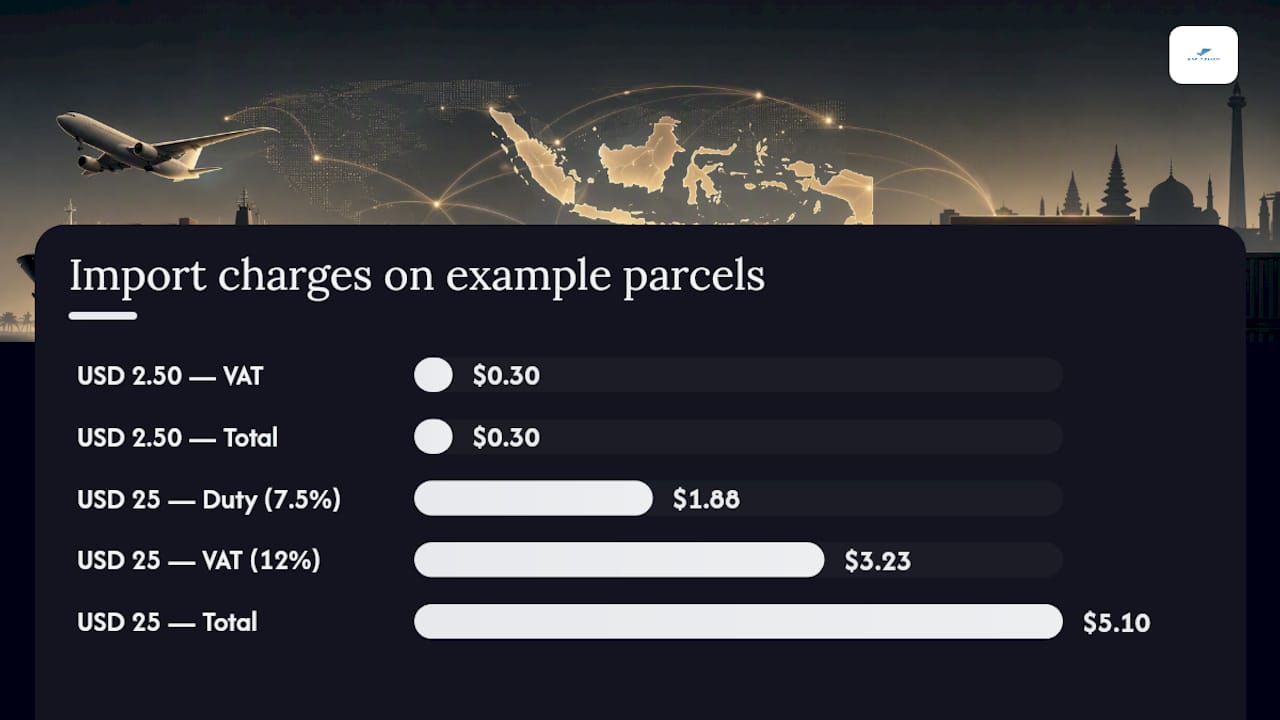
- Parcel valued at USD 2.50 (below the USD 3 de minimis). Import duty: waived. VAT: still assessed, generally on the customs value, at the current 12% rate. There's no VAT exemption tied to the USD 3 duty threshold, so this parcel still generates a bill, just a small one.
- Parcel valued at USD 25 (above the USD 3 de minimis). Import duty: applies at the relevant tariff rate for the product category, commonly in the 7.5% range for many general merchandise items under simplified schemes, though the exact rate depends on HS classification. VAT: applies at 12% on top of the duty-inclusive value. The combined effect means a USD 25 item can carry several dollars in additional charges by the time it reaches the recipient.
Whether freight and insurance costs get folded into the assessable customs value depends on the specific carrier and clearance method, but Indonesian practice generally follows a CIF-style approach (cost, insurance, and freight) rather than assessing duty on the product price alone. That detail matters more than most sellers realize, because it means a low-priced item shipped with expensive express freight can cross the de minimis line even when the product itself is nearly free.
A rough working formula: Customs value ≈ product price + freight + insurance. Apply the duty rate to that figure if it's above USD 3, then apply 12% VAT to the duty-inclusive total. It's a simplified model, but it gets sellers close enough to set realistic buyer expectations.
A Practical Checklist Before You Ship to Indonesia
The single biggest source of customer complaints in cross-border e-commerce isn't the duty itself. It's the surprise. Buyers who know a charge is coming rarely complain about it; buyers who get an unexpected bill at the door frequently refuse the parcel or leave a negative review.
A few checkout and shipping practices consistently reduce that friction:
- Show an estimated duty and VAT figure at checkout, even a rough one, so buyers aren't blindsided.
- Include the correct HS code on every commercial invoice, not just a generic product name.
- Write specific, accurate product descriptions. "Cotton t-shirt, men's, size L" clears faster than "clothing item."
- Match the declared value to the actual transaction price. Deliberately underdeclaring to dodge duty is a documented enforcement target, not a clever workaround.
- Keep your invoice, waybill, and customs declaration internally consistent. Mismatched paperwork is one of the fastest routes to a manual review.
Delivered Duty Paid (DDP) shipping is worth considering if you sell into Indonesia regularly. Under DDP, the seller prepays estimated duty and VAT as part of the shipping cost, and the recipient receives the parcel without a surprise bill at the door. The tradeoff is that DDP requires more upfront accuracy in customs valuation, since underestimating the charges means the seller absorbs the shortfall rather than the buyer. For occasional shippers, Delivered At Place (DAP), where the recipient pays on arrival, remains simpler to administer even though it carries a higher refusal risk.
Pro Tip: If you ship to Indonesia more than a few times a month, test DDP on a small batch of orders first. Compare refusal rates against your usual DAP shipments before switching your entire catalog over.
Simply Parcel's guide to essential international shipping documentation for SMEs has invoice and packing list templates that map directly onto what Indonesian customs officers expect to see.
How Simply Parcel Helps Reduce Customs Friction
Getting the paperwork right by hand, shipment after shipment, is where most small shippers lose time and where most clearance delays actually start. A platform that prompts for the right fields at booking catches errors before they reach a customs officer, not after.
A booking flow that generates shipping labels and customs documentation automatically from the details you enter can cut down on the mismatched invoice and waybill problem that causes many Indonesian clearance delays. A few features matter specifically for shipments into markets with strict de minimis enforcement:
- HS-code prompts during booking reduce the chance of the vague product descriptions that trigger manual review.
- Multiple courier integrations let you compare which partner carrier has the most reliable Indonesia clearance track record for your product category.
- Service tier options, including Priority Shipping, Connect Plus Shipping, and Economy Shipping, give you flexibility to match transit speed against how time-sensitive a shipment is, which matters when a parcel gets flagged for review.
Pre-clearing paperwork and choosing DDP where it makes sense are operational decisions, not just customs technicalities. A seller who treats documentation as an afterthought will see more refused parcels in Indonesia than one who builds accurate invoicing into their process from the start. Simply Parcel's blog carries ongoing guidance on documentation templates and booking workflows as regulations continue to shift.
Typical Duty Rates and Low-Value Consignment Rules
Duty rates in Indonesia vary by product category, but a commonly cited rate for a broad range of general merchandise under simplified low-value regimes sits around 7.5%, applied once a shipment clears the USD 3 de minimis. Higher-value or more sensitive categories, like electronics or certain textiles, can carry different tariff schedules entirely, and getting the HS code right is what determines which rate actually applies.
VAT sits on top of duty for nearly every shipment, regardless of value. Indonesia raised its standard VAT rate to 12% effective January 1, 2025, and that increase touches everything from a USD 4 parcel to a USD 400 one, according to customs profile data. There is no VAT-specific de minimis running parallel to the USD 3 duty threshold. That's the detail most sellers miss when they assume a "low value" shipment means "tax free."
Low-value consignment rules under PMK 199/2019 and the 2025 procedural updates also introduce simplified assessment methods for certain value bands, intended to speed processing for the huge volume of small e-commerce parcels entering the country. Simplified doesn't mean exempt. It means customs uses a more standardized calculation method rather than a full line-by-line review, which can actually work in a shipper's favor if the paperwork is clean, since it reduces the odds of a manual hold.
When Does the De Minimis Value Not Apply?
The USD 3 threshold covers ordinary commercial imports, but several categories sit outside its normal logic. Personal gifts between individuals sometimes receive different treatment than commercial e-commerce parcels, though "gift" status isn't a blanket exemption. Customs officers assess plausibility, and a package of ten identical phone cases labeled as a gift rarely passes without question.
Genuine trade samples, particularly those marked with no commercial value and used strictly for product evaluation rather than resale, can sometimes receive different handling. But this exemption is narrow and inconsistently applied across ports, so it should never be treated as a reliable workaround for regular commercial shipments.
Restricted and prohibited categories operate entirely outside the de minimis framework. Certain secondhand goods, some agricultural products, and specific media content face import restrictions regardless of declared value. A USD 2 shipment of a banned item doesn't get a pass just because it falls under the duty threshold. Value and legality are separate questions, and sellers who conflate the two run into trouble fast.
If you regularly ship gifts or samples into Indonesia, document the purpose clearly on the commercial invoice and keep the quantities consistent with genuine personal or evaluation use rather than commercial volume. That distinction is often what separates a smooth clearance from a flagged one.
How Indonesia's Threshold Compares to Neighboring Markets
Indonesia's USD 3 de minimis value sits at the low end of Southeast Asian thresholds, and that gap matters if you're shipping across multiple ASEAN markets from the same catalog. Some neighboring countries maintain considerably higher exemption levels, which means a product priced identically can clear duty-free in one market and get taxed the moment it crosses into Indonesia.
Sellers who run regional storefronts sometimes assume similar customs treatment across Southeast Asia, then get caught off guard when Indonesian orders generate complaints that never showed up from neighboring markets. Simply Parcel's breakdown of Malaysia's gift customs threshold is a useful point of comparison if you're managing shipments into both markets and want to see how differently two neighboring customs regimes treat similar parcel values.
The broader pattern across the region, and globally, is a gradual tightening of de minimis thresholds as governments respond to the explosive growth of cross-border e-commerce. Indonesia's move from USD 100 to USD 3 over roughly a decade isn't an isolated policy quirk. It reflects a wider concern among finance ministries that ultra-low thresholds erode both tax revenue and protection for domestic retailers competing against inexpensive imported goods.
How This Threshold Reshapes Cross-Border E-Commerce
A USD 3 de minimis value effectively means nearly every cross-border e-commerce parcel entering Indonesia is dutiable, taxable, or both. That single fact reshapes how sellers need to think about pricing, because a landed cost calculation that ignores Indonesian duty and VAT will consistently undersell what the buyer actually ends up paying.
Research on merchant behavior around shifting de minimis thresholds found consistent patterns of value bunching, where sellers cluster declared values just under whatever threshold is active, a behavior documented in academic analysis of de minimis policy changes. At USD 3, that kind of bunching is barely worth attempting since almost nothing of genuine value fits under the ceiling. The practical result is that Indonesian customs enforcement has shifted its attention toward VAT compliance and accurate classification rather than duty-threshold gaming.
For platforms and marketplaces, this has pushed a broader shift toward showing landed costs at checkout rather than leaving buyers to discover charges after the fact. Sellers who ignore this trend see higher cart abandonment on Indonesia-bound orders and more refused deliveries once the parcel arrives, since a buyer who wasn't warned about VAT is far more likely to decline payment at the courier's door.
What Happens to Shipments Above the De Minimis Value
Once a shipment's assessable value clears USD 3, it enters standard duty and VAT assessment, and the consequences of getting the declaration wrong scale up considerably. Underdeclaring value to stay artificially low is treated as a customs violation, not a gray area, and can result in penalties, seizure, or extended holds while officers verify the actual transaction value.
Delays for shipments above the threshold typically stem from the same root causes as smaller parcels: inconsistent paperwork, vague descriptions, or an HS code that doesn't match the goods. The difference is that higher-value shipments draw more scrutiny by default, since customs officers have more revenue at stake in getting the assessment right.
Penalties for misdeclaration can include back duty assessed at the correct rate, administrative fines, and in more serious or repeated cases, further investigation into the importer or exporter. None of this is unique to Indonesia, but the country's relatively low de minimis value means far more shipments fall into this higher-scrutiny category than would in a market with a higher threshold.
Practically, the fix is upstream, not downstream. A shipment built on an accurate invoice, correct HS classification, and a declared value that matches the actual transaction rarely triggers penalty proceedings, even when it clears well above USD 3. The shipments that run into trouble are almost always the ones where the paperwork told a different story than the goods inside the box.
Can You Challenge a Customs Valuation in Indonesia?
Importers who disagree with a customs valuation or duty assessment do have recourse, though it's a formal process rather than a quick phone call. Indonesian customs procedures generally allow an importer to file an objection with the customs office that issued the assessment, providing supporting documentation such as the original commercial invoice, proof of payment, or a corrected declaration.
If that initial objection doesn't resolve the dispute, escalation typically proceeds through Indonesia's Tax Court, which handles customs valuation disputes as part of its broader jurisdiction over tax and duty matters. This process takes time, and for a low-value e-commerce parcel, the administrative cost of a formal appeal often exceeds the disputed duty amount, which is why most sellers focus on preventing valuation disputes rather than fighting them after the fact.
The most effective appeal is the one you never have to file. Keeping a clean paper trail, meaning the original invoice, proof of the transaction price, and consistent product descriptions across every document, gives you the evidence needed to resolve most valuation questions informally with the courier or customs broker before they escalate into a formal dispute. For commercial shippers moving regular volume, working with a licensed customs broker in Indonesia is generally more practical than navigating an appeal independently.
Our Take on Shipping Into Indonesia's Low-Value Threshold
Most advice on Indonesia's de minimis value stops at the number, USD 3, and treats it as the whole story. It isn't. The real operational risk sits in the VAT gap that conventional advice glosses over: a threshold this low means duty exemption barely matters for the vast majority of parcels, since VAT catches almost everything anyway.
We think sellers overinvest in optimizing declared values to stay under USD 3 and underinvest in the paperwork accuracy that actually determines whether a shipment clears smoothly. The threshold reduction from USD 100 to USD 3 wasn't designed to be worked around. It was designed to make duty exemption nearly irrelevant, shifting the real compliance burden onto accurate classification and VAT handling.
If you take one thing from this guide, prioritize documentation consistency over value minimization. A correctly classified, honestly valued shipment above USD 3 clears faster and more predictably than a mislabeled one hovering just under it. That's the opposite of what most sellers assume when they first encounter Indonesia's rules.
— Simply
Sources
- Indonesia - Import Tariffs
- Indonesia — Customs profile — Goods Across Borders
- Global Express Association — Indonesia entry
- Indonesia Introduces New Regulations on Imported and Exported Shipments, Here's The List! - Indonesia Sentinel
FAQ
How much is import duty in Indonesia?
Import duty rates vary by product category, but for many general merchandise items falling under simplified low-value consignment rules, a common rate is around 7.5% once a shipment's value exceeds the USD 3 de minimis. Duty is calculated on the customs value, which generally includes product cost, freight, and insurance.
What is a de minimis value?
A de minimis value is the threshold below which a government waives a specific charge, such as import duty, on incoming shipments. It does not automatically waive every tax; in Indonesia, the USD 3 de minimis exempts duty but not VAT.
What is the current import tariff rate for Indonesia?
Tariff rates in Indonesia depend on the harmonized system code of the product, with many general goods falling in a range around 7.5% under simplified regimes, while specific categories like electronics or textiles can carry different rates. VAT applies separately at 12% as of January 1, 2025, regardless of the duty rate.
What are the import duty exemptions in Indonesia?
The main duty exemption is the USD 3 de minimis value, which waives import duty on shipments below that threshold. This exemption does not extend to VAT, which is assessed on nearly all imports, and it does not override restrictions on prohibited or controlled goods categories.
Does the Indonesia de minimis value cover VAT as well as duty?
No. The USD 3 de minimis in Indonesia applies only to import duty.