Singapore's cross-border e-commerce market reached US$8.2 billion in GMV in 2022 and is projected to hit US$11 billion by 2025, with 70% of consumers buying from overseas sellers every month. For small businesses and e-commerce sellers in Singapore, this growth represents real opportunity. But one missing document can bring a shipment to a complete halt, triggering delays, fines, or even destruction of your goods at the border. This guide breaks down every required document, every filing step, and every exemption you need to know, so your next international shipment moves without a hitch.
Table of Contents
- Why correct shipping documentation matters
- The core documents for international shipping
- Step-by-step: Registering and filing with Singapore Customs
- Special cases, exemptions, and controlled goods
- What most guides miss: The real pitfalls and practical shortcuts
- Simplify global shipping: How Simply Parcel can help
- Frequently asked questions
Key Takeaways
| Point | Details |
|---|---|
| Core documents | Every export needs a permit, invoice, waybill, packing list, and sometimes a Certificate of Origin. |
| Use digital platforms | TradeNet makes filing and retrieving permits fast and secure. |
| Know exemptions | Low-value, non-controlled air shipments under S$1,000 may skip the permit. |
| Handle controlled goods carefully | Strategic, food, and other controlled goods need extra licenses before shipment. |
| Avoid mistakes | Double-check documents and consider a licensed agent to prevent costly delays. |
Why correct shipping documentation matters
Paperwork might feel like the least exciting part of running an e-commerce business, but it carries serious consequences when it goes wrong. Customs authorities across the world reject shipments for documentation errors every single day. In Singapore's context, where cross-border trade moves at high volume and speed, even a small mistake can cascade into a costly problem.
Complete paperwork is essential to avoid delays, carrier rejections, and additional costs at every stage of international shipping. When your commercial invoice lists the wrong declared value, for example, customs may flag the shipment for inspection. That inspection adds days to your transit time. For an e-commerce seller, late deliveries translate directly into negative reviews and lost repeat customers.
The financial risks go beyond inspection fees. Goods held at customs may incur storage charges. Goods returned to the sender trigger double shipping costs. In the worst cases, particularly with perishable items or restricted goods, your shipment may be destroyed entirely. No refund. No recourse.
"Missing a single required document doesn't just slow a shipment down. It can result in your goods being quarantined, returned, or permanently seized at the destination port."
Here is a quick overview of the most common consequences of documentation errors:
- Shipment delays of 3 to 14 additional days
- Storage and demurrage fees charged by the carrier or port
- Customs fines for incorrect or false declarations
- Return shipping costs paid by the sender
- Loss of customer trust and potential refund demands
Pro Tip: Before your first shipment to any new country, verify the exact documentation requirements with your logistics partner. Destination-country rules change regularly, and reliable courier services will flag those requirements for you before you book.
The core documents for international shipping
Knowing the stakes, you need to understand exactly which documents are required for a standard export from Singapore. Most shipments require five core documents. Some situations call for extras. Here is a clear breakdown.
Core export documents from Singapore include the Customs Export Permit (filed via TradeNet), a Commercial Invoice, an Air Waybill or Bill of Lading, a Packing List, and a Certificate of Origin where applicable for Free Trade Agreements.
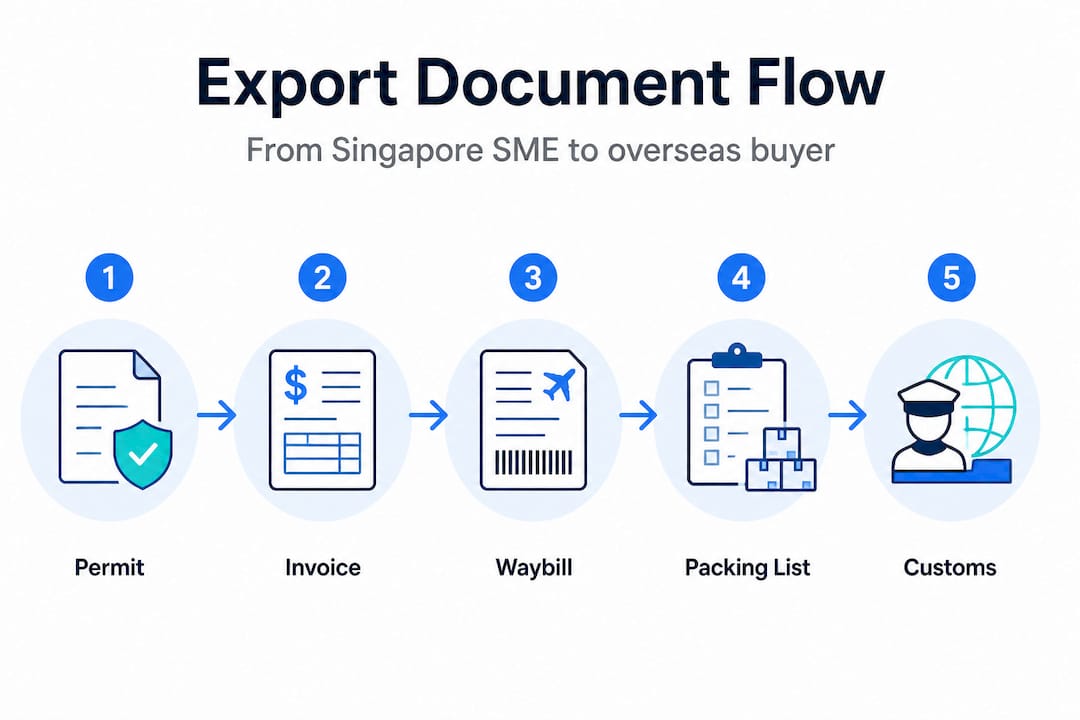
| Document | Purpose | When needed | Issued by |
|---|---|---|---|
| Customs Export Permit | Declares goods for export compliance | Most controlled/dutiable shipments | Singapore Customs via TradeNet |
| Commercial Invoice | States value, description, seller/buyer details | Every commercial shipment | Seller/Exporter |
| Air Waybill / Bill of Lading | Contract of carriage between shipper and carrier | Every shipment | Courier or freight carrier |
| Packing List | Itemizes contents, weights, dimensions | Every shipment | Seller/Exporter |
| Certificate of Origin | Proves goods originated in Singapore for FTA benefits | FTA-eligible shipments only | Singapore Customs or authorized body |
Understanding each document's purpose saves you time and prevents over-preparation. For a deeper look at shipping terminology, this shipping terminology guide covers the key definitions you will encounter regularly.
Must-have for every commercial shipment:
- Commercial Invoice (with accurate HS codes, declared value, and buyer/seller details)
- Air Waybill or Bill of Lading (provided by your courier or freight forwarder)
- Packing List (itemized contents with weights and dimensions)
Sometimes required, depending on your goods and destination:
- Customs Export Permit via TradeNet (required for controlled, dutiable, or high-value goods)
- Certificate of Origin (only if you are claiming FTA preferential tariff rates)
- Import licenses or product-specific permits required by the destination country
Pro Tip: Do not apply for a Certificate of Origin unless your buyer has specifically requested it to claim FTA tariff benefits at the destination. It adds cost and time without benefit if not needed. For a broader look at the full export process, this complete shipping guide walks you through end-to-end steps.
Step-by-step: Registering and filing with Singapore Customs
Once you know which documents you need, the next step is getting set up to file them correctly. Singapore Customs requires businesses to register with ACRA for a Unique Entity Number, activate a Customs Account, and use TradeNet for permit applications. You may also appoint a declaring agent to handle submissions on your behalf.
Here is the step-by-step process for new exporters:
-
Register with ACRA. If you haven't already, register your business with the Accounting and Corporate Regulatory Authority to obtain your Unique Entity Number (UEN). This is your official business identifier in Singapore.
-
Activate your Customs Account. Log into the Singapore Customs portal and activate your account using your UEN. This step is mandatory before you can apply for any permits.
-
Register with TradeNet. TradeNet is Singapore Customs' electronic data interchange system. All permit applications and amendments are submitted through this platform. You can access it via the government's National Single Window.
-
Apply for the relevant export permit. Once registered, you submit your permit application through TradeNet before your goods are exported. The system checks your data against existing regulations and returns approval or queries.
-
Receive and attach your permit. Approved permits are issued digitally. Print or save the permit number for your shipping documentation set.
-
Appoint a declaring agent if preferred. If the process feels overwhelming as a new exporter, you can authorize a registered declaring agent to file on your behalf. This is a legal and widely used option for SMEs who prefer to focus on their core business.
"Using a declaring agent is not a shortcut. It is a legitimate and often smarter strategy for businesses shipping internationally for the first time. Agents know the system, the edge cases, and the fastest paths through compliance."
TradeNet processes most permit applications within minutes during business hours. However, applications involving controlled goods or incomplete data may be queued for manual review, which can take hours or longer. Accuracy upfront saves time downstream.
Pro Tip: If you are a new exporter, using a declaring agent for your first three to five shipments is highly recommended. Once you understand the process, you can self-file confidently. When you are ready to arrange international parcel pickup, having your permit ready in advance prevents last-minute delays.
Special cases, exemptions, and controlled goods
Not every shipment triggers the same documentation requirements. Some are simpler. Some are significantly more complex. Knowing where your goods fall saves time and prevents nasty surprises.

When an export permit is NOT required:
Non-controlled, non-dutiable air exports valued under S$1,000 are generally exempt from the customs export permit requirement. Note that partial clearance at land checkpoints is not allowed under this exemption.
Common exemption scenarios include:
- Personal gifts or low-value items sent via air courier under S$1,000
- Non-regulated consumer goods with no controlled substance classifications
- Documents and printed materials with no commercial value
When additional permits ARE required:
Controlled goods such as strategic items, certain food products, pharmaceuticals, chemicals, and electronics may require additional licenses or permits from the relevant controlling authority before Singapore Customs will approve your export permit.
| Shipment type | Export permit required | Additional license | Issued by |
|---|---|---|---|
| Standard goods, air, under S$1,000 | No | No | Not applicable |
| Standard goods, air, over S$1,000 | Yes | No | Singapore Customs |
| Dutiable goods (e.g. alcohol, tobacco) | Yes | Yes | Singapore Customs / Singapore Food Agency |
| Strategic goods / dual-use items | Yes | Yes | Strategic Goods Control Office |
| Hand-carried exports | Yes (for controlled items) | Depends on goods | Singapore Customs |
| Temporary exports (returned goods) | Yes | No (if conditions met) | Singapore Customs |
Edge cases that often catch SMEs off guard include:
- Hand-carried items: If you personally carry goods out of Singapore for business purposes, those items may still require an export permit depending on their category and value.
- Temporary exports: Goods sent abroad for repair or exhibition and returned to Singapore follow a specific re-import procedure. You must declare them correctly on the way out and on the way back.
- Strategic goods: Items on the strategic goods control list, such as certain electronics with dual military and civilian applications, require approval from the Strategic Goods Control Office before any other permit is issued.
Understanding where your product sits in these categories is essential. For help with understanding shipping rates alongside your compliance requirements, it's worth reviewing your full cost picture before confirming a shipping method.
What most guides miss: The real pitfalls and practical shortcuts
Most documentation guides hand you a checklist and stop there. That's useful, but it doesn't protect you from the most common and costly mistakes that Singapore SMEs actually make. Here is the perspective that comes from working directly with businesses shipping internationally every week.
The single biggest error is treating documentation as a one-time setup. Businesses put in the work, get their templates right, and then ship the same way for months or years, assuming nothing has changed. But regulations shift. Destination countries update their import rules. Singapore Customs revises permit conditions. A template that worked perfectly in 2024 may create problems in 2026 if you haven't checked for updates.
The fix is simple: review your documentation requirements at least once per quarter and every time you open a new destination market. Build this into your standard operating procedure.
The second overlooked shortcut is pre-validation with your logistics provider. Most SMEs submit documents, then find out post-booking that something is wrong. Professional logistics partners can review your documents before your shipment is booked, flagging errors before they become problems. This one step can cut customs-related delays dramatically.
Here are two practical shortcuts that genuinely work:
Shortcut 1: Build and save template documents for every recurring lane. If you ship regularly to Malaysia, Australia, and the United States, maintain a verified template commercial invoice, packing list, and permit checklist for each. When you have a new order, you tweak rather than rebuild. This cuts your documentation time significantly and reduces the chance of errors introduced during rushed preparation.
Shortcut 2: Use digital tools and integrate with TradeNet-compatible platforms. Manual data entry across multiple documents introduces inconsistency. When your product description on the commercial invoice doesn't exactly match the packing list, customs officers notice. Digital tools that auto-populate data across documents eliminate this problem entirely.
Booking via a courier pickup best practices workflow that includes automatic label generation keeps your data consistent from start to finish. When one source of truth feeds all your documents, the error rate drops to near zero.
The uncomfortable reality is that documentation compliance is not a one-time project. It is an ongoing operational discipline. The SMEs that get this right treat it the same way they treat inventory management: systematic, reviewed regularly, and never fully delegated to memory.
Simplify global shipping: How Simply Parcel can help
Understanding the documentation requirements is the first step. Executing on them accurately and efficiently, shipment after shipment, is where many Singapore SMEs struggle. Simply Parcel is built to close that gap. The platform automatically generates shipping labels and documentation for international shipments, integrates with major courier partners, and gives you real-time tracking so you always know where your parcel is. You can get a shipping quote in minutes, review your full international shipping details before committing, and track your parcel at every step. For Singapore SMEs who want faster, more accurate cross-border shipping without the documentation headaches, Simply Parcel is the practical next step.
Frequently asked questions
Which exports from Singapore are exempt from customs permits?
Non-controlled, non-dutiable air shipments valued under S$1,000 do not require an export permit, though this exemption does not apply at land checkpoints.
What additional documentation is needed for controlled goods?
Controlled goods such as strategic items, certain food products, and pharmaceuticals require extra licenses from the relevant authority, which must be secured before Singapore Customs will issue your export permit.
How do I get a UEN and activate a Customs Account?
Register your business with ACRA to receive your UEN, then log in to the Singapore Customs portal to activate your Customs Account before submitting any permit applications via TradeNet.
Is a Certificate of Origin required for all exports?
No. A Certificate of Origin is only necessary when your buyer wants to claim preferential tariff rates under a Free Trade Agreement at the destination country.
Can I appoint someone else to file documents on my behalf?
Yes. You may appoint a registered declaring agent to submit your permit applications through TradeNet, which is a practical option for new exporters or businesses with high shipment volumes.