Gifts sent to Malaysia are not automatically duty-free. The key number is MYR 500: goods sold online and valued at MYR 500 or less qualify as Low Value Goods (LVG) and are subject to a 10% sales tax set by Malaysia's Ministry of Finance. Parcels above MYR 500 may attract both import duty and Sales and Service Tax (SST). The Royal Malaysian Customs Department (JKDM) is the official authority governing all import rules, and their guidance is the definitive source for current rates and exemptions.
Before your parcel ships, check three things quickly:
- Declared value on the customs form — is it at or below the Low Value Goods threshold?
- Invoice or pro forma invoice — does it match the declared value?
- Item classification — is the item excluded from LVG treatment (alcohol, tobacco, e-cigarettes)?
If all three look clean and the value stays within the LVG threshold, the parcel will likely clear with only the 10% LVG sales tax applied. Higher-value parcels may incur import duty plus SST.
Key Takeaways
Gifts to Malaysia are subject to a 10% LVG sales tax when the CIF value is at or below the threshold for Low Value Goods; parcels exceeding this threshold face import duty and SST in addition.
| Point | Details |
|---|---|
| LVG threshold and tax | Goods sold online valued at MYR 500 or less attract a 10% LVG sales tax; above MYR 500, import duty and SST also apply. |
| Traveler allowances differ | Air arrivals get RM 1,000 duty-free; land/sea arrivals get RM 500 — these are separate from the postal/courier LVG rule. |
| Excluded categories | Alcohol, tobacco, e-cigarettes, and related products are excluded from LVG and remain fully dutiable regardless of value. |
| Accurate docs prevent delays | A pro forma invoice with individual item values and a clear description is the most reliable way to avoid inspection holds. |
| Simplyparcel simplifies the process | Simplyparcel auto-generates customs invoices and labels, compares couriers, and supports DDP options for Malaysia-bound shipments. |
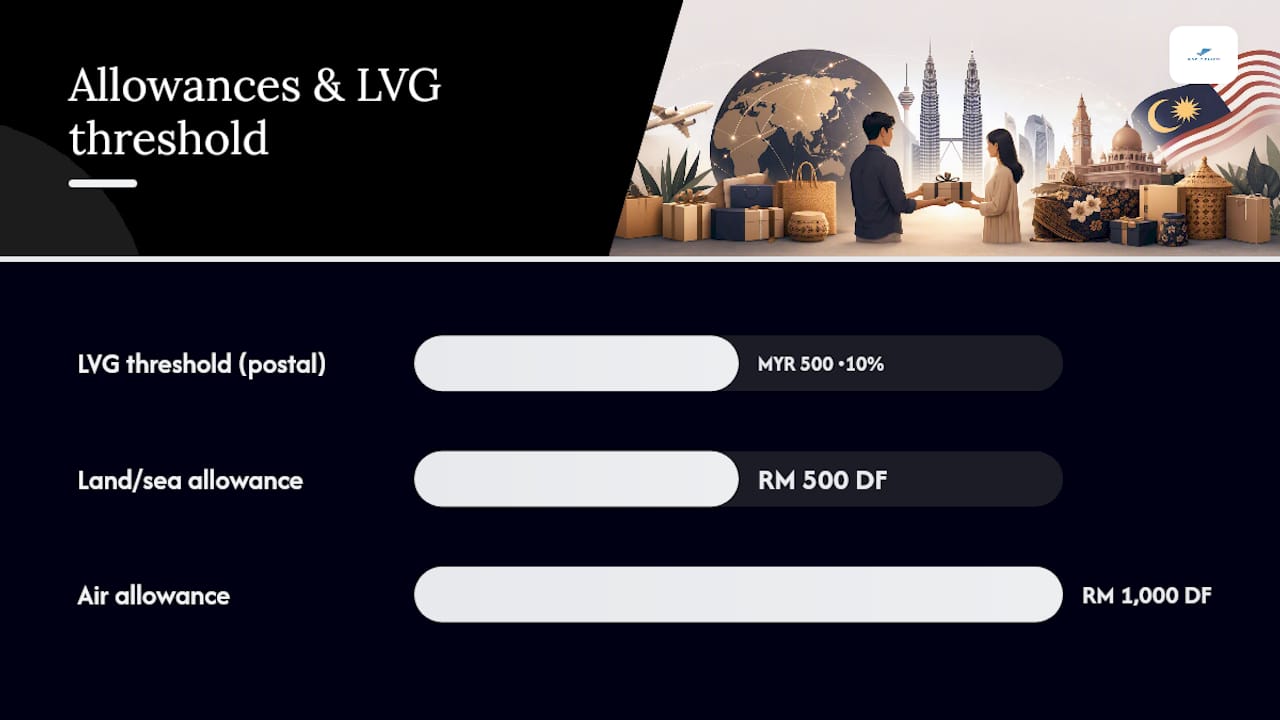
Table of Contents
- What does Malaysian customs consider a gift vs. a commercial shipment?
- How does the Malaysia gift customs threshold work, and what taxes apply?
- What items are restricted or prohibited when sending gifts to Malaysia?
- What documents do you need to declare a gift correctly?
- How does customs inspect and clear gift parcels, and how long does it take?
- How can you legally reduce customs surprises when sending gifts?
- What should you do if customs charges duties on your gift parcel?
- How do couriers handle gift parcels and customs formalities for Malaysia?
- Singapore-to-Malaysia gift parcel checklist
- Simplyparcel makes sending gifts to Malaysia straightforward
- Sources
What does Malaysian customs consider a gift vs. a commercial shipment?
Customs officers do not take "gift" at face value. JKDM looks at the whole picture of a shipment to decide whether it is a genuine personal gift or a commercial import in disguise.
Key indicators that support a genuine gift classification:
- Single sender, single recipient — one person sending to one person, not a seller dispatching to multiple buyers
- One-off or infrequent shipment — a birthday present sent once differs from weekly parcels of the same item
- No commercial invoice showing a sale price — a pro forma invoice or a simple gift declaration is more appropriate
- Reasonable quantity — one bottle of perfume reads as a gift; twelve bottles of the same SKU reads as stock
- "Gift" marked on the customs declaration form — this alone is not enough, but it supports the overall picture
Conversely, customs may reclassify a parcel as a commercial import if it carries a seller's invoice, shows evidence of payment from buyer to seller, or contains multiple identical items. Under the MyLVG FAQ, sellers who bring LVG into Malaysia exceeding MYR 500,000 in any 12-month period must register under the Sales Tax Act — which shows that JKDM actively monitors volume and seller behavior, not just individual parcel values.
Charitable donations and product samples occupy a grey area. JKDM may grant concessions, but you should contact JKDM directly or consult a licensed customs agent before shipping these categories.
How does the Malaysia gift customs threshold work, and what taxes apply?
The LVG de minimis rule
The official LVG guide defines Low Value Goods as goods sold at a price not exceeding MYR 500 that are brought into Malaysia. This rule was introduced to level the playing field between overseas online sellers and local Malaysian retailers.
Goods excluded from LVG treatment — and therefore still subject to regular customs duties and excise taxes — include:
- Cigarettes and tobacco products
- Intoxicating liquors
- Smoking pipes
- E-cigarettes and related preparations
Traveler allowances vs. postal/courier LVG
If you are carrying gifts personally into Malaysia, a different set of rules applies. According to JKDM's Traveler's Guide, air arrivals generally receive a duty-free allowance of up to RM 1,000 for general goods, while land and sea arrivals receive RM 500. Goods beyond those amounts must be declared and may be taxed. These traveler allowances are separate from the LVG postal/courier rule and should not be confused with it.
How customs calculates parcel value
JKDM uses the CIF value (Cost + Insurance + Freight) as the basis for assessment, converted to MYR at the customs exchange rate on the date of import.
Worked example:
Had the CIF value exceeded MYR 500, import duty and SST would both be assessed on top.
What items are restricted or prohibited when sending gifts to Malaysia?
Some gifts will be stopped regardless of their value. Knowing the categories in advance saves time, money, and the frustration of a returned or confiscated parcel.
Prohibited items (never allowed):
- Illegal drugs and narcotics
- Weapons, firearms, and ammunition (without proper authorization)
- Products derived from endangered species (CITES-listed items)
- Counterfeit or pirated goods
Restricted items (allowed only with permits or in limited quantities):
- Alcohol and tobacco (subject to excise duty; excluded from LVG)
- Prescription pharmaceuticals (require Health Ministry approval or import permit)
- Fresh food, plants, and soil (subject to Department of Agriculture and Veterinary Services clearance)
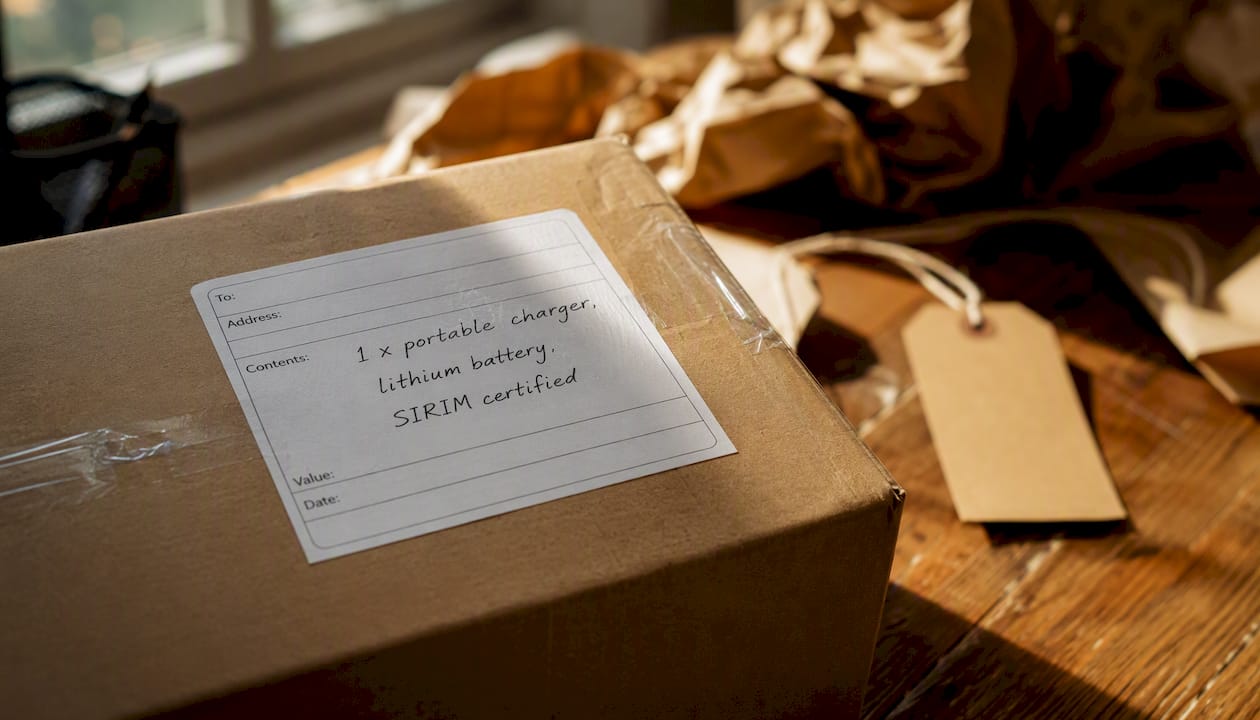
- Lithium batteries and power banks (must comply with SIRIM standards)
- Chemicals and hazardous materials (require specific permits)
If customs stops a restricted item without the correct permit, the typical outcomes are confiscation, a fine, or return-to-sender at the shipper's cost. For items in doubt, check the JKDM prohibited and restricted goods list before packing.
Pro Tip: Always declare the exact contents on the outer label and include any relevant permits inside the parcel. A parcel marked "electronic device" with no further detail is far more likely to be pulled for physical inspection than one labeled "1 x wireless mouse, lithium battery, SIRIM certified."
What documents do you need to declare a gift correctly?
Getting the paperwork right is the single most reliable way to avoid customs delays. Here is what senders should prepare:
- Airway bill / waybill — generated by your courier; must include sender and recipient full names, addresses, and contact numbers
- Commercial invoice — required when a sale has taken place; list each item, its unit value, and currency
- Pro forma invoice — used when no sale has occurred (a genuine gift); still list item descriptions and realistic market values
- CN22 or CN23 form — required for postal shipments; CN22 covers lower-value items, CN23 for higher values or commercial content
- Import permits or certificates — mandatory for restricted items (pharmaceuticals, food, regulated electronics)
When to use a pro forma invoice vs. a commercial invoice: If you are sending a gift you purchased and are not selling to the recipient, use a pro forma invoice. Write "gift — no commercial value" only if the item genuinely has no resale value; for everything else, state the realistic purchase price. Understating value to avoid tax is illegal and can result in seizure or fines.
Sender checklist:
- Full recipient name, address, and phone number
- Accurate item descriptions (not just "clothes" — write "2 x cotton T-shirts")
- Individual unit values in the original purchase currency
- "Gift" marked on the customs declaration where applicable
- Copies of any permits for restricted items
- Your own contact details in case customs needs to reach the sender
How does customs inspect and clear gift parcels, and how long does it take?
When your parcel arrives in Malaysia, it enters a risk-assessment process before physical clearance.
Typical clearance steps:
- Parcel arrives at the port of entry or customs facility
- Customs system performs an automated risk assessment based on declared value, item type, and sender profile
- Low-risk parcels are released quickly; flagged parcels go to physical inspection
- If inspected, customs officers verify contents against the declared invoice
- A duty/tax bill is issued if charges apply, sent to the recipient or the courier
Postal vs. courier timelines:
Postal shipments (via Pos Malaysia) tend to take longer through customs, sometimes several days to over a week if flagged. Courier shipments (DHL, FedEx, and similar) typically move faster because couriers act as licensed customs brokers and submit electronic pre-clearance data before the parcel lands.
Additional costs to expect:
- Courier customs handling or brokerage fees (charged separately from duties)
- Storage fees if a parcel sits uncollected after a duty notice
- Duties and taxes collected either online via the courier's portal or at the customs office on pickup
Incomplete documentation is the most common reason for delays. A missing invoice or vague item description can add days to clearance, even for low-value parcels.
How can you legally reduce customs surprises when sending gifts?
There are practical, lawful steps that reduce the chance of unexpected charges or delays. None of them involve hiding value.
- Use accurate, detailed descriptions. "Handbag" is vague; "1 x leather handbag, brown, approx. MYR 350 value" gives customs everything it needs.
- Declare honestly. Under-declaring value is a customs offense in Malaysia. If caught, the penalty can exceed the duty you were trying to avoid.
- Avoid splitting shipments to game the threshold. Sending three parcels of MYR 400 each on the same day to the same recipient is a red flag. JKDM can aggregate related shipments and treat them as a single commercial import.
- Choose Delivered Duty Paid (DDP) shipping when you want the recipient to receive the parcel without any surprise charges at the door. Under DDP, duties and taxes are prepaid by the sender. Under Delivered at Place (DAP), the recipient pays on arrival.
- Use a courier that offers customs estimates at booking. Knowing the likely tax before you ship lets you decide whether to proceed, adjust the shipment, or notify the recipient.
Pro Tip: For gifts between family members, include a brief cover letter inside the parcel explaining the relationship (e.g., "birthday gift from mother to daughter") and the occasion. This is not a legal requirement, but it gives a customs officer useful context when assessing whether the shipment is genuinely personal.
What should you do if customs charges duties on your gift parcel?
Receiving a duty notice is not the end of the road. Follow these steps to resolve it quickly.
- Read the notice carefully. Identify whether the charge is LVG sales tax (10%), import duty, SST, or a combination. The notice should specify the assessed value and the tax code applied.
- Verify the declared value. Compare the customs-assessed CIF value against your original invoice or pro forma. Errors in freight or insurance calculations do happen.
- Confirm the item classification. Check that the tariff code assigned matches the actual item. A misclassified item can result in a higher duty rate than the correct one.
- Pay via the courier's portal or at the customs office. Most major couriers allow online payment of duties before delivery. Pos Malaysia parcels may require payment at the post office or customs counter.
- Dispute if the charge is incorrect. Gather your proof of value (receipts, bank records, pro forma invoice) and contact the courier's customs team first. If unresolved, escalate directly to JKDM with documentary evidence.
- Request a refund for overpayment or misclassification. Refund scenarios are limited but real. If customs assessed a higher value than the actual CIF, or applied the wrong tariff code, you can file a formal objection with JKDM. Expect the process to take several weeks.
The difference between DAP and DDP matters here: under DAP, the recipient handles payment and any disputes. Under DDP, the sender's courier or freight forwarder manages it on their behalf.
How do couriers handle gift parcels and customs formalities for Malaysia?
Couriers do more than transport parcels. For international shipments, they typically act as customs brokers, submitting pre-arrival data to JKDM and managing duty collection on behalf of recipients.
Standard courier practices for Malaysia-bound gift parcels:
- Electronic pre-clearance submission before the parcel lands
- Automated duty calculation based on declared value and HS tariff code
- Notification to recipient (email or SMS) when duties are due
- Option to pay online before delivery or at the door
- DDP service available on select routes, where duties are prepaid at booking
DHL Malaysia publicly states that gifts and personal effects shipped into Malaysia are subject to the same customs rules as commercial goods, and that the declared value on the airway bill is used for duty assessment. DHL's customs brokerage team handles JKDM clearance on behalf of the recipient for most express shipments.
Couriers use airway bills and commercial or pro forma invoices rather than the CN22/CN23 postal forms. This distinction matters because couriers can submit data electronically and often clear parcels faster than the postal system.
Questions to ask your courier or aggregator before booking:
- Is customs brokerage included in the service fee, or is it a separate charge?
- Do you offer DDP for Malaysia-bound shipments?
- Can you provide an estimated duty/tax amount at the time of booking?
- Will you generate the customs invoice and airway bill automatically?
For guidance on choosing between courier services for international shipments, the service level and customs support vary significantly between providers.
Singapore-to-Malaysia gift parcel checklist
If you are shipping from Singapore, this checklist covers the steps most likely to prevent clearance problems.
Before you pack:
- Confirm the item is not on Malaysia's prohibited or restricted list
- Check whether the item requires an import permit (pharmaceuticals, food, regulated electronics)
- Gather your proof of purchase (receipt, order confirmation, bank statement)
When preparing documentation:
- Write a pro forma invoice if no sale is involved; use a commercial invoice if you paid for the item
- List every item individually with accurate descriptions and MYR-equivalent values
- Convert SGD values to MYR using a conservative exchange rate and note the rate used
- Include the recipient's full name, Malaysian address, and mobile number
Choosing your service:
- Select DDP if you want the recipient to receive the parcel without paying at the door
- Consider priority or connect-plus services for time-sensitive gifts; economy is cheaper but slower and may sit longer in customs queues
- Use a platform that auto-generates your shipping label and customs invoice to reduce manual errors
Pro Tip: Keep a digital copy of every document you submit — invoice, waybill, and any permits. If customs queries the shipment, having everything ready to email speeds up resolution considerably.
Simplyparcel's online booking platform handles label generation, customs documentation, and courier comparison in one place, which reduces the paperwork errors that most commonly delay clearance. The Simplyparcel blog also covers documentation requirements in detail for common shipping scenarios.
What most senders get wrong about Malaysia gift customs
Most gift parcels clear without drama. The MYR 500 LVG threshold means a large share of personal gifts fall into a predictable, low-tax category.
The problems cluster around a few recurring mistakes: missing or vague invoices, item descriptions that say "miscellaneous goods" instead of naming each item, and the tempting but risky idea of splitting a single large gift into multiple smaller parcels to stay under the threshold. Customs officers see that pattern regularly.
The reassuring reality is that accurate documentation does most of the work. A clear pro forma invoice, an honest declared value, and a correctly labeled parcel will clear faster and with fewer questions than an expensive parcel with incomplete paperwork. When in doubt, err on the side of providing more detail, not less.
Simplyparcel makes sending gifts to Malaysia straightforward
Knowing the rules is half the job. The other half is making sure your parcel is documented, labeled, and booked correctly before it leaves Singapore. Simplyparcel handles the logistics side: compare courier rates, auto-generate your shipping label and customs invoice, and choose between DDP and DAP options so the recipient knows exactly what to expect. Free pickup is available, and you can track your shipment in real time through the platform.
Ready to send? Get an instant quote and book your Malaysia-bound parcel in minutes.
Sources
Rules, exchange rates, and permit requirements can change. Bookmark these pages and check them before every shipment.
- Sales Tax On Imported Low-Value Goods Sold Online
- MyLVG | Jabatan Kastam Diraja Malaysia
- Traveler's Guide
If a rule seems unclear or your item sits in a grey area, contact JKDM directly or consult a licensed Malaysian customs agent before shipping. The cost of a quick inquiry is far lower than the cost of a confiscated parcel.