Every international parcel leaving Singapore needs a correct commercial invoice (or the matching CN22/CN23 for small postal packets), an HS code with at least 6 digits, and a matching air waybill or consignment note. The sender is legally responsible for the accuracy of every field. Most non-dutiable, non-controlled shipments exported by air and within the permit exemption threshold skip the TradeNet permit requirement, but the paperwork itself is never optional.
TL;DR:
- Using electronic advance data with EAD submission significantly reduces customs delays for both postal and courier shipments.
- Accurate HS codes, especially full 8-digit classifications, are crucial for smooth clearance and avoiding classification queries.
- Export permits are required for dutiable, controlled, or high-value goods but not for parcels under S$1,000 sent by air without special permits.
- Providing immediate proof of delivery and tracking screenshots ensures zero-rating GST claims and prevents penalties during audits.
- Preparing and verifying customs paperwork before booking, including invoices, HS codes, and export permits, minimizes the risk of shipment holds.
Table of Contents
- What to Prepare Before You Book a Courier
- CN22, CN23, or a Commercial Invoice: Which One Do You Need?
- Finding the Right HS Code for Your Shipment
- When You Actually Need a TradeNet Export Permit
- Keeping the Proof That Lets You Zero-Rate GST
- Mistakes That Get Parcels Held (and How to Avoid Them)
- How Simplyparcel Supports Your Customs Paperwork
- Book Your Shipment and Generate Your Documents in One Step
- Where to Verify These Rules Yourself
- Why the Paperwork Matters More Than the Parcel
- Sources
What to Prepare Before You Book a Courier
A rushed booking is where most customs problems start. Before you schedule a pickup or drop off a parcel, get these pieces sorted:
- Commercial invoice: itemized descriptions, quantities, unit values, total CIF value in Singapore dollars, HS code(s), and country of origin.
- Packing list: matches the invoice line by line, especially for multi-item shipments.
- Consistent references: the AWB or consignment note number should match the label and invoice exactly, since mismatched references are a common trigger for manual checks.
- Shipment type confirmation: know whether you're sending postal (CN22/CN23) or courier (commercial invoice, often with electronic data), since the carrier's requirements differ.
- Delivery proof: screenshot the tracking status and proof of delivery once the parcel lands, and keep it filed for GST purposes.
Getting a commercial invoice and packing list right the first time saves you from a phone call asking for corrected paperwork mid-transit.
CN22, CN23, or a Commercial Invoice: Which One Do You Need?
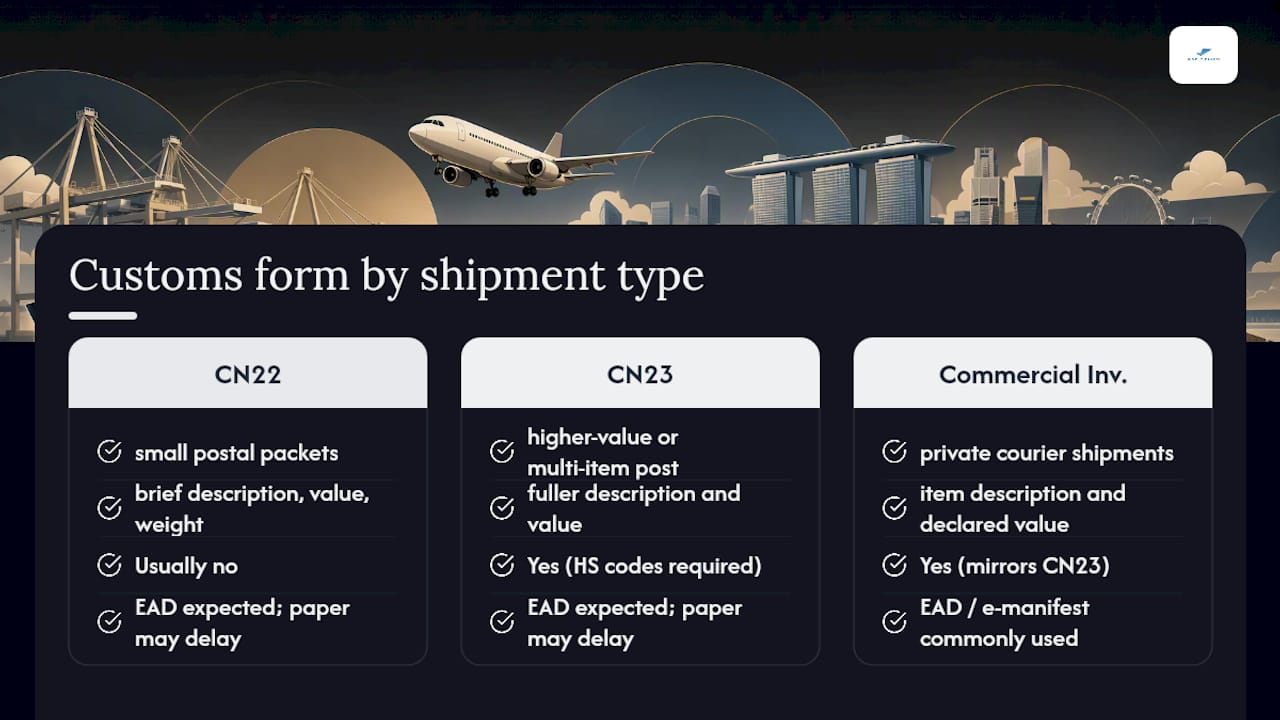
The form depends on how the parcel is moving, not on what's inside it. CN22 covers small postal packets under specific weight and value thresholds and asks for a brief description, value, and weight. CN23 applies to higher-value or multi-item postal consignments and requires more detail, including HS codes and a fuller description of contents.
Private courier shipments skip CN22/CN23 entirely. Instead, they run on a commercial invoice paired with an electronic manifest, and the data fields largely mirror what CN23 asks for: HS code, declared value, and item description. What's changed in recent years is how that data gets to customs before the parcel does.
Electronic Advance Data, or EAD, is now expected across most postal and courier networks. Sending only a paper CN22 or CN23 without matching electronic data is one of the more common reasons parcels sit in a queue instead of moving. If your carrier offers paperless trade or EAD submission at booking, use it every time.
Pro Tip: If you're not sure whether your carrier transmits EAD automatically, ask before you book. A five-minute question at checkout beats a three-day hold at the border.
Finding the Right HS Code for Your Shipment
Singapore extends the standard six-digit Harmonized System to eight digits under the ASEAN Harmonised Tariff Nomenclature, or AHTN. Commercial shipments must carry at least a 6-digit HS code, and supplying the full 8-digit AHTN code where you can reduces the odds of a misclassification query.
- Check the description on your invoice first. Vague terms like "electronics" or "accessories" almost guarantee a request for more detail.
- Use the HS/CA product code checker published by Singapore Customs to search by product type or material.
- Request an official classification ruling for S$75 if you're shipping the same item repeatedly and want certainty.
- Classify by material or function, not by brand name or marketing description.
- Keep a classification log for repeat SKUs so you're not re-researching the same product every time you ship it.
When You Actually Need a TradeNet Export Permit
Not every shipment needs a permit, but the ones that do require it before the parcel moves, not after. You'll typically need to apply for a Customs export permit via TradeNet when:
- The goods are dutiable (liquor, tobacco, certain motor vehicles).
- The goods are controlled under another authority (strategic goods, certain chemicals, some medical items).
- The consignment value crosses thresholds tied to permit-specific conditions.
The exception most individuals and small shippers rely on is non-dutiable, non-controlled goods valued at S$1,000 or less, exported by air, which generally don't require a permit. That exception doesn't relax the documentation standard. Your invoice, HS code, and value still need to be correct, because customs can still ask questions on a permit-exempt parcel. When a permit is required, the application runs through TradeNet using the correct message and declaration type for your goods category.
Keeping the Proof That Lets You Zero-Rate GST
Clearance staff and courier operators typically check for a commercial invoice, packing list, AWB or house AWB, and the export permit if one applies. That's the documentation side. The GST side is separate, and it's where SMEs most often lose money they didn't need to lose.
To zero-rate GST on an export, IRAS accepts evidence including courier tracking records, proof of delivery, shipping labels, and transaction invoices. Shipment labels and online tracking now count as acceptable transport documentation on their own.
- Save a tracking snapshot the moment delivery is confirmed.
- Keep the payment receipt tied to that specific shipment.
- Archive any correspondence confirming the overseas customer received the goods.
Grab this evidence immediately. Some carrier systems purge tracking history after a set period, and a missing screenshot is a weak position in a GST audit.
Mistakes That Get Parcels Held (and How to Avoid Them)
Marking a paid commercial sale as a "gift" to dodge duty is one of the fastest ways to trigger a fraud flag, and it rarely saves the sender anything once the parcel is opened for inspection. Beyond that, three errors account for most of the holds Singapore shippers run into: undervaluing goods to shrink the GST bill, leaving off the HS code entirely, and skipping EAD submission when the carrier supports it.
Singapore Customs is clear that the exporter carries the legal responsibility for what's declared, even when a courier generates the paperwork. That responsibility doesn't transfer just because someone else printed the label.
- Generate documents through your booking platform instead of retyping data across multiple forms.
- Request an official HS ruling when you're genuinely unsure of a classification.
- Export your tracking and proof-of-delivery screenshots the day the parcel arrives, not weeks later.
- Flag controlled or dutiable goods before booking, not after the carrier rejects the shipment.
How Simplyparcel Supports Your Customs Paperwork
Simplyparcel builds commercial invoices and shipping labels automatically at booking, pulling your declared values and item details into a format that lines up with what customs and couriers expect. The platform gives HS-code lookup guidance during booking, which helps you avoid the classification guesswork that causes most holds. Because Simplyparcel integrates with courier partners that support EAD and paperless trade, your electronic data typically reaches customs before the parcel does.
Tracking capture happens automatically too, giving you a delivery record ready for GST zero-rating without hunting through old emails. For deeper Singapore-specific guidance, the Simplyparcel blog covers documentation and export topics in more detail.
Book Your Shipment and Generate Your Documents in One Step
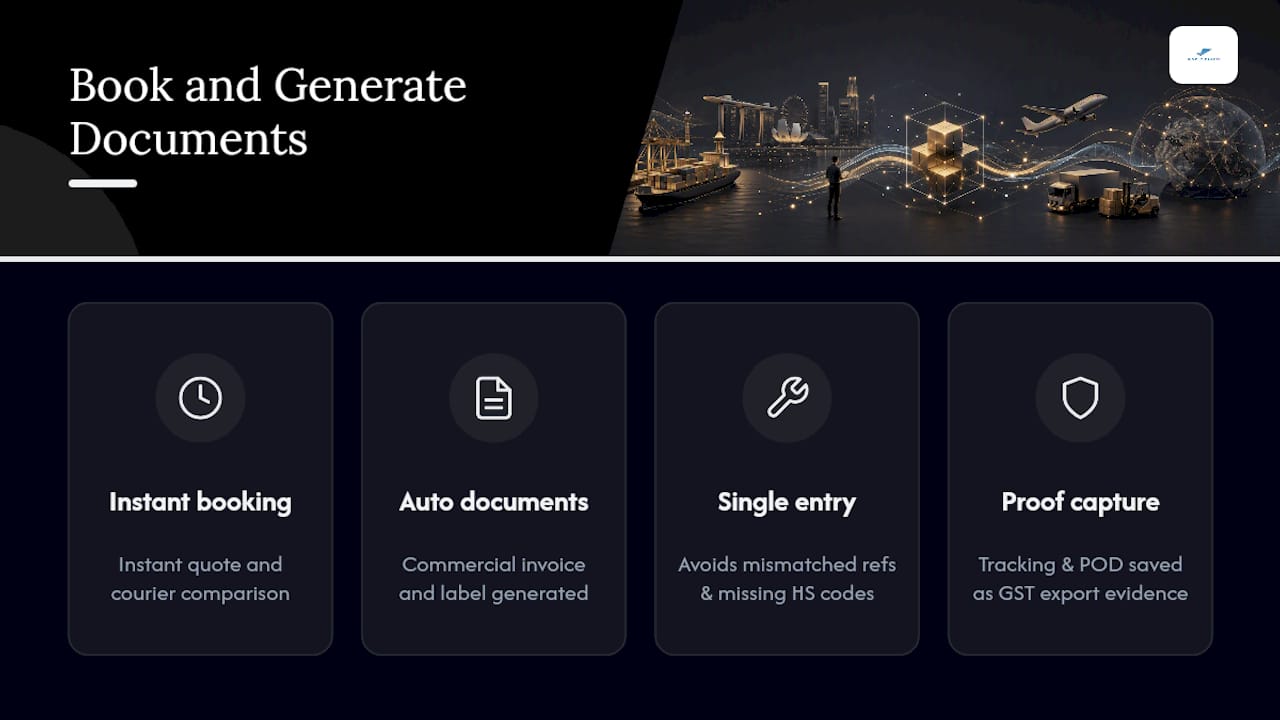
Simplyparcel replaces the usual back-and-forth of preparing customs paperwork separately from booking a courier. You get an instant quote, compare courier partners side by side, and the platform auto-generates your commercial invoice and shipping label from the details you enter once. That single-entry workflow is what actually prevents the mismatched references and missing HS codes that cause holds at clearance.
Because tracking and proof-of-delivery are captured automatically through the platform, you keep the export evidence IRAS expects for GST zero-rating without a separate filing step. If you're preparing a shipment now, get an instant quote and book your parcel to see how much of the paperwork Simplyparcel handles for you before pickup.
Where to Verify These Rules Yourself
For case-specific questions, go straight to the source. Singapore Customs publishes HS classification guidance and export procedures, TradeNet handles permit applications, IRAS sets GST export-evidence requirements, and SingPost governs postal parcel handling. Check the official page for your specific goods before you ship.
Why the Paperwork Matters More Than the Parcel
Most shippers treat customs documentation as an afterthought bolted onto the "real" work of getting a parcel from A to B. That's backwards. The paperwork is the shipment, as far as customs is concerned, and a beautifully packed box with a vague invoice description will sit in a warehouse just as long as a poorly packed one.
The bigger blind spot we see among Singapore SMEs isn't the export permit rules, which are genuinely well documented by Singapore Customs. It's the GST evidence trail. Businesses zero-rate an export, assume the tracking number is proof enough, and then can't produce it eighteen months later when a review comes around because the carrier's system purged the history. That's not a customs problem. That's a recordkeeping habit, and it's entirely fixable the moment you treat tracking screenshots as financial records, not shipping trivia.
If there's one thing worth changing about how Singapore shippers approach this, it's timing. Capture your proof the day it exists. Classify your goods before you're rushed. The rules themselves are not the obstacle. The obstacle is doing this work under time pressure instead of building it into how you book a shipment in the first place.
— Simply
Sources
- Understanding HS classification | Singapore Customs
- EAD — Electronic Advance Data | Universal Postal Union (UPU)