International shipping is not just for large corporations with dedicated logistics teams. Every day, individuals in Singapore mail birthday gifts to family in Australia, small business owners fulfill orders to customers in Europe, and freelancers send product samples to clients in the U.S. Yet many still assume cross-border shipping is too complicated or costly for them to manage. This guide cuts through that assumption. You will learn exactly what international shipping involves, how your parcel travels from Singapore to its destination, what drives the cost, and how to pick the right courier without making expensive mistakes.
Table of Contents
- What international shipping really means
- The full journey: From pickup in Singapore to delivery abroad
- Key costs and variables affecting international shipping
- How to choose the right courier and avoid common mistakes
- A fresh perspective: Why small senders in Singapore should rethink international shipping
- Ready to ship internationally? Get the best solutions with Simply Parcel
- Frequently asked questions
Key Takeaways
| Point | Details |
|---|---|
| International shipping defined | Sending goods from Singapore to other countries is now accessible to everyone, not just big businesses. |
| Transparent process steps | Understanding each stage of overseas delivery helps you better plan timelines and avoid issues. |
| Key cost factors | Rates are driven by parcel size, destination, delivery speed, and included services like insurance. |
| Smart courier selection | Choosing reputable services and avoiding common mistakes makes shipping easier for individuals and small businesses. |
What international shipping really means
International shipping is the process of sending goods or documents across national borders from one country to another. For Singapore senders, this means any parcel, envelope, or pallet that leaves Singapore and enters a foreign country's postal or customs system. The sender could be anyone: a student mailing a gift, an e-commerce seller dispatching orders, or a company sending commercial samples.
At its core, international shipping involves four fundamental steps:
- Preparing your shipment: Packing goods securely, labeling them correctly, and completing the necessary paperwork such as commercial invoices and customs declarations.
- Declaring your contents: Every international parcel must have a customs declaration stating what is inside, the value, and the country of origin. Accurate declarations prevent delays and penalties.
- Paying for logistics: This includes the base shipping rate, any applicable surcharges (fuel, remote area, oversize), and potentially customs duties or taxes at the destination.
- Following destination regulations: Every country has its own rules on what can and cannot be imported. These rules affect what you can ship and how you must label it.
Singapore's shipping infrastructure is exceptional. International shipping connects Singapore with more than 220 countries via courier networks, meaning senders here have access to virtually any destination on earth. Major global carriers operate out of Singapore, giving both individuals and SMEs a wide range of speed and price options.
The biggest difference between domestic and international shipping lies in customs. A local delivery skips border formalities entirely. An international shipment must pass through export customs in Singapore and import customs at the destination, which adds time, potential cost, and documentation requirements. Understanding this distinction is the foundation of shipping smartly.
For broader shipping tips tailored to Singapore senders, it helps to research destination-specific requirements before you book anything.
Pro Tip: Always check prohibited and restricted items for the destination country before shipping. A single undeclared or restricted item can cause your entire shipment to be held, returned, or destroyed at your expense.
The full journey: From pickup in Singapore to delivery abroad
Now that you know what international shipping is, let's follow your package's journey from Singapore to its overseas destination. Understanding each checkpoint helps you predict timelines, prepare documents, and avoid surprises.
- Pickup or drop-off in Singapore: Your parcel is collected by the courier or dropped at a service point. This is when your shipment is weighed, measured, and scanned into the tracking system.
- Export processing: The courier consolidates your parcel with others headed to the same region. Shipping labels and export documentation are verified at this stage.
- Singapore export customs clearance: Singapore Customs reviews your declaration. Singapore's export process is generally fast, but incomplete paperwork can cause holds.
- International transit: Your parcel moves via air freight (or sea freight for large or economy shipments) to a hub near the destination country. Regional destinations like Malaysia or Thailand may see faster movement than intercontinental routes.
- Import customs clearance: This is often the most variable step. The destination country's customs authority reviews your declaration, checks duties and taxes owed, and either releases or holds the parcel.
- Last-mile delivery: A local carrier in the destination country handles the final delivery to the recipient's address.
Shipping routes and delivery times vary widely depending on the destination, the courier selected, and how quickly customs processes your parcel.
| Destination | Express (days) | Standard (days) | Economy (days) |
|---|---|---|---|
| Malaysia / Thailand | 1 to 2 | 2 to 4 | 3 to 6 |
| Australia / Japan | 2 to 4 | 5 to 8 | 7 to 12 |
| United Kingdom / Europe | 3 to 5 | 7 to 10 | 10 to 15 |
| United States | 3 to 6 | 7 to 12 | 12 to 18 |
Did you know? Customs clearance delays account for the majority of international shipping slowdowns worldwide. An accurate, complete commercial invoice is your single best tool for keeping your parcel moving without interruption.
Modern courier platforms let you track shipments at every stage, giving you and your recipient real-time visibility. Accurate paperwork is not just a formality. It is your protection against delays and extra costs at the import stage. Always include a detailed description of contents, declared value, and country of origin on every shipment.

For more context on cross-border shipping challenges that Singapore senders commonly face, understanding each checkpoint will save you time and money.
Key costs and variables affecting international shipping
With a clear sense of the shipping journey, it is essential to understand what affects your cost and how to manage it effectively.
International shipping rates are made up of several components:
- Base rate: The starting price determined by weight, dimensions, and destination.
- Surcharges: Fuel surcharges, remote area delivery fees, and oversize parcel fees are common additions that can significantly increase your bill.
- Customs duties and taxes: Charged by the destination country, not the courier. These depend on the product category and declared value.
- Insurance: Optional but strongly recommended for high-value items. Coverage rates vary by courier and parcel value.
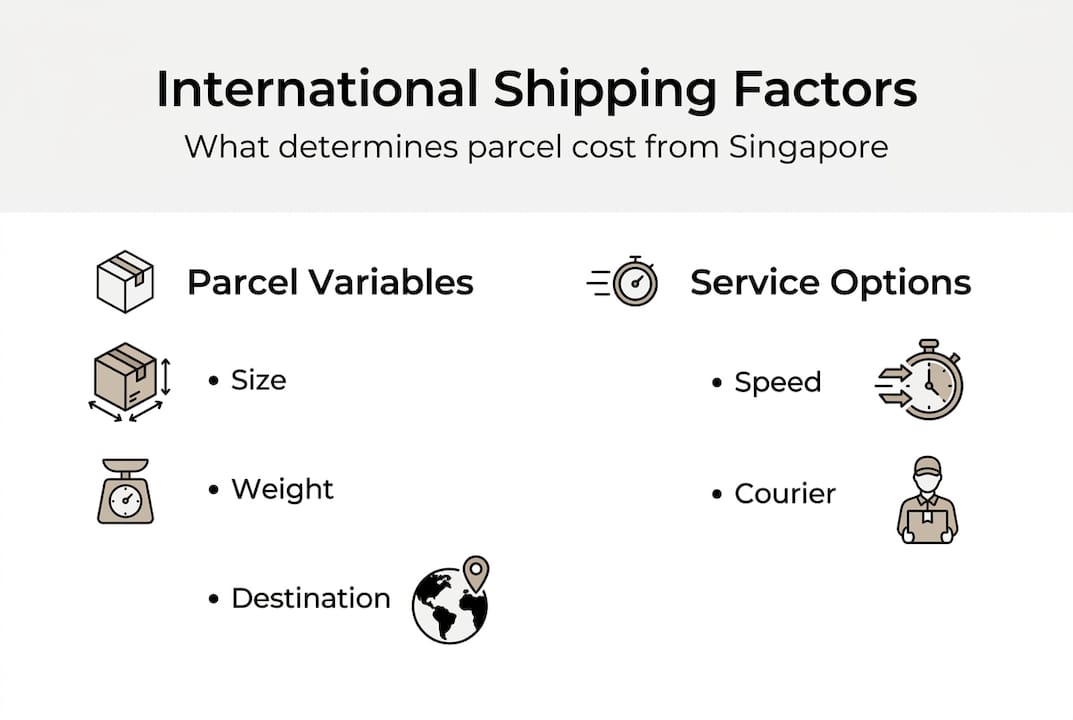
Rates depend on parcel size, weight, speed, and destination, which means two parcels of the same size can have very different costs based purely on where they are going or how fast you need them to arrive.
| Service type | Typical transit | Best for | Relative cost |
|---|---|---|---|
| Express / Priority | 2 to 5 days | Urgent, high-value items | Highest |
| Standard / Connect-Plus | 5 to 10 days | Regular business shipments | Moderate |
| Economy | 10 to 18 days | Budget-conscious, non-urgent parcels | Lowest |
For SMEs shipping frequently, consolidated shipping is worth understanding. Consolidation means combining multiple smaller parcels into a single larger shipment, which reduces the per-unit cost significantly. This approach is especially useful for small businesses that send regular orders to the same region but do not always have enough volume to fill a full cargo booking on their own.
To get instant shipping quotes and compare rates across couriers, using an aggregator platform removes the manual work of contacting each carrier separately.
Pro Tip: Compare quotes from multiple couriers for every shipment, especially if you ship frequently. Rates can differ substantially for the same route, and even a small per-parcel saving adds up significantly over dozens or hundreds of shipments per month.
How to choose the right courier and avoid common mistakes
After understanding cost variables, choosing the right shipping partner and avoiding mishaps is the final piece of the puzzle.
When evaluating a courier, work through this checklist:
- Track record and reliability: Does the courier consistently meet its stated delivery times? Look for reviews from other Singapore-based senders.
- Real-time tracking: Trustworthy couriers offer transparent tracking and clear customs support so both sender and recipient always know where the parcel is.
- Competitive rates: Compare the full cost, including surcharges, not just the advertised base rate.
- Customs assistance: Does the courier provide guidance on documentation, or do they leave you to figure it out alone?
- Insurance options: Confirm what is covered, what is excluded, and what the claims process looks like.
Common mistakes that Singapore senders make include:
- ❌ Missing or incomplete documentation (commercial invoice, packing list, customs declaration)
- ❌ Shipping restricted or prohibited items without checking destination country rules
- ❌ Underestimating delivery time, especially for economy shipments to far destinations
- ❌ Declaring an incorrect value to reduce duties, which can lead to seizure or fines
- ❌ Ignoring courier fine print around surcharges and country-specific exclusions
For expert shipping tips on navigating specific routes and couriers, staying informed is the easiest way to avoid costly errors.
Using a Singapore-based aggregator platform simplifies this process considerably. Instead of managing relationships with multiple couriers, you compare, book, and track everything in one place. For SMEs, this means less administrative overhead and more time focused on growing the business.
Pro Tip: Always read courier fine print for surcharges and country-specific exclusions. A low advertised rate can become significantly more expensive once remote area fees and fuel surcharges are applied.
A fresh perspective: Why small senders in Singapore should rethink international shipping
The conventional view has long been that international shipping belongs to large companies with logistics departments, freight contracts, and dedicated customs brokers. That view is outdated.
Modern aggregator platforms have removed the minimum volume barrier entirely. A single-package sender in Singapore can now access the same courier networks and competitive rates that were once reserved for bulk shippers. The e-commerce boom has accelerated this shift. If you are a small business selling goods online and not shipping internationally, you are leaving a significant portion of the global market untouched.
Personal connections matter here too. Sending gifts, documents, or support packages to family abroad is now fast, affordable, and trackable in real time. The old friction of visiting post offices and filling out paper forms is largely gone.
The barrier is no longer logistical. It is psychological. Old assumptions about cost and complexity keep many Singapore senders from exploring what is actually a straightforward, accessible process. Browsing recent success stories from other senders can quickly put those concerns to rest. The world is within reach for anyone willing to ship.
Ready to ship internationally? Get the best solutions with Simply Parcel
Now that you understand how international shipping works and what it costs, the next step is putting that knowledge into action.
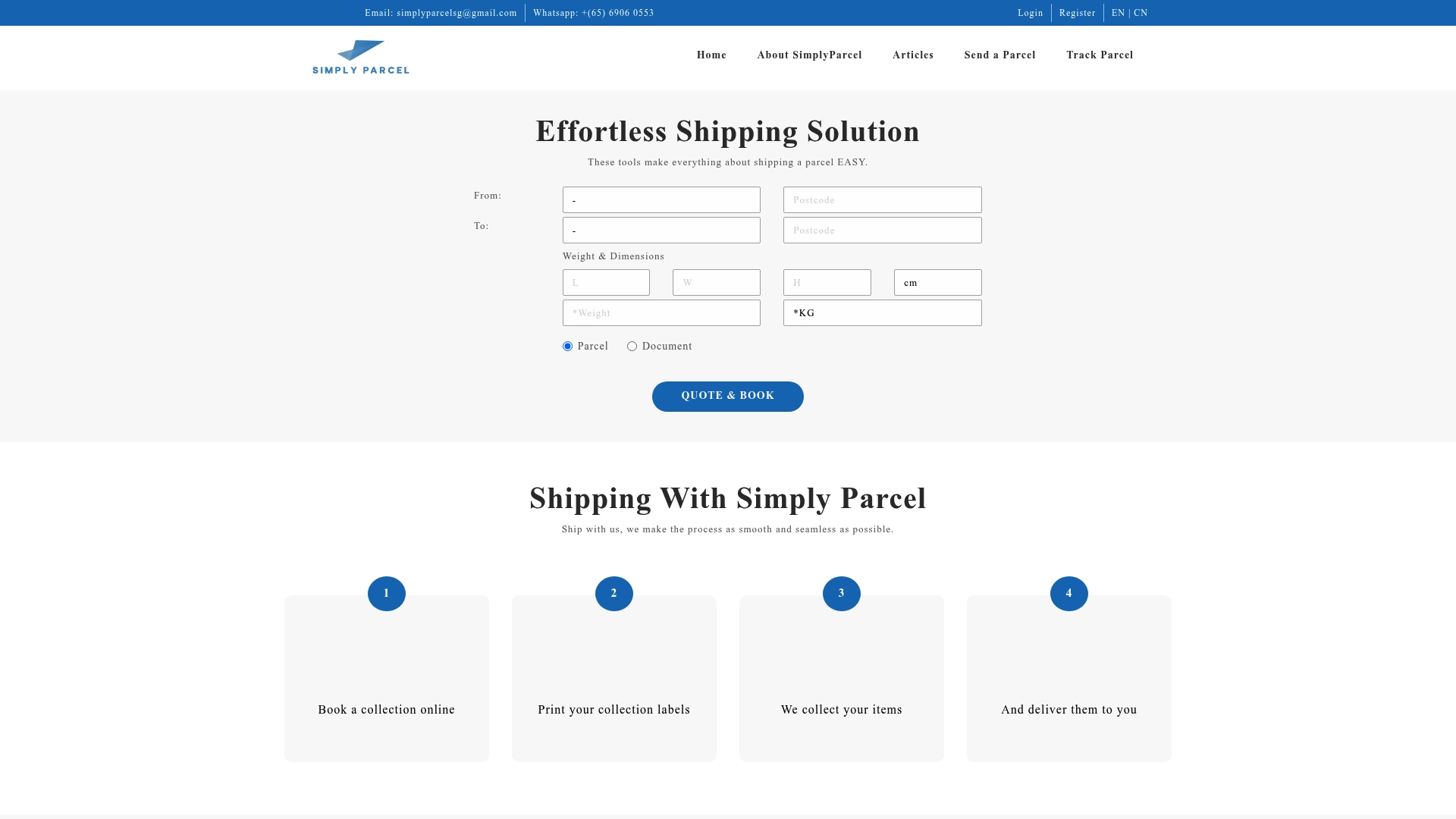
Simply Parcel makes international shipping from Singapore straightforward and transparent. You can get a shipping quote instantly, compare rates across multiple couriers, and book a pickup without leaving your desk. Need to check on a package already in transit? Use the platform to track your shipments in real time. Whether you are sending a single parcel or managing regular SME orders, you can see shipping options across priority, connect-plus, and economy services, all in one place.
Frequently asked questions
How do I calculate international shipping costs from Singapore?
Shipping rates depend mainly on parcel weight, dimensions, destination, and service speed. Use an online quote tool to compare rates from multiple couriers side by side for the most accurate estimate.
What items are prohibited or restricted for international shipping?
Singapore and destination countries both have lists of prohibited or restricted goods, including cash, lithium batteries, perishables, and hazardous materials. Always verify regulations for both ends of the shipment before packing.
How long does international shipping usually take from Singapore?
Delivery typically ranges from 2 days for express regional shipments to 15 or more days for economy service to distant destinations. Shipping routes and delivery times vary widely depending on the courier chosen and how quickly customs processes the parcel at the destination.
Can small businesses ship internationally as easily as large corporations?
Yes. Aggregator platforms open international shipping to SMEs in Singapore by offering competitive rates, streamlined booking, and customs guidance without requiring high shipment volumes or long-term contracts.