
Express shipping is a premium delivery service that guarantees your parcel arrives within 1–3 business days, prioritizing speed above all else. The industry term for this service is "expedited shipping," and the two terms are used interchangeably across carriers like DHL, FedEx, and USPS. Whether you are an individual sending a last-minute gift or a business preventing a production halt, understanding why choose express shipping comes down to one question: what does a delay actually cost you? This guide gives you a clear, practical answer.
Why choose express shipping over standard delivery?
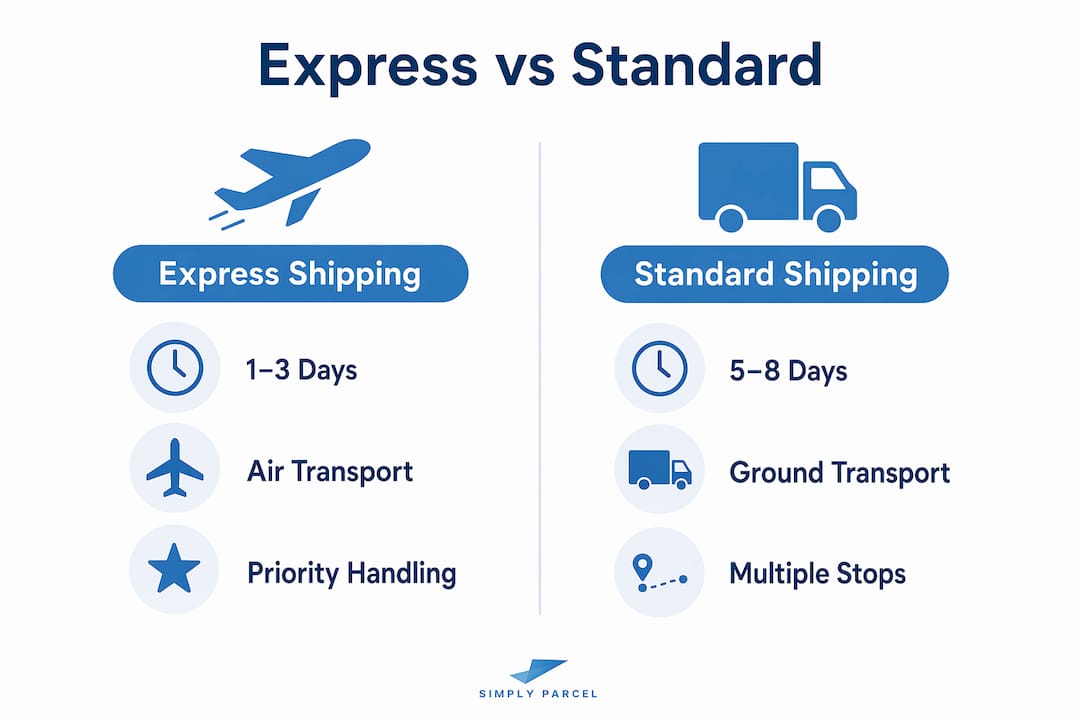
Express shipping delivers parcels in 1–3 business days, while standard ground shipping typically takes 5–8 days. That gap is not just about convenience. It represents the difference between a production line running on schedule and one sitting idle, or between a customer completing a purchase and abandoning their cart.
The premium you pay for express shipping buys you a guaranteed delivery window, often backed by a money-back promise from the carrier. Standard shipping offers no such guarantee. When timing is critical, that guarantee is the entire value proposition.

For businesses, the cost of a delay frequently exceeds the cost of the express shipping fee. For individuals, the calculus is simpler: either the parcel needs to arrive by a specific date, or it does not.
What makes express shipping faster than standard shipping?
Speed in express shipping comes from three operational factors: transportation mode, handling priority, and transit stops.
- Air freight for long distances. Express shipments use air freight and priority ground transport, bypassing the slower road-based networks that standard parcels travel through.
- Fewer handling points. Standard parcels pass through multiple sorting facilities. Express shipments move through a reduced number of touchpoints, which cuts transit time and lowers the risk of damage or misrouting.
- Priority processing. At every facility, express parcels are processed before standard ones. This means your shipment does not wait in a queue overnight.
- Guaranteed windows. Carriers like USPS Priority Mail Express and DHL Express back their delivery promises with refunds if the window is missed. Standard shipping carries no equivalent commitment.
- Technology integration. On-demand delivery apps now let shippers book pickups and track parcels in real time, adding flexibility without sacrificing speed.
Pro Tip: If your destination is across a border, air-based express shipping also clears customs faster because express shipments are typically processed through dedicated customs lanes.
The combination of air transport, fewer stops, and priority handling is why express shipments consistently outperform standard ones. It is not one factor but the entire chain working together.
What are the main benefits of choosing express shipping?
The benefits of express shipping extend well beyond speed. Here are the six most significant advantages for both individuals and businesses.
- Guaranteed delivery for time-sensitive parcels. Medical supplies, legal documents, and urgent gifts all have hard deadlines. Express shipping is the only option that contractually commits to meeting them.
- Prevention of production downtime. Express cargo prevents costly production delays by getting critical components to manufacturers before assembly lines stall. A single missed part can halt an entire facility.
- Lower cart abandonment in e-commerce. Shoppers expect fast delivery. Express shipping builds customer retention by meeting those expectations, turning one-time buyers into repeat customers.
- Support for just-in-time inventory. Businesses running just-in-time inventory models rely on express shipping to replenish stock exactly when needed, avoiding both overstocking and shortages.
- Higher customer trust and loyalty. Fast, reliable delivery signals professionalism. Customers who receive orders on time are more likely to leave positive reviews and return for future purchases.
- Competitive advantage in e-commerce. Offering express delivery options is a proven conversion lever, particularly in time-sensitive sectors like pharmacy, grocery, and electronics.
"Express shipping is not just a logistics choice. It is a customer experience decision that directly affects your revenue and reputation."
The sectors that benefit most from fast delivery are those where timing changes the product's value entirely. A pharmacy delivering medication, a grocer delivering fresh produce, or an electronics retailer fulfilling a same-day order all depend on speed as a core part of their service promise.
Walmart's investment in this area illustrates the scale of the opportunity. 26% of express deliveries in select U.S. markets now arrive in 30 minutes or less. That speed directly reduces cart abandonment and drives customer satisfaction at a measurable level.
How to decide when express shipping is the right choice
The decision to use expedited shipping should be based on the consequences of delay, not urgency alone. Pay the premium only when a delay presents genuine operational or financial risk. That is the clearest rule in logistics decision-making.
Use the table below to assess your situation before booking.
| Scenario | Use express shipping? | Reason |
|---|---|---|
| Perishable goods (food, medicine) | Yes | Spoilage risk makes delay costly |
| Critical manufacturing components | Yes | Production downtime exceeds shipping cost |
| Urgent legal or financial documents | Yes | Missed deadlines carry legal or financial penalties |
| Standard retail goods, no deadline | No | Standard shipping is sufficient and cheaper |
| Personal gifts with flexible timing | No | Economy or connect-plus options work fine |
| Time-sensitive promotional inventory | Yes | Late stock misses the sales window entirely |
Two additional factors shape the decision for businesses.
Shipment value vs. shipping cost. If the item is worth significantly more than the express fee, the math usually favors express. A $2,000 electronic component shipped express for $50 is a straightforward call.
Reputation risk. For e-commerce businesses, a late delivery does not just inconvenience one customer. It generates a negative review that influences future buyers. The cost of that reputational damage often exceeds the cost of express shipping.
Pro Tip: If you ship express regularly, ask your carrier or aggregator about volume discounts. Platforms like Simplyparcel let you compare rates across multiple carriers, so you can find the fastest option at the best price without booking each carrier separately. Check shipping speed options to understand where express fits within the full range of available services.
For businesses weighing express against standard, the right framework is simple: calculate the cost of the delay, then compare it to the express shipping fee. If the delay costs more, book express.
How modern express services go beyond speed
Speed is the headline feature of express shipping, but the best carriers now offer recipient control features that reduce failed deliveries and improve the overall experience.
- Address changes post-dispatch. DHL's On-Demand Delivery platform lets recipients change delivery address or place a vacation hold for up to 30 days after the shipment has been sent. This eliminates the most common cause of failed delivery attempts.
- Flexible delivery windows. Recipients can select a specific time slot that fits their schedule, reducing the chance of a missed delivery.
- Real-time tracking. Express shipments are fully traceable at every stage. Both sender and recipient can monitor progress and receive alerts, which reduces anxiety and support inquiries.
- Dynamic scheduling. On-demand delivery apps allow last-minute booking changes, giving businesses the flexibility to redirect shipments as operational needs shift.
- Proactive notifications. Carriers send SMS and email updates at key transit milestones, keeping recipients informed without requiring them to check manually.
These features matter because a fast shipment that fails to deliver on the first attempt is not actually fast. Failed deliveries add days to the process and frustrate both sender and recipient. Recipient control tools solve this problem at the source.
For e-commerce businesses, these features also reduce customer service costs. Fewer missed deliveries mean fewer support tickets, fewer refund requests, and fewer negative reviews.
Key takeaways
Express shipping is the right choice when the cost of delay exceeds the cost of the premium, making it a financial decision as much as a logistics one.
| Point | Details |
|---|---|
| Speed guarantee | Express shipping delivers in 1–3 business days, backed by carrier money-back promises. |
| Operational protection | Express cargo prevents production downtime and supply chain disruptions for businesses. |
| E-commerce advantage | Fast delivery reduces cart abandonment and builds customer loyalty and repeat purchases. |
| Decision framework | Choose express when delay costs more than the shipping fee, not simply out of impatience. |
| Recipient control | Modern carriers like DHL offer address changes and flexible windows to prevent failed deliveries. |
Simplyparcel's view on using express shipping wisely
Express shipping is one of the most misunderstood tools in logistics. Customers often treat it as a default when they are anxious, and avoid it entirely when they are watching costs. Both approaches miss the point.
The right way to think about express shipping is as insurance against a specific risk. If a delay will cost you money, damage your reputation, or break a commitment to a customer, express shipping is not expensive. It is the cheapest way to avoid a much larger problem. If none of those risks apply, standard or economy shipping serves you just as well at a fraction of the price.
What I have seen working with shippers across Singapore and internationally is that the businesses that use express shipping most effectively are the ones that have mapped their risk scenarios in advance. They know exactly which shipment types require express and which do not. That clarity saves them money and prevents the panic bookings that cost far more than a planned express shipment would have.
Technology is also changing the calculus. Features like real-time tracking, recipient-controlled delivery windows, and instant rate comparisons make express shipping more accessible and more predictable than it was even three years ago. The barrier to using it well is lower than most shippers realize.
Use express shipping when timing is genuinely critical. Use economy or standard options when it is not. The discipline to tell the difference is what separates efficient logistics from expensive ones.
— Simply
Simplyparcel makes express shipping straightforward
Simplyparcel is a Singapore-based shipping aggregator that lets you compare express delivery options across major carriers in one place. You get instant quotes, automatic label generation, and real-time tracking without managing multiple carrier accounts. Whether you are an individual sending an urgent parcel abroad or a business protecting your supply chain, Simplyparcel gives you the tools to book the right service at a competitive rate. The platform covers both domestic and international express routes, with clear transit timelines so you know exactly what you are paying for. Get an instant quote and book your express shipment today, or visit Simplyparcel to review all available shipping speeds and options.
FAQ
What is express shipping and how fast is it?
Express shipping is a premium delivery service that guarantees parcel arrival within 1–3 business days, compared to 5–8 days for standard ground shipping. Carriers back this window with money-back guarantees.
What is the difference between express shipping and standard shipping?
Express shipping uses air freight, priority processing, and fewer transit stops to deliver faster. Standard shipping uses ground transport with more handling points and no guaranteed delivery window.
Is express shipping worth the extra cost?
Express shipping is worth the cost when a delay creates financial loss, production downtime, or reputational damage. Pay the premium only when delay presents genuine risk, not as a default choice.
Which types of shipments benefit most from express delivery?
Perishable goods, critical manufacturing components, legal documents, and time-sensitive e-commerce orders benefit most. These are shipments where late arrival changes the outcome entirely.
Can I track an express shipment in real time?
Yes. Express shipments are fully traceable at every transit stage. Carriers like DHL also offer recipient-controlled delivery options, including address changes and flexible scheduling after dispatch.