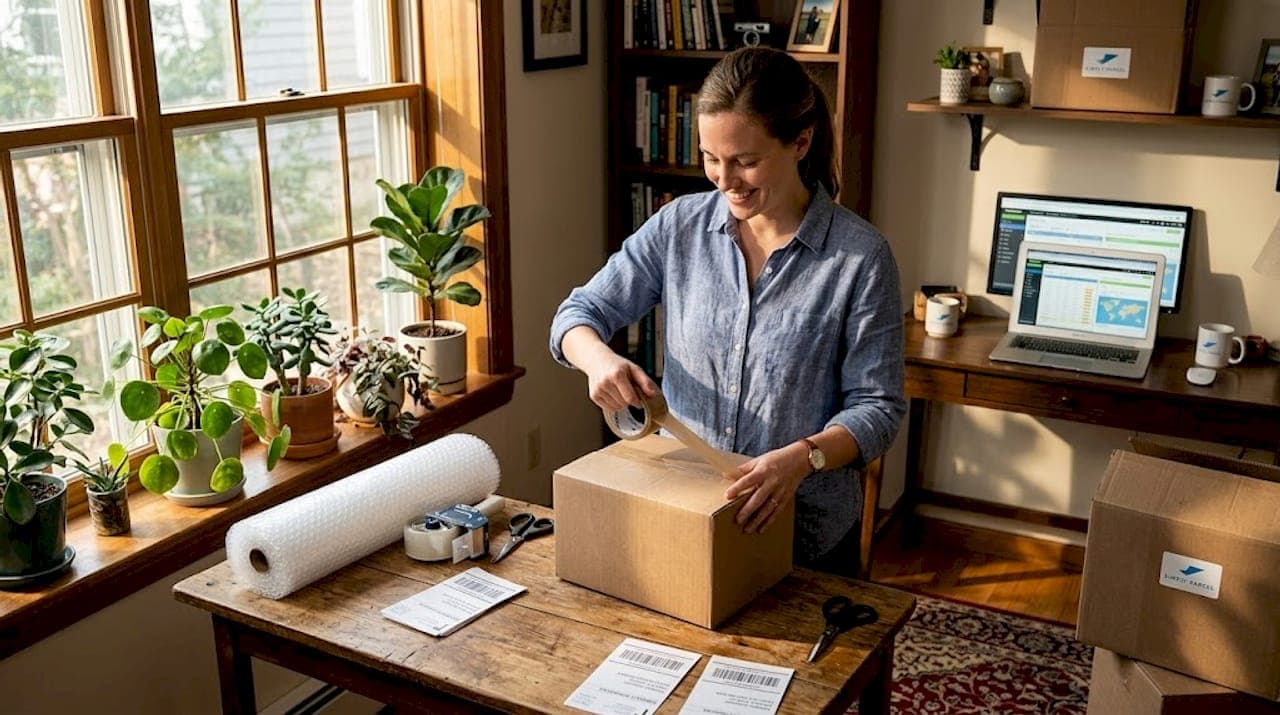
Shipping costs eat into your margins faster than almost any other operational expense. For small businesses, the gap between retail shipping rates and optimized rates can mean the difference between a profitable order and a break-even one. The right shipping tips for small businesses go well beyond "pack things carefully." They cover carrier selection, packaging decisions, workflow setup, and how you manage customer expectations at checkout. This guide covers all of it, with specific steps you can apply immediately, whether you ship ten parcels a week or a hundred.
Table of Contents
- Key takeaways
- 1. Shipping tips for small businesses: how to choose the right carrier
- 2. Packaging advice that protects products and controls costs
- 3. Setting up a shipping workflow that scales
- 4. Cost-saving strategies and managing customer expectations
- My honest take on shipping strategy for small businesses
- How Simplyparcel helps small businesses ship smarter
- FAQ
Key takeaways
| Point | Details |
|---|---|
| Carrier choice drives cost | Matching the right carrier to each shipment type can reduce costs by 20 to 40 percent. |
| Packaging affects pricing | Right-sized packaging avoids dimensional weight surcharges that silently inflate shipping bills. |
| Workflow setup saves time | A dedicated packing station and label printing system cuts fulfillment errors for high-volume senders. |
| Free shipping is a strategy | Building shipping costs into product pricing turns free shipping into a customer acquisition tool. |
| Continuous review matters | Regularly comparing carrier rates and reassessing your tools keeps costs under control as your business grows. |
1. Shipping tips for small businesses: how to choose the right carrier
Not every carrier fits every shipment. The cost and service quality you get depends on a combination of factors: package weight, dimensions, destination, speed requirements, and the type of product you sell.
Here is what to evaluate when comparing carriers:
- Weight and dimensions. Carriers charge based on either actual weight or dimensional weight (length x width x height divided by a divisor), whichever is higher. Flat-rate options from national postal services work well for dense, heavy items in small boxes.
- Destination. Domestic ground shipping is cheap for short zones but expensive for cross-country. International shipments require carriers with strong customs clearance track records.
- Speed. Standard ground, express, and same-day all carry different price points. Match the speed to what your customer actually needs, not just what sounds impressive.
- Product type. Fragile or high-value items may require carriers with stronger insurance options or specialized handling.
Multi-carrier shipping strategies let you route lighter or less urgent packages through postal services, urgent shipments through express couriers, and large freight through specialized carriers. The more flexible your carrier mix, the better your cost control.
Business accounts matter too. Commercial pricing and shipping platforms can reduce shipping costs by 20 to 40 percent compared to retail counter rates. Setting up a business account with two or three carriers takes less than an hour and pays for itself on the first shipment.
Pro Tip: Compare rates across carriers before booking every single shipment. A shipment that costs $18 through one carrier might cost $11 through another for the same destination and weight.
2. Packaging advice that protects products and controls costs
Packaging is where many small businesses quietly lose money. Over-sized boxes, excessive void fill, and poorly designed layouts all drive up dimensional weight charges and materials costs.
The most common mistake is choosing a box based on what is available rather than what fits the product. Carriers calculate dimensional weight by measuring the outside of the box, so a product sitting in a box three inches too large on every side can push you into a higher rate bracket.
Here is a comparison of common packaging approaches and their trade-offs:
| Packaging type | Cost level | Flexibility | Best for |
|---|---|---|---|
| Stock corrugated boxes | Low | High | Most ecommerce products |
| Custom-printed boxes | Medium to high | Low | Brand-focused packaging |
| Poly mailers | Very low | Medium | Soft goods, apparel |
| Padded bubble mailers | Low | Medium | Small, light fragile items |
| Rigid mailers | Low to medium | Low | Flat items, documents |
Generic boxes with custom labels keep your SKU inventory costs low and give you flexibility as your product line grows. You get a branded look without committing to large print runs of a box that may become obsolete when your product sizing changes.
Protective cushioning matters more than box thickness. The shake test is simple: pack the item, close the box, and shake it. If you hear or feel movement, add more fill. Damage during transit usually happens because items shift, not because boxes crack.
For startups thinking ahead, packaging specialists recommend prioritizing clarity, flexibility, and polish to avoid costly redesigns and obsolete inventory. If you plan to commission custom packaging, always request the cut and crease template (called a dieline) before your designer starts work. Dieline misalignments create print errors that waste inventory and delay launches.
- Use the smallest box that fits your product with adequate cushioning
- Buy packaging materials in bulk to reduce per-unit cost
- Choose recyclable or minimal materials if your customer base values sustainability
- Avoid using branded tissue paper and ribbon on shipments that frequently get damaged in transit
Pro Tip: Stock three or four standard box sizes rather than ordering a unique size for every SKU. This simplifies reordering, reduces storage needs, and speeds up packing time.
3. Setting up a shipping workflow that scales
Disorganized fulfillment is expensive. Misprinted labels, wrong addresses, and missed pickups all create real costs, either in reshipping fees, customer refunds, or wasted labor time.

Start by designating a dedicated packing and shipping area. This does not need to be elaborate. A table with a scale, measuring tape, label printer, and organized box storage is enough to handle a significant daily volume. Efficient label printing setups significantly reduce fulfillment errors for businesses shipping 50 or more packages per day.
Here is a repeatable process to follow for each outgoing shipment:
- Weigh and measure the packed box before entering shipment details.
- Compare rates across carriers using a multi-carrier platform or aggregator.
- Purchase and print the label immediately after booking.
- Attach the label securely, covering any previous barcodes on reused boxes.
- Schedule a pickup or batch your drop-offs to reduce daily trips.
Multi-carrier rate comparison tools automate rate lookups and label printing, cutting the manual work out of every shipment. Platforms that integrate directly with your ecommerce store pull order details automatically, eliminating manual entry errors.
Accurately weighing and measuring packages prevents surcharges that appear days after the shipment when carriers audit package dimensions at their facilities. Those surprise charges add up fast for businesses processing high volumes.
Pro Tip: Batch your label printing at a set time each day rather than printing one label per order as it comes in. It is faster, reduces printer errors, and keeps your packing station organized.
4. Cost-saving strategies and managing customer expectations
Reducing costs does not always mean finding cheaper carriers. Sometimes it means rethinking how shipping costs flow through your business model.
Building shipping costs into your product price and offering free standard shipping is one of the most effective small business logistics tips available. Free shipping works as a marketing investment rather than a pure cost. It removes friction at checkout and increases conversion rates, particularly for first-time buyers.
Tiered shipping options give customers control while protecting your margins. Offer free standard shipping as the default, and charge a reasonable premium for express or same-day options. Customers who need speed will pay for it. Customers who are price-sensitive will wait.
Here are more cost-saving practices worth implementing:
- Set a free shipping threshold. Offering free shipping on orders above a minimum amount increases average order value and offsets the shipping cost.
- Audit your addresses before sending. Returned and undeliverable packages cost you the original shipping fee plus a return fee. Use address verification tools, especially for bulk orders.
- Leverage volume discounts. As your monthly shipment volume grows, negotiate directly with carriers or use a courier comparison platform to access better rates.
- Simplify your returns process. A clear, low-friction return policy reduces customer service contacts and builds repeat purchase trust. Include a return label or clear instructions in every package.
- Add a personal touch. A printed thank-you card or handwritten note costs almost nothing and generates the kind of customer goodwill that drives reviews and referrals.
For businesses shipping perishable products, inventory management methods like FIFO (first in, first out) optimize product shelf life and fulfillment accuracy. Shipping the oldest stock first reduces waste and returns from expired items.
My honest take on shipping strategy for small businesses
I have worked with enough small businesses to recognize a consistent pattern. Most spend time optimizing ad spend, product sourcing, and website conversion, and then treat shipping as an afterthought. They pick one carrier, never revisit the decision, and absorb rising costs without realizing they have options.
The businesses that get shipping right treat it as a system, not a task. They build a repeatable workflow early, even when volume is low. They test carrier options regularly. They understand that packaging decisions made at launch will either save or cost them money every single day for years.
What surprises most owners is how much packaging design affects real costs. A box that is two inches too large in each dimension does not just look sloppy. It pushes you into a higher dimensional weight bracket on every single shipment. Multiply that across thousands of orders and it becomes a significant expense that proper packaging would have eliminated entirely.
My other strong opinion: do not wait until your shipping volume is large to start comparing rates and using aggregator platforms. Start now. The tools available through platforms like Simplyparcel are built for exactly this stage of business. Getting into good habits early is far cheaper than fixing a broken system later.
Shipping is one of the few areas where small businesses can genuinely compete with larger players. With the right tools and a willingness to review decisions regularly, you can match or beat the per-unit shipping costs of much bigger operations.
— Simply
How Simplyparcel helps small businesses ship smarter
If you are based in Singapore or ship internationally from Singapore, Simplyparcel gives you access to multi-carrier rate comparisons, instant booking, and automatic label generation in one place. You get transparent shipping rates across priority, connect-plus, and economy service levels so you can match speed to budget on every order. Free pickup is included, which removes one more logistics task from your day. Real-time tracking keeps both you and your customers informed throughout transit. Whether you send ten parcels a month or a thousand, the platform scales with you. Get an instant shipping quote and see what a better rate on your next international shipment looks like.
FAQ
How can small businesses reduce shipping costs?
Business accounts and shipping platforms reduce shipping costs by 20 to 40 percent compared to retail rates. Combining right-sized packaging, multi-carrier comparison, and volume discounts compounds those savings further.
What is dimensional weight and why does it matter?
Dimensional weight is a pricing method carriers use when a package is large but light. Carriers charge based on the greater of actual weight or dimensional weight, so oversized packaging can significantly increase your shipping cost even for lightweight products.
How do I choose between standard and express shipping for my customers?
Offer both options and let customers decide. Free standard shipping removes checkout friction, while paid express covers the cost of urgency. Tiered shipping options protect your margins while satisfying different buyer needs.
What packaging mistakes cost small businesses the most money?
Using boxes that are too large is the most expensive common mistake because it inflates dimensional weight charges on every shipment. Poor internal cushioning leads to product damage and costly returns, which is why the shake test before sealing every box is worth doing consistently.
Is free shipping actually profitable for small businesses?
Yes, when structured correctly. Building the shipping cost into your product price and offering free shipping above a minimum order threshold increases conversion rates and average order value, making it a marketing investment rather than a straight expense.