
Shipping speed options are defined as the delivery timeframes carriers offer to move packages from origin to destination, each priced according to how fast the parcel arrives. Whether you are sending a birthday gift or fulfilling a customer order, the tier you choose directly affects cost, transit time, and recipient satisfaction. Carriers like USPS, UPS, and FedEx each structure their speed tiers differently, which makes comparing them confusing without a clear reference point. This guide breaks down every major tier, explains what actually drives delivery times, and shows you how to match the right option to your shipment.
What are the main shipping speed options and how do they differ?
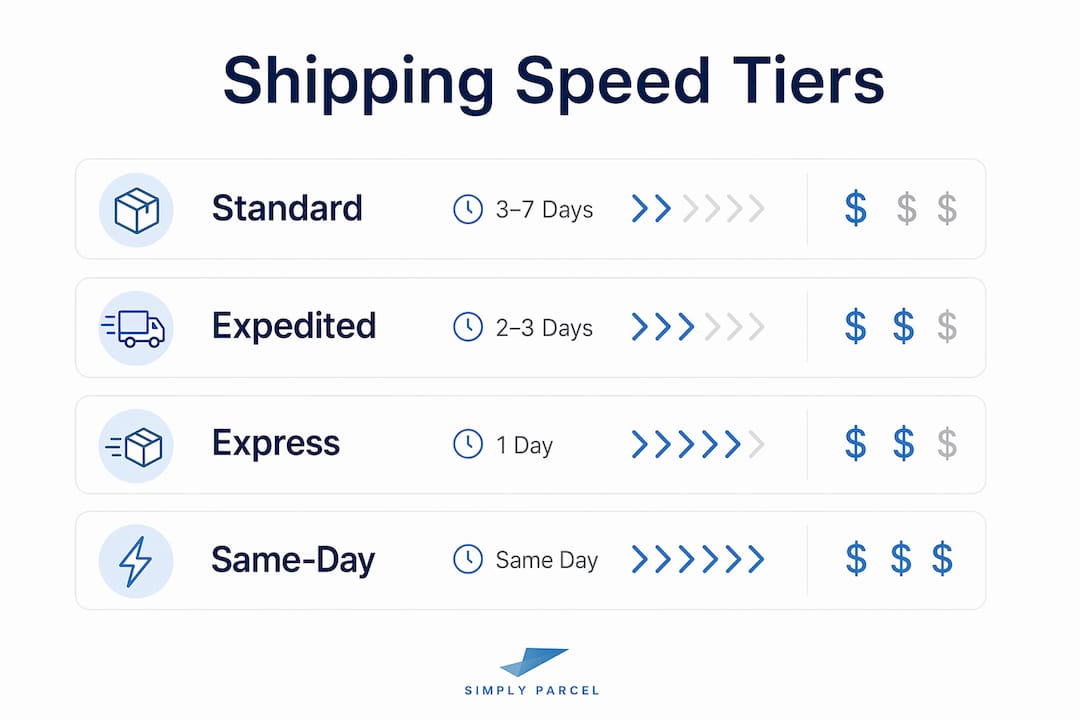
Shipping speed options fall into four primary categories: standard, expedited, express, and same-day. Each tier trades cost for time, and understanding where each sits on that spectrum is the foundation of every smart shipping decision.
Standard shipping covers the widest range of domestic deliveries, typically completing in 3 to 7 business days. It is the most cost-effective choice for non-urgent parcels, and most carriers default to ground or economy services at this tier. USPS Ground Advantage, UPS Ground, and FedEx Ground all fall here.

Expedited shipping moves faster, generally delivering within 1 to 3 business days domestically. USPS Priority Mail sits at 2 to 3 days, while UPS Second Day Air and FedEx 2Day both target two business days. This tier costs more than standard but significantly less than express, making it the most popular upgrade for time-sensitive but non-critical shipments.
Express shipping is the premium domestic tier, covering overnight and next-day guaranteed delivery. USPS Priority Mail Express, UPS Next Day Air, and FedEx Overnight all serve this category, typically completing delivery in 1 to 2 days. The price premium is real: express can cost two to four times more than expedited on the same route.
Same-day shipping is the fastest option available, but it operates under strict geographic constraints. It applies almost exclusively to local deliveries within a metro area, and carriers or platforms like Amazon Logistics and local courier networks handle the majority of these runs. Cost is highest per package, and availability depends entirely on your location and the carrier's local network.
For international shipments, the spread widens considerably. Express international typically completes in 1 to 3 days, while economy international can stretch to 7 to 21 or more days, with customs adding another 1 to 3 days on top. That gap matters enormously when you are planning inventory replenishment or promising a customer a delivery date.
| Speed tier | Typical transit time | Relative cost | Best use case |
|---|---|---|---|
| Standard | 3–7 business days | Low | Non-urgent parcels, bulk orders |
| Expedited | 1–3 business days | Medium | Time-sensitive but budget-conscious |
| Express | 1–2 business days | High | Guaranteed fast delivery, high-value items |
| Same-day | Same day (local only) | Very high | Emergency or last-minute local deliveries |
| Economy international | 7–21+ business days | Lowest | Low-urgency cross-border shipments |
| Express international | 1–3 business days | Highest | Urgent cross-border shipments |
Pro Tip: If you are shipping internationally and your recipient can wait 5 to 7 days, connect-plus or priority services from aggregators like Simplyparcel often land between economy and express pricing while cutting transit time by half.
How do shipping carriers define and name their speed tiers?
Carrier terminology is one of the biggest sources of confusion in shipping. "Expedited" is not a standardized industry term. It is a relative label that means faster than the seller's or carrier's own baseline service, which varies widely depending on who is using it.
Here is how the three major U.S. carriers name their tiers:
- USPS: Ground Advantage (standard), Priority Mail (expedited, 2 to 3 days), Priority Mail Express (express, 1 to 2 days guaranteed)
- UPS: UPS Ground (standard), UPS 2nd Day Air (expedited), UPS Next Day Air Saver and UPS Next Day Air (express)
- FedEx: FedEx Ground (standard), FedEx 2Day (expedited), FedEx Overnight and FedEx First Overnight (express)
The naming inconsistency creates real problems. A retailer advertising "expedited shipping" may be offering UPS 2nd Day Air or simply upgrading from their own slow fulfillment baseline to a 3-day service. Neither is wrong, but neither is the same thing.
Processing time compounds the confusion further. Transit time is measured from the moment a carrier scans the package, not from when you place the order. If a seller takes one business day to pick, pack, and hand off the parcel, an "expedited 2-day" order can realistically arrive in 3 business days. This gap between advertised speed and actual delivery is the most common source of customer complaints in e-commerce.
The practical fix is to read the fine print on any carrier's service page and confirm whether the quoted transit time includes or excludes processing. When you book through a platform like Simplyparcel, transit timelines are displayed clearly alongside each service tier, so you are comparing apples to apples before you commit.
What factors influence actual shipping delivery times beyond the speed option?
Choosing express does not guarantee express results. Several variables outside the speed tier itself can push delivery beyond the quoted window, and knowing them lets you plan more accurately.
-
Distance and routing. Domestic ground shipments crossing multiple shipping zones take longer than those within the same region. A parcel moving from Singapore to a rural address in Europe travels through more handoff points than one going to a major city hub, adding time at each transfer.
-
Customs clearance. For international shipments, customs is the single biggest wildcard. Even express international services quote 1 to 3 days in transit, but customs processing can add 1 to 3 additional days depending on the destination country, declared value, and documentation accuracy. Incomplete commercial invoices are the most common cause of customs delays.
-
Carrier schedule reliability. In 2026, port congestion and geopolitical rerouting have pushed schedule reliability below 60% on major Asia-Europe lanes, with some routes adding 10 to 14 days. That figure means more than four in ten shipments on those lanes arrive outside the quoted window. Businesses relying on sea freight for inventory need to build buffer time into every order cycle.
-
Value-added services. Options like Saturday delivery are not included in standard speed tiers. Saturday delivery requires an extra fee and carrier support, and assuming it is included in a standard express booking is a common and costly mistake.
-
Holidays and weekends. Transit times are measured in business days. A package shipped on a Thursday via 2-day service does not arrive Saturday. It arrives Monday, or Tuesday if Friday is a public holiday. This calculation catches both individual senders and businesses off guard.
Build a minimum one-business-day buffer into every expedited shipment to account for processing time, carrier handoffs, and unexpected delays. For international express, add two to three days to account for customs.
For sea freight specifically, inland drayage and customs clearance add 3 to 10 days on top of quoted ocean transit times. These costs are often excluded from carrier quotes, so the total door-to-door timeline is consistently longer than the headline number suggests.
How to choose the right shipping speed option for your needs
Choosing the right tier comes down to four variables: urgency, budget, package characteristics, and destination. Working through each one in order prevents both overspending on speed you do not need and underspending on speed that costs you a customer.
-
Assess urgency first. Identify the latest acceptable arrival date and work backward. If a customer orders on Monday and needs delivery by Thursday, a 2-day expedited service with same-day processing is the minimum viable option. If the deadline is flexible, standard shipping recovers margin without sacrificing satisfaction.
-
Set a cost ceiling. Express shipping can represent 30 to 50 percent of the total order value on low-cost items. For a $15 product, paying $18 for overnight delivery makes no financial sense unless the customer is paying for it explicitly. Match the speed tier to what the shipment economics can support.
-
Factor in package size and value. High-value items benefit from express services not just for speed but for reduced handling time and better tracking visibility. Fragile or temperature-sensitive goods often require express tiers because longer transit times increase exposure to damage or spoilage.
-
Optimize by shipping zone. Domestic shipping costs scale with distance zones. Distributing inventory across multiple fulfillment locations reduces the average zone distance, which lets you offer faster delivery at standard shipping prices. This is the core logic behind multi-location fulfillment strategies used by growing e-commerce businesses.
-
Match speed to customer expectations. Free standard shipping satisfies most buyers when the timeline is communicated clearly at checkout. Offering expedited as a paid upgrade captures revenue from buyers who need speed without forcing the cost onto your margin.
Pro Tip: For international shipments from Singapore, compare priority and economy tiers side by side using a platform like Simplyparcel before booking. The price gap between tiers is often smaller than expected, and the transit time difference can be significant enough to justify the upgrade for customer-facing orders.
You can also explore fast delivery options from Singapore to see how priority and express tiers compare on specific international routes.
Key takeaways
Choosing the right shipping speed requires matching delivery timeframes to urgency, budget, and destination, not defaulting to the fastest or cheapest option available.
| Point | Details |
|---|---|
| Four core speed tiers | Standard, expedited, express, and same-day each serve distinct urgency and cost profiles. |
| Carrier names vary | USPS, UPS, and FedEx use different labels for similar speeds; always verify transit time, not just tier name. |
| Processing time adds days | Transit time starts at carrier scan, not order placement; factor in 1 or more business days for handling. |
| External factors shift timelines | Customs, port congestion, and holidays can add 1 to 14 days beyond the quoted speed tier. |
| Cost-to-urgency match matters | Align speed tier to shipment economics; express on low-value items erodes margin without adding customer value. |
Simplyparcel's take on shipping speed in 2026
What I have seen consistently is that most shipping mistakes are not about choosing the wrong speed tier. They are about misreading what the quoted transit time actually covers. Sellers advertise 2-day shipping, customers expect 2-day delivery, and nobody accounts for the processing day, the weekend, or the customs hold. The gap between those two things is where trust breaks down.
The 2026 logistics environment has made this worse. Schedule reliability on disrupted routes is genuinely below 60% in some corridors. That is not a reason to panic, but it is a reason to stop treating carrier estimates as guarantees. Treat them as targets, build in buffers, and communicate proactively with recipients when delays occur.
The hybrid approach works best for most businesses. Use economy or standard tiers for replenishment stock and non-urgent B2B orders. Reserve expedited and express for customer-facing orders where delivery speed directly affects satisfaction scores and repeat purchase rates. This split keeps total shipping costs manageable while protecting the customer experience where it counts most.
Carrier selection also matters more than most people realize. Two carriers quoting the same transit time on the same route can have meaningfully different reliability records. Comparing actual performance data, not just advertised timelines, is the most underused tactic in shipping optimization. Platforms that aggregate multiple carriers give you that comparison in one place, which is exactly why aggregators have become the default tool for serious shippers.
— Simply
Ship smarter with Simplyparcel
Simplyparcel gives you instant access to multiple carrier speed tiers, from economy to priority express, all in one place. You can get an instant quote for your parcel, compare transit times and costs side by side, and book with free pickup from Singapore. Whether you are sending a single parcel or managing regular international shipments, Simplyparcel shows you exactly what each speed tier costs and delivers, with no guesswork. The platform also generates shipping labels and documentation automatically, so you move from quote to dispatch without the manual back-and-forth. Start your next shipment at Simplyparcel and see how much clarity the right comparison tool adds to every booking decision.
FAQ
What does "shipping speed options explained" mean in practice?
Shipping speed options refer to the delivery timeframes carriers offer, ranging from same-day local delivery to economy international services taking 21 or more days. Each tier is priced differently based on how fast the carrier commits to moving your parcel.
How long does expedited shipping actually take?
Expedited shipping typically delivers within 1 to 3 business days domestically, but transit time starts when the carrier scans the package, not when you place the order. Add at least one business day for processing when calculating the real arrival date.
Is express shipping always faster than expedited?
Express shipping guarantees overnight or next-day delivery, making it faster than expedited in most cases. However, the price difference is significant, so express is only worth the cost when the delivery deadline is firm and the shipment value justifies the premium.
What causes shipping delays even when I choose a fast tier?
Customs clearance, port congestion, public holidays, and carrier schedule disruptions all affect delivery times regardless of the speed tier selected. In 2026, geopolitical route disruptions have added 10 to 14 days on some international lanes, making buffer planning a necessity rather than a precaution.
Does Saturday delivery come standard with express shipping?
No. Saturday delivery is a separate add-on that requires carrier support and an additional fee. It is not included in standard express or expedited services, so you need to select and pay for it explicitly when booking.