Most people assume all shipping services work the same way. Drop a package, wait a few days, done. But that assumption costs businesses sales and individuals peace of mind. Understanding what is express courier, how it differs from standard shipping, and when to use it can make a real difference in your shipping outcomes. This guide breaks down the definition of express courier, how pricing works, what you actually get for the money, and how to choose the right service for your needs.
Table of Contents
- Key takeaways
- What is express courier service?
- How express courier pricing works
- Benefits of express courier for individuals and businesses
- Express courier vs. standard shipping
- How to choose and use express courier services
- My take on express courier: what experience actually teaches you
- Ship smarter with Simplyparcel
- FAQ
Key takeaways
| Point | Details |
|---|---|
| Express courier defined | Express courier prioritizes speed with delivery in 1-3 business days, often with same-day or overnight options. |
| Cost varies significantly | Prices range from $25 to $300+ depending on urgency, distance, package size, and added fees. |
| Direct transport model | Express couriers use point-to-point transport, not hub-and-spoke networks, which reduces delays. |
| Cut-off times matter | Missing a mid-afternoon cut-off can turn next-day delivery into a two-day shipment or force a costlier upgrade. |
| Match service to need | Choosing a lower-cost express tier instead of premium overnight often meets the same business requirement. |
What is express courier service?
An express courier service is a shipping method designed specifically for fast, reliable, time-definite delivery. Unlike standard postal services, which consolidate packages into large batches and route them through multiple handling points, express couriers prioritize your package and move it as directly as possible to its destination.
Express shipping typically guarantees delivery within 1 to 3 business days. Many services offer same-day or overnight options with specific time commitments, such as delivery by 10:30 AM or by end of day. That level of precision is something standard postal delivery simply does not offer.
What makes the express courier service model different at the operational level is how packages are handled. Your parcel receives priority status at every sorting point. Express couriers use direct point-to-point transport, real-time GPS tracking, and priority handling at sorting centers to minimize stops and reduce delays. Many providers also back their service with money-back guarantees if a delivery window is missed.
Pro Tip: When you book an express courier, look for the specific delivery commitment in writing. "Express" without a stated delivery window is vague marketing. A real express courier service will quote you a time-definite commitment.
Here is how express courier compares to standard shipping at a glance:
| Feature | Express courier | Standard shipping |
|---|---|---|
| Delivery time | 1-3 business days (same-day/overnight available) | 3-7 business days |
| Tracking | Real-time GPS tracking | Basic tracking updates |
| Handling | Priority, minimal stops | Standard batch processing |
| Accountability | Money-back guarantees common | Limited liability |
| Cost | Higher | Lower |
| Best for | Urgent, high-value, or time-sensitive shipments | Non-urgent, budget-conscious shipping |
How express courier pricing works
Express courier pricing is not a flat rate. Several factors influence the final cost, and understanding them helps you budget accurately and avoid surprises.
Same-day delivery typically costs between $25 and $300+, while overnight and express delivery options generally run between $50 and $200. Urgency alone can push prices up by 30 to 50 percent compared to lower-priority tiers. That is a meaningful difference if you are shipping regularly.
Here are the main factors that affect express courier pricing:
- Urgency: Same-day requests cost more than next-day or two-day options. The faster you need it, the higher the rate.
- Distance: Longer routes cost more, but distance is only part of the picture.
- Package dimensions and weight: Most couriers use dimensional weight pricing, which means a large, light box can cost as much as a heavy one.
- Fuel surcharges: These fluctuate with market conditions and are typically added automatically to your invoice.
- Out-of-hours and weekend deliveries: Requesting delivery outside standard business hours adds a premium.
- Waiting time fees: If a courier has to wait at pickup or delivery, extra charges apply.
- Remote area surcharges: Deliveries to locations outside a courier's standard service zone carry additional fees.
Hidden fees like fuel surcharges and off-hours premiums can inflate your total cost by up to 50 percent over the base rate. Always request a full cost breakdown before confirming a booking.
Pro Tip: Do not automatically choose "Priority Overnight" just because it sounds safest. Many shippers overspend by defaulting to premium tiers when a standard express option would have met their delivery window just as well. Match the service tier to your actual deadline.
Benefits of express courier for individuals and businesses
Speed is the headline benefit, but it is not the only reason people choose express courier services. The real advantages show up across reliability, tracking, and customer experience.

For e-commerce businesses, clear delivery dates at checkout directly reduce cart abandonment. Customers are far more likely to complete a purchase when they see a guaranteed delivery date rather than a vague "5 to 7 business days" estimate. That predictability is built into express courier service by design.
Here is a breakdown of the core benefits and common use cases:
- Guaranteed delivery windows: You know exactly when your package will arrive, which matters for time-sensitive business operations.
- Real-time tracking: Both sender and recipient can monitor the shipment at every stage, reducing anxiety and support requests.
- High-value shipment security: Express couriers offer greater accountability and often insurance options for valuable goods.
- Perishable goods transport: Food, medical supplies, and biological samples need fast movement. Express courier is often the only viable option.
- Last-minute business documents: Contracts, legal filings, and sensitive paperwork cannot wait for standard mail.
- Customer satisfaction: Businesses that offer fast shipping options see higher repeat purchase rates and fewer negative reviews.
- Peak season reliability: During high-volume periods, express couriers prioritize their committed shipments over standard parcels.
For individuals, express courier makes the most sense when timing genuinely matters. Sending a birthday gift that arrives a week late defeats the purpose. Shipping a passport application that misses a government deadline has real consequences.
Express courier vs. standard shipping
The difference between express and standard shipping goes beyond delivery speed. The operational models are fundamentally different, and that gap affects everything from tracking quality to accountability.
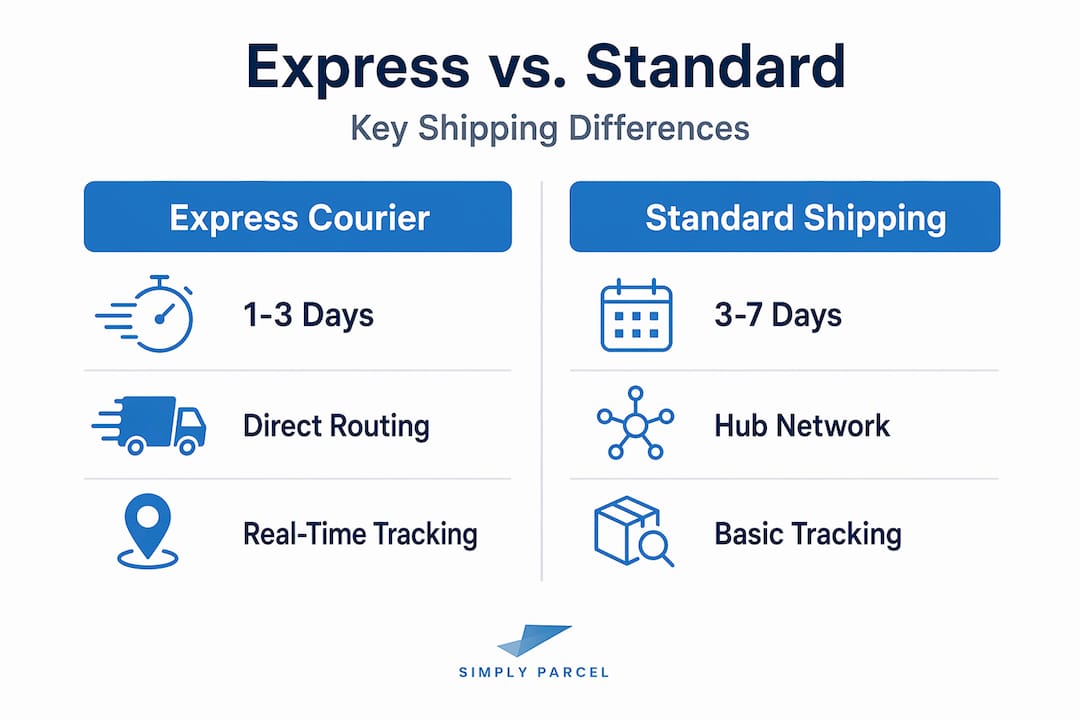
Standard shipping relies on a hub-and-spoke network. Your package travels from a local facility to a regional hub, then to another hub, then to a local distribution center, and finally to the recipient. Standard shipping takes 3 to 7 business days and typically comes with basic tracking that only updates at major scan points. Accountability is limited, and delays at any hub multiply through the chain.
Express courier operates on a point-to-point or near-direct model. Your package moves from pickup directly toward the destination with minimal transfers. Priority handling at each touch point reduces the chance of delay, and real-time GPS tracking keeps everyone informed throughout.
Here is a direct comparison across the factors that matter most:
| Criteria | Express courier | Standard shipping |
|---|---|---|
| Speed | 1-3 days, often same-day/overnight | 3-7 business days |
| Routing | Point-to-point, minimal transfers | Hub-and-spoke, multiple handoffs |
| Tracking detail | Real-time GPS updates | Basic milestone scans |
| Personalization | High (specific time windows) | Low (general delivery estimates) |
| Accountability | Money-back guarantees | Limited recourse |
| Cost | $25-$300+ | Generally lower |
| Best scenario | Urgent, valuable, or time-sensitive | Non-urgent, cost-sensitive |
When is standard shipping the right call? When your package is not time-sensitive, when cost is the primary concern, and when the recipient has flexibility. Sending promotional materials ahead of a trade show next month does not need express handling. Sending a replacement component that shuts down a production line absolutely does.
How to choose and use express courier services
Choosing the right express courier service takes more than picking the fastest option. A few practical steps can save you money and prevent frustrating delivery failures.
-
Confirm the cut-off time before booking. Missing a mid-afternoon cut-off can push a next-day delivery to a two-day delivery, or force you into a costlier same-day upgrade. Always ask what the latest booking time is for your required delivery window.
-
Match the service tier to your actual deadline. Calculate backwards from when the package must arrive. If you need delivery by Thursday and you are booking on Tuesday, a two-day express option may cost significantly less than overnight.
-
Request full pricing upfront. Ask specifically about fuel surcharges, remote area fees, and out-of-hours charges. A quote that excludes these can be 30 to 50 percent lower than your final invoice.
-
Communicate clearly with the courier. Provide accurate dimensions, weight, and any special handling requirements at the time of booking. Errors discovered at pickup can cause delays or require rebooking.
-
Use a courier comparison tool. Platforms that aggregate multiple courier options let you compare price, speed, and service quality side by side. This is especially useful for international shipping from Singapore, where rates and transit times vary considerably across providers.
-
Plan ahead during peak seasons. Even express couriers experience volume surges around holidays and major sales events. Booking earlier in the day and choosing providers with strong peak-season track records reduces risk.
-
Leverage real-time tracking. Courier tracking technology now gives both senders and recipients live updates. Use this to manage expectations with customers or business contacts and get ahead of any delays.
My take on express courier: what experience actually teaches you
I've worked with enough shippers to know that most express courier mistakes happen before the package is even picked up. The biggest one is not reading cut-off times carefully. A shipper will book a next-day service at 4:00 PM, not realizing the cut-off was 2:00 PM. The package sits overnight, arrives a day late, and everyone blames the courier. The courier followed its own rules exactly.
In my experience, the second most common mistake is automatically choosing the most expensive tier. Shippers treat "Priority Overnight" as the safe default, not realizing that a standard express option with a 5:00 PM delivery commitment would have met the exact same business need at a fraction of the cost.
What I've learned is that using courier comparison tools is not optional if you ship regularly. Prices across providers for the same route and weight can differ by 40 percent or more. That gap adds up fast over a month of shipments.
The other thing most articles skip is surcharges. Fuel surcharges, residential delivery fees, and extended area charges are real, they are common, and they are rarely emphasized at the point of sale. Ask for a total cost including all applicable surcharges before confirming. It takes one extra question and can save you a genuine surprise when the invoice arrives.
— Simply
Ship smarter with Simplyparcel
If you are ready to put this knowledge into practice, Simplyparcel makes it straightforward. As a Singapore-based shipping platform, Simplyparcel lets you compare express courier options from multiple providers in one place, so you can see price, speed, and service level side by side before committing.
Whether you are an individual sending a parcel abroad or a business managing regular international shipments, Simplyparcel's platform covers multiple speed tiers including priority, connect-plus, and economy options. Free pickup, automatic label generation, and real-time tracking are included. You get full cost transparency upfront, including fees, so there are no surprises at invoicing.
Visit Simplyparcel to explore your options, or go straight to the shipment quote page to get a price in under a minute.
FAQ
What is the definition of express courier?
An express courier is a shipping service that prioritizes speed and delivers packages within 1 to 3 business days, often with same-day or overnight options. It uses point-to-point transport, real-time tracking, and priority handling to meet time-definite delivery commitments.
How does express courier differ from standard shipping?
Express courier uses direct routing with minimal transfers and real-time tracking, while standard shipping routes packages through multiple hubs and typically takes 3 to 7 business days. Express services also offer money-back guarantees that standard shipping rarely includes.
How much does an express courier service cost?
Same-day express courier typically costs between $25 and $300+, while overnight options generally range from $50 to $200. Final pricing depends on urgency, distance, package size, and additional fees like fuel surcharges and out-of-hours premiums.
When should I use express courier instead of standard shipping?
Use express courier when timing is critical, such as for urgent documents, perishable goods, high-value items, or shipments that directly affect customer satisfaction. Standard shipping works well when the package is not time-sensitive and cost is the primary concern.
What factors affect express courier pricing the most?
Urgency and distance are the largest drivers, but fuel surcharges, weekend delivery fees, and remote area charges can add 30 to 50 percent to the base rate. Always request a full breakdown including all applicable fees before confirming your booking.