Yes, a gift sent abroad usually still travels with a commercial invoice. Customs officers do not see your intentions, only the paperwork, so the invoice must say clearly that the goods are a gift, what they are, and what they would cost at retail. Marking a box "gift" does not make it duty-free. A complete, honest invoice is what gets the parcel through. When you book with us, our platform generates the shipping labels and customs documentation automatically, so you enter the item details once and they carry onto the paperwork.
This guide is for people sending gifts and personal parcels from Singapore: students, expats, small sellers who send samples, and anyone mailing a present home. It shows what goes on the invoice, how to value something nobody paid for, and where gift rules actually apply.
TL;DR
- A commercial invoice is the shipper's statement of what is in the parcel and what it is worth. Customs use it to assess duties and taxes, per the U.S. International Trade Administration.
- For a gift, write "gift, no commercial value" or similar, but still state the item, quantity, material, origin and a fair retail value.
- Gift status can lower or remove duty in some countries, but only below set limits. Singapore, for example, applies GST relief only up to S$400 CIF value.
- Vague descriptions such as "gift" or "clothes" are the most common cause of questions and holds. Be specific.
- Always sign the invoice yourself. The signer answers for its accuracy.
Table of Contents
- What a commercial invoice is, and why a gift needs one
- Do all gifts need an invoice?
- What goes on a commercial invoice for a gift
- How to fill it out, step by step
- Does "gift" mean no duty or tax?
- Worked example: a gift box to the United States
- Common mistakes that cause holds
- Sending gifts as a seller or dropshipper
- Ship your gift with the paperwork handled
- Our perspective
- FAQ
- Sources
What a commercial invoice is, and why a gift needs one
A commercial invoice is a customs document. It lists who is sending the goods, who is receiving them, what each item is, how many there are, what they are worth and where they were made. In the buyer's country, customs officials use it to assess import duties and taxes, as the U.S. International Trade Administration explains.
The word "commercial" confuses senders. You did not sell anything, so it feels like the wrong form. But a customs officer abroad still has to decide three things for every parcel: what is inside, what it is worth, and whether tax or duty is due. The invoice answers those questions. Without it, the officer has to guess, and a guess usually means the parcel waits.
The United States shows how this works in law. Its rules for mail imports require, for each shipment of merchandise, an invoice or bill of sale. For goods that were not purchased or sold, they require a statement of the fair retail value in the country of shipment. That rule is in 19 CFR 145.11. The same part of the regulations says shipments lacking the required declaration and invoice may be subject to seizure and forfeiture.
In short, a gift has no price paid, but it still needs a documented value.
Do all gifts need an invoice?
Not every item. Personal letters and papers with no commercial value are treated differently from goods. But once there are objects in the box, such as clothing, cosmetics, electronics, food or toys, plan on including an invoice. Different destinations and carriers handle low-value parcels differently, so the safe habit is to attach one every time goods are inside.
For parcels leaving Singapore, also check whether an export permit is involved. Gifts and samples worth up to a small total can often leave without one, unless the goods are dutiable or controlled. Our guide on the Singapore export permit and HS checks covers when that applies.
What goes on a commercial invoice for a gift
Treat each field as an answer to a question customs will ask. If you answer it, nobody has to guess.
| Field | What to write for a gift | Why customs want it |
|---|---|---|
| Invoice type or reason for export | "Gift" (not sold) | Tells the officer no sale took place |
| Sender | Your full name, street address, phone, email | Identifies who is responsible for the shipment |
| Recipient | Full name, address, phone, email | Lets customs and the carrier contact the receiver |
| Item description | Specific: "women's cotton knit sweater, blue" | Needed to classify the goods |
| Quantity | Number of units of each item | Lets the officer check the box against the list |
| Unit value | Fair retail value of one unit | Used to calculate the total |
| Total value and currency | Sum of all items, e.g. USD or SGD | The base for duty and tax |
| Country of origin | Where each item was made, from its label | Affects duty rates |
| Weight | Net and gross | Cross-checks with the carrier's label |
| Signature and date | Sender's own signature | The signer answers for the facts |
The signer matters. The invoice is a statement by the sender, so a carrier or a tool can prepare it, but the person who signs is accountable for what it says. Read it before you sign.
How to fill it out, step by step
1. List every item separately
Write one line per type of item. "Two shirts, one scarf, one box of chocolates" becomes three lines, each with its own quantity and value. Lumping things together as "gifts" or "personal items" is the fastest way to attract questions.
When you book with us, you enter the contents once during booking, and the customs documentation is generated automatically from those details. That saves retyping the same data onto a form and removes a common source of mismatches between the label and the invoice.
2. Describe each item in plain, specific words
Good descriptions say what the item is, what it is made of and what it is for. Compare:
- Weak: "clothes", "gift", "accessories", "stuff"
- Better: "men's cotton T-shirt", "stainless steel water bottle", "leather wallet", "children's board game"
For branded or technical goods, add the brand and model. A complete description also helps if something goes wrong later and you need a record of exactly what was packed. A parcel that arrives broken is a separate problem, but the same detail applies, as this write-up on what to do after a damaged statue arrives shows for fragile items.
3. Declare a fair retail value
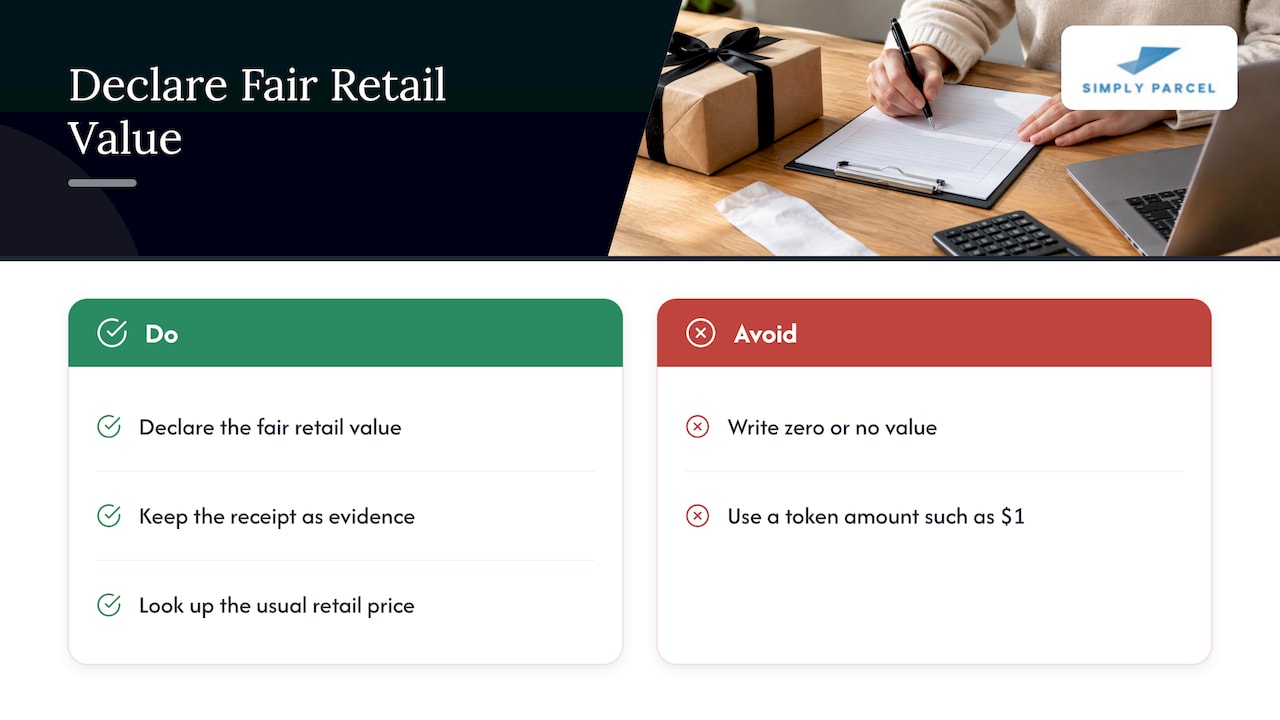
This is where gift senders go wrong most often. Two mistakes are common: writing "0" or "no value", and writing a token amount such as $1 to avoid tax.
The U.S. rule quoted above asks, for goods not purchased, for the fair retail value in the country of shipment. In practice, that means what a shopper would pay for the same item in a normal shop. If you bought the item, your receipt is the best evidence, so keep it. If it was given to you, look up the usual retail price of the same or a similar item and use that.
A zero value can delay a parcel because customs cannot assess it. An understated value risks penalties and seizure. Neither is worth it.
4. State the origin of each item
Check the label or packaging for "Made in...". Different items in the same box can come from different countries, so declare them line by line. If you are unsure, check the product or the manufacturer's page rather than assume.
5. Mark the shipment as a gift, not as a sale
Where the form asks for the purpose of export, choose gift. If the form has a free-text reason, write something short such as "Gift to family member, not for resale". Keep it truthful. If you are actually sending goods to a customer who has paid, that is a sale, and the invoice must show the sale price.
6. Sign, date and keep a copy
Sign where the form requires it, add the date, and keep a copy or photo with your booking record. You will need it if the recipient is asked a question by customs.
Does "gift" mean no duty or tax?
No. Gift status is not a free pass. It matters only where the destination has a specific gift rule, and those rules have limits on value, frequency and who the sender and receiver are.
| Destination | What the official rule says | What it means for you |
|---|---|---|
| United States | Bona fide gifts from a person abroad to a person in the U.S. with a total fair retail value of $100 or less pass free of duty and tax without a formal entry, and $200 for some territories (19 CFR 145.32) | Declare the real retail value. One gift per recipient per day is the usual pattern, so do not split one big gift into several parcels |
| Singapore (imports) | All postal or courier imports, including gifts, are subject to GST and/or duty. GST relief applies only to post or air imports, excluding liquor and tobacco, with a CIF value of S$400 or less (Singapore Customs) | Relevant when friends or family send you a gift, or when you send a gift back |
| European Union | The €150 duty exemption ended in 2026 | See our EU duty-free threshold guide for how gifts are treated now |
| Malaysia | Gift thresholds apply to senders | See our Malaysia gift customs guide |
The thresholds are a reason to declare accurately, not to hide value. A $90 gift falls under the U.S. limit if you declare $90. If you declare $5 and are queried, you have to explain a gap that the officer can see.
Our article on when gifts face customs duty compares the S$400 and US$100 thresholds in more depth.
What CIF means
CIF stands for cost, insurance and freight. Singapore Customs calculates it as the cost of the goods plus insurance plus freight. If the insurance or freight figures are not provided, Singapore Customs uses flat rates for courier imports or the actual postage paid for postal imports. If the seller provides free shipping, you do not add freight to the CIF value, according to the Singapore Customs page. This is useful when you are estimating what a recipient in Singapore might owe. Our guide to calculating Singapore import cost walks through an example with GST.
Worked example: a gift box to the United States
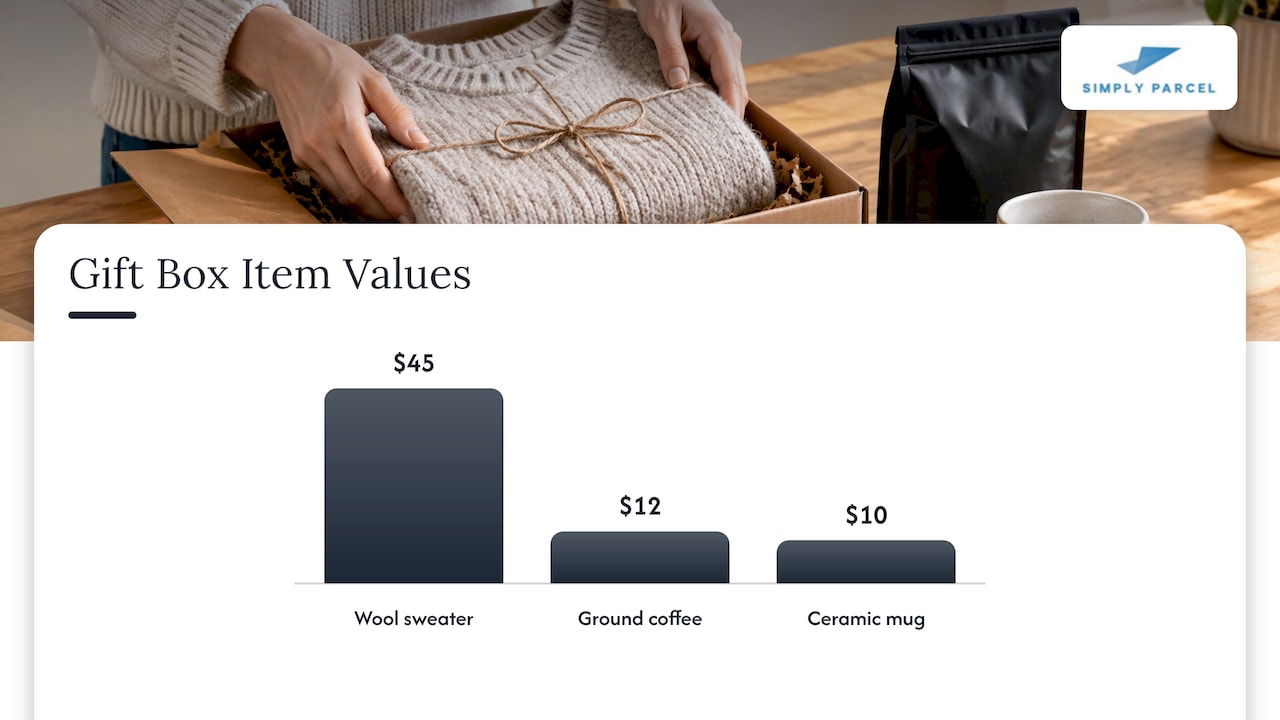
Say you are an expat in Singapore sending a birthday parcel to your sister in the U.S. The box has a wool sweater, a bag of local coffee and a small ceramic mug.
Your invoice lists:
- Women's wool sweater, grey, 1 unit, $45, made in China
- Ground coffee, 250 g bag, 1 unit, $12, made in Singapore
- Ceramic mug, hand-painted, 1 unit, $10, made in Singapore
Total fair retail value: $67. Purpose: gift, not for resale. This total sits under the $100 limit in the U.S. rule above, so, assuming the conditions for a bona fide gift are met, it should not attract duty. Food items can have their own entry rules at the destination, so confirm what is allowed before you pack. When you book, our team's guidance on restricted goods and customs requirements helps you check this.
If instead the box held $350 of goods, the gift limit would not cover it. The invoice would still be correct, and the recipient may owe duty or tax. Being accurate means no surprises about why.
Common mistakes that cause holds
- Writing "gift" as the only description. The officer still has to know what the object is.
- Declaring zero value. Use a fair retail value.
- Mismatch between invoice and box. If the invoice says two items and the box has five, the parcel can be pulled for inspection.
- Missing origin. Fill in a country for each line.
- Splitting one large gift into many parcels to stay under a threshold. Thresholds are measured by aggregate value, and the rules are about genuine gifts.
- Sending restricted goods as a present. Liquor, tobacco, medicines, batteries and some foods have separate rules whether or not they are gifts. Check these before packing.
A business sender should also know that a commercial invoice and a packing list do different jobs. The first states value, the second states contents and packaging. Our comparison of packing list vs commercial invoice explains each. If you are a small business sending samples or stock abroad, essential international shipping documents for Singapore SMEs lists everything that may be needed.
Sending gifts as a seller or dropshipper
Sellers sometimes send free gifts or samples to customers, influencers or partners. The same logic applies: describe the item precisely and state a fair retail value, even though no one paid. Marking a sample as a gift when the recipient is a paying customer, or when the goods will be resold, is a misstatement. If goods are sold, use the sale price.
For regular exports, consistent descriptions across every parcel make your shipping smoother. For an overview of how exporting works from Singapore, see our 2026 export guide and our summary of what you need for a customs declaration in Singapore.
Ship your gift with the paperwork handled
If you are sending a gift from Singapore, you can compare Priority, Connect Plus and Economy shipping, book online and have the pickup come to your door at no charge. Our platform generates the shipping labels and customs documentation automatically, and tracking runs in real time once the parcel is on its way. You can add optional protection coverage at booking if the gift is valuable.
To see the options for your destination, get an instant quote, or start from our international shipping page.

Our perspective
Most customs delays on personal parcels start at the same place: a form filled in quickly, with a vague description and a value that does not match the box. The sender meant no harm, but the officer cannot tell.
We built our booking flow around one idea: you should only have to describe your parcel once. You enter what is inside, and the labels and customs documentation are generated for you. That keeps the invoice consistent with the shipment, which is exactly what customs look for.
We also think senders deserve to choose their speed and budget without surprises. That is why we offer Priority, Connect Plus and Economy options from several carrier partners, free pickup at your doorstep, and no monthly volume commitment. Whether you are sending one birthday parcel or a regular flow of orders, the process is the same, and our guidance on restricted goods and customs requirements is there before you ship, not after.
Declare honestly, describe specifically, and let the platform handle the rest.
SP
FAQ
Do I need a commercial invoice for a gift?
In most cases, yes, when there are goods in the box. The invoice tells customs what the items are and what they are worth, even when nothing was sold. Mark the purpose as a gift and still state a fair retail value, which is what U.S. rules ask for goods that were not purchased.
What value do I put on a gift I did not buy?
Use the fair retail value: the price a normal shop would charge for the same or a similar item in the country you ship from. Do not write zero and do not write a token amount. If you have a receipt, keep it with your records.
Does calling a parcel a gift make it duty-free?
No. Gift allowances exist in some countries but only up to a limit. The U.S. allows bona fide gifts with a total retail value of $100 or less to pass without duty or tax, while Singapore applies GST relief only up to S$400 CIF for post or air imports. Above those limits, duty or tax may apply.
Who signs the commercial invoice?
The sender signs. A carrier or a booking platform can prepare the document, but the signer is responsible for its accuracy. Check every line before you sign.
Sources
- Commercial Invoice, U.S. International Trade Administration
- Part 145, Mail Importations, 19 CFR, 2025
- Importing by Postal or Courier Service, Singapore Customs