You need a Customs export permit if your goods are dutiable, controlled, strategic, or being removed from licensed premises. Non-controlled, non-dutiable goods sent by air valued under S$1,000 are generally exempt. Your next move: run your product through the HS/CA Product Code Checker, then start your TradeNet application or hand it to a Declaring Agent.
TL;DR:
- Export permits are required for dutiable, controlled, or strategic goods, especially when they leave licensed premises or exceed valuation thresholds.
- Correctly selecting and applying for the right TradeNet permit code (such as DRT, APS, TC) is crucial for smooth Customs clearance and to avoid rejection or delays.
- Early verification of HS codes through the Product Code Checker and obtaining necessary authorizations from Competent Authorities prevent border delays and rejections.
- Strategic goods demand advanced planning with lead times of five to seven days for permits, and exemptions apply only to non-controlled, lower-value goods sent by air under S$1,000.
- Customs liability remains with the exporter regardless of platform use, emphasizing the importance of accurate declaration, supporting documentation, and compliance.
Table of Contents
- Types of Export Permits and TradeNet Codes You'll Encounter
- How Do You Apply for an Export Permit in Singapore?
- Are Your Goods Controlled, Prohibited, or Strategic?
- Timelines, Fees, and When You're Exempt
- What Documents Do You Need at the Checkpoint?
- Who's Liable When a Declaration Goes Wrong?
- What Shipping Platforms Can and Can't Do for You
- A Quick Checklist Before You Book Your Shipment
- Book Your Export Shipment with Simply Parcel
Types of Export Permits and TradeNet Codes You'll Encounter
TradeNet sorts every export permit into a code, and picking the right one determines how fast Customs clears your shipment. Get the code wrong and you risk rejection or delays at the checkpoint.
Here's how the main categories break down:
- DRT (Direct Export): Use this for locally manufactured or GST-paid goods leaving Singapore directly. It's the most common code for straightforward commercial exports.
- APS (Approved Premises/Schemes): This applies when goods move from a licensed warehouse, zero-GST warehouse, or Free Trade Zone to a foreign destination. Dutiable goods stored under bond typically fall here.
- TC (Temporary Consignment): Covers goods leaving Singapore temporarily, such as items for repair, exhibition display, or eventual re-import. Variants like TCR, TCO, and TCS handle different temporary-export scenarios depending on whether goods return unchanged, altered, or not at all.
- Strategic goods permits: Individual, Bulk, and Intra-Trade Transaction (ITT) permits apply to items on the Strategic Goods Control List. When TradeNet itself is unavailable, exporters can fall back on a Letter of Undertaking to keep shipments moving while the formal permit catches up.
Matching your shipment to the correct permit type up front saves you from resubmitting later.
How Do You Apply for an Export Permit in Singapore?
Getting your export permit approved comes down to sequencing. Skip a step and TradeNet will reject the submission outright.
- Register your business and get a UEN. If you're not already registered with ACRA, you'll need a Unique Entity Number before Customs will recognize you as an exporter.
- Activate a Customs Account. This links your UEN to Singapore Customs systems and is a prerequisite for any permit application.
- Decide who submits the declaration. You can appoint a licensed Declaring Agent to handle TradeNet on your behalf, or register as a DA yourself and obtain a TradeNet user ID.
- Complete the TradeNet fields accurately. This includes the HS code, FOB value, country of origin, and the correct permit code (DRT, APS, TC, or a strategic goods variant).
- Gather supporting documents before you submit. A commercial invoice, airway bill or bill of lading, and any Competent Authority approvals should be ready, not chased after the fact.
Registering your business, activating your account, and submitting through TradeNet are the three non-negotiable steps, whether you self-file or use an agent.
Pro Tip: Even if you appoint a Declaring Agent, request a copy of the submitted permit before your goods leave the warehouse. Agents make errors too, and you're the one Customs holds accountable.
Are Your Goods Controlled, Prohibited, or Strategic?
Before TradeNet will process anything, you need to know whether your goods trigger extra scrutiny. This is the step most first-time exporters skip, and it's the one that causes the most border delays.
Run your product's HS code through the HS/CA Product Code Checker. It flags whether an item is controlled, and if so, which Competent Authority governs it. Controlled goods, think pharmaceuticals, chemicals, food products, or telecom equipment, need a license or certificate from that authority before Customs will even look at your permit application.
A frequent cause of border delays is exporters overlooking Competent Authority pre-authorization for controlled items, so checking early in your planning avoids a last-minute rejection.
Strategic goods sit in their own category entirely:
- Individual Permit: For a single shipment; requires at least five working days' lead time.
- Bulk Permit: Covers repeated shipments of the same strategic goods over a set period.
- ITT (Intra-Trade Transaction): For goods that don't leave Singapore's control chain but change hands; requires at least seven working days before the transaction.
Timelines, Fees, and When You're Exempt
Timing your application correctly avoids both penalties and unnecessary rush fees. The baseline rule: submit your permit before export, not after.
Strategic goods have stricter windows. Individual permits need five working days' notice; ITT applications need seven. Certain bulk commodities, like petroleum or steel, sometimes carry adjusted timelines that allow limited post-departure regularization, but these are exceptions, not a fallback plan for late filers.
On exemptions, the rule most exporters rely on is straightforward: non-controlled, non-dutiable goods exported by air under S$1,000 in total value typically don't need a permit. Documents, personal effects, and trade samples or gifts under S$400 usually qualify too. That exemption disappears the moment goods come from licensed premises, involve dutiable items, or fall under the Hand-Carried Exports Scheme, where GST-registered businesses must secure an HCES permit before departure to keep their zero-rating intact.
- Permit application fees are modest on their own, but Declaring Agents typically add a service charge on top.
- Budget for that agent fee separately if you're not self-filing.
What Documents Do You Need at the Checkpoint?
Getting your permit approved is only half the job. Customs officers at the checkpoint need to see the right paperwork, and Singapore's land checkpoints don't allow shortcuts.
- For containerized cargo: Present your approved export permit, commercial invoice, and airway bill or bill of lading. A packing list is often expected too, especially for mixed shipments.
- For conventional cargo and hand-carried goods: Requirements are lighter, but permit presentation is still required whenever the shipment isn't covered by an exemption.
- Follow the one-permit rule. Every container or vehicle needs its own permit. Woodlands and Tuas checkpoints don't allow partial clearance, so consolidating multiple permits into one truckload will stall your shipment.
- If TradeNet is down: File a Letter of Undertaking and complete the formal permit once the system is restored. Missing that follow-up window turns a technical outage into a compliance breach.
Who's Liable When a Declaration Goes Wrong?
The exporter carries legal responsibility for every TradeNet entry, full stop. Handing your logistics to a courier or an aggregator platform doesn't transfer that liability. Customs holds the business named on the permit accountable for HS code accuracy, FOB values, and country of origin, regardless of who typed the numbers in.
The mistakes that trigger enforcement tend to repeat: wrong HS codes, missing CA pre-authorization, permits filed after goods have already left, and false assumptions about exemption thresholds. Penalties scale with the mistake. Late or careless declarations draw administrative fines, while false declarations can reach S$10,000 and carry up to 12 months' imprisonment under Section 128(1)(a) of the Customs Act.
- Pre-validate your HS code before every new product line ships.
- Keep CA approval letters on file, not just referenced.
- Build a pre-submission checklist and use it every time, no exceptions for "simple" shipments.
Pro Tip: Treat every export like it's your first one. Complacency, not ignorance, causes most repeat-exporter penalties.
What Shipping Platforms Can and Can't Do for You
A platform like Simply Parcel speeds up the logistics side of exporting: instant courier rate comparisons, pickup booking, automatic shipping label and document generation, and real-time tracking once your parcel is moving. For businesses juggling multiple couriers and shipment types, that's a genuine time saver.
What it doesn't do is assume your Customs liability. Unless a platform is registered as a Declaring Agent, the legal responsibility for accurate TradeNet entries stays with you.
- Use the platform to handle courier selection, booking, and paperwork generation.
- Confirm your HS code and permit details yourself, or route them through a registered DA.
- Treat generated shipping documents as a starting point, not a substitute for verified TradeNet entries.
A Quick Checklist Before You Book Your Shipment
Run through this before every export: confirm your HS code, secure any CA approval your goods require, have your invoice and AWB ready, decide whether you or a Declaring Agent files TradeNet, submit the permit with the right code, and present everything at the checkpoint. Skip one step and you're gambling with a fine, not just a delay.
— Simply
Book Your Export Shipment with Simply Parcel
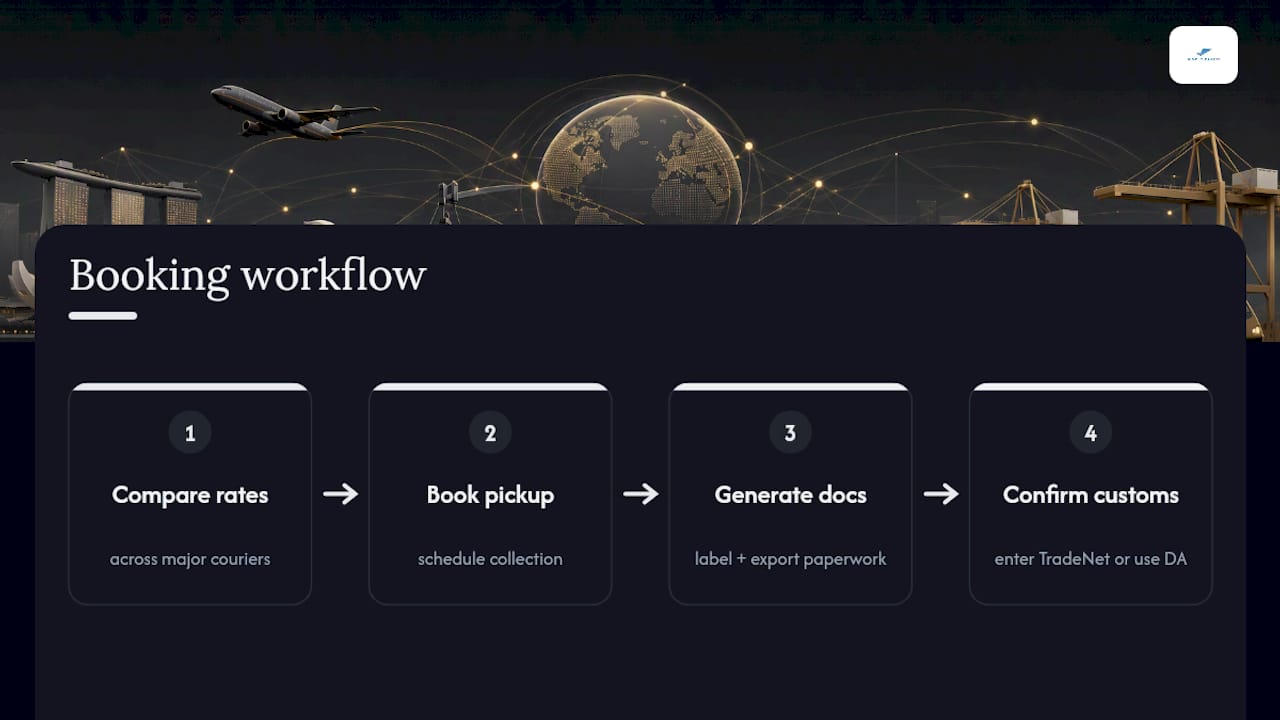
Comparing couriers, booking pickups, and generating labels manually eats hours you don't have when you're also chasing HS codes and Customs approvals. Simply Parcel handles the logistics side instantly: compare rates across major courier partners, book a pickup, and generate your shipping label and export documentation in one pass, whether you're moving a single parcel or a commercial freight load.
That said, Simply Parcel isn't a Declaring Agent. Once your documents are ready, confirm your TradeNet permit entries yourself or route them through a registered DA before your shipment leaves. Use the platform for what it does best, speed and coordination, and keep your Customs compliance airtight on your end.
Ready to move your next shipment? Get an instant shipping quote and book your pickup in minutes.