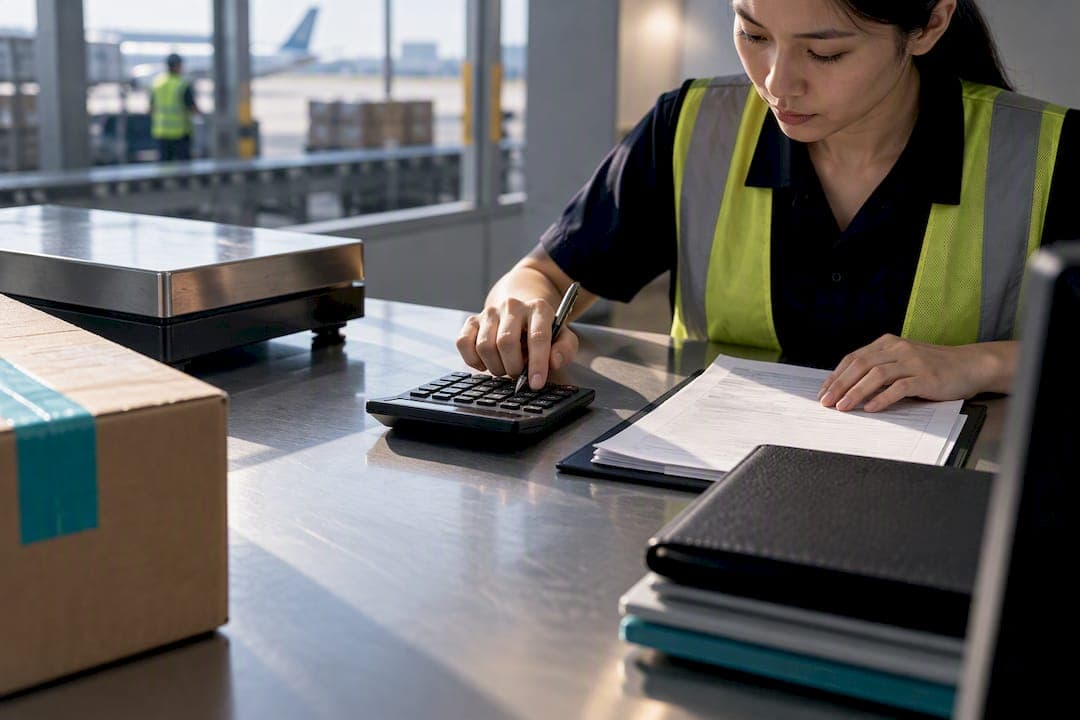
The quickest way to estimate customs duties and GST in Singapore: calculate CIF (cost + freight + insurance), apply any duty rate if the goods are dutiable, then charge 9% GST on the customs value plus duty. Add carrier and permit fees separately, and check Singapore Customs and the Inland Revenue Authority of Singapore (IRAS) for current rates before you commit to a number. Goods below the S$400 threshold arriving by air or post generally do not incur GST.
TL;DR:
- Goods arriving by air or post under S$400 generally do not incur GST unless they are liquor or tobacco, or the relief is overridden by aggregation rules.
- The customs value includes invoice price, freight, insurance, and additional charges like packing, royalties, and assists, using flat rates if actual data is missing.
- Duty rates only apply to four categories: liquor, tobacco, motor vehicles, and petroleum; rates vary between ad valorem and fixed per-unit amounts.
- Correct HS classification and consistent consignor details are critical, as errors can cause underpayment or delays, with penalties for incorrect declarations.
- Keep supporting documents like invoices and freight certificates on file for at least five years to defend against potential customs audits.
Table of Contents
- How Do You Calculate a Customs Duties Estimate for Singapore?
- How Does Singapore Customs Establish Customs Value?
- Which Goods Actually Attract Customs Duty in Singapore?
- What Is the S$400 Low-Value Relief and How Does OVR Change It?
- Worked Examples: From CIF to a Final Tax Number
- How and When Do You Actually Pay These Charges?
- Your Step-by-Step Checklist for an Accurate Estimate
- How Simply Parcel Helps You Manage the Landed-Cost Process
- Overview of HS Codes and Why They Determine Your Duty Rate
- Common Exemptions Beyond the S$400 Low-Value Relief
- Steps and Procedures for Customs Clearance in Singapore
- Penalties for Getting a Customs Declaration Wrong
- Where to Check the Latest Rates and Get Help
- Why the Standard Advice on Customs Estimates Falls Short
- Sources
- FAQ
How Do You Calculate a Customs Duties Estimate for Singapore?
Before you plug numbers into a spreadsheet, gather seven pieces of information: the invoice price, the Incoterm (FOB, CIF, or EXW), freight cost, insurance cost, the HS code or a clear product description, the quantity or weight, and the country of origin. Missing even one of these turns your estimate into a guess.
Here's the minimal workflow that gets you from raw invoice to a usable number:
- Confirm whether the goods are dutiable (liquor, tobacco, motor vehicles, petroleum) or fall into the much larger non-dutiable bucket that still owes GST.
- Build your CIF value: add the invoice cost to actual freight and insurance, or apply Singapore Customs' flat-rate percentages if those figures are not on hand.
- Apply the duty rate, if one applies, to get your duty amount.
- Add duty to CIF, then multiply by 9% to get GST.
- Layer on carrier, permit, and clearance fees, which are separate from tax.
One frequent trap: "free shipping" on an online invoice does not mean zero freight for customs purposes. If no freight figure is stated, Singapore Customs expects you to apply the flat-rate percentage rather than assume the cost was S$0. The same caution applies to declared "samples" or "gifts," which still need a customs value based on fair market price, not the invoice price of S$0.
How Does Singapore Customs Establish Customs Value?
Singapore Customs primarily uses the transaction value method, which means your customs value is the CIF price: the price actually paid or payable for the goods, plus freight and insurance to bring them to Singapore. Several other charges get folded into that number too, and importers often forget them.
Add to the invoice price where they apply:
- Packing costs and any assists you supplied to the manufacturer (tooling, molds, design work).
- Selling commissions paid to agents involved in the sale.
- Royalties or license fees tied to the imported goods.
- Actual freight and insurance charges for transport into Singapore.
When freight and insurance are not itemized on your invoice, apply the flat-rate percentages Singapore Customs publishes by export region: 24.5% for Africa, Canada, and the USA; 19% for Europe, Japan, Australia, and New Zealand; 15.5% for China, Korea, and India; 9.5% for Thailand, the Philippines, and Indonesia; and 5% for Peninsular Malaysia. You calculate these percentages against the FOB value to arrive at an estimated CIF figure.
If your invoice is in a foreign currency, convert it using the appropriate exchange rate, referencing weekly rates where required for consistency with your permit filing.
Pro Tip: Keep the commercial invoice, freight quote, and insurance certificate on file for at least five years. If Customs ever questions your declared value, having original supporting documents is the difference between a quick clarification and a retroactive tax bill.
Which Goods Actually Attract Customs Duty in Singapore?
Only four categories carry duty in Singapore: intoxicating liquors, tobacco products, motor vehicles, and petroleum or biodiesel products. Everything else you import, from electronics to clothing to furniture, is non-dutiable, though it still attracts GST on the customs value.
Within those four dutiable categories, rates come in two forms:
- Ad valorem duty: a percentage of the customs value, commonly used for motor vehicles.
- Specific duty: a fixed amount per unit, such as per litre of alcohol, per kilogram of tobacco, or per stick of cigarettes.
Getting the HS classification right matters enormously here, because a small shift in alcohol strength, product weight, or packaging category can move a specific duty rate significantly. A wine importer who misjudges alcohol-by-volume, for instance, can end up under-declaring duty without realizing it. Check exact current rates on the Singapore Customs duties and dutiable goods pages before finalizing any estimate involving these four categories.
What Is the S$400 Low-Value Relief and How Does OVR Change It?
Goods with a CIF value of S$400 or less, imported by air or post, are generally relieved from GST, but this relief excludes liquor and tobacco entirely and does not typically extend to shipments by sea or land. That single exclusion catches a lot of first-time importers off guard.
A second wrinkle sits on top of the relief: the Overseas Vendor Registration (OVR) regime. Many overseas platforms are now registered under OVR and collect GST directly at checkout, which means the parcel arrives with tax already paid, regardless of its value. If a seller charged you GST online, do not expect a second GST charge at the border for the same goods.
Key practical points to model into your forecast:
- Confirm whether your CIF value is truly under S$400 before assuming relief applies.
- Ask the seller whether GST was already collected under OVR rules.
- Watch for aggregation: multiple parcels from the same consignor arriving together can be treated as one combined import, which can push the total value over S$400 and cancel the relief you were counting on.
- Verify the invoice and airway bill details before you build low-value relief into your cost forecast.
Worked Examples: From CIF to a Final Tax Number
The clearest way to see this formula work is with real numbers. Here are two scenarios that cover the most common situations importers face.
Non-dutiable electronics example:
- You import a laptop with an invoice price of S$1,000, plus S$50 freight and no separate insurance, giving a CIF of S$1,050.
- Since S$1,050 exceeds the S$400 relief threshold, GST applies: 9% × S$1,050 = S$94.50.
- If the same laptop had a CIF of S$390, it would generally sit under the relief and owe no GST, unless the seller already collected GST under OVR at checkout.
Dutiable goods example:
Singapore Customs uses a motor vehicle to illustrate how duty stacks before GST is applied: a customs value of S$101,000 with a 20% excise duty produces duty of S$20,200.
Round currency conversions consistently, and always verify the specific duty rate against current Singapore Customs publications rather than a prior shipment's rate, since rates and classifications can shift.
How and When Do You Actually Pay These Charges?
SingPost and commercial couriers typically notify the recipient once a parcel clears the checkpoint, and payment is usually required before the item is released for delivery. That notification, not the shipping date, is usually your real deadline for cashflow planning.
Beyond duty and GST, expect several charges that are not government taxes at all:
- A clearance or handling fee charged by the courier or postal service for processing your import.
- A disbursement fee, if the carrier advanced GST or duty on your behalf before collecting it from you.
- Permit application fees through TradeNet, where a basic permit can run around S$3.19 (roughly S$0.90 statutory plus S$2.29 processing).
Commercial importers who file their own permits often pay duty and GST directly through a GIRO arrangement with Singapore Customs, while individual recipients typically pay through the courier or SingPost at the point of collection. The routes carry different timing: a GIRO-based business declarant usually knows costs upfront, while a recipient paying a courier at the door faces a same-day payment demand. Either way, these provider charges sit apart from the tax itself and should be modeled as a separate line in your forecast.
Your Step-by-Step Checklist for an Accurate Estimate
Paste this sequence into a spreadsheet and you have a repeatable process for every shipment:
- Confirm the HS code and whether the goods fall into one of the four dutiable categories.
- Collect the invoice, freight cost, insurance cost, and Incoterm from your supplier.
- Apply the relevant flat-rate percentage if actual freight and insurance figures are unavailable.
- Compute duty (if applicable), then GST at 9% on customs value plus duty.
- Add permit, clearance, and carrier charges on top of the tax total.
- Retain the invoice, transport documents, and any permit records for future reference.
Pro Tip: If you're expecting several parcels from the same supplier, keep the consignor name and airway bill details consistent across shipments. Customs can treat same-day, same-consignor parcels as a single import, which quietly removes low-value relief you may have counted on.
How Simply Parcel Helps You Manage the Landed-Cost Process
Once you have your estimate, the paperwork still has to get done correctly. Simply Parcel supports Singapore importers and exporters with online booking, auto-generated shipping labels and documentation, and real-time tracking across multiple courier partners. That combination helps SME exporters, individuals shipping personal items, and businesses handling return shipments keep their documentation aligned with what Customs and carriers expect at clearance, reducing the chance of a delay caused by a mismatched invoice or missing detail.
Overview of HS Codes and Why They Determine Your Duty Rate
Every imported product gets classified under a Harmonized System (HS) code, an internationally standardized numbering system that tells Customs exactly what the goods are and which rules apply to them. Singapore uses an extended version of this code, often referred to as the ASEAN Harmonized Tariff Nomenclature, which adds extra digits beyond the international six-digit standard for finer classification.
The HS code you assign controls three things at once: whether the item is dutiable, which rate type applies if it is, and whether any permit or license is required before the goods can clear. Two products that look similar to a layperson, say, a decorative item made of wood versus one made of a restricted material, can carry entirely different classifications and entirely different costs.
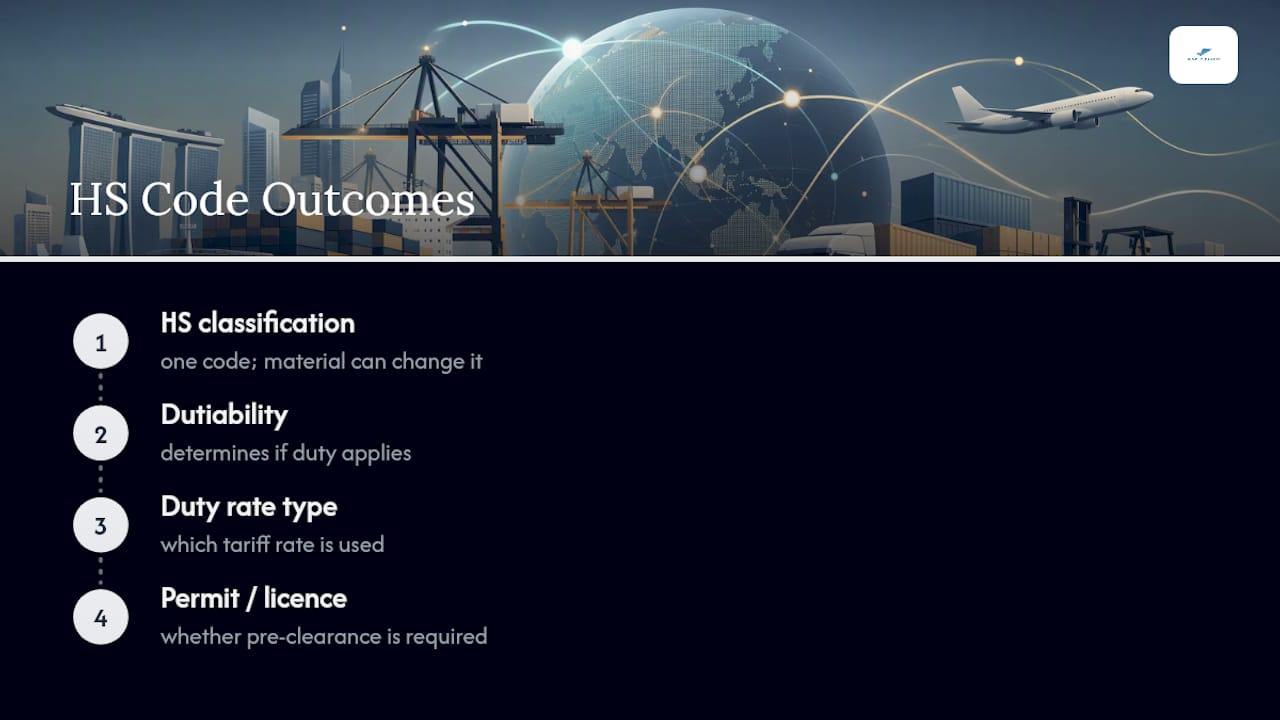
Getting the classification wrong is one of the most common reasons import estimates go sideways. An importer who classifies a shipment under the wrong code might underpay duty, triggering a reassessment later, or overpay simply because they defaulted to a broader, higher-rate category out of caution. Neither outcome helps your forecasting.
If you are unsure how to classify a product, Singapore Customs offers a classification advice service, and many freight forwarders and customs brokers can help verify the correct code before you ship. Getting this step right at the start of your estimate is worth more than any other single input, because everything downstream, duty type, duty rate, and even permit requirements, flows from this one classification decision.
Common Exemptions Beyond the S$400 Low-Value Relief
The S$400 threshold gets the most attention, but it is not the only relief available to importers and travelers bringing goods into Singapore. Several other categories exist, and each comes with its own conditions.
Personal effects and household goods brought in by someone relocating to Singapore can qualify for relief, provided the items were owned and used abroad before the move and are not intended for resale. This differs meaningfully from buying new furniture overseas and shipping it in, which does not carry the same exemption.
Diplomatic and consular imports carry their own exemption framework, reflecting international agreements rather than standard trade rules. These shipments follow a distinct approval process tied to the diplomatic mission's status, not the general import procedures individual consumers or businesses use.
Returned goods, meaning items that were originally exported from Singapore and are coming back unchanged (for repair, a failed sale, or a returned online order) can also sometimes avoid duty and GST a second time, provided you can document the original export. This is particularly relevant for businesses handling international returns, since without proof of the original export, Customs has no way to distinguish a returning item from a fresh import.
Each of these exemptions requires supporting paperwork, whether that's a relocation declaration, a diplomatic note, or an original export permit. None of them apply automatically just because a shipment seems like it should qualify, so build the paperwork requirement into your process rather than assuming relief will be granted.
Steps and Procedures for Customs Clearance in Singapore
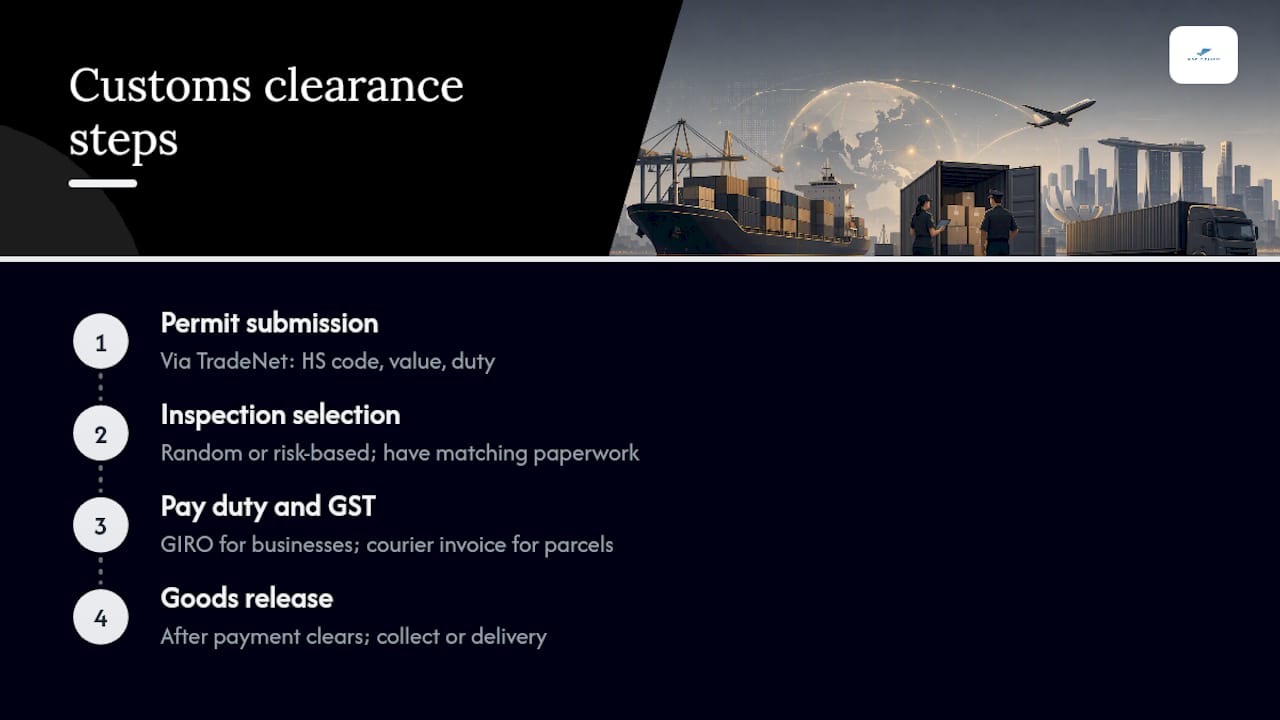
Clearance in Singapore runs through the TradeNet system, and understanding the sequence helps you avoid delays that ripple into extra storage or demurrage charges.
First, the importer or a licensed declaring agent submits a permit application through TradeNet before or upon arrival of the goods, declaring the HS code, customs value, and any applicable duty. For most non-dutiable, non-controlled goods, this permit processes quickly, often within minutes if the declaration is complete and accurate.
Second, Customs may select certain shipments for physical or documentary inspection. This is not necessarily a sign of a problem. Random checks and risk-based selections are a routine part of border control, and a smooth inspection depends heavily on having consistent paperwork, matching invoice values, and a defensible declared value on hand.
Third, once the permit is approved, duty and GST become payable. Commercial importers typically settle this through a GIRO arrangement linked to their Customs account, while individual shipments arriving by post or courier get invoiced by SingPost or the courier at the point of delivery.
Fourth, once payment clears, the goods are released for delivery or collection. For postal items, this usually means a notification letter or an online payment request must be settled before the parcel leaves the mail center.
Businesses that import regularly often work with a declaring agent or freight forwarder to handle the TradeNet submission, since errors in the permit application, incorrect HS codes, wrong values, mismatched quantities, are the most common cause of clearance delays. Building a habit of reviewing your permit details against the actual shipment before submission saves far more time than fixing a rejected declaration after the fact.
Penalties for Getting a Customs Declaration Wrong
Declaring an incorrect value, HS code, or quantity is not a minor administrative slip in Singapore. Under the Customs Act, penalties for making an incorrect declaration, whether by underdeclaring value, misclassifying goods to reduce duty, or omitting dutiable items, can include fines and, in serious or repeated cases, prosecution.
Beyond the immediate financial penalty, an incorrect declaration usually results in a reassessment: Singapore Customs recalculates the correct duty and GST owed and requires payment of the shortfall, on top of whatever penalty applies. This retroactive tax bill is often the more costly outcome for businesses, since it can apply across multiple past shipments if a pattern of misclassification is discovered during an audit.
Honest mistakes still carry consequences, even without intent to evade duty. This is exactly why keeping commercial invoices, freight documentation, and correspondence about product classification matters well beyond the moment your shipment clears. If Customs later questions a declared value, having a clear paper trail showing how you arrived at that figure is the strongest protection against an escalated penalty.
For businesses importing at volume, the practical takeaway is to build a verification step into your process before goods ship, ideally a second person or a declaring agent reviewing HS codes and declared values against the actual invoice. It costs a few minutes per shipment and is dramatically cheaper than a retroactive assessment across a year's worth of imports.
Where to Check the Latest Rates and Get Help
Rates, thresholds, and relief rules do shift, and relying on last year's numbers is one of the easiest ways to under-forecast a shipment's true cost. Singapore Customs maintains current duty rates, GST guidance, and flat-rate percentages on its official site, and it's worth bookmarking the pages relevant to your typical imports rather than searching fresh each time.
For GST-specific questions, particularly around OVR registration and how GST is collected by overseas vendors, the Inland Revenue Authority of Singapore (IRAS) is the authoritative source, since GST policy sits under IRAS even though Singapore Customs handles collection at the border for many imports.
For postal shipments specifically, SingPost publishes its own procedures for how it notifies recipients, collects payment, and releases parcels, which is useful if you're trying to understand timing rather than tax calculation. If you have a shipment-specific question that general guidance doesn't answer, both Singapore Customs and IRAS maintain contact channels for direct enquiries, and a licensed declaring agent or customs broker can often resolve classification questions faster than a general search.
Why the Standard Advice on Customs Estimates Falls Short
Most guidance treats customs estimation as a single lookup: find the duty rate, multiply, done. That's backwards. The formula itself, CIF times duty rate, then GST on top, is simple enough to memorize in a minute. What actually trips up Singapore importers is the input quality feeding that formula: an unverified freight figure, a guessed HS code, or an assumption that S$400 relief applies when aggregation quietly canceled it.
The conventional approach also treats OVR as a footnote when it should be step one. If GST already landed at checkout, recalculating it at the border is a wasted exercise and a common source of confusion for first-time buyers.
Prioritize your HS classification and your consignor consistency before you touch a duty rate. Get those two things right, and the arithmetic takes care of itself. Get them wrong, and no amount of formula precision will save your forecast from a Customs reassessment down the line. Tools that automate documentation, including the auto-generated paperwork Simply Parcel provides at booking, help reduce the human error that causes most of these misclassifications in the first place, but they don't replace understanding why the classification matters.
— Simply
FAQ
How Much Is Customs Duty in Singapore?
Customs duty in Singapore only applies to four categories: liquor, tobacco, motor vehicles, and petroleum products, using either an ad valorem percentage or a specific rate per unit. Most other imported goods carry no duty at all, though GST still applies at 9% on the customs value.
How Do I Estimate Customs Duties Before I Ship?
Calculate your CIF value (cost, freight, and insurance), check whether your product falls into one of the four dutiable categories, then apply the relevant duty rate followed by 9% GST on the combined total. Use Singapore Customs' flat-rate percentages if you don't have actual freight and insurance figures yet.
How Can I Calculate Customs Duty Manually?
Multiply the applicable ad valorem percentage by your customs value, or multiply the specific rate by your quantity, weight, or volume, depending on which measurement the product's HS classification requires. Singapore Customs publishes the exact rate structure for each of the four dutiable categories on its duties overview page.
How Do I Calculate Import Duty and GST Together?
Add duty to your CIF customs value first, then apply 9% GST to that combined figure, since GST is charged on customs value plus duty rather than on the invoice price alone.
Do I Need to Pay GST on a S$300 Parcel From Overseas?
Generally no, since parcels with a CIF value of S$400 or less arriving by air or post typically qualify for GST relief, unless the goods are liquor or tobacco. If the overseas seller already collected GST under the OVR regime at checkout, that GST has already been paid regardless of the parcel's value.