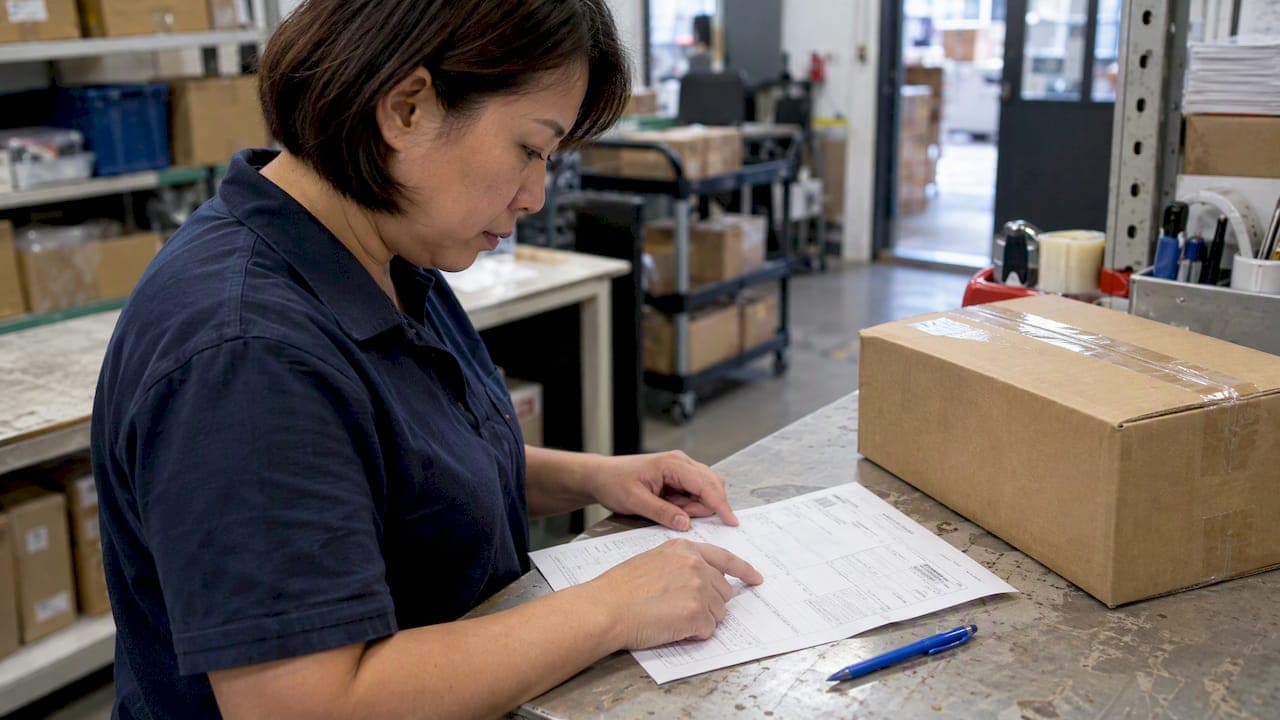
An air waybill (AWB, also written airway bill) is the transport document that travels with an air shipment. It is the contract between the shipper and the carrier, a receipt that the carrier took your goods, and the reference number everyone in the chain uses to find your cargo. It is not a document of title, so it does not prove who owns the goods.
This guide covers what the AWB does, how to read the number, the difference between master and house waybills, how an AWB compares with a bill of lading, a shipping label and an invoice, and what to check before you ship. We write from the point of view of a Singapore-based shipping platform, so the customs notes focus on Singapore. Other countries have their own rules.
TL;DR
- An AWB is a non-negotiable contract of carriage between shipper and carrier. It moves the goods but does not transfer ownership.
- The AWB number has 11 digits: a 3-digit airline prefix, then an 8-digit block that ends in a check digit. You use it to track the shipment.
- A master AWB (MAWB) is issued by the airline to a freight forwarder. A house AWB (HAWB) is issued by the forwarder to you.
- You are responsible for the accuracy of the details, even if someone else prepares the document. Wrong values or HS codes cause delays and can affect insurance claims.
- When you book a courier shipment, the system usually generates the waybill for you. Your job is to supply correct data.
Table of Contents
- What an air waybill is
- What an AWB contains
- How to read an AWB number
- Master AWB vs house AWB
- Paper AWB vs electronic AWB (e-AWB)
- AWB vs bill of lading vs shipping bill
- AWB vs shipping label vs commercial invoice
- Who issues the AWB and who is responsible for it
- Consequences of AWB errors
- Checklist before you ship by air
- Our perspective: you should not have to build the waybill by hand
- Compare options and book from Singapore
- FAQ
- Sources
What an air waybill is
An air waybill is a document made out by or on behalf of the shipper. It evidences the contract between the shipper and the carrier for carrying goods over the carrier's routes. IATA guidance describes it as the contract of carriage between the shipper (often a forwarder) and the airline, governed by IATA Resolution 600a.
In practice the AWB does three jobs:
- Contract. It records the terms under which the carrier agreed to move the cargo from origin to destination.
- Receipt. It confirms the carrier accepted the shipment as described.
- Data sheet. It lists the shipper and consignee, the goods, weight, pieces and routing, so ground handlers, airlines and customs agents can act on the same information.
Maersk compares it to a boarding pass: without it, your goods cannot fly. The comparison works because the document identifies the cargo and tells every handler where it is going.
The same document goes by other names. FedEx notes it is also called a consignment note, dispatch note or waybill. If you searched for the airway bill meaning, this is it: same document, different spelling.
What an AWB contains
Exact layouts differ by carrier, but a waybill typically carries:
- Shipper name and address
- Consignee (receiver) name and address
- Airport of departure and airport of destination
- Number of pieces, gross weight and chargeable weight
- Description of the goods and declared value for carriage
- Freight charges and who pays them (shipper or consignee)
- Handling information, such as dangerous goods or temperature needs
- The AWB number itself
Customs agencies rely on this data, which is why the details need to match your commercial invoice and your export or import declaration.
How to read an AWB number
People searching for the AWB number meaning usually have a tracking problem: they have a number and want to know what it says. A standard IATA AWB number has 11 digits. According to TLV Flights, that is a three-digit airline prefix followed by an eight-digit shipment number, the last of which is a check digit.
| Part | Digits | What it tells you |
|---|---|---|
| Airline prefix | First 3 | Which airline or cargo brand issued the number |
| Serial number | Next 7 | The individual waybill |
| Check digit | Last 1 | A modulus-7 check that catches typing errors |
So a number written as 123-4567 8901 would break down as prefix 123, serial 4567890 and check digit 1. (That number is an illustration, not a real shipment.) The number is usually printed in the top corners of the waybill.
Two practical points:
- Track on the airline's cargo page. Enter the full 11 digits, with or without the hyphen, depending on the site.
- Courier tracking numbers are different. Express carriers often use their own tracking formats for door-to-door parcels. Use whichever number your booking confirmation labels as the tracking number.
Master AWB vs house AWB
When forwarders consolidate many small shipments into one air cargo booking, two layers of waybill appear:
- Master air waybill (MAWB): issued by the airline to the freight forwarder. It carries the 11-digit airline number used for end-to-end tracking.
- House air waybill (HAWB): issued by the forwarder to the individual exporter, SME or consumer whose goods are inside the consolidation.
The airline sees one bulk shipment under the MAWB. You see your own shipment under the HAWB. If you ship through a forwarder or courier aggregator, the HAWB is usually the document you are dealing with, and the MAWB sits behind it.
The distinction matters in Singapore customs too. Singapore Customs lists the Air Waybill as a supporting document for import clearance, alongside the permit and commercial invoice. For certain small-value air courier parcels (non-controlled, non-dutiable goods with a CIF value of S$400 or less, cleared at Changi Airfreight Centre), forwarders may use a summary list with the HAWB instead. For exports, Singapore Customs expects the permit with invoices and the BL or AWB to be produced when required. Check the current rules on the Singapore Customs pages before you ship, because thresholds can change.
Paper AWB vs electronic AWB (e-AWB)
The e-AWB replaces the paper set with electronic data. Investopedia notes the e-AWB has been the default since 2019. It removes the need for paper documents to accompany the aircraft.
There is one condition. IATA's local guidelines say the airline and the forwarder need a bilateral or IATA multilateral e-AWB agreement in place before a given shipment can go electronic. If no agreement exists, the shipment falls back to paper.
For you as a shipper, the practical effect is small: you rarely handle the AWB itself. You provide the data, and the carrier or forwarder files it.
AWB vs bill of lading vs shipping bill
These documents get mixed up, and the confusion is costly. The short version:
| Air waybill | Bill of lading | Shipping bill | |
|---|---|---|---|
| Mode | Air | Sea | Customs export filing, used in some countries such as India |
| Role | Contract of carriage and receipt | Contract, receipt and, in some forms, document of title | Customs declaration to clear goods for export |
| Negotiable? | No | Can be | Not a transport contract |
| Can transfer ownership in transit? | No | Yes, if negotiable | No |
The main point for bill of lading vs air waybill comparisons: an AWB is not a document of title like a marine bill of lading. If you need to sell the goods while they are in flight, the AWB cannot do that. Buyers who need a title document or a bank-backed payment arrangement should discuss options with their bank or trade finance adviser before choosing air freight.
A shipping bill is a customs filing, not the carrier's contract. Singapore exporters do not file a shipping bill. They use a customs permit declared through TradeNet where one is required. Our guide to the Singapore export permit covers that step.
AWB vs shipping label vs commercial invoice
Two more comparisons come up often.
Is an air waybill the same as a shipping label? No. The label is the sticker on the box. It carries the barcode and address so the parcel can be sorted. The AWB is the contract and data record behind it. For express parcels the two are often generated together, and the barcode on the label points to the waybill data. That is why people use the words interchangeably, but the label alone does not describe the contract.
AWB vs commercial invoice. Practitioners stress that the AWB is a transport document while the commercial invoice is the value document. Customs authorities use the invoice to assess taxes and duties. Mixing the two up leads to clearance problems. If your invoice and waybill disagree on description, quantity or value, expect questions. Our comparison of the pro forma and commercial invoice explains which one fits which situation.

Who issues the AWB and who is responsible for it
The airline issues the MAWB number. A forwarder, courier or the airline's agent issues the HAWB. Even so, the shipper carries the responsibility for accuracy. Investopedia's guide makes the point that the shipper stays responsible even when a forwarder prepares the paperwork, and that incorrect HS codes or declared values can lead to seizures, delays or rejected insurance claims.
That means you should treat every field as yours.
Consequences of AWB errors
A waybill mistake rarely stays small, because every party downstream acts on the data. Typical outcomes:
- Customs hold. The goods description, HS code or value does not match the invoice, so the shipment waits for clarification.
- Misrouting or failed delivery. A wrong consignee address or phone number leaves the parcel without a way to reach the receiver.
- Duty and tax disputes. An understated value draws penalties or reassessment in the destination country.
- Insurance problems. A claim built on inaccurate declarations may be rejected.
The pattern is the same in other kinds of transport. A missing or mismatched document stalls the whole job, which is why delays in a different industry, such as interstate moving delays and how to avoid them, often trace back to details nobody checked early. Catching the problem before pickup costs minutes. Fixing it after the cargo is at the airport costs days.
Checklist before you ship by air
- Match names and addresses to the ID or business registration of the sender and receiver. Include a working phone number and email for the receiver.
- Describe the goods plainly. "Cotton T-shirts, men's, 20 pieces" works. "Samples" or "gifts" does not.
- Use the right HS code for commercial goods. If you are unsure, confirm it before booking.
- Declare the real value and make it match the commercial invoice. Our guide to shipment value declaration explains how.
- Weigh and measure the packed parcel, not the goods alone. Carriers bill on chargeable weight, which can be based on volume.
- Check restricted and prohibited items for both Singapore and the destination country before you pack.
- Keep copies of the waybill, invoice and permit for your records.
For a wider view of paperwork, see our customs declaration guide for Singapore and the list of essential shipping documents for Singapore SMEs. If any term in this article is new, the international shipping terminology guide defines it.
Our perspective: you should not have to build the waybill by hand
Most people who search for the AWB meaning are not freight professionals. They are sellers, students and families who need a parcel to reach another country. They do not need to learn how to fill in a master waybill. They need to understand what the document does so they can supply accurate details.
That is how we built the booking flow. You enter the sender, receiver, contents and value. The platform generates the shipping labels and customs documentation from that information, so you are not retyping the same data on three forms. Because the waybill is built from what you enter, the quality of your inputs is what matters. A precise description and a value that matches the invoice prevent most of the problems we see.
Our advice, in order of importance:
- Treat the commercial invoice and the waybill as one story. The goods, quantities and values should read the same on both.
- Choose the speed that matches the need. Priority suits urgent or high-value parcels, Connect Plus balances speed and cost, and Economy suits parcels that can wait.
- Ask before you ship if something is restricted. A question beforehand is cheaper than a parcel held at customs.
— SP
Compare options and book from Singapore
If you are ready to send something abroad, you can compare Priority, Connect Plus and Economy options for your route, or get a shipment quote directly. Pickup at your door is free, the labels and customs documents are generated for you, and you can follow the parcel with real-time tracking. There is no monthly volume commitment, so it works for one-off parcels and for regular business shipping.
FAQ
What is an air waybill in simple terms?
It is the contract and receipt for goods flown by air. It names the sender and receiver, describes the cargo and carries the number used for tracking. It does not prove ownership of the goods.
Is an air waybill negotiable?
No. An AWB is a non-negotiable document, unlike some bills of lading. It cannot be used to sell or transfer the goods while they are in transit.
What is the difference between an MAWB and an HAWB?
The airline issues the MAWB to a freight forwarder for a consolidated shipment. The forwarder issues an HAWB to each individual shipper inside that consolidation. You normally deal with the HAWB, and the MAWB number is used for airline-level tracking.
Do I need to print the air waybill myself?
Usually not. With a courier or aggregator booking, the system generates the shipping label and documents, and you attach the label to the parcel. Where an e-AWB is used, the data travels electronically rather than on paper, provided the required agreements are in place.
Where do I find my AWB number?
Look at your booking confirmation, the shipping label or the documents from your forwarder. A standard AWB number has 11 digits. If you see a shorter or differently formatted number, it is probably the courier's own tracking number, which you should use on that courier's tracking page.
Sources
- Air Waybill (AWB): Key Details, Purpose, and Acquisition, Investopedia
- What is an air waybill (AWB) in air freight? Maersk
- What is an air waybill? FedEx
- Air Waybill (AWB): An Importer's Guide, TLV Flights
- AWB number format explained, Air Waybill Tracker
- Air Waybills, CHAMP Cargospot help
- e-AWB Recommended Guidelines (HYD), IATA
- Local Guideline and Recommendations to facilitate e-AWB adoption, IATA
- Documents for clearance of goods (imports), Singapore Customs
- Documentation for clearance of goods (exports), Singapore Customs