
Misunderstanding who pays for freight or who bears the risk of a lost container is not a small oversight. For Singapore importers and exporters, confusing terms like FOB, CIF, or AWB can result in unexpected charges at customs, disputed insurance claims, or goods stuck at the port. Many shippers sign contracts or book shipments without fully understanding the obligations those terms create. This guide cuts through the jargon with straightforward explanations, practical examples, and advice tailored to Singapore's trade environment, so you can make smarter decisions and avoid the costly mistakes that catch too many shippers off guard.
Table of Contents
- Why shipping terminology matters for Singapore importers and exporters
- Key Incoterms explained: Responsibilities, risks, and costs
- Essential shipping documents: Bills of lading, airway bills, and more
- The role of freight forwarders, customs, and HS codes in Singapore
- The hidden traps and expert shortcuts in shipping terms
- Streamline your shipping: Next steps with Simply Parcel
- Frequently asked questions
Key Takeaways
| Point | Details |
|---|---|
| Incoterms clarify obligations | Knowing key Incoterms helps you avoid confusion and share shipping risks and costs appropriately. |
| Documents impact delivery | Correct shipping documents are essential for customs clearance and smooth ownership transfer. |
| HS codes determine duties | Accurate HS codes are required in Singapore to calculate taxes, avoid penalties, and get permits. |
| Expert help prevents mistakes | Working with experienced forwarders and agents reduces costly errors in international shipments. |
Why shipping terminology matters for Singapore importers and exporters
Singapore is one of the world's busiest trade hubs. Its port consistently ranks among the top globally by container throughput, which means there is a constant flow of goods moving in and out under a wide range of commercial arrangements. For small businesses and individual shippers alike, understanding the language of international trade is not optional. It is the foundation of every safe, cost-effective shipment.
When a term is misread or misapplied, the consequences are concrete. A shipper who assumes the seller covers inland freight under a CIF agreement may find themselves with an unexpected bill at the Singapore destination port. A buyer relying on EXW without understanding that they must handle export customs clearance at the seller's country can face export violations. These are not edge cases. They happen regularly, and the financial losses are real.
"Incoterms are standardized rules published by the International Chamber of Commerce (ICC) defining buyer and seller responsibilities for delivery, costs, risks, and customs in international trade." Incoterms 2020 rules
The ICC's Incoterms rules provide a universal language for trade. They tell both parties exactly where financial responsibility and physical risk transfer from seller to buyer. For Singapore businesses trading with partners in Europe, the US, or Southeast Asia, knowing which Incoterm applies to your contract is foundational.
Beyond Incoterms, Singapore's customs framework adds its own layer of terminology. Import duties are calculated based on the CIF value of goods, meaning the combined cost of the goods, insurance, and freight to Singapore's port of entry. Singapore import procedures confirm that most imports are subject to 9% GST calculated on this CIF value, while specific dutiable goods like liquor and tobacco attract additional duties. Misquoting or misrecording the CIF value can mean underpaying or overpaying tax, both of which carry risks.
Singapore also requires import and export permits to be declared through the TradeNet/Networked Trade Platform (NTP) system. A permit application using incorrect terminology or wrong goods classification codes can be rejected, delaying the entire shipment. You can find additional shipping tips and guidance to help you navigate these requirements before your next shipment.
Key consequences of terminology errors include:
- Unexpected freight or insurance charges that erode profit margins
- Customs clearance delays caused by incorrect permit applications
- Legal disputes between buyer and seller over risk and cost responsibility
- Penalties from Singapore Customs for incorrect declarations
- Loss of goods during transit with no valid insurance claim because responsibility was unclear
Understanding the language removes these risks. It turns an opaque process into a manageable one.
Key Incoterms explained: Responsibilities, risks, and costs
With the basics established, let's dig deeper into the Incoterms that matter most for Singapore trade. These rules are not just legal language. They are practical tools that shape every cost estimate, insurance arrangement, and logistics plan you put together.
Incoterms 2020 details cover eleven distinct rules, but five appear most frequently in Singapore trade contracts. Here is how each one actually works in practice.
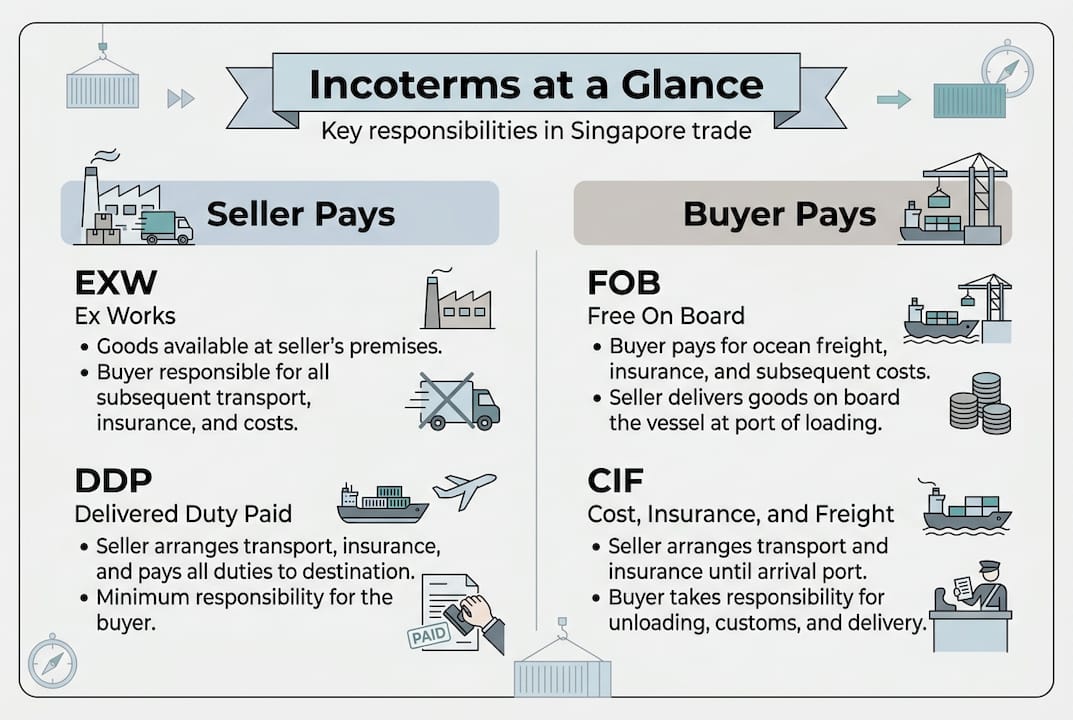
EXW (Ex Works): EXW places full responsibility on the buyer from the moment goods are ready at the seller's premises. The buyer arranges pickup, manages export clearance in the seller's country, pays all freight, and handles import clearance in Singapore. This term carries minimal obligation for the seller, but it is genuinely risky for inexperienced buyers who are unfamiliar with the seller's local export regulations. Many Singapore SMEs use EXW without realizing they need a local agent in the country of export, which adds complexity and cost.
FOB (Free On Board): FOB applies only to sea freight, and under this rule, the seller delivers goods and loads them onto the vessel at the port of shipment. Risk transfers to the buyer at that point. The buyer then pays ocean freight, insurance, and handles import clearance in Singapore. FOB is extremely common, especially in Asian manufacturing trade lanes, but it carries a structural problem for containerized cargo that we will address shortly.
CIF (Cost, Insurance, and Freight): Under CIF, the seller pays freight and minimum insurance to the destination port. However, risk actually transfers at the point of vessel loading, just like FOB. This creates a counterintuitive situation: the seller pays for freight and insurance, but the buyer bears the risk from the moment goods are loaded. If the cargo is damaged at sea, the buyer bears the loss even though they did not arrange the insurance policy.
DDP (Delivered Duty Paid): DDP places maximum obligation on the seller. The seller delivers goods to the buyer's location in Singapore, cleared through customs and with all duties paid. This is very convenient for buyers but can be expensive, and sellers must be registered or represented in Singapore to handle import clearance legally.
DAP (Delivered At Place): Similar to DDP, but the buyer handles import customs and duties once the goods arrive at the agreed destination. DAP offers a middle ground where the seller manages the main freight but stops short of customs obligations.
| Incoterm | Who pays freight | Who pays import duty | Risk transfers at |
|---|---|---|---|
| EXW | Buyer | Buyer | Seller's premises |
| FOB | Buyer | Buyer | Loading on vessel |
| CIF | Seller | Buyer | Loading on vessel |
| DAP | Seller | Buyer | Named destination |
| DDP | Seller | Seller | Named destination |
Pro Tip: For containerized sea freight, the ICC itself recommends using FCA (Free Carrier) instead of FOB, and CIP (Carriage and Insurance Paid To) instead of CIF. This is because containers are handed to the carrier at an inland terminal before vessel loading, so FOB and CIF create a gap in risk coverage during that early stage. Using FCA or CIP removes that gap and gives both parties cleaner protection.
Essential shipping documents: Bills of lading, airway bills, and more
After learning who does what under Incoterms, it is vital to understand the documents that move with your shipment. Documents are not paperwork formalities. They are legal instruments that determine ownership of goods, trigger customs clearance, and protect you in disputes.
Bill of Lading (B/L): The Bill of Lading serves three functions: it is a receipt for goods shipped, evidence of the carriage contract between shipper and carrier, and a document of title. A negotiable (also called "to order") Bill of Lading can be transferred to a third party, effectively transferring ownership of the goods in transit. There are two common types: a Master B/L issued by the shipping line (the main carrier), and a House B/L issued by a freight forwarder for consolidated shipments. Understanding which type you hold matters because it affects how you collect or release cargo at the destination.
Air Waybill (AWB): The Air Waybill is non-negotiable, which means it cannot transfer ownership like a B/L. It functions as a receipt for goods, a contract of carriage, and a customs document for air cargo. A Master AWB is issued by the airline, while a House AWB is issued by a freight forwarder when consolidating multiple smaller shipments. Because it is non-negotiable, the named consignee on the AWB is always the one who receives the cargo. There is no risk of the cargo being redirected through document transfer, which can actually be an advantage for certain types of shipments.
Supporting documents every Singapore shipper needs:
- Commercial invoice: States the value, description, and origin of goods. Used to calculate duties and GST.
- Packing list: Details what is inside each package, including weight and dimensions. Required for customs inspection.
- Certificate of origin: Declares where goods were manufactured. Relevant for free trade agreements Singapore has in place.
- Singapore customs permits: Required for controlled goods and declared through TradeNet/NTP before shipment.
- Insurance certificate: Confirms coverage during transit; essential under CIF or CIP terms.
Errors in these documents are a common source of delay. A wrong description on the commercial invoice can cause customs to flag a shipment for inspection. A mismatch between the packing list and the actual cargo can trigger re-examination. Even a single digit error in the consignee address on a B/L can complicate cargo release.
You can use Simply Parcel's real-time tracking and document tools to stay on top of your shipment status and ensure documentation is in order throughout the journey.
The role of freight forwarders, customs, and HS codes in Singapore
Understanding documents is only half the story. Let's explore the people and systems that help you navigate Singapore's shipping landscape every day.
A freight forwarder arranges transport, prepares documentation, and handles customs procedures on behalf of shippers. They act as an agent, coordinating with airlines, shipping lines, trucking companies, and customs authorities. Some forwarders operate as Non-Vessel Operating Common Carriers (NVOCCs), meaning they issue their own House Bills of Lading for ocean shipments without owning the actual vessel. Container Freight Stations (CFS) are facilities where LCL (Less than Container Load) shipments are consolidated or deconsolidated. If your goods share a container with other shippers' cargo, you are likely moving through a CFS.
In Singapore, anyone submitting trade declarations to Singapore Customs must either be a registered Declaring Agent or appoint one. Declaring Agents are companies registered with Singapore Customs to submit permit applications through TradeNet/NTP on behalf of importers and exporters. If you are a small business without internal customs expertise, engaging a Declaring Agent is not optional for regulated goods. It is a legal requirement.
Services a freight forwarder typically provides:
- Booking cargo space with airlines and shipping lines
- Preparing and submitting customs permit applications
- Arranging cargo insurance on the shipper's behalf
- Coordinating pickup, consolidation, and delivery
- Advising on HS Codes and trade compliance
This is where HS Codes become critical. HS Codes are 6-10 digit identifiers from the Harmonized System, a globally standardized framework for classifying goods. In Singapore, the correct HS Code determines the duty rate, whether a permit is needed, and any import restrictions that apply. Misclassifying goods is one of the most common and costly mistakes shippers make. Singapore Customs can impose fines for incorrect declarations, and in serious cases, goods may be seized.
Pro Tip: Never rely solely on your supplier or freight forwarder to assign your HS Code. Verify the classification yourself using Singapore Customs' online tools at the NTP portal. If you are unsure, request a formal classification ruling from Singapore Customs before shipment. This takes time but eliminates the risk of penalty.
You can review how shipment details and responsibilities are structured when booking through a platform like Simply Parcel, which provides clear breakdowns of what is covered at each stage.
The hidden traps and expert shortcuts in shipping terms
Having covered the foundational concepts, here is some experienced, hard-won perspective that goes beyond what most guides will tell you.
The single most common costly mistake we see from Singapore shippers is using FOB for containerized ocean freight. It feels familiar, and many suppliers default to it. But the moment your container is handed to a CFS or terminal before vessel loading, and something goes wrong, you are in a grey area of risk responsibility. The buyer thinks the seller still carries the risk. The seller thinks the risk has transferred. Neither party is clearly covered. FCA solves this, but shippers resist changing terms because FOB is what they know.
HS Code errors are equally stubborn. A small business shipping electronics may classify a product under a broad consumer electronics code when a more specific subheading applies, one that triggers a different permit or a lower duty rate. Either error costs money. The right code requires research, and the research genuinely pays off.
The expert shortcut is simple: build a pre-shipment checklist. Confirm the Incoterm matches your transport mode. Verify the HS Code against Singapore Customs records. Check that every document uses identical descriptions. Confirm the consignee and notify party details on the B/L or AWB match the permit declarations exactly. This checklist, used consistently, prevents the majority of costly clearance problems.
Find more practical shipping advice and guides to keep your international shipments running smoothly.
Streamline your shipping: Next steps with Simply Parcel
Now that you are equipped with practical shipping knowledge, Simply Parcel is here to help you put it into practice without the complexity.
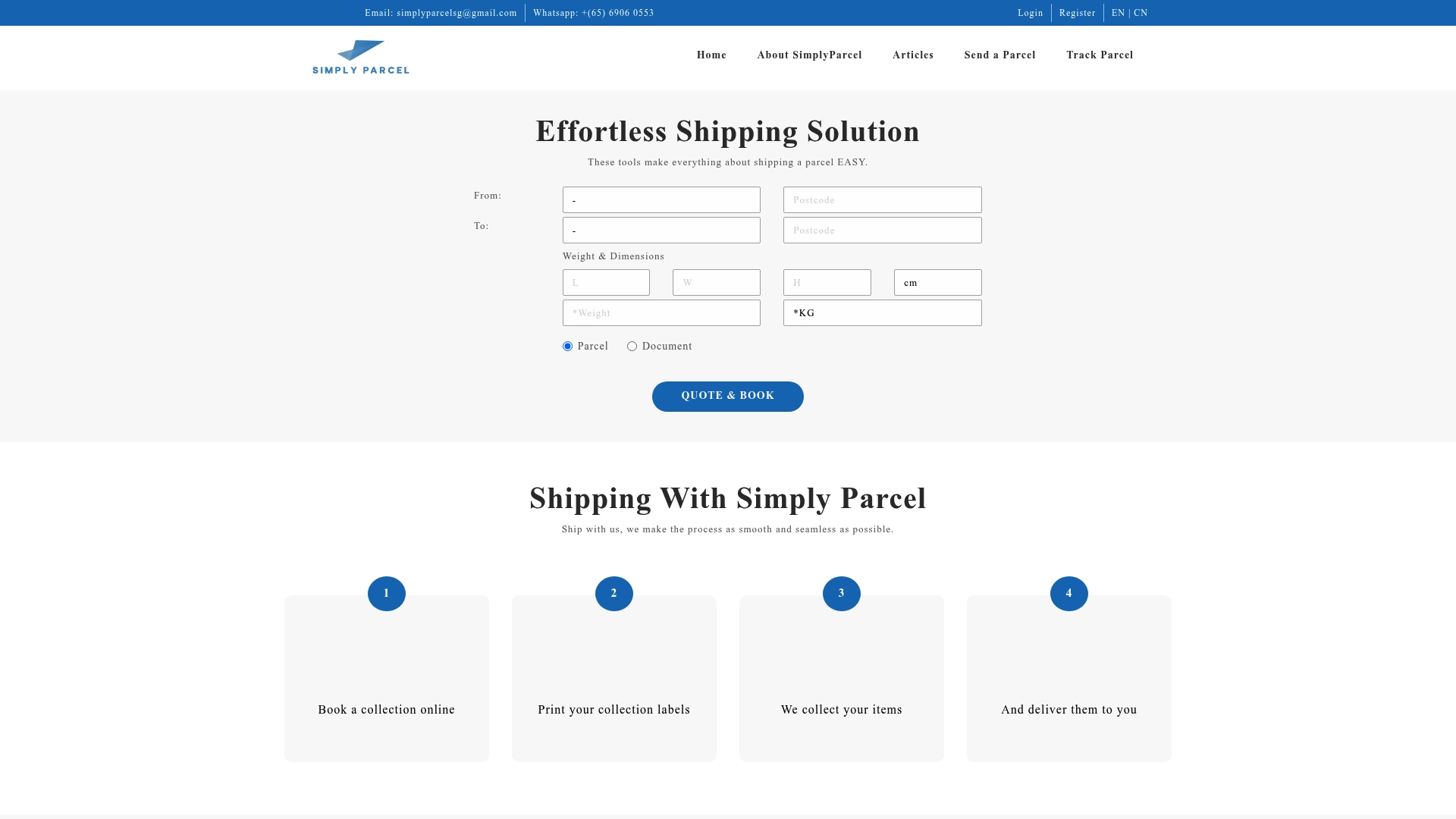
Simply Parcel is Singapore's trusted shipping aggregator, designed to make international shipping accessible, transparent, and cost-effective. Whether you are sending a single parcel or managing regular export volumes, the platform offers instant quote comparisons, automated label generation, and real-time tracking across major courier partners. Use Simply Parcel to get a shipment quote in minutes, review instant shipping details for your specific route, or explore the full range of services on the Simply Parcel homepage. Take the knowledge from this guide and ship with confidence, backed by a platform built for Singapore shippers.
Frequently asked questions
What does CIF value include for Singapore import GST?
CIF value covers cost, insurance, and freight to the port of entry in Singapore and forms the taxable base for calculating import GST at 9% and any applicable duties on dutiable goods.
What is the difference between House B/L and Master B/L?
A Master B/L is issued by the carrier (the shipping line), while a House B/L is issued by a freight forwarder, typically for consolidated or LCL shipments where multiple shippers share one container.
Why should I avoid FOB/CIF for container shipments?
FOB and CIF transfer risk at the point of vessel loading, but containers are often handed to a terminal or CFS before loading, creating a risk gap for containerized cargo; FCA and CIP are better suited because they transfer risk at the point the carrier takes custody.
How do I classify my goods for Singapore customs?
Assign the correct 6-10 digit HS Code for your goods using Singapore Customs' TradeNet/NTP system, which then determines the applicable duty rate, permit requirements, and any import controls for your shipment.