
Shipment value declaration is the shipper's stated monetary worth of goods in a package, recorded on transport and customs documents at the time of booking. It serves two distinct purposes: it tells the carrier how much liability to accept if the shipment is lost or damaged, and it gives customs authorities the basis for calculating import duties and taxes. Getting this figure right protects you financially and keeps your shipment moving without delays.
Three key terms are worth separating from the start:
- Declared value: The monetary worth you state when booking a shipment, used by the carrier to set its liability limit.
- Customs value: The figure a customs authority uses to calculate duties and taxes, generally based on the transaction value of the goods.
- Invoice value: The amount shown on the commercial invoice, which should align with both of the above.
Carriers like FedEx and DHL, along with US Customs and Border Protection (CBP), all rely on your declared value to process shipments correctly. When these figures are consistent and accurate, customs clearance moves faster and your liability coverage holds up when you need it.
Why declaring shipment value matters for every shipment
Declaring the correct shipment value protects your interests at every stage of the shipping process, from the moment a carrier picks up your parcel to the point it clears customs at the destination.
- Carrier liability: Without a declared value, most carriers default their liability to $100. If your shipment is worth $2,000 and you never declared a value, you can only recover $100 for a loss.
- Shipping costs: Higher declared values typically increase your shipping rate because the carrier takes on more financial risk. This is a direct trade-off between cost and coverage.
- Customs duties and taxes: Customs authorities use the declared value to calculate import duties, VAT, and other applicable taxes. An inaccurate figure can result in overpayment or, worse, a penalty.
- Regulatory compliance: CBP and customs agencies worldwide treat undervalued shipments as potential fraud. Accurate declarations keep you on the right side of trade law and avoid costly holds.
Understanding the role of customs in shipping makes it clear why this step is not optional. A correct declaration is the foundation of a smooth international shipment.

How to calculate and declare your shipment value correctly
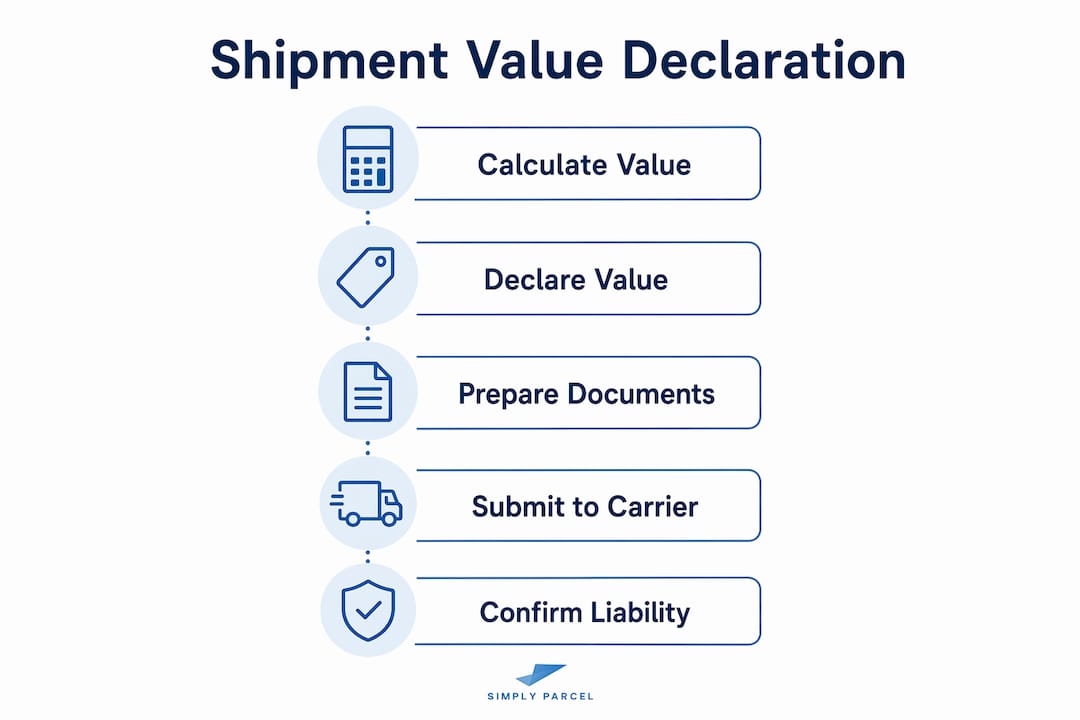
Calculating your declared value accurately takes a few deliberate steps. Follow this process for every international shipment.
-
Start with the transaction value. The transaction value is the actual price paid or payable for the goods. This is the primary method recognized by the WTO customs valuation framework and should be your default starting point.
-
Use replacement or fair market value when no sale price exists. For gifts, samples, or items transferred between related parties, use the fair market value. CBP requires a declared value even for gifts and free items.
-
Separate goods value from shipping costs. Customs value is based on the goods themselves. Freight charges and insurance may or may not be included depending on the Incoterms used and the destination country's rules. For example, under CIF (Cost, Insurance, and Freight) terms, freight and insurance are part of the customs value.
-
Match your declared value to your commercial invoice. The figure on your customs declaration must match the invoice. Discrepancies trigger inspections and can result in shipment holds.
-
Complete the correct customs forms. For shipments entering the US, this typically means a commercial invoice with a clear itemized breakdown: product description, unit price, quantity, and total value. For other destinations, check the specific customs declaration form required.
-
Keep supporting documentation ready. Proof of payment, purchase orders, and receipts help verify your declared value if customs questions it. Carriers like DHL recommend having these documents accessible throughout the shipping process.
Pro Tip: For businesses shipping regularly to the same destination, a periodical value declaration can cover multiple shipments under one filing, reducing paperwork significantly.
How declared value affects customs duties and taxes
Customs authorities calculate import duties as a percentage of the customs value, so the figure you declare directly determines what the importer pays at the border. Under WTO rules, the transaction value method is the primary approach, meaning the actual price paid for the goods forms the base for duty calculations.
- Accurate declarations reduce duty disputes. When your declared value matches your invoice and supporting documents, customs agents process the shipment faster.
- Undervaluation triggers reassessment. Customs authorities have the right to challenge your declared value. If they suspect inaccuracy, they can request additional proof of purchase or apply an alternative valuation method, which may result in a higher assessed value and additional duties owed.
- Declared value and customs-assessed value should match. The declared value is what you state; the customs value is what the authority determines. Ideally, these are identical. When they diverge, you face either overpayment or a penalty.
- Undervaluation is treated as fraud. CBP and other customs agencies view undervalued shipments as potential tax evasion, not just a paperwork error. The consequences go beyond a simple fine.
Accurate international shipping documentation is your best defense against customs complications. A well-prepared commercial invoice with itemized values, HS codes, and product descriptions gives customs agents everything they need to clear your shipment without delays.
What carrier liability limits mean for your declared value
Carrier liability and declared value are closely linked, but they are not the same as shipping insurance. Understanding the difference protects you from a costly gap in coverage.
Statistic callout: If a shipper does not explicitly state a value, carriers default their liability to $100. Declaring a higher value raises that cap, with most carriers allowing declared values up to a high limit under specific conditions.
When you declare a value, the carrier accepts liability up to that amount if the shipment is lost or damaged. However, declared value is not insurance. It increases the carrier's liability limit but does not guarantee compensation for every type of loss. Natural disasters, war, and improper handling may all fall outside the carrier's terms.
Packaging requirements are strict. If your shipment arrives damaged and the carrier determines it was improperly packed, your declared value claim can be denied regardless of the amount you declared. Professional packaging is a condition of coverage, not a suggestion.

For high-value goods, third-party cargo insurance provides broader protection than declared value alone. It covers a wider range of loss causes and typically has a faster claims process.
Risks of getting your shipment value declaration wrong
Misdeclaring shipment value, whether intentionally or by mistake, carries real financial and legal consequences.
- Customs fines and penalties: Undervaluation can result in fines, back duties, and in serious cases, legal action. DHL's guidance on accurate shipment valuation notes that penalties can significantly affect a business's bottom line.
- Shipment holds and delays: Customs authorities can hold a shipment while they investigate a discrepancy. This disrupts delivery timelines and damages customer relationships.
- Inadequate compensation: If you declare a value lower than the actual worth of your goods and the shipment is lost, you can only recover the declared amount, not the real value.
- Voided carrier liability: Incorrect documentation or packaging failures can void your declared value protection entirely, leaving you with no recourse.
Avoiding these outcomes comes down to three practices: use the actual transaction value, keep your invoice and customs declaration consistent, and review common shipping mistakes before every international shipment.
Simplyparcel makes it straightforward to get your shipment documentation right from the start. When you book an international shipment through Simplyparcel, the platform guides you through declaring the correct value, generating accurate shipping labels, and connecting with trusted courier partners, so your parcel clears customs without unnecessary complications.
Key Takeaways
Accurate shipment value declaration protects your carrier liability coverage, determines customs duties, and keeps your shipments compliant with international trade regulations.
| Point | Details |
|---|---|
| Default carrier liability is $100 | Without a declared value, most carriers limit their liability to $100 per shipment. This applies regardless of the shipment's actual value, as noted by major carriers such as FedEx and DHL. |
| Transaction value is the customs standard | WTO rules require customs valuation to be based on the actual price paid for the goods. |
| Declared value is not insurance | It raises the carrier's liability cap but does not cover all causes of loss or damage. |
| Undervaluation carries legal risk | CBP treats undervalued shipments as potential fraud, with fines and shipment holds as consequences. |
| Documentation must be consistent | Your declared value, commercial invoice, and customs forms must all show the same figure. |