
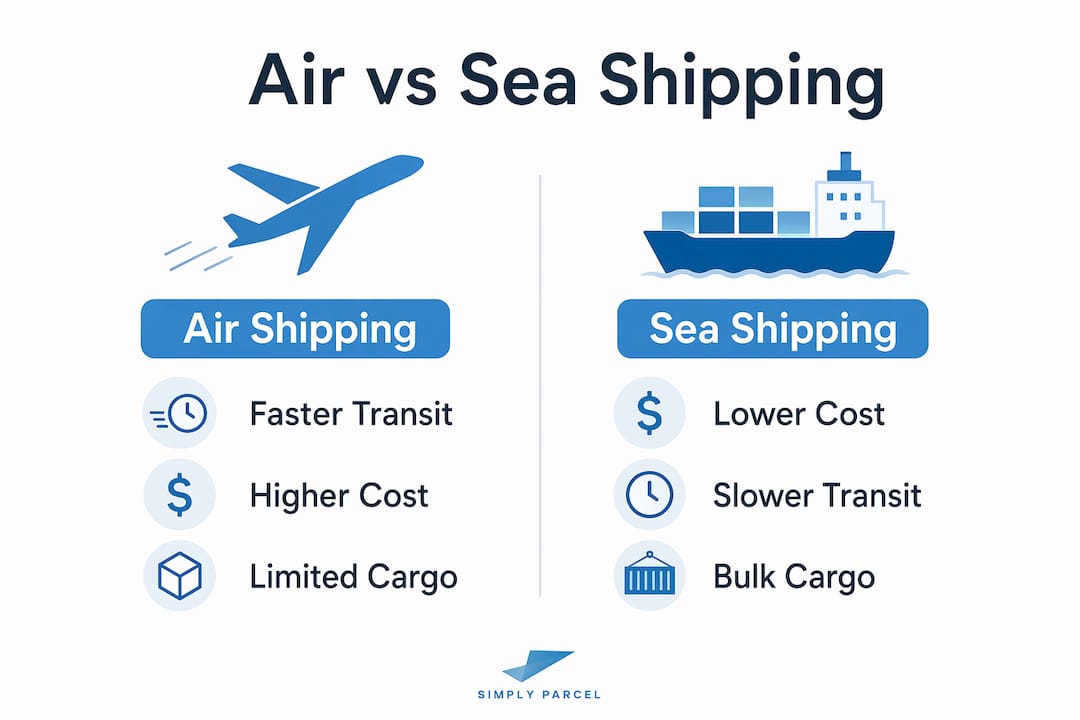
Air freight is fast and expensive. Sea freight is slow and affordable. That's the core of the air vs sea shipping comparison, but the real decision is more nuanced than that. The right choice depends on what you're shipping, how quickly you need it, your budget, and how much inventory risk you can absorb.
Here's a quick side-by-side to orient your thinking:
- Speed: Air freight typically delivers in a few days; sea freight takes several weeks
- Cost: Air freight costs significantly more per kilogram than sea freight
- Cargo fit: Air suits urgent, high-value, or perishable goods; sea suits bulky, heavy, or non-urgent shipments
- Carbon footprint: Air freight emits significantly more CO₂ per tonne-kilometer compared to sea freight
- Restrictions: Air freight has stricter cargo rules, especially for hazardous materials and lithium batteries
- Volume capacity: Sea freight handles full containers and massive loads that air simply cannot accommodate
This guide walks through each factor in detail so you can make a confident, well-informed decision for your next shipment.
How do air and sea shipping costs actually compare?
Cost is usually the first question, and the gap between the two modes is real. Air freight is priced by chargeable weight, which is the greater of actual weight or volumetric weight. Sea freight uses a different model entirely: you pay either for a Full Container Load (FCL) or a Less-than-Container Load (LCL), where you share container space with other shippers.

For small shipments, the math can surprise you. Air freight costs can become competitive with sea LCL for moderate-sized shipments once you factor in destination terminal fees, handling charges, and the longer transit time's effect on your working capital. Sea LCL adds fees for consolidation, deconsolidation, and port handling that erode the headline rate advantage.
| Shipment Size | Air Freight | Sea Freight (LCL) | Sea Freight (FCL) |
|---|---|---|---|
| Under 50 kg | Most practical option | Rarely cost-effective | Not applicable |
| 50–150 kg | Often competitive with LCL, especially after terminal fees are included | Possible, but fees add up | Not applicable |
| 500 kg and above | Very expensive | Preferred option | Consider if volume justifies |
| Full container | Not practical | Not applicable | Most cost-effective |
Beyond the base rate, several factors drive your final bill:
- Fuel surcharges: Both modes apply them, but air surcharges fluctuate more sharply
- Peak season premiums: Air rates spike heavily in Q4 around holiday demand; sea rates spike during port congestion events
- Customs clearance fees: Charged separately by brokers regardless of mode
- Origin and destination handling: Airport terminal fees vs. port handling and drayage
- Insurance: Typically calculated as a percentage of cargo value; rates differ by mode
Pro Tip: Use a shipping cost calculator to compare total landed cost, not just the freight rate. A cheaper sea rate can become more expensive once you add LCL handling fees and the cost of capital tied up during a 35-day transit.
What are the real transit time differences between air and sea?
Speed is where air freight wins decisively. A shipment from the U.S. to Europe or Asia by air typically arrives in 3–7 days door to door. The same shipment by sea takes 25–40 days or more, depending on the route, port of origin, and whether the vessel makes intermediate stops.
That gap has real consequences for shipping speed in logistics. A 30-day transit means 30 days of inventory sitting in a container, capital you can't use, and stock you can't sell. If demand shifts during that window, you're stuck.
Key transit time considerations for each mode:
- Air freight: A few days typical; customs clearance at airports is generally faster due to 24/7 operations and electronic pre-clearance systems
- Sea freight: Several weeks typical; port-to-port timing does not include additional inland trucking time
- Port congestion: Ocean freight faces congestion and rerouting risks that can add days or weeks to a voyage with little warning
- Air reliability: Airlines operate on fixed schedules with high adherence; missed connections are recovered quickly
- Door-to-door timing: Both modes require origin pickup and destination delivery, but air's faster port clearance compresses the total timeline significantly
Transit time reality check: A 35-day sea shipment from Shanghai to Los Angeles can become 50+ days during peak congestion periods. Air freight on the same lane holds close to its 5-day estimate even during busy seasons.
Which cargo types are best suited to air or sea freight?
The nature of your cargo often decides the mode before cost or speed even enters the picture. Air freight suits urgent, high-value, perishable, or small-volume cargo such as electronics, pharmaceuticals, fashion samples, and medical devices. Sea freight is built for large, bulky, heavy, or non-urgent shipments like machinery, raw materials, furniture, and textiles.
Cargo characteristics that point toward air freight:
- High value-to-weight ratio (electronics, jewelry, precision instruments)
- Perishable goods with short shelf lives (fresh produce, cut flowers, biologics)
- Urgent replenishment stock or time-sensitive product launches
- Small to medium shipments where speed justifies the premium
- Goods with strict temperature or handling requirements that benefit from shorter transit
Cargo characteristics that point toward sea freight:
- Large volume or heavy machinery that physically cannot fit in an aircraft
- Non-urgent goods with predictable demand and long lead times
- Low-value, high-volume commodities where freight cost per unit matters most
- Hazardous materials that face stricter air restrictions (more on this below)
- Full container loads for maximum cost efficiency; LCL for smaller volumes sharing container space
One option worth knowing: consolidated air freight, also called groupage, bundles multiple shippers' cargo onto a single aircraft. This approach reduces air freight rates by 15–25%, giving small and medium-sized businesses a way to access air speed without paying for a full charter or exclusive booking.
How does the environmental impact of air vs sea shipping compare?
The carbon footprint difference between the two modes is not marginal. It's dramatic. Air freight emits a much higher amount of CO₂ per tonne-kilometer compared to sea freight. That means air freight produces roughly 40 to 50 times more emissions per unit of cargo moved.
Carbon footprint gap: Air freight generates approximately 500–600g CO₂ per tonne-km versus 10–15g CO₂ per tonne-km for sea freight, a difference that makes sea shipping the clear choice for businesses with ESG commitments.
For businesses with sustainability targets or corporate ESG reporting requirements, this gap is hard to ignore. Choosing sea freight for eligible shipments is one of the most direct ways to reduce your supply chain's carbon output. MIT research on corporate greenhouse gas emissions has highlighted transportation mode selection as a primary lever for scope 3 emissions reduction.
The shipping industry is responding. Carriers are investing in liquefied natural gas (LNG) vessels, wind-assisted propulsion, and slow steaming practices to cut sea freight emissions further. On the air side, sustainable aviation fuel (SAF) is gaining traction, though it remains expensive and limited in supply. If environmental impact is a factor in your shipping decisions, explore eco-friendly shipping options that balance carbon reduction with practical logistics needs.
What regulations and restrictions apply to air freight?
Air freight operates under stricter cargo rules than sea freight, and knowing these limits before you book saves you from costly rejections or delays. The International Air Transport Association (IATA) sets the global framework for dangerous goods by air, and U.S. carriers must also comply with Title 49 of the Code of Federal Regulations, which governs hazardous materials transport.
Common air freight restrictions include:
- Lithium batteries: Strict limits on watt-hour ratings; many configurations are prohibited in cargo holds on passenger aircraft
- Hazardous materials (hazmat): Flammables, corrosives, oxidizers, and explosives face tight quantity limits or outright bans
- Liquids and aerosols: Quantity restrictions apply; many require special packaging and labeling
- Oversized or overweight cargo: Aircraft hold dimensions create hard physical limits that sea containers do not
- Perishables requiring specific temperatures: Accepted, but require specialized cold-chain handling and documentation
- Sanctioned goods and destinations: U.S. Treasury sanctions programs restrict certain shipments regardless of mode, but air carriers enforce these checks at booking
Sea freight accepts a broader range of cargo, including many hazardous materials that are prohibited by air, provided they meet IMDG (International Maritime Dangerous Goods) code requirements. If your product falls into a restricted category for air, sea is often the only viable international option.
Customs documentation requirements are similar for both modes: commercial invoice, packing list, bill of lading (sea) or airway bill (air), and any applicable certificates of origin or export licenses. The Schedule B classification system from the U.S. Census Bureau applies to all U.S. exports regardless of mode.
How does the shipping process work for air and sea freight?
The operational steps differ enough between modes that understanding them helps you plan timelines and avoid surprises.
Air freight process:
- Book with an airline or freight forwarder; provide commodity details, weight, and dimensions
- Prepare an airway bill (AWB) and commercial invoice; dangerous goods require additional declarations
- Cargo is collected from your facility or dropped at an airport cargo terminal
- Airline consolidates or loads cargo; departure is typically within 24–48 hours of acceptance
- Customs clearance at destination airport, often completed within 1–2 business days
- Last-mile delivery by ground carrier to final address
Sea freight process:
- Book FCL or LCL space with a shipping line or freight forwarder well in advance (often 2–4 weeks)
- Prepare a bill of lading, commercial invoice, packing list, and any required certificates
- For FCL, a container is delivered to your facility for loading (or you load at a container freight station)
- For LCL, your cargo goes to a consolidation warehouse where it is grouped with other shipments
- Vessel departs on a fixed sailing schedule; transit takes 25–40+ days depending on the lane
- Customs clearance at destination port; port handling and drayage to final delivery point
Tracking frequency differs noticeably. Air shipments update at each scan point, typically every few hours. Sea shipments update at port events, which may be days apart. For businesses managing customer expectations or inventory systems, air's tracking granularity is a practical advantage. Understanding the full bulk freight shipping process helps you plan container bookings and documentation timelines accurately.
What customs clearance differences should you know about?
Customs clearance works differently for air and sea shipments, and the timing gap between them affects your total delivery window more than most shippers expect.
Air freight customs clearance benefits from 24/7 airport operations and electronic pre-clearance systems. Many major airports process commercial air cargo within one to two business days, and pre-filing your entry with U.S. Customs and Border Protection (CBP) before the aircraft lands can compress that further. The Automated Broker Interface (ABI) and the Automated Manifest System (AMS) are the standard electronic filing tools for U.S. imports.
Sea freight customs clearance at major U.S. ports like Los Angeles, Long Beach, and New York/New Jersey can take longer, particularly during peak import seasons or when CBP selects a container for examination. A "hold" or "exam" on a sea shipment can add 5–10 business days to your timeline and generate additional costs for demurrage and detention. Knowing your Incoterms, as defined by the International Chamber of Commerce and referenced by U.S. trade authorities, clarifies who is responsible for customs costs and risk at each stage of the journey.
One practical difference: air shipments are typically cleared as a single unit, while LCL sea shipments must wait for the entire container to be deconsolidated before individual cargo is released. That adds time even after the vessel docks.
Strategic considerations: balancing cost, speed, and supply chain risk
Choosing between air and sea freight is a supply chain architecture decision, not just a rate comparison. The real calculus involves service levels, inventory costs, stockout risk, and lead-time flexibility, all weighed against the headline freight price.
Total cost of ownership is the right framework. A 35-day sea transit means 35 days of capital tied up in goods you can't sell. For high-value products, that carrying cost can rival or exceed the air freight premium. Add the risk of a stockout if demand spikes during transit, and the "cheaper" sea option may cost more in lost sales.
Strategic factors to weigh:
- Inventory buffer: Sea freight requires larger safety stock to cover long lead times; air freight lets you run leaner
- Demand predictability: Stable, foreseeable demand favors sea; volatile or seasonal demand favors air's flexibility
- Schedule reliability: Air freight holds its schedule more consistently; ocean freight faces congestion risks that can cascade across your supply chain
- Hybrid strategies: Many businesses ship the bulk of a product line by sea and use air for urgent replenishment or new product launches
- Multi-carrier approaches: Combining modes across your shipment portfolio reduces overall risk and cost
Pro Tip: If you're shipping the same product line regularly, consider a split strategy: send your base inventory by sea and keep a small air freight budget for urgent top-ups. This approach often delivers a better total cost than committing exclusively to one mode.
Insurance considerations for air and sea freight
Cargo insurance is not optional for international shipments, and the cost and coverage structure differ between modes in ways that affect your total shipping budget.
Marine cargo insurance covers sea freight and, despite the name, typically extends to air freight as well under an "all-risk" policy. Premiums are calculated as a percentage of the cargo's commercial invoice value, usually ranging from 0.1% to 0.5% depending on commodity type, route, and claims history. High-value goods like electronics or pharmaceuticals attract higher rates.
Air freight generally carries lower insurance premiums than sea freight for equivalent cargo values. The shorter transit time reduces exposure duration, and the lower incidence of physical damage during air handling (compared to the rough conditions inside a container over weeks at sea) means fewer claims. Sea freight, particularly LCL, involves more handling touchpoints, each one a potential damage event.
Carrier liability limits are worth understanding. Under the Warsaw Convention and its successor the Montreal Convention, air carrier liability for cargo loss or damage is limited. Sea carrier liability under the Hague-Visby Rules is also capped, often at levels far below the actual cargo value. Purchasing your own all-risk policy closes that gap and gives you control over the claims process rather than depending on the carrier's terms.
Common challenges in air and sea shipping and how to manage them
Every mode has its failure points. Knowing them in advance lets you build contingencies before a problem becomes a crisis.
Air freight challenges:
- Capacity constraints: Aircraft belly space is limited, and dedicated freighter capacity books out quickly during peak seasons. Book early and confirm space in writing.
- Rate volatility: Air freight rates can spike sharply in response to demand surges or fuel price changes. Locking in rates with a forwarder or using consolidated groupage shipments provides more stability.
- Cargo rejections: Undeclared hazardous materials or incorrect packaging trigger rejections at the terminal. Verify IATA dangerous goods compliance before tendering cargo.
- Weight and dimension limits: Aircraft hold dimensions are fixed. Oversized cargo that fits in a sea container may not fit in any aircraft configuration.
Sea freight challenges:
- Port congestion: Major U.S. ports experience periodic congestion that delays vessel arrivals and container release. Build buffer time into your delivery commitments and monitor port advisories.
- Demurrage and detention fees: Containers left at the port beyond the free time window accumulate daily fees. Coordinate your customs broker and trucking provider before the vessel arrives.
- LCL damage risk: Shared containers mean your cargo is handled alongside other shippers' goods. Use rigid packaging and consider FCL if your cargo is fragile or high-value.
- Schedule changes: Vessel sailings are subject to blank sailings (canceled departures) and port omissions. Maintain a backup sailing option and communicate lead-time buffers to your customers.
Overcoming international shipping challenges consistently comes down to preparation: accurate documentation, proper packaging, early booking, and a reliable freight forwarder who monitors your shipment actively. Reviewing common shipping mistakes before you book can prevent the most expensive errors.
Simplyparcel makes comparing and booking international shipping straightforward
Deciding between air and sea freight is one thing. Finding competitive rates across both modes without spending hours on the phone with carriers is another challenge entirely. Simplyparcel gives you a faster path to that answer.
As a shipping aggregator built for individuals and small to medium businesses, Simplyparcel lets you compare courier and freight options side by side, book online, and get your shipping labels and documentation generated automatically. Whether you need priority air delivery or economy sea freight, the platform shows you real rates with clear transit timelines so you can make the call based on your actual shipment, not a generic estimate.
Free pickup, real-time tracking, and transparent pricing mean you're not left guessing about what your shipment costs or where it is. For businesses managing regular international shipments, that visibility reduces the administrative load significantly. Get an instant shipping quote and see which option fits your cargo, timeline, and budget today.
Key Takeaways
Sea freight delivers the lowest cost per unit for large, non-urgent shipments, while air freight is the only practical choice when speed, cargo value, or perishability outweighs the price premium.
| Point | Details |
|---|---|
| Cost threshold for air vs sea | Air freight becomes cost-competitive with sea LCL for shipments in the 50–150 kg range once terminal fees are included. |
| Carbon footprint gap | Air freight emits 500–600g CO₂ per tonne-km; sea freight emits just 10–15g CO₂ per tonne-km. |
| Transit time difference | Air delivers in 3–7 days; sea takes 25–40+ days, with congestion risk adding further delays. |
| Groupage as a middle option | Consolidated air freight (groupage) reduces air rates by 15–25%, giving SMEs faster transit at lower cost. |
| Simplyparcel for rate comparison | Simplyparcel lets you compare air and sea freight rates side by side and book online with automatic documentation. |