A courier moves a parcel from one address to another. A third-party logistics provider (3PL) runs the work around the parcel: it stores your stock, picks and packs each order, and then hands the box to a carrier. If you send parcels from Singapore, whether personal items, documents or a few dozen e-commerce orders a week, you need the courier part first. At Simply Parcel you compare courier options, book a free doorstep pickup and get your labels and customs paperwork generated in one booking. A 3PL becomes relevant only when the warehouse work, not the delivery, is what slows you down.
TL;DR
- A courier collects and delivers. A 3PL stores inventory, packs orders, ships them and can process returns.
- 3PLs often use established carriers themselves, so the two are not rivals at the delivery step. The real question is who holds your stock and packs the box.
- If you send parcels from your home, your shop or a small stockroom, booking couriers directly is the simplest setup, with no storage fees and no monthly commitment.
- Consider a 3PL when order volume, several sales channels or seasonal peaks exceed what you can store and pack yourself.
- For international shipments from Singapore, choose the speed tier first (priority, connect-plus or economy), then compare quotes for your parcel.
Table of Contents
- What a courier does
- What a 3PL does
- 3PL vs courier at a glance
- Courier, logistics and freight forwarder: sorting the terms
- How cost compares
- When a courier is enough
- When to use a 3PL
- A simple decision path
- Booking the courier side well
- Perspective
- Ship your next parcel from Singapore
- FAQ
- Sources
What a courier does
A courier company collects a parcel or document, moves it through its network and delivers it to the recipient. Logistics services generally fall into three groups: warehousing, freight shipping and courier services, and couriers typically handle the final delivery and can take on special-circumstance shipments, according to NetSuite's overview of logistics providers.
When you book a courier, you do the rest yourself:
- You own and store the goods.
- You pack the box and choose the box size.
- You print the label and prepare customs documents for international parcels.
- You decide which service level to buy.
- You handle any return that comes back.
That sounds like a lot, but for most senders it is a few minutes per parcel. A student mailing textbooks home, an expat shipping household items to family or a small seller dispatching ten orders a week usually does not need anything beyond a good booking process.
What a 3PL does
A 3PL is an outside company that takes over logistics tasks on your behalf. The definition has widened over the years: Modern Materials Handling, citing the Council of Supply Chain Management Professionals, notes that freight forwarders, courier companies and other firms that integrate subcontracted logistics and transport can all describe themselves as 3PLs. In e-commerce, though, the word usually means a warehouse partner.
Shopify's guide to third-party logistics describes the typical flow:
- Your inventory arrives at the 3PL's warehouse and is received.
- Your store syncs orders to the 3PL's warehouse system.
- Staff pick and pack each order.
- The parcel ships with a carrier, which may be an established courier or the 3PL's own fleet.
- Returns and exchanges are processed.
Notice step 4. A 3PL frequently depends on a courier to complete the delivery. You are not choosing between two ways of crossing the border. You are choosing whether someone else also warehouses and packs your goods.
A sample of what a 3PL offers is visible on pages such as 3PL fulfillment services for growing brands, which list warehousing, inventory management, order fulfillment, returns processing and custom packaging.
3PL vs courier at a glance
| Question | Courier booking | 3PL |
|---|---|---|
| Main job | Collect and deliver a parcel | Store, pick, pack, ship and process returns |
| Where your stock sits | With you | In the provider's warehouse |
| Who packs the box | You | The provider's staff |
| Delivery | The courier's own network | Usually an established carrier, sometimes its own fleet |
| Cost shape | Paid per shipment | Contract terms, usually with storage and handling on top of postage |
| Best for | Personal parcels, documents, small and mid-size outbound flows | Higher volumes, several sales channels, seasonal peaks |
| Tracking | Per shipment | Order and delivery tracking, usually through the 3PL's systems |
The table shows why the two are often confused. Both end with a tracked parcel at someone's door. The difference sits upstream of the label.
Courier, logistics and freight forwarder: sorting the terms
The search results for this topic mix several words. Here is the plain version.
- Courier: moves parcels and documents, usually door to door.
- Logistics provider: a broad term for any company handling storage, transport or both. A courier is one kind.
- 3PL: a logistics provider that takes over a bundle of your supply chain tasks, most often warehousing and fulfillment.
- Freight forwarder: arranges the transport of goods between locations, typically across borders, and often acts as an intermediary rather than owning warehouses. A 3PL's focus is storage and fulfillment, while a forwarder's focus is moving cargo, as one fulfillment company explains in its comparison.
For a Singapore exporter, that last distinction matters when shipments grow from parcels into pallets. Parcels fit a courier. Palletized cargo and containers fit a forwarder. Storage and order picking fit a 3PL.
How cost compares
A courier is paid per shipment. You see the price of the parcel, and nothing is owed in a month when you ship nothing. This is why couriers tend to suit unpredictable or low volume. Locus's 2026 comparison of last-mile models describes a courier network's cost as variable per shipment and transparent, with the strongest unit economics when volume is low or swings widely. It describes a 3PL's cost as variable but bounded by a contract.
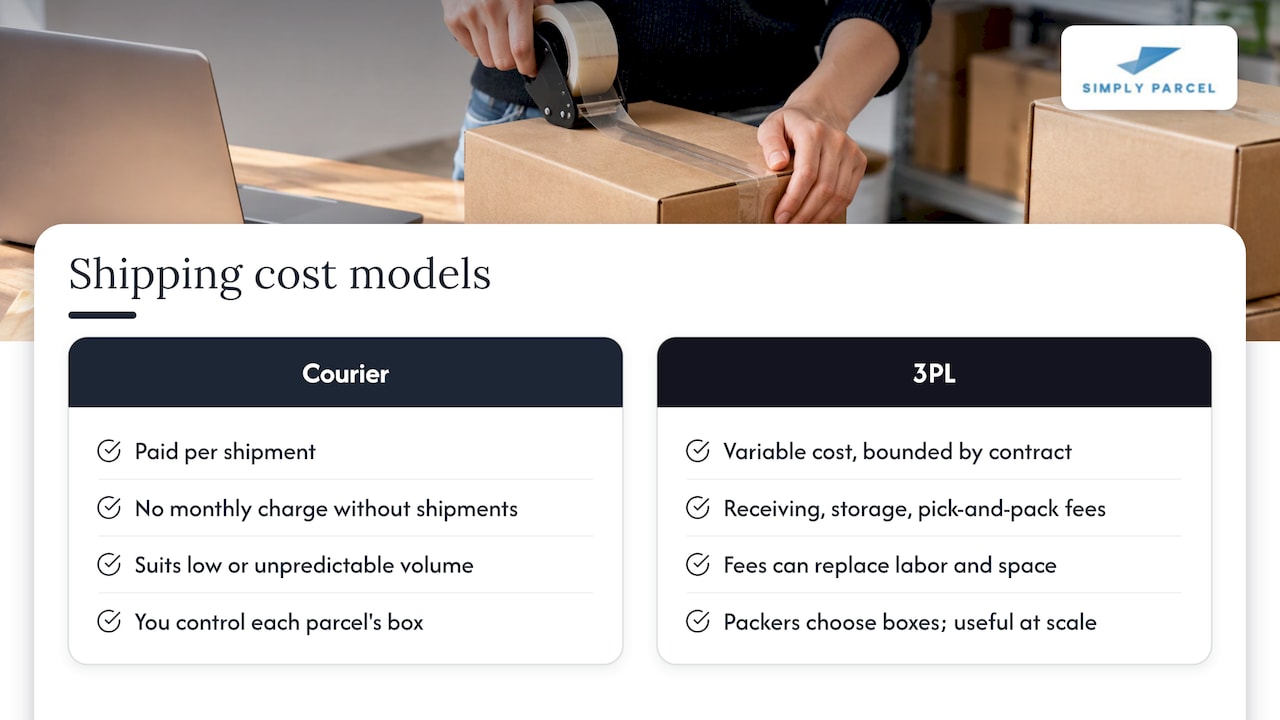
With a 3PL you typically pay for several things on top of postage: receiving your stock, storing it, picking and packing each order, and sometimes onboarding. Those fees make sense when they replace your own labor and space. They can feel heavy when you are shipping a handful of orders.
For courier rates themselves, the weight you are charged is not always the weight on the scale. Carriers compare actual weight to volumetric weight, which is calculated from box dimensions. Our guide to Singapore courier rates and the 5,000 divisor shows the arithmetic, and a smaller box often lowers the bill. Fuel surcharges add another line, and the fuel surcharge calculator guide walks through how to estimate it.
Worked example: you ship a 2 kg book parcel in a box of 40 x 30 x 20 cm. The volume is 24,000 cubic centimeters. Divided by 5,000, that is 4.8 kg of volumetric weight, more than double the actual weight. A box that is tighter to the book can bring the chargeable weight down. A courier booking lets you test this per parcel. A 3PL's packers choose boxes for you, which is useful at scale but not something you control box by box.
When a courier is enough
A direct courier booking fits when:
- You send personal items. Students and expats sending belongings, gifts or documents have no inventory to warehouse.
- Your volume is small or uneven. Per-shipment pricing means a quiet month costs you nothing in fixed fees.
- You keep stock at home or in a small unit. If you can store and pack comfortably, you do not need someone else's shelves.
- You dropship from Singapore in small batches. You order, pack and book the pickup. Our ecommerce shipping guide for Singapore covers that routine.
- You want control of the box. You decide packaging, protection and presentation.
One practical benefit: you can start with a self-run setup, learn which products break, which boxes work and where customers complain, and only then decide what to outsource. That experience makes any later 3PL conversation better informed.
When to use a 3PL
A 3PL starts to earn its place when the work around the parcel, not the parcel, becomes the bottleneck. FreightOptics lists the usual signals:
- Order volume exceeds what you can receive, store and fulfill yourself.
- Seasonal peaks make permanent staff and space inefficient.
- Inventory control has outgrown spreadsheets.
- Shipping errors and slow returns hurt customer satisfaction.
- You sell across several channels, such as a marketplace, your own store and retail, each with separate requirements.
- You are expanding and need more warehouse locations or international distribution.
The same source notes that product type matters. Food, hazardous goods, oversized goods and high-return categories each need different controls, so ask any prospective warehouse partner how it handles your category before you sign.
Returns deserve a mention. The U.S. Postal Service Office of Inspector General explains in a 2024 report on reverse logistics that returns are harder to plan than outbound shipping: volume is hard to forecast, the condition of the item is unknown until it arrives, and routing can go to the merchant, a reseller, a refurbisher, a recycler or disposal. It adds that end-to-end 3PLs can handle the entire returns process. If returns are a daily burden for you, that is a solid reason to look at a 3PL.
A simple decision path
Answer these in order.
- Do you hold inventory? If you send occasional parcels or documents, you need a courier booking and nothing else.
- Can you store and pack what you sell without it taking over your week? If yes, stay with courier bookings.
- Are you shipping to several sales channels with different rules? If yes, a 3PL or a mix becomes worth pricing.
- Do peaks overwhelm you? If your orders spike around sales seasons, price a 3PL for the peak.
- Are most shipments international? Check that whichever setup you choose gives you correct customs documents and tracking to the destination country.
Most readers of this page will stop at step 1 or 2. That is fine. Both outcomes are common, and a courier booking is a complete answer for them.
Booking the courier side well
Whichever model you pick, a courier still delivers the parcel, so the booking quality shapes the result. Here is the routine and where it goes wrong.
1. Weigh and measure the packed box
Use the finished box, with filling and tape. Mistakes here lead to a corrected price after pickup, because the carrier re-measures. Enter dimensions and weight in the quote form at Simply Parcel's shipment quote page and you see the options for your destination side by side.
2. Choose the speed tier
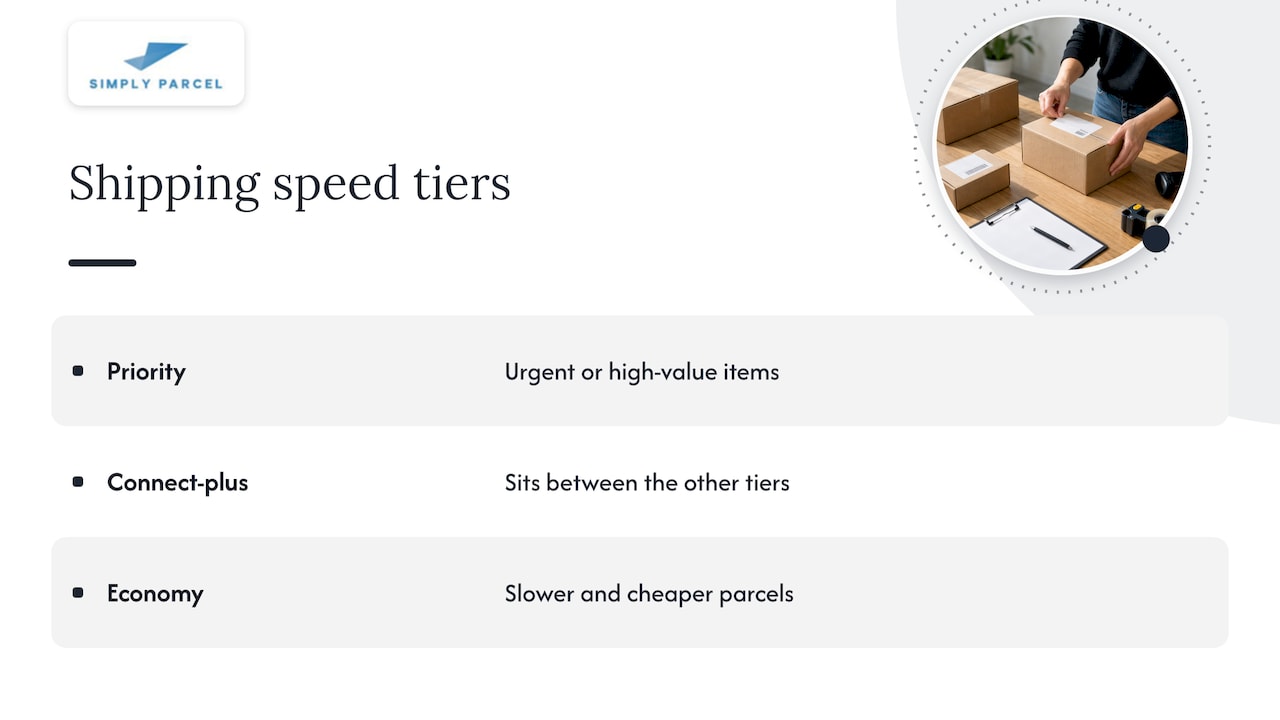
We offer priority, connect-plus and economy shipping. Priority is for urgent or high-value items, economy for parcels that can travel slower and cheaper, and connect-plus sits between them. For a closer look at one pair of tiers, read our comparison of FedEx International Priority and Connect Plus.
3. Check what you can send
Restricted goods, such as batteries, liquids or certain foods, can be refused by carriers or by the destination country. Guidance on restricted goods and customs requirements is part of what we offer, so you can check before you pack, not after a parcel is held.
4. Book and print
Booking online generates your shipping label and the customs documentation automatically, which removes a common cause of delay: a missing or mistyped commercial invoice. Pickup at your door is free, so you do not need to visit a drop-off point.
5. Add protection if the contents justify it
Optional additional protection coverage is available. Think about the replacement cost of the contents, not just the postage.
6. Track and share
Real-time tracking shows where the parcel is. If you sell online, send the tracking link to your customer. Our guide to the role of tracking in e-commerce explains why this cuts "where is my order?" messages.
Perspective
We see 3PL and courier as two layers, not two competitors. The courier layer is the one every international parcel needs: someone collects it, clears it and delivers it. The warehouse layer is optional, and it makes sense only when you hold enough stock and ship enough orders to need it.
That is why we built Simply Parcel around the courier layer. You compare several reputable carrier partners in one place, pick priority, connect-plus or economy for the job, and book with free pickup at your door. Labels and customs documents are generated for you, and there is no monthly volume commitment, so a week with three parcels and a week with thirty cost you the same effort.
For sellers, the courier layer also keeps working if you grow into a warehouse partner later, because parcels still need a carrier at the end. Starting here means you learn your real shipping patterns first, and you carry that knowledge into any later decision.
SP
Ship your next parcel from Singapore
If your answer on the decision path was "courier", the next step is a quote. Enter your destination, weight and box size, compare the priority, connect-plus and economy options, and book a free pickup. Individuals, small businesses and e-commerce sellers all use the same flow.

Start at Simply Parcel or go straight to the booking page for priority, connect-plus and economy shipping. If you ship for a business, our roundup of courier platforms for businesses explains what to look for in a booking platform.
FAQ
Is a 3PL the same as a courier?
No. A courier collects and delivers parcels. A 3PL is a broader provider that typically stores stock, picks and packs orders, ships them and processes returns. Many 3PLs hand the final delivery to an established courier.
Are courier services and logistics services the same?
Not exactly. Logistics is the wider field and covers warehousing, freight shipping and courier services. A courier is one type of logistics provider, focused on final delivery.
When should I move from couriers to a 3PL?
Look at the signals: orders outgrow your storage and packing capacity, seasonal peaks strain your team, spreadsheets no longer control inventory, or you sell on several channels. Until then, booking couriers per shipment keeps costs tied to what you actually send.
How is a 3PL different from a freight forwarder?
A 3PL manages warehousing, order fulfillment and shipping to your customers. A freight forwarder coordinates transport of goods between locations, typically across borders, and mostly works as an intermediary. Forwarders fit pallets and containers, while parcels fit couriers.
Sources
- What Is a Logistics Service Provider (LSP)? Types and more, NetSuite
- 3PL vs 4PL: What are these PLs, Anyway?, Modern Materials Handling
- 3PL: How Third-Party Logistics Works (2026), Shopify
- 3PL vs Courier vs In-House Last-Mile Efficiency: 2026 Guide, Locus
- When Should You Use a 3PL?, FreightOptics
- Sending It Back: Reverse Logistics and the U.S. Postal Service, USPS OIG, May 2024
- 3PL vs. Freight Forwarder: Explained by Examples, Red Stag Fulfillment